A Complete AI-Guided Precursor Optimization Architecture for a Reaction-Flavor R&D Platform
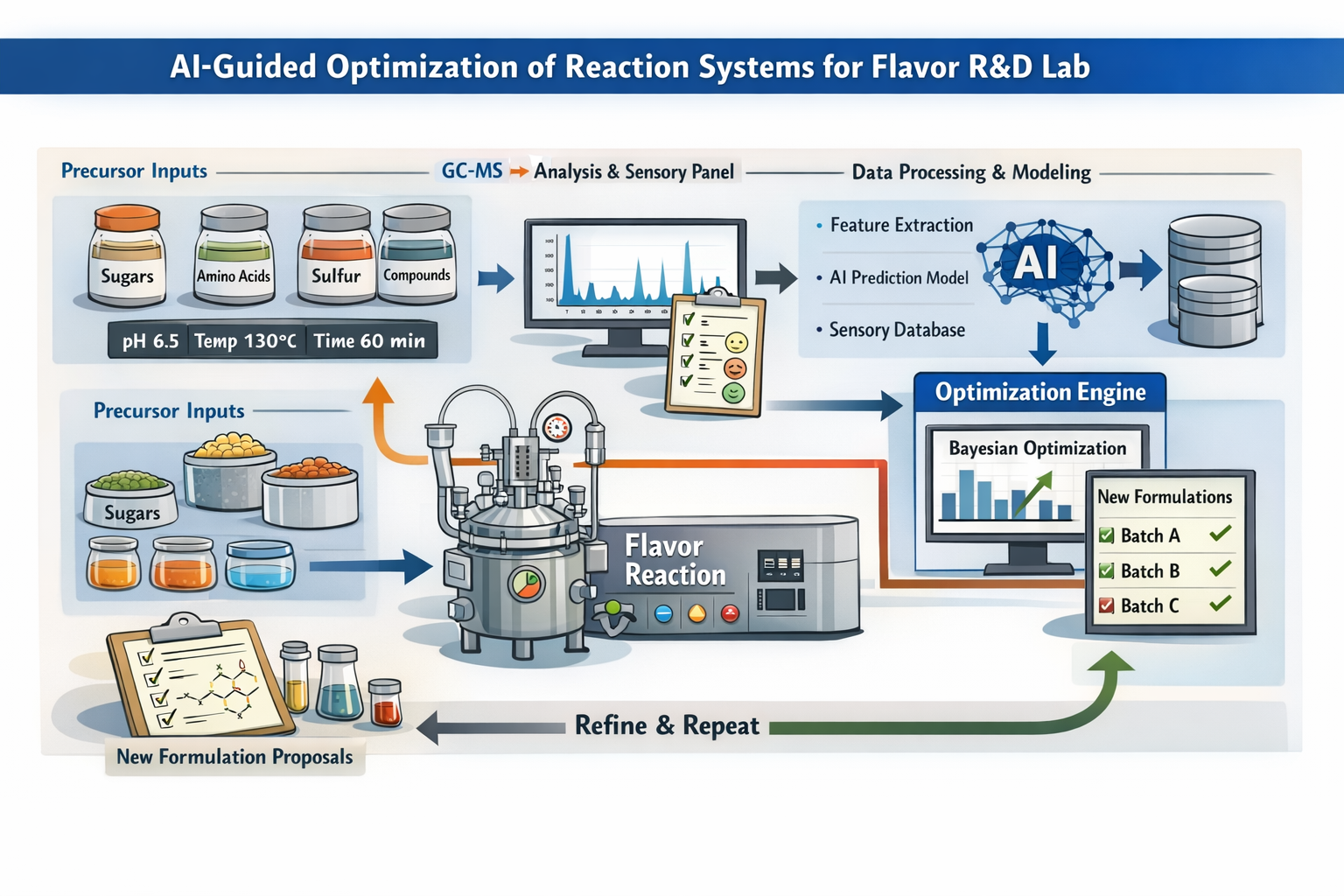
Below is a complete AI-guided precursor optimization architecture for a reaction-flavor R&D platform.
This is designed to:
- Optimize sugar/amino/sulfur/lipid ratios
- Control reaction conditions
- Predict volatile output
- Link GC-MS + sensory data
- Autonomously improve formulations
🧠 SYSTEM OVERVIEW
We build a closed-loop system:
Formulation → Reactor → GC-MS → Feature Extraction →
Prediction Model → Optimization Engine → New Formulation
The goal:
Maximize sensory score for a defined target profile under cost + regulatory constraints.
1️⃣ DATA STRUCTURE FOUNDATION
Every reaction run must generate structured data.
A. Input Vector (X)
For each batch:
Chemical Inputs
- Sugar types (%)
- Amino acids (%)
- Sulfur donors (%)
- Thiamine (%)
- Lipids (%)
- Moisture (%)
Process Variables
- pH
- Temp ramp curve
- Total time
- Oxygen %
- Pressure
Total features: ~40–80 numeric variables.
B. Output Vector (Y)
Analytical Data
- GC-MS peak intensities
- Retention index
- Key marker compounds (e.g., 2-furfurylthiol, 2-acetylpyrazine)
- Total sulfur volatiles
- Pyrazine index
Sensory Panel Scores
- Roasty (0–10)
- Meaty
- Sweet
- Sulfur intensity
- Burnt
- Authenticity
- Overall liking
2️⃣ FEATURE ENGINEERING LAYER
We do not feed raw GC-MS directly.
Instead:
Extract Chemical Descriptors
Examples:
- Total pyrazine area
- Strecker aldehyde ratio
- Sulfur compound cluster score
- Furan index
- Lipid oxidation aldehyde score
These become engineered features.
3️⃣ MODELING LAYER
We use three model tiers.
Tier 1: Forward Prediction Model
Predict:
(X: formulation + conditions) → (Y: volatile + sensory profile)
Best models:
- Gradient Boosting (XGBoost)
- Random Forest
- Neural Network (if dataset > 1000 runs)
Outputs:
- Predicted GC profile
- Predicted sensory vector
Tier 2: Inverse Optimization Model
Goal:
Find X that maximizes a target sensory profile.
Use:
- Bayesian Optimization
- Gaussian Process Regression
- Genetic Algorithm (multi-objective)
Objective example:
Maximize:
0.5*Roasty + 0.3*Authenticity + 0.2*Sweetness
- 0.4*Burnt
Under constraints:
- Cysteine < 10%
- Cost per kg < $12
- No restricted precursors
Tier 3: Reaction Pathway Awareness Model (Advanced)
Add chemical rules:
Example constraints:
- Pyrazines ↑ when pH > 7
- Sulfur harshness ↑ when cysteine > 12%
- Ribose increases meatiness exponentially
This can be encoded via:
- Rule-based modifiers
- Hybrid physics-informed ML
4️⃣ CLOSED-LOOP OPTIMIZATION SYSTEM
Workflow:
Step 1
Define Target:
"Chicken roast authentic, moderate sulfur, low burnt"
Step 2
AI proposes 5 candidate formulations.
Step 3
Reactor runs 5 batches.
Step 4
GC-MS + sensory panel input.
Step 5
Model retrains.
Step 6
New optimized proposals.
Repeat until convergence.
5️⃣ MULTI-PROFILE LEARNING
Instead of training separate models:
Use shared chemical backbone learning.
The model learns:
- Core Maillard behavior
- Sulfur chemistry
- Lipid oxidation trends
Then fine-tunes for:
- Coffee
- Beef
- Maple
- Popcorn
This dramatically reduces data requirements.
6️⃣ ACTIVE LEARNING STRATEGY
Rather than random experiments:
AI selects experiments that maximize information gain.
It chooses:
- Edge-of-boundary sulfur levels
- Novel sugar combinations
- Extreme pH conditions
This reduces required experiments by 40–60%.
7️⃣ VOLATILE TARGETING MODE
You can also invert the system:
Instead of "maximize sensory roast", you can target:
- 2-Furfurylthiol = X ppm
- 2-Acetylpyrazine = Y ppm
- DMTS < threshold
The optimizer finds precursor ratios that hit chemical targets.
8️⃣ COST-AWARE OPTIMIZATION
Add:
Total Cost = Σ(precursor cost × %)
Then optimize for:
Max Flavor Score / Cost Ratio
Useful for commercialization.
9️⃣ PLATFORM ARCHITECTURE
Backend
- Python
- PyTorch or XGBoost
- Bayesian optimization library
- SQL database
Hardware Integration
- Reactor API
- GC-MS export API
- LIMS integration
🔟 DIGITAL FLAVOR TWIN
Eventually:
Create a digital twin of your reactor system.
Simulate:
- Reaction curves
- Volatile formation kinetics
- Sensory projection
AI can run 10,000 virtual experiments before 5 real ones.
1️⃣1️⃣ STRATEGIC ADVANTAGE
This turns your R&D from:
Trial-and-error chemist intuition
into:
Data-accelerated flavor discovery engine.
This is exactly how:
- Firmenich (now part of DSM-Firmenich)
- Givaudan
- IFF
are modernizing reaction flavor development.
But most mid-size flavor houses do not yet have a fully integrated closed-loop AI-reactor system.
###