A Comprehensive Guide to Flash Point Testing: Theory, Applications in Flavor, and Method Evaluation
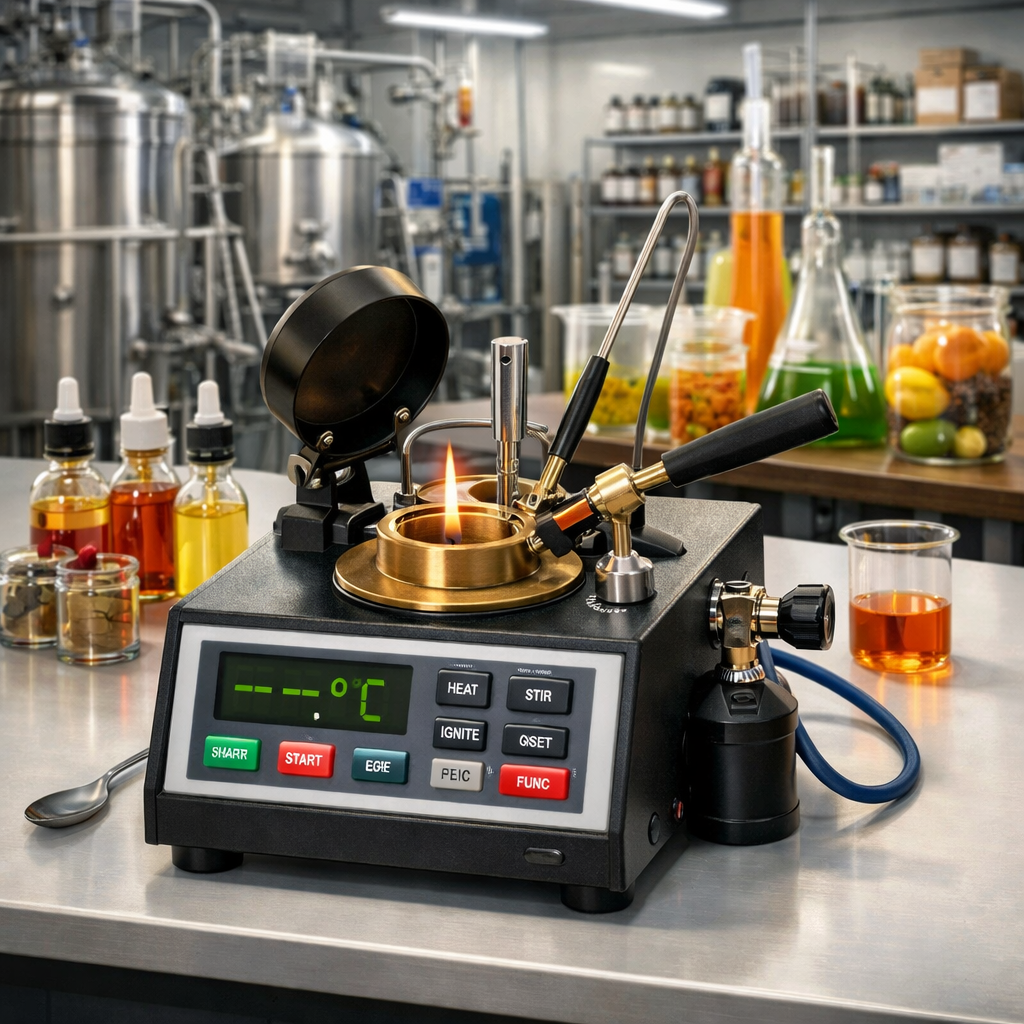
The Society of Flavor Chemists requires certified flavorists to understand and operate more than a dozen instruments used for testing food and flavor products. These instruments are listed on the syllabus for the Society's qualification exam. The flash point tester is one of these required instruments.
Introduction
In industries dealing with volatile substances, safety is paramount. A flash point tester is a critical instrument used to determine the flash point of a substance—the lowest temperature at which its vapors ignite when exposed to an ignition source. This parameter is not merely a number; it is a cornerstone of safe handling, transportation, storage, and regulatory compliance.
This guide provides a detailed overview of the theory, function, and reporting of flash point tests, with a specific focus on its profound relevance to the flavor industry, as well as the advantages and limitations of the testing methods.
1) Theory, Function, and Reporting of Test Results
The Theory: Understanding Volatility and Ignition Risk
The theory behind flash point testing is rooted in physical chemistry. A liquid does not burn itself; it is its vapor that combusts. As temperature increases, the vapor pressure of a liquid rises, leading to a higher concentration of flammable vapors above its surface.
The flash point is the temperature at which this vapor concentration reaches the lower flammable limit (LFL) for that specific substance. At this precise temperature, introducing a standardized ignition source (such as a small flame or electric spark) will cause the vapors to flash—a brief, momentary ignition—but not sustain combustion. The temperature required for sustained burning is known as the fire point, which is typically higher.
The Function of a Flash Point Tester
A flash point tester automates and standardizes the process of determining this critical temperature. Its primary functions are to:
- Maintain Precise Temperature Control: The tester heats the sample at a controlled rate to ensure accuracy and repeatability.
- Introduce a Standardized Ignition Source: At regular temperature intervals, the device introduces a test flame or spark into the vapor space above the sample.
- Detect Ignition: Modern testers use sensors (e.g., thermocouples or pressure sensors) to automatically detect the occurrence of a flash.
- Ensure Safety: By containing the test and controlling the ignition source, the instrument allows for the safe analysis of potentially hazardous materials.
Reporting the Test Results
The output of a flash point test is a temperature, but its reporting is highly dependent on the test method used. The two most common global standards are:
- Pensky-Martens Closed Cup (PMCC) - ASTM D93 / ISO 2719: This is the most widely used method for flammable liquids. The sample is heated in a sealed cup, and the ignition source is introduced through a shutter. Results from this method are generally lower and are considered more representative of actual conditions in closed containers (like storage tanks or bottles). It is the preferred method for regulatory classification (e.g., by OSHA, DOT, UN).
- Cleveland Open Cup (COC) - ASTM D92 / ISO 2592: The sample is heated in an open cup. This method is used for materials with high flash points (above 79°C / 175°F) or for materials that form a surface film, such as some resins or heavy oils. Open cup results are typically higher than closed cup results because vapors can dissipate.
A standard report will typically include:
- Flash Point Value: e.g., "45°C (113°F)"
- Test Method: e.g., "ASTM D93, Pensky-Martens Closed Cup"
- Corrections: If the test was performed at a non-standard atmospheric pressure, the result is corrected to standard pressure (101.3 kPa) and reported as such.
- Sample Identification: Unique ID, batch number, and composition.
2) Relevance to the Flavor Industry
The flavor industry relies heavily on volatile organic compounds, making flash point testing absolutely critical for several reasons:
A. Regulatory Compliance and Shipping
Flavor formulations often contain ethanol, essential oils, and other solvents with low flash points. Regulatory bodies like the U.S. Department of Transportation (DOT) , International Air Transport Association (IATA) , and International Maritime Organization (IMO) classify hazardous materials based on flash point.
- Flammable Liquids (Class 3): Any mixture with a flash point below 60°C (140°F) is typically classified as a flammable liquid, imposing strict packaging, labeling, and shipping requirements.
- Combustible Liquids: Those with flash points between 60°C and 93°C (140°F-200°F) have less stringent but still important regulations.
Without accurate flash point data, a flavor manufacturer cannot legally or safely transport products internationally.
B. Workplace Safety and Process Design
In manufacturing facilities, flash point dictates:
- Area Classification: Determining whether a blending or storage area requires explosion-proof electrical equipment and specialized ventilation.
- Storage: Mandating the use of flammable storage cabinets or detached flammable liquid warehouses.
- Process Safety: Establishing safe operating temperatures to ensure that processes remain well below the flash point of any mixture.
C. Product Formulation and Quality Control
For flavor houses, flash point is a key quality attribute.
- Consistency: A change in flash point can indicate a batch-to-batch variation in raw materials (e.g., a higher-than-specified ethanol content).
- Formulation Safety: When creating new flavors, flavorists must consider the flash point of the final product. A product intended for a consumer application with potential heat exposure must be formulated to have a safely high flash point.
3) Advantages and Limitations of the Testing Method
Advantages
- Safety Assurance: The primary advantage is the ability to quantify fire and explosion risk, enabling the implementation of robust safety protocols.
- Regulatory Acceptance: Standardized methods (ASTM, ISO) provide legally defensible data that is accepted by global regulatory agencies, streamlining international trade.
- Versatility: Flash point testers can analyze a wide range of materials, from low-viscosity solvents to viscous flavor emulsions and pastes (using specialized accessories).
- Precision and Repeatability: Modern automated testers provide highly repeatable results with minimal operator influence, ensuring data integrity for quality control.
Limitations
- Method Dependency: The result is not an absolute physical constant but a function of the test method. A substance can have a closed-cup flash point of 30°C and an open-cup flash point of 35°C. This requires users to always specify the method used. Discrepancies can arise if the wrong method is chosen.
- Sample Limitations:
- Viscous Materials: Highly viscous liquids or pastes can trap volatile components, leading to artificially high flash points if not heated slowly and uniformly.
- Surface Films: Materials that form a surface skin (e.g., drying oils) can inhibit vapor release, which is why an open-cup method is preferred.
- Aqueous Mixtures: Water-based flavors can be challenging. Water can elevate the flash point, but if the mixture separates or forms a volatile layer on top, the flash point may be governed by that layer, requiring careful interpretation.
- Small Sample Size vs. Bulk Behavior: A flash point test is performed on a small, homogenous sample. It may not perfectly replicate the behavior of a large container with vapor pockets or stratification. However, regulations are designed with this conservative approach in mind.
- Cost and Maintenance: High-quality automated flash point testers represent a significant capital investment and require regular calibration, cleaning, and maintenance to ensure accuracy and prevent cross-contamination of flavor samples.
Conclusion
The flash point tester is an indispensable tool that bridges the gap between chemical properties and practical safety. For the flavor industry, it is the gatekeeper for regulatory compliance, safe manufacturing, and reliable product quality. While the testing methods have specific limitations—chiefly the dependency on the chosen standard—their advantages in risk mitigation and regulatory acceptance are unmatched.
Understanding the theory, correctly interpreting the results, and selecting the appropriate test method (closed vs. open cup) are essential skills for quality control, safety, and logistics professionals in the flavor sector. By prioritizing accurate flash point determination, companies protect their workforce, their products, and their ability to operate in a global marketplace.