Patent Document: A Fragrance Base Composition with a Bursting Aroma Effect, a Fragrance and Its Preparation Method
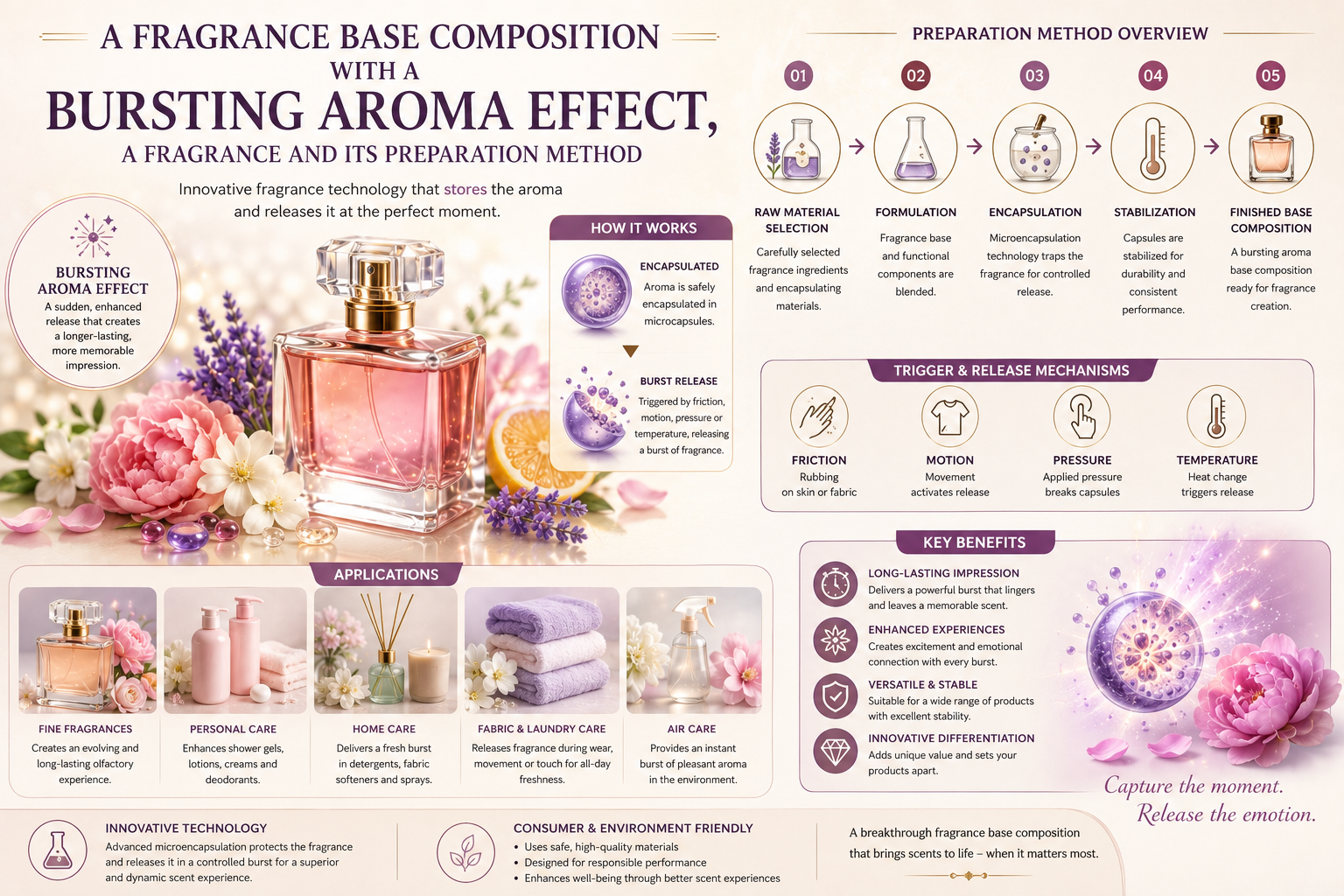
Patent Number: CN121896040A
Country: China
Status: Pending
Publication Date: February 24, 2026
Application Number: CN202610221125.XA
Priority Date: 2026
Inventors: [Not specified in the document]
Current Assignee: [Not specified in the document]
Technical Field
The application relates to the technical field of perfume-based fragrances, in particular to a perfume base composition with a perfume bursting effect, an essence, and a preparation method thereof.
Background
With the development of the daily chemical, food, tobacco, and other industries, consumer requirements for the olfactory experience of fragrance-based products are increasingly improving. An excellent fragrance base is required to have a beautiful fragrance and, furthermore, to rapidly release a full and strong fragrance—namely, a "bursting aroma" effect—in the initial stage of use. This effect attracts people for the first time while maintaining good fragrance retention and durability.
Currently, fragrance-based products on the market are mostly formed by directly compounding tens or even hundreds of monomer fragrances. The preparation process of this method is complex and seriously dependent on the experience of a perfumer. The stability and reproducibility of the formula are difficult to control. More importantly, in order to pursue the "bursting aroma" effect, it is usually necessary to add certain monomers with strong volatility and sharp fragrance in a high proportion. However, this often causes problems such as inconsistent fragrance, overly stimulating top notes, and poor fragrance durability. In addition, the prior art lacks a systematic solution that can modularize complex perfume formulations and efficiently and stably prepare fragrance bases with excellent bursting aroma effects through scientific compatibility and proportion regulation among modules.
Summary of the Invention
To overcome the problems of existing fragrance-based products, the present application provides a fragrance-based composition with a fragrance-explosion effect that is scientific in design, flexible in preparation, and excellent in effect, as well as a preparation method thereof.
First Aspect: Fragrance Base Composition with Bursting Aroma Effect
A perfume composition with a burst effect comprises one or more of the following fragrance bases: tea fragrance base, aldehyde fragrance base, apple fragrance base, juicy peach fragrance base, passion fruit fragrance base, and peanut fragrance base.
The specific compositions of each fragrance base are as follows (in parts by weight):
Tea Fragrance Base
- Methyl salicylate: 13-16 parts
- Octadienal: 1-3 parts
- Raspberry ketone: 120-140 parts
- β-Damascone: 8-12 parts
- β-Ionone: 75-85 parts
- Isomethyl ionone: 8-12 parts
- Cis-jasmone: 140-160 parts
- Methyl heptenone: 3-6 parts
- α-Damascone: 2-4 parts
- 2-Amyl cyclopentanone: 2-4 parts
- Leaf alcohol: 1-3 parts
- Linalool: 140-160 parts
- Geraniol: 45-55 parts
- Dipropylene glycol (DPG): 310-320 parts
- Nerol: 18-23 parts
- 2,3,5-Trimethyl pyrazine: 0.5-1 part
- 2,3-Dimethyl pyrazine: 0.3-0.7 part
- Indole: 25-30 parts
- 2,5-Dimethyl pyrazine: 1.5-2.5 parts
- 2,6-Dimethyl pyrazine: 0.7-1.2 parts
Aldehyde Fragrance Base
- p-Cresol: 0.8-1.2 parts
- Diethyl phthalate (DEP): 730-740 parts
- Tricyclodecenyl acetate: 25-33 parts
- Phenylacetaldehyde: 17-23 parts
- Methylnonanal: 4-7 parts
- Dodecanal: 18-23 parts
- Undecanal: 5-10 parts
- Rabbit grass aldehyde (Ligustral): 25-33 parts
- Undecylenic aldehyde: 45-55 parts
- Isoundecylenic aldehyde: 85-95 parts
- Undecenol: 5-10 parts
- 2,4-Nonadienal: 0.5-1.5 parts
- 2-Dodecenal: 2-4 parts
Apple Fragrance Base
- Isoamyl acetate: 28-33 parts
- Ligustral: 45-55 parts
- Ethyl caproate: 18-25 parts
- Leaf alcohol acetate: 50-70 parts
- Ethyl butyrate: 18-22 parts
- Hexyl acetate: 40-55 parts
- Pear alcohol ester (Fructone): 15-23 parts
- trans-2-Hexenal: 16-23 parts
- Leaf alcohol: 70-90 parts
- α-Damascone: 25-35 parts
- Allyl heptanoate: 70-90 parts
- Linalool: 180-200 parts
- Ethyl 2-methylbutyrate: 50-70 parts
- o-tert-Butyl cyclohexanol acetate: 140-160 parts
- Dipropylene glycol (DPG): 110-130 parts
- Leaf benzoate: 15-22 parts
Juicy Peach Fragrance Base
- Tetradecal (Peach aldehyde): 480-520 parts
- Benzyl acetate: 110-130 parts
- Linalool: 90-110 parts
- Dimethylbenzyl butyrate: 25-35 parts
- Isoamyl acetate: 8-13 parts
- Ethyl butyrate: 8-12 parts
- Tricyclodecenyl propionate: 18-23 parts
- Propiolactone: 18-23 parts
- Hexyl acetate: 25-33 parts
- Leaf alcohol acetate: 25-33 parts
- Leaf alcohol: 18-25 parts
- Ligustral: 18-25 parts
- o-tert-Butyl cyclohexanol acetate: 18-25 parts
- Ligustral: 10-15 parts
- Ethyl caproate: 10-15 parts
- Storax acetate: 10-15 parts
- Ethyl 2-methylbutyrate: 7-10 parts
- Ethyl acetate: 7-10 parts
- Damascenone: 6-10 parts
- Benzaldehyde: 3-6 parts
- Hexadecal: 3-6 parts
- Peach sulfide: 0.1-0.3 part
- 4-Methyl-2-isopropyl thiazole: 0.1-0.3 part
Passion Fruit Fragrance Base
- Sweet orange oil: 40-60 parts
- Ethyl 2-methylbutyrate: 5-15 parts
- Ethyl cinnamate: 40-60 parts
- Ethyl dodecanoate: 5-15 parts
- Leaf alcohol acetate: 10-30 parts
- Ethyl acetoacetate: 480-520 parts
- Ethyl isovalerate: 5-15 parts
- Hexadecal: 160-200 parts
- Ethyl maltol: 10-20 parts
- Damascone: 0.1-0.3 part
- Peach sulfide: 2-4 parts
- Linalool: 5-15 parts
- Ethyl maltol: 70-90 parts
- Furanone methyl ether: 4-6 parts
- 3-Hexenal: 4-6 parts
- Dipropylene glycol (DPG): 50-54 parts
Peanut Fragrance Base
- Benzaldehyde: 0.05-0.15 part
- 2,3,5-Trimethyl pyrazine: 4-6 parts
- 2-Acetyl pyrazine: 0.4-0.6 part
- Benzoic acid: 4-6 parts
- Ethyl maltol: 20-40 parts
- Thiothiazole (5-hydroxyethyl-4-methylthiazole): 3-5 parts
- Thiothiazole acetate: 4-6 parts
- Vanillin: 40-60 parts
- δ-Decalactone: 7-9 parts
- Cypress brain: 13-15 parts
- δ-Dodecalactone: 3-5 parts
- 2-Acetyl pyridine: 3-5 parts
- Ethyl vanillin: 5-15 parts
- 2,3-Diethyl-5-methyl pyrazine: 0.3-0.5 part
- Dipropylene glycol (DPG): 840-880 parts
Optional Specific Formulations (Preferred Embodiments)
Tea Fragrance Base:
- Methyl salicylate: 15 parts
- Octadienal: 2 parts
- Raspberry ketone: 130 parts
- β-Damascone: 10 parts
- β-Ionone: 80 parts
- Isomethyl ionone: 10 parts
- Cis-jasmone: 150 parts
- Methyl heptenone: 5 parts
- α-Damascone: 3 parts
- 2-Amyl cyclopentanone: 3 parts
- Leaf alcohol: 2 parts
- Linalool: 150 parts
- Geraniol: 50 parts
- DPG: 316.5 parts
- Nerol: 20 parts
- 2,3,5-Trimethyl pyrazine: 1 part
- 2,3-Dimethyl pyrazine: 0.5 part
- Indole: 27 parts
- 2,5-Dimethyl pyrazine: 2 parts
- 2,6-Dimethyl pyrazine: 1 part
Aldehyde Fragrance Base:
- p-Cresol: 1 part
- DEP: 734 parts
- Tricyclodecenyl acetate: 30 parts
- Phenylacetaldehyde: 20 parts
- Methylnonanal: 5 parts
- Dodecanal: 20 parts
- Undecanal: 8 parts
- Ligustral: 30 parts
- Undecylenic aldehyde: 50 parts
- Isoundecylenic aldehyde: 90 parts
- Undecenol: 8 parts
- 2,4-Nonadienal: 1 part
- 2-Dodecenal: 3 parts
Apple Fragrance Base:
- Isoamyl acetate: 30 parts
- Ligustral: 50 parts
- Ethyl caproate: 20 parts
- Leaf alcohol acetate: 60 parts
- Ethyl butyrate: 20 parts
- Hexyl acetate: 50 parts
- Fructone: 20 parts
- trans-2-Hexenal: 20 parts
- Leaf alcohol: 80 parts
- α-Damascone: 30 parts
- Allyl heptanoate: 80 parts
- Linalool: 190 parts
- Ethyl 2-methylbutyrate: 60 parts
- o-tert-Butyl cyclohexanol acetate: 150 parts
- DPG: 120 parts
- Leaf benzoate: 20 parts
Juicy Peach Fragrance Base:
- Tetradecal: 501.60 parts
- Benzyl acetate: 120 parts
- Linalool: 100 parts
- Dimethylbenzyl butyrate: 30 parts
- Isoamyl acetate: 10 parts
- Ethyl butyrate: 10 parts
- Tricyclodecenyl propionate: 20 parts
- Propiolactone: 20 parts
- Hexyl acetate: 30 parts
- Leaf alcohol acetate: 30 parts
- Leaf alcohol: 20 parts
- Ligustral: 20 parts
- o-tert-Butyl cyclohexanol acetate: 20 parts
- Ligustral: 12 parts
- Ethyl caproate: 12 parts
- Storax acetate: 12 parts
- Ethyl 2-methylbutyrate: 8 parts
- Ethyl acetate: 8 parts
- Damascenone: 8 parts
- Benzaldehyde: 4 parts
- Hexadecal: 4 parts
- Peach sulfide: 0.20 part
- 4-Methyl-2-isopropyl thiazole: 0.20 part
Passion Fruit Fragrance Base:
- Sweet orange oil: 50 parts
- Ethyl 2-methylbutyrate: 10 parts
- Ethyl cinnamate: 50 parts
- Ethyl dodecanoate: 10 parts
- Leaf alcohol acetate: 20 parts
- Ethyl acetoacetate: 500 parts
- Ethyl isovalerate: 10 parts
- Hexadecal: 180 parts
- Ethyl maltol: 15 parts
- Damascone: 0.2 part
- Peach sulfide: 3 parts
- Linalool: 10 parts
- Ethyl maltol: 80 parts
- Furanone methyl ether: 5 parts
- 3-Hexenal: 5 parts
- DPG: 51.8 parts
Peanut Fragrance Base:
- Benzaldehyde: 0.1 part
- 2,3,5-Trimethyl pyrazine: 5 parts
- 2-Acetyl pyrazine: 0.5 part
- Benzoic acid: 5 parts
- Ethyl maltol: 30 parts
- Thiothiazole (5-hydroxyethyl-4-methylthiazole): 4 parts
- Thiothiazole acetate: 5 parts
- Vanillin: 50 parts
- δ-Decalactone: 8 parts
- Cypress brain: 14 parts
- δ-Dodecalactone: 4 parts
- 2-Acetyl pyridine: 4 parts
- Ethyl vanillin: 10 parts
- 2,3-Diethyl-5-methyl pyrazine: 0.4 part
- DPG: 859 parts
Optional Combinations of Fragrance Bases
The perfume composition may comprise the following combinations by weight:
| Combination | Fragrance Base 1 | Fragrance Base 2 | Fragrance Base 3 |
|---|---|---|---|
| 1 | Aldehyde: 10-25 parts | Juicy Peach: 35-55 parts | Passion Fruit: 30-45 parts |
| 2 | Apple: 25-40 parts | Juicy Peach: 30-50 parts | Peanut: 20-35 parts |
| 3 | Tea: 15-35 parts | Passion Fruit: 25-45 parts | Peanut: 30-50 parts |
| 4 | Tea: 5-15 parts | Apple: 40-60 parts | Juicy Peach: 25-40 parts |
Optionally, the perfume base composition may consist of a tea fragrance base and one or more of an aldehyde fragrance base, an apple fragrance base, a juicy peach fragrance base, a passion fruit fragrance base, and a peanut fragrance base.
Second Aspect: Preparation Method
A method for preparing a fragrance composition having a pop effect, comprising the steps of:
- Preparing the tea fragrance base, aldehyde fragrance base, apple fragrance base, juicy peach fragrance base, passion fruit fragrance base, and peanut fragrance base according to the formula of each fragrance base.
- Selecting one or more of the 6 fragrance bases according to the requirements of the target fragrance type and the characteristic of the burst effect, compounding according to parts by weight, and stirring and mixing uniformly at room temperature to obtain the fragrance base composition with the effect of bursting aroma.
Third Aspect: Fragrance
A fragrance comprising the fragrance-based composition.
Fourth Aspect: Applications
An application of the perfume base composition and essence with a pop-up effect in preparing perfumes, cosmetics, washing products, or air fresheners.
Beneficial Effects
- The application integrates the existing complex perfume formula into six perfume modules (tea fragrance base, aldehyde fragrance base, apple fragrance base, juicy peach fragrance base, passion fruit fragrance base, and peanut fragrance base) with distinct characteristics and stable perfume in advance. By this operation, a perfume dispenser can directly select and combine the perfume modules, greatly reducing the blending difficulty and improving the research and development efficiency of perfume bases and the reproducibility of the formula.
- The application determines the proportion of each fragrance base through a large number of experiments, ensuring that the fragrance of the fragrance base is harmonious and has strength. In addition, the perfume base modules can generate an obvious synergistic effect.
- The fragrance-explosion effect of the fragrance-based composition provided by the application is realized by the combined action and superposition of fragrance-retaining components of a plurality of fragrance-based modules. This ensures the durability and stability of the whole fragrance and avoids the defect of a heavy head and light foot of the traditional fragrance-explosion base.
- The application can obtain different types of perfume bases by selecting and adjusting the proportion of the six perfume bases, thereby being widely applied to various products needing to highlight the expressive force of the perfume, cosmetics, washing products, air fresheners, and the like.
Detailed Description
The information on the raw materials used in the examples of the present application is shown in Table 1 below. All raw materials used in the present application are commercially available.
Table 1: CAS Numbers for Each Feedstock in the Application
(The original document contained a table listing CAS numbers for all raw materials. This table has been omitted for brevity but is part of the original disclosure.)
The present application will be described in further detail with reference to preparation examples and performance tests.
Preparation Example 1: Tea Fragrance Base
Composition (by weight):
- Methyl salicylate: 15 g
- Octadienal: 2 g
- Raspberry ketone: 130 g
- β-Damascone: 10 g
- β-Ionone: 80 g
- Isomethyl ionone: 10 g
- Cis-jasmone: 150 g
- Methyl heptenone: 5 g
- α-Damascone: 3 g
- 2-Amyl cyclopentanone: 3 g
- Leaf alcohol: 2 g
- Linalool: 150 g
- Geraniol: 50 g
- Dipropylene glycol: 316.5 g
- Nerol: 20 g
- 2,3,5-Trimethyl pyrazine: 1 g
- 2,3-Dimethyl pyrazine: 0.5 g
- Indole: 27 g
- 2,5-Dimethyl pyrazine: 2 g
- 2,6-Dimethyl pyrazine: 1 g
Preparation Method: All raw materials were weighed and uniformly mixed to obtain the tea fragrance base.
Preparation Example 2: Aldehyde Fragrance Base
Composition (by weight):
- p-Cresol: 1 g
- Diethyl phthalate: 734 g
- Tricyclodecenyl acetate: 30 g
- Phenylacetaldehyde: 20 g
- Methylnonanal: 5 g
- Dodecanal: 20 g
- Undecanal: 8 g
- Ligustral: 30 g
- Undecylenic aldehyde: 50 g
- Isoundecylenic aldehyde: 90 g
- Undecenol: 8 g
- 2,4-Nonadienal: 1 g
- 2-Dodecenal: 3 g
Preparation Method: All raw materials were weighed and uniformly mixed to obtain the aldehyde fragrance base.
Preparation Example 3: Apple Fragrance Base
Composition (by weight):
- Isoamyl acetate: 30 g
- Ligustral: 50 g
- Ethyl caproate: 20 g
- Leaf alcohol acetate: 60 g
- Ethyl butyrate: 20 g
- Hexyl acetate: 50 g
- Fructone: 20 g
- trans-2-Hexenal: 20 g
- Leaf alcohol: 80 g
- α-Damascone: 30 g
- Allyl heptanoate: 80 g
- Linalool: 190 g
- Ethyl 2-methylbutyrate: 60 g
- o-tert-Butyl cyclohexanol acetate: 150 g
- DPG: 120 g
- Leaf benzoate: 20 g
Preparation Method: All raw materials were weighed and uniformly mixed to obtain the apple fragrance base.
Preparation Example 4: Juicy Peach Fragrance Base
Composition (by weight):
- Tetradecal: 501.60 g
- Benzyl acetate: 120 g
- Linalool: 100 g
- Dimethylbenzyl butyrate: 30 g
- Isoamyl acetate: 10 g
- Ethyl butyrate: 10 g
- Tricyclodecenyl propionate: 20 g
- Propiolactone: 20 g
- Hexyl acetate: 30 g
- Leaf alcohol acetate: 30 g
- Leaf alcohol: 20 g
- Ligustral: 20 g
- o-tert-Butyl cyclohexanol acetate: 20 g
- Ligustral: 12 g
- Ethyl caproate: 12 g
- Storax acetate: 12 g
- Ethyl 2-methylbutyrate: 8 g
- Ethyl acetate: 8 g
- Damascenone: 8 g
- Benzaldehyde: 4 g
- Hexadecal: 4 g
- Peach sulfide: 0.20 g
- 4-Methyl-2-isopropyl thiazole: 0.20 g
Preparation Method: All raw materials were weighed and uniformly mixed to obtain the juicy peach fragrance base.
Preparation Example 5: Passion Fruit Fragrance Base
Composition (by weight):
- Sweet orange oil: 50 g
- Ethyl 2-methylbutyrate: 10 g
- Ethyl cinnamate: 50 g
- Ethyl dodecanoate: 10 g
- Leaf alcohol acetate: 20 g
- Ethyl acetoacetate: 500 g
- Ethyl isovalerate: 10 g
- Hexadecal: 180 g
- Ethyl maltol: 15 g
- Damascone: 0.2 g
- Peach sulfide: 3 g
- Linalool: 10 g
- Ethyl maltol: 80 g
- Furanone methyl ether: 5 g
- 3-Hexenal: 5 g
- DPG: 51.8 g
Preparation Method: All raw materials were weighed and uniformly mixed to obtain the passion fruit fragrance base.
Preparation Example 6: Peanut Fragrance Base
Composition (by weight):
- Benzaldehyde: 0.1 g
- 2,3,5-Trimethyl pyrazine: 5 g
- 2-Acetyl pyrazine: 0.5 g
- Benzoic acid: 5 g
- Ethyl maltol: 30 g
- Thiothiazole (5-hydroxyethyl-4-methylthiazole): 4 g
- Thiothiazole acetate: 5 g
- Vanillin: 50 g
- δ-Decalactone: 8 g
- Cypress brain: 14 g
- δ-Dodecalactone: 4 g
- 2-Acetyl pyridine: 4 g
- Ethyl vanillin: 10 g
- 2,3-Diethyl-5-methyl pyrazine: 0.4 g
- DPG: 859 g
Preparation Method: All raw materials were weighed and uniformly mixed to obtain the peanut fragrance base.
Fragrance Burst Time Test
Test Method:
- A rectangular container was prepared, and a magnetic stirrer was placed inside.
- The container door was opened, and a cup containing 200 mL of deionized water was placed on the magnetic stirrer.
- One evaluator was fixed at a small opening above the container (20 cm from the liquid surface), and the rest were standing by at the same distance (to avoid subjective interference).
- Under conditions of 25°C and 120 r/min, 1 g of the sample to be tested was quickly added. A stopwatch was started (marked as time zero), and the container door was closed.
- The evaluator sniffed the air every 1 second, recording the time (in seconds) when the flavor smell was clearly sensed for the first time.
- The test was repeated at least 10 times, replacing the sample and the evaluator each time.
- The average value of the multiple test results from multiple evaluators was taken as the fragrance burst time (the average time to smell the fragrance).
Test 1: Fragrance Burst Time of Individual Fragrance Bases
The fragrance bases of Preparation Examples 1-6 were used as test fragrance bases at 100% concentration. The fragrance bases were mixed with dipropylene glycol at a weight ratio of 1:9 to obtain test fragrance bases at 10% concentration. Both types of test fragrance bases were added to a shower gel base material at an addition amount of 0.8% to obtain samples to be tested. The odor time (fragrance bursting time) and the odor of the fragrance bases in the samples were tested according to the test method. Each fragrance base was tested 15 times in parallel, and the average value was obtained. The results are shown in Table 2 below.
Table 2: Burst Time of Fragrance Bases
| Fragrance Base | Burst Time (seconds) at 100% Concentration | Burst Time (seconds) at 10% Concentration |
|---|---|---|
| Tea | [Data not provided in original text] | [Data not provided in original text] |
| Aldehyde | [Data not provided in original text] | [Data not provided in original text] |
| Apple | [Data not provided in original text] | [Data not provided in original text] |
| Juicy Peach | [Data not provided in original text] | [Data not provided in original text] |
| Passion Fruit | [Data not provided in original text] | [Data not provided in original text] |
| Peanut | [Data not provided in original text] | [Data not provided in original text] |
Note: The original document Table 2 contained specific numerical values for burst times. These values are part of the original disclosure but were not extractable in a structured format. The table structure is shown for completeness.
Test 2: Fragrance Burst Time of Fragrance Bases in Essence
The fragrance bases obtained in Preparation Examples 1-6 were added to either a "powdery essence" or a "tea tree essence" in the amounts shown in Table 3. The essence was then added to a shower gel at an amount of 0.8% to obtain samples to be tested. The fragrance burst time of the samples was measured according to the above-mentioned test method. The results are shown in Table 3.
Composition of the Powdery Essence (for reference):
The powdery essence comprised: 1% hexyl acetate, 0.1% p-cresyl methyl ether, 0.2% p-cymene, 15% sweet terpene, 0.4% isoamyl butyrate, 0.5% green flower, 0.1% methyl benzoate, 5% linalool, 0.1% rose ether, 15% phenethyl alcohol, 7% benzyl acetate, 16% ethyl linalool, 1% phenylacetaldehyde, 4% citronellol, 1% nerol, 25% linalyl acetate, 0.3% geraniol, 3% o-tert-butylcyclohexyl acetate, 2% indole, 0.4% dimethylbenzyl primate, 3% heliotropin, 2% orange flower acetate, 4% geranyl acetate, 2% cis-jasmone, 0.2% methyl ionone, 2% linalool, 0.3% caryophyllene, 2% anthocyanin aldehyde, 0.5% coumarin, 0.4% isoeugenol, 0.2% ethyl vanillin, 3% ionone, 10% Mankollan, 5% BHT, 15% heliotropin, 3% tetradecal (peach aldehyde), 148% methyl dihydrojasmonate, 13% methylhexyl cinnamaldehyde, 12% super ambroxide, 120% Jiale musk stock solution, 102% vomit musk, 3% malvalactone, 172% musk-T, 217.3% DPG, 2% dihydromyrcenol, 2% terpineol, 15% benzyl alcohol, 40% white flower alcohol, 5% Liu Suanshe ester, with the balance being diethyl phthalate.
Composition of the Tea Tree Essence (for reference):
The tea tree essence comprised: 85‰ methyl dihydrojasmonate, 28‰ linalyl acetate, 3‰ styryl acetate, 0.8‰ ligustral, 5‰ lactulose aldehyde, 2‰ heliotropin, 2‰ hydroxy vanillin, 5‰ ionone, 10‰ ambergris ketone, 0.7‰ p-tert-butyl phenylpropionaldehyde, 0.3‰ damascenone, 20‰ musk stock solution, 5‰ musk, 950‰ citronellol, 732.7‰ DPG, 17‰ linalool, 38‰ natural menthol, 40‰ orange terpene, 1‰ p-cymene, 0.5‰ N-methyl anthranilate, with the balance being diethyl phthalate.
Procedure:
The fragrance bases obtained in Preparation Examples 1-6 were added to the powdery or tea tree essence, respectively, in a proportion at which the price of 1 kg of powdery or tea tree essence was increased by 10 yuan. The essence was added to the body wash at 0.8%, and the results are shown in Table 3.
Table 3: Results of Test of the Time to Burst of Fragrance Base in Essence
| Sample | Addition Amount | Burst Time (seconds) |
|---|---|---|
| Powdery Essence (Control) | 0% | [Control value] |
| Powdery Essence + Tea Base | [Amount] | [Time] |
| Powdery Essence + Aldehyde Base | [Amount] | [Time] |
| Powdery Essence + Apple Base | [Amount] | [Time] |
| Powdery Essence + Peach Base | [Amount] | [Time] |
| Powdery Essence + Passion Fruit Base | [Amount] | [Time] |
| Powdery Essence + Peanut Base | [Amount] | [Time] |
| Tea Tree Essence (Control) | 0% | [Control value] |
| Tea Tree Essence + Tea Base | [Amount] | [Time] |
| ... (similar data for all bases) | ... | ... |
Note: The original document Table 3 contained specific numerical data for addition amounts and burst times. These values are part of the original disclosure but were not extractable in a structured format. The table structure is shown for completeness.
Test Results Interpretation:
According to the test results in Table 3, after each of the aroma bases provided by the application was added to the powdery essence and the tea tree essence, the time for smelling the aroma in the essence was obviously shortened, and the aroma burst time could be basically kept within 8 seconds.
Example 1: Modern Flower Bud Aldehyde Fragrance Base
Composition:
- Aldehyde fragrance base: 20 g
- Juicy peach fragrance base: 50 g
- Passion fruit fragrance base: 20 g
Preparation Method:
The aldehyde fragrance base, juicy peach fragrance base, and passion fruit fragrance base were weighed and placed into a mixer. The mixture was stirred at 25°C and 40 rpm for 30 minutes until uniformly mixed to obtain the flower and fruit aldehyde fragrance base.
Characteristics:
The modern flower and fruit aldehyde fragrance base has the characteristics of being a modern compound fruit fragrance with bright and full fragrance and excellent diffusion and fragrance explosion effects. The aldehyde fragrance provides a classical "perfume feel" framework, the juicy peaches contribute a full main body sweetness, and the passion fruit infuses a unique sour and refreshing vigor and tropical amorous feelings. This fragrance base is very suitable for women's perfumes, body care products (bath cream and body milk), and household fragrances pursuing vivid memory points, creating a pleasant, clean, and attractive atmosphere.
Example 2: Nut Food Flavor Base
Composition:
- Apple fragrance base: 35 g
- Juicy peach fragrance base: 40 g
- Peanut fragrance base: 30 g
Preparation Method:
The components were mixed according to the method of Example 1.
Characteristics:
The nutlet delicacy flavoring base has the characteristics that its fragrance has extremely strong interestingness and identification. The fresh vitality of fruits and the warmth and richness of delicacies are perfectly combined. The "pop-up" effect of the opening can quickly attract attention, and then the depth and loving sense of the fragrance are increased. These fragrance bases are suitable for use in body care products or space fragrances where comfort, liveliness, and satisfaction are desired, providing youthful, lively pleasure and happiness.
Example 3: Fruit Tea Nut Food Flavor Base
Composition:
- Tea fragrance base: 35 g
- Passion fruit fragrance base: 40 g
- Peanut fragrance base: 30 g
Preparation Method:
The components were mixed according to the method of Example 1.
Characteristics:
The fruit tea nut delicacy flavor base has the characteristics of combining fresh fruit tea with attractive delicacy flavor, creating a unique aroma with dynamic change, depth, and satisfaction. It avoids the single thin, sweet, and greasy nature of pure fruit flavor, offering a fresh and natural surface with a warm undertone. This fragrance base is very suitable for use in high-end creative fragrances, particularly salon fragrances or neutral fragrances, and in atmosphere fragrances for bookstores, cafes, or home spaces created with a pattern.
Example 4: Fruity Tea Aroma Burst Type Aroma Base
Composition:
- Tea fragrance base: 10 g
- Apple fragrance base: 50 g
- Juicy peach fragrance base: 40 g
Preparation Method:
The components were mixed according to the method of Example 1.
Characteristics:
The fruity tea-flavor explosive-flavor type flavor base has the characteristics of combining fruit flavor and tea flavor. The composite fruit flavor of apples and juicy peaches forms the core of an absolutely full and sweet taste, while the tea flavor infuses a refreshing tea and a plant green flavor, making the fragrance breathable by instantly relieving greasiness and refreshing. The flavor burst effect of this flavor base is that the juicy fruits explode in sweetness, and the pleasant fresh tea feel closes the experience, making the flavor distinct and interesting.
Example 5: Modern Fresh Fruit-Flavored Base
Composition:
- Tea fragrance base: 10 g
- Aldehyde fragrance base: 8 g
- Apple fragrance base: 50 g
- Juicy peach fragrance base: 32 g
Preparation Method:
The components were mixed according to the method of Example 1.
Characteristics:
The modern fresh fruit-flavored base has the characteristics of taking fresh and juicy compound fruit flavor as its core, with a bright and transparent feeling and an elegant deep flavor. The apples and juicy peaches form a full and attractive main body, while the aldehyde flavor endows a classical perfume framework and a brilliant opening. The tea flavor skillfully avoids a sweet and greasy taste and adds a base of anti-human smell. This perfume base is very suitable for mainstream commercial perfume (especially young line or fresh line), high-end washing and caring products (shampoo, bath lotion), household cleaning products, or air fresheners. It can create a clean, pleasant, natural, and unpretentious atmosphere with a high-grade feeling.
Claims
Claim 1: A fragrance-based composition with a fragrance-bursting effect, characterized in that the fragrance-based composition comprises one or more of a tea fragrance base, an aldehyde fragrance base, an apple fragrance base, a juicy peach fragrance base, a passion fruit fragrance base, and a peanut fragrance base;
- The tea fragrance base comprises, by weight, 13-16 parts of methyl salicylate, 1-3 parts of octadienal, 120-140 parts of raspberry ketone, 8-12 parts of β-damascone, 75-85 parts of β-ionone, 8-12 parts of isomethyl ionone, 140-160 parts of cis-jasmone, 3-6 parts of methyl heptenone, 2-4 parts of α-damascone, 2-4 parts of 2-amyl cyclopentanone, 1-3 parts of leaf alcohol, 140-160 parts of linalool, 45-55 parts of geraniol, 310-320 parts of dipropylene glycol, 18-23 parts of nerol, 0.5-1 part of 2,3,5-trimethyl pyrazine, 0.3-0.7 part of 2,3-dimethyl pyrazine, 25-30 parts of indole, 1.5-2.5 parts of 2,5-dimethyl pyrazine, and 0.7-1.2 parts of 2,6-dimethyl pyrazine;
- The aldehyde fragrance base comprises, by weight, 0.8-1.2 parts of p-cresol, 730-740 parts of diethyl phthalate, 25-33 parts of tricyclodecenyl acetate, 17-23 parts of phenylacetaldehyde, 4-7 parts of methylnonanal, 18-23 parts of dodecanal, 5-10 parts of undecanal, 25-33 parts of ligustral, 45-55 parts of undecylenic aldehyde, 85-95 parts of isoundecylenic aldehyde, 5-10 parts of undecenol, 0.5-1.5 parts of 2,4-nonadienal, and 2-4 parts of 2-dodecenal;
- The apple fragrance base comprises, by weight, 28-33 parts of isoamyl acetate, 45-55 parts of ligustral, 18-25 parts of ethyl caproate, 50-70 parts of leaf alcohol acetate, 18-22 parts of ethyl butyrate, 40-55 parts of hexyl acetate, 15-23 parts of fructone, 16-23 parts of trans-2-hexenal, 70-90 parts of leaf alcohol, 25-35 parts of α-damascone, 70-90 parts of allyl heptanoate, 180-200 parts of linalool, 50-70 parts of ethyl 2-methylbutyrate, 140-160 parts of o-tert-butyl cyclohexanol acetate, 110-130 parts of dipropylene glycol, and 15-22 parts of leaf benzoate;
- The juicy peach fragrance base comprises, by weight, 480-520 parts of tetradecal, 110-130 parts of benzyl acetate, 90-110 parts of linalool, 25-35 parts of dimethylbenzyl butyrate, 8-13 parts of isoamyl acetate, 8-12 parts of ethyl butyrate, 18-23 parts of tricyclodecenyl propionate, 18-23 parts of propiolactone, 25-33 parts of hexyl acetate, 25-33 parts of leaf alcohol acetate, 18-25 parts of leaf alcohol, 18-25 parts of ligustral, 18-25 parts of o-tert-butyl cyclohexanol acetate, 10-15 parts of ligustral, 10-15 parts of ethyl caproate, 10-15 parts of storax acetate, 7-10 parts of ethyl 2-methylbutyrate, 7-10 parts of ethyl acetate, 6-10 parts of damascenone, 3-6 parts of benzaldehyde, 3-6 parts of hexadecal, 0.1-0.3 part of peach sulfide, and 0.1-0.3 part of 4-methyl-2-isopropyl thiazole;
- The passion fruit fragrance base comprises, by weight, 40-60 parts of sweet orange oil, 5-15 parts of ethyl 2-methylbutyrate, 40-60 parts of ethyl cinnamate, 5-15 parts of ethyl dodecanoate, 10-30 parts of leaf alcohol acetate, 480-520 parts of ethyl acetoacetate, 5-15 parts of ethyl isovalerate, 160-200 parts of hexadecal, 10-20 parts of ethyl maltol, 0.1-0.3 part of damascone, 2-4 parts of peach sulfide, 5-15 parts of linalool, 70-90 parts of ethyl maltol, 4-6 parts of furanone methyl ether, 4-6 parts of 3-hexenal, and 50-54 parts of dipropylene glycol;
- The peanut fragrance base comprises, by weight, 0.05-0.15 part of benzaldehyde, 4-6 parts of 2,3,5-trimethyl pyrazine, 0.4-0.6 part of 2-acetyl pyrazine, 4-6 parts of benzoic acid, 20-40 parts of ethyl maltol, 3-5 parts of thiothiazole (5-hydroxyethyl-4-methylthiazole), 4-6 parts of thiothiazole acetate, 40-60 parts of vanillin, 7-9 parts of δ-decalactone, 13-15 parts of cypress brain, 3-5 parts of δ-dodecalactone, 3-5 parts of 2-acetyl pyridine, 5-15 parts of ethyl vanillin, 0.3-0.5 part of 2,3-diethyl-5-methyl pyrazine, and 840-880 parts of dipropylene glycol.
Claim 2: The fragrant composition with pop effect of claim 1, wherein the tea fragrance base comprises, by weight, 15 parts of methyl salicylate, 2 parts of octadienal, 130 parts of raspberry ketone, 10 parts of β-damascone, 80 parts of β-ionone, 10 parts of isomethyl ionone, 150 parts of cis-jasmone, 5 parts of methyl heptenone, 3 parts of α-damascone, 3 parts of 2-amyl cyclopentanone, 2 parts of leaf alcohol, 150 parts of linalool, 50 parts of geraniol, 316.5 parts of dipropylene glycol, 20 parts of nerol, 1 part of 2,3,5-trimethyl pyrazine, 0.5 part of 2,3-dimethyl pyrazine, 27 parts of indole, 2 parts of 2,5-dimethyl pyrazine, and 1 part of 2,6-dimethyl pyrazine;
- The aldehyde fragrance base comprises, by weight, 1 part of p-cresol, 734 parts of diethyl phthalate, 30 parts of tricyclodecenyl acetate, 20 parts of phenylacetaldehyde, 5 parts of methylnonanal, 20 parts of dodecanal, 8 parts of undecanal, 30 parts of ligustral, 50 parts of undecylenic aldehyde, 90 parts of isoundecylenic aldehyde, 8 parts of undecenol, 1 part of 2,4-nonadienal, and 3 parts of 2-dodecenal;
- The apple fragrance base comprises, by weight, 30 parts of isoamyl acetate, 50 parts of ligustral, 20 parts of ethyl caproate, 60 parts of leaf alcohol acetate, 20 parts of ethyl butyrate, 50 parts of hexyl acetate, 20 parts of fructone, 20 parts of trans-2-hexenal, 80 parts of leaf alcohol, 30 parts of α-damascone, 80 parts of allyl heptanoate, 190 parts of linalool, 60 parts of ethyl 2-methylbutyrate, 150 parts of o-tert-butyl cyclohexanol acetate, 120 parts of dipropylene glycol, and 20 parts of leaf benzoate;
- The juicy peach fragrance base comprises, by weight, 501.60 parts of tetradecal, 120 parts of benzyl acetate, 100 parts of linalool, 30 parts of dimethylbenzyl butyrate, 10 parts of isoamyl acetate, 10 parts of ethyl butyrate, 20 parts of tricyclodecenyl propionate, 20 parts of propiolactone, 30 parts of hexyl acetate, 30 parts of leaf alcohol acetate, 20 parts of leaf alcohol, 20 parts of ligustral, 20 parts of o-tert-butyl cyclohexanol acetate, 12 parts of ligustral, 12 parts of ethyl caproate, 12 parts of storax acetate, 8 parts of ethyl 2-methylbutyrate, 8 parts of ethyl acetate, 8 parts of damascenone, 4 parts of benzaldehyde, 4 parts of hexadecal, 0.20 part of peach sulfide, and 0.20 part of 4-methyl-2-isopropyl thiazole;
- The passion fruit fragrance base comprises, by weight, 50 parts of sweet orange oil, 10 parts of ethyl 2-methylbutyrate, 50 parts of ethyl cinnamate, 10 parts of ethyl dodecanoate, 20 parts of leaf alcohol acetate, 500 parts of ethyl acetoacetate, 10 parts of ethyl isovalerate, 180 parts of hexadecal, 15 parts of ethyl maltol, 0.2 part of damascone, 3 parts of peach sulfide, 10 parts of linalool, 80 parts of ethyl maltol, 5 parts of furanone methyl ether, 5 parts of 3-hexenal, and 51.8 parts of dipropylene glycol;
- The peanut fragrance base comprises, by weight, 0.1 part of benzaldehyde, 5 parts of 2,3,5-trimethyl pyrazine, 0.5 part of 2-acetyl pyrazine, 5 parts of benzoic acid, 30 parts of ethyl maltol, 4 parts of thiothiazole (5-hydroxyethyl-4-methylthiazole), 5 parts of thiothiazole acetate, 50 parts of vanillin, 8 parts of δ-decalactone, 14 parts of cypress brain, 4 parts of δ-dodecalactone, 4 parts of 2-acetyl pyridine, 10 parts of ethyl vanillin, 0.4 part of 2,3-diethyl-5-methyl pyrazine, and 859 parts of dipropylene glycol.
Claim 3: The fragrant composition with the explosive effect according to claim 2, wherein the fragrant composition consists of, by weight, 10-25 parts of aldehyde fragrance base, 35-55 parts of juicy peach fragrance base, and 30-45 parts of passion fruit fragrance base.
Claim 4: The fragrant composition with the fragrant explosion effect according to claim 2, wherein the fragrant composition consists of, by weight, 25-40 parts of apple fragrance base, 30-50 parts of juicy peach fragrance base, and 20-35 parts of peanut fragrance base.
Claim 5: The fragrant composition with the fragrant explosion effect according to claim 2, wherein the fragrant composition consists of, by weight, 15-35 parts of tea fragrance base, 25-45 parts of passion fruit fragrance base, and 30-50 parts of peanut fragrance base.
Claim 6: The fragrant composition with the explosive fragrance effect according to claim 2, wherein the fragrant composition consists of, by weight, 5-15 parts of tea fragrance base, 40-60 parts of apple fragrance base, and 25-40 parts of juicy peach fragrance base.
Claim 7: A fragrance composition having a pop fragrance effect according to claim 2, wherein the fragrance composition consists of a tea fragrance base and one or more of an aldehyde fragrance base, an apple fragrance base, a honey peach fragrance base, a passion fruit fragrance base, and a peanut fragrance base.
Claim 8: A method for preparing a fragrance composition having a pop effect according to any one of claims 1 to 6, comprising the steps of:
- Preparing the tea fragrance base, aldehyde fragrance base, apple fragrance base, juicy peach fragrance base, passion fruit fragrance base, and peanut fragrance base according to the formula of each fragrance base;
- Selecting one or more of the 6 fragrance bases according to the requirements of the target fragrance type and the characteristic of the burst effect, compounding according to parts by weight, and stirring and mixing uniformly at room temperature to obtain the fragrance base composition with the effect of bursting aroma.
Claim 9: A fragrance comprising a fragrance composition according to any one of claims 1 to 6.
Claim 10: Use of a fragrance-based composition with a pop-off effect according to any one of claims 1 to 6, or a fragrance according to claim 9, for the preparation of perfumes, cosmetics, washing products, or air fresheners.
###