Acetals in Flavor Chemistry: What Every Flavorist Needs to Know
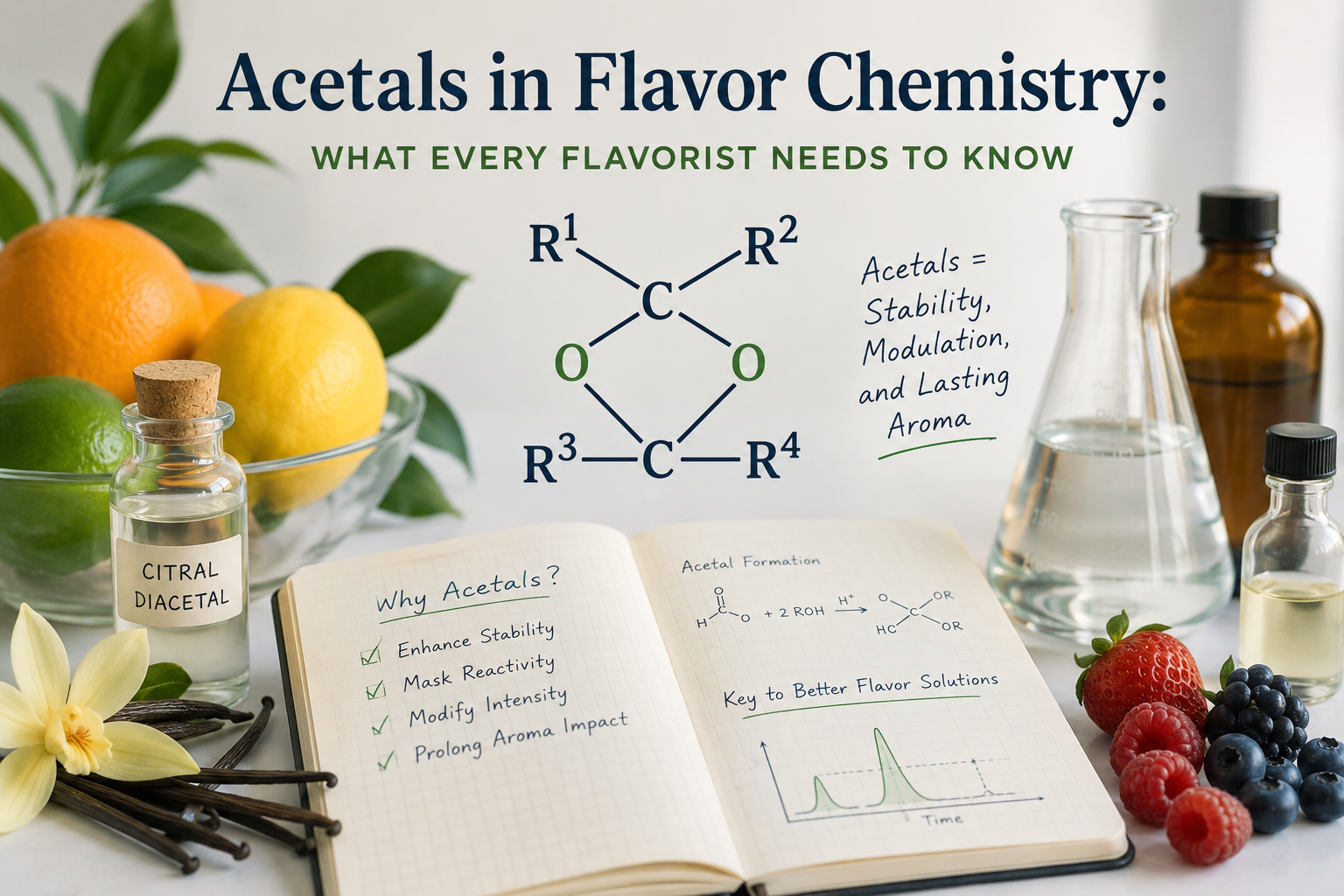
1. General Substituent Group: Structure, Functionality, Reactivity & Stability
Structure
An acetal is built around a single carbon bonded to two ether-type oxygens (–OR groups), one hydrogen, and one R group inherited from the parent carbonyl:
        OR'
         |
   R — C — H
         |
        OR'
Acetals form when an aldehyde reacts with two equivalents of an alcohol (or one diol, giving a cyclic ring) under acid catalysis, releasing water:
R-CHO + 2 R'OH ⇌ R-CH(OR')2 + H2O (acid-catalyzed, reversible)
If the parent carbonyl is a ketone instead of an aldehyde, the product is technically a ketal, though current IUPAC nomenclature folds ketals into the broader "acetal" category. Reaction with a 1,2- or 1,3-diol instead of two separate alcohols produces a cyclic acetal — a 1,3-dioxolane (5-membered ring) or 1,3-dioxane (6-membered ring) — which is itself a heterocyclic structure.
Functionality
Acetals function chemically as a protected (masked) form of an aldehyde. The carbonyl's reactive C=O is converted into a much less reactive sp³ center. In flavor work, this masking is intentional: it allows formulators to carry an aldehyde's character into a system in a more controllable, less aggressive form.
Reactivity
- Stable to base, nucleophiles, oxidizing agents, and most conditions an ester or aldehyde would react under.
- Hydrolyzes readily under aqueous acidic conditions (low pH, heat, or moisture) back to the original aldehyde + alcohol.
- This pH-dependence is the defining reactivity trait of the class, and it's exploited deliberately in flavor delivery: an acetal can sit quietly in a neutral or alkaline base, then release its parent aldehyde note when it hits an acidic environment (a beverage, saliva, a fruit preparation).
Stability
- Far more resistant to oxidation than the free aldehyde — aldehydes readily over-oxidize to acids, polymerize, or undergo Strecker degradation; acetals largely avoid this because the reactive carbonyl is gone.
- Stable in neutral-to-alkaline, anhydrous, or low-moisture systems; unstable in acidic aqueous systems.
- This added stability generally comes with a softer, sweeter, less sharp aroma than the corresponding free aldehyde — acetals are frequently described as "fruity," "winey," "mellow," or "rounded" rather than "green," "pungent," or "harsh."
2. IUPAC and Common Names
Flavor acetals are almost always referred to by common (semi-systematic) names built from the parent aldehyde + alcohol, while IUPAC names use dialkoxy-alkane nomenclature.
| Common (Flavor Industry) Name | IUPAC Name | Aroma Note |
|---|---|---|
| Acetaldehyde diethyl acetal | 1,1-diethoxyethane | Fruity, rummy, winey |
| Acetaldehyde dimethyl acetal | 1,1-dimethoxyethane | Fruity, ethereal |
| Heptanal dimethyl acetal | 1,1-dimethoxyheptane | Fatty, green-fruity |
| Octanal dimethyl acetal | 1,1-dimethoxyoctane | Waxy, citrus-fruity |
| Benzaldehyde dimethyl acetal | (dimethoxymethyl)benzene | Mild almond, milder than benzaldehyde |
| Cinnamaldehyde diethyl acetal | (3,3-diethoxyprop-1-enyl)benzene | Soft cinnamon, fruity |
| Phenylacetaldehyde dimethyl acetal | (2,2-dimethoxyethyl)benzene | Honey, rose, floral |
| Furfural diethyl acetal | 2-(diethoxymethyl)furan | Bready, mild caramellic |
| 2-Pentyl-1,3-dioxolane | 2-pentyl-1,3-dioxolane | Melon, fresh green |
Note the pattern: [parent aldehyde] + [alcohol/glycol] + "acetal" (common) vs. carbon-numbered dialkoxy/dioxolane name (IUPAC).
3. Structural & Functional Grouping
Aliphatic acetals Derived from straight- or branched-chain aliphatic aldehydes (acetaldehyde, hexanal, octanal, decanal) plus simple alcohols (methanol, ethanol) or glycols. The largest and most commercially used group — e.g., acetaldehyde diethyl acetal, octanal dimethyl acetal. Profiles range from sharp/ethereal (short chain) to fruity to waxy (long chain).
Terpene-derived acetals Built from terpenoid aldehydes such as citral (a geranial/neral mixture). Citral dimethyl or diethyl acetal retains a citrus character but with improved stability versus the free, easily-oxidized citral — useful where citral's tendency to degrade (and develop off-notes) under storage is a problem.
Aromatic acetals Derived from aromatic-ring aldehydes — benzaldehyde, cinnamaldehyde, phenylacetaldehyde. These tend to soften and round out aromatic aldehyde notes that can otherwise read as harsh or "bitter-almond" (benzaldehyde) or sharp (cinnamaldehyde), shifting them toward mellower, sweeter impressions.
Heterocyclic acetals Two senses apply here:
- Acetals of heterocyclic aldehydes, e.g., furfural diethyl acetal — softens furfural's burnt/bready sharpness into a milder, sweeter caramellic note.
- Cyclic acetals themselves (1,3-dioxolanes, 1,3-dioxanes) are structurally heterocyclic regardless of what aldehyde or alcohol they were built from, since the ring itself contains two oxygen heteroatoms. 2-Pentyl-1,3-dioxolane (melon note) is a good example: the pendant pentyl chain is aliphatic, but the molecule's ring is a true heterocycle.
4. Carbon Chain Length Progression — Aliphatic Acetals
| Chain Length (parent aldehyde) | Typical Aroma | Volatility / Physical Trend |
|---|---|---|
| C2–C4 (acetaldehyde, propanal) | Sharp, ethereal, pungent, solvent-like, rummy | High volatility, low boiling point, more water-soluble |
| C6–C10 (hexanal–decanal) | Fruity, green, citrus, waxy-fresh | Moderate volatility; classic "fresh fruity" character |
| C12+ (lauraldehyde and above) | Waxy, fatty, soapy, weak intensity | Low volatility, high boiling point, oily/waxy physical state, low water solubility, high lipophilicity |
As chain length increases: aroma character shifts from sharp/pungent → fruity → waxy/fatty/soapy; molecular weight, boiling point, and lipophilicity (log P) rise; volatility and water solubility fall; and the odor threshold (in concentration terms) generally rises, meaning longer-chain compounds are usually less potent per unit weight even where their character is pleasant.
5. Organoleptic Changes Across the Oxidation Sequence (Alcohol → Aldehyde → Acid), and Where Acetals Fit
| Stage | Example (C6) | Aroma | Reactivity / Stability |
|---|---|---|---|
| Primary alcohol | Hexanol | Mild, green, slightly fatty, sweet "leafy" note | Relatively unreactive, stable, higher odor threshold |
| Aldehyde | Hexanal | Sharp, grassy, "cut-grass," tallowy — much more potent | Highly reactive: prone to further oxidation, Strecker degradation, polymerization; low odor threshold |
| Carboxylic acid | Hexanoic acid | Sour, sweaty, cheesy/goaty, rancid | Chemically stable end-state; resists further oxidation |
The aldehyde stage is simultaneously the most aromatically potent and the least chemically stable point in the sequence — which is precisely the problem acetal formation solves. Converting the aldehyde into its acetal:
- Masks/softens the sharp, sometimes harsh aldehyde character into something sweeter, rounder, and more "fruity/winey."
- Restores chemical stability, similar to (though not identical to) the stability of the acid endpoint, without the sour/rancid shift in character.
- Effectively gives formulators a way to "park" an aldehyde note in a stable, low-reactivity form and release it (via acid hydrolysis) on demand.
6. Saturated vs. Unsaturated Compounds of the Same Chain Length
The classic comparison — hexanol (saturated) vs. cis-3-hexenol (unsaturated, "leaf alcohol") — extends directly into the acetal class:
- Saturated aliphatic acetal (e.g., octanal dimethyl acetal, acetaldehyde diethyl acetal): fruity, mild, fresh, "round" — a relatively neutral, sweet-leaning fruity character.
- Unsaturated acetal (e.g., (E)-2-hexenal diethyl acetal): the double bond introduces a noticeably greener, leafier, more vegetal edge, paralleling how cis-3-hexenol reads "fresher/greener" than saturated hexanol.
The double bond changes more than just smell: it alters molecular geometry and rigidity, which affects both volatility (often a somewhat lower boiling point than the saturated analog of equal carbon number) and how the molecule fits olfactory receptors — producing the characteristic "fresher, sharper-edged, more diffusive" green impression versus the "rounder, fattier" saturated counterpart.
This matters practically for acetal chemistry in particular: unsaturated aldehydes like cis-3-hexenal are notoriously unstable (prone to isomerization and oxidation). Forming the acetal is one of the more effective ways to deliver that "fresh-cut green leaf" character in a commercially stable form, since the free unsaturated aldehyde degrades quickly on its own.
###