Africa Food & Flavor Regulatory Update: Key Legal and Regulatory Developments | August 15–September 15, 2026
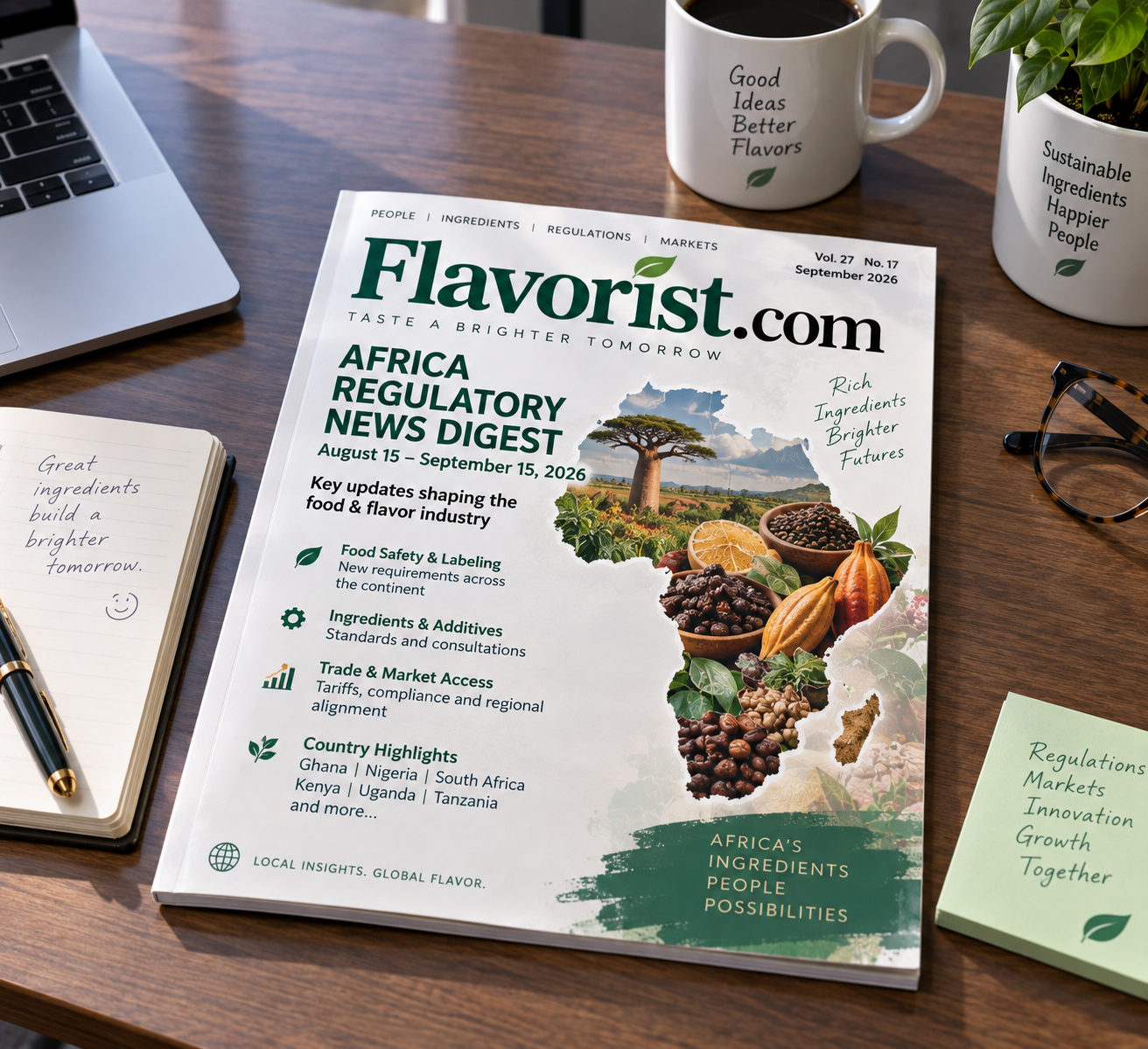
Africa Food & Flavor Regulatory Update
Key Legal and Regulatory Developments | August 15–September 15, 2026
The digest results from a search of official regulators, standards bodies, government gazettes and regional sources across East, West, Southern and North Africa, supplemented by specialist food-law reporting. It focuses on measures affecting foods, beverages, flavors, ingredients, additives, labeling, food safety, packaging, alcohol, sweeteners, agricultural raw materials and market access.
There are 16 material developments released during the requested period. “All” cannot be guaranteed literally across 50+ African jurisdictions and numerous subnational authorities; this is a best-effort comprehensive review of searchable national/regional sources. Routine recalls and inspections were excluded unless they communicated a broader compliance requirement.
- Tanzania — New GAP standards for cereals, pulses and horticultural crops | August 16. Tanzania Bureau of Standards opened public review of a package of draft Good Agricultural Practice standards and audit checklists covering cereals, pulses and horticultural crops, with consultation running August 16–October 15. Although upstream from finished-food regulation, GAP requirements can materially affect flavor and ingredient companies sourcing herbs, spices, fruit, vegetables, grains and botanical raw materials. The standards address production controls at farm level and associated conformity assessment. Manufacturers relying on Tanzanian agricultural ingredients should monitor the final requirements and consider whether supplier questionnaires, farm audits, pesticide-management programs, traceability systems and raw-material specifications will need to incorporate the new GAP framework. Tanzania Bureau of Standards
Tanzania Bureau of Standards — Draft standards under public review - Ghana — FDA warns that flood-damaged foods and beverages cannot be cleaned and resold | August 17. Ghana FDA issued a strong compliance warning after discovering flood-affected bottled water and soft drinks being cleaned for resale. FDA directed manufacturers, distributors and retailers to quarantine and dispose of food or beverage stock exposed to floodwater, rather than washing, repacking, relabeling or returning it to commerce. Approximately a truckload of affected beverages was seized for disposal. The announcement provides a useful regulatory interpretation for manufacturers' emergency-response procedures: flood exposure can compromise package integrity and microbiological safety even where the container appears intact. Companies should incorporate quarantine, notification, traceability and supervised disposal procedures into disaster-response plans. Ghana News Agency
Ghana regulatory coverage — FDA flood-damaged food warning - Botswana — Additive standard for fruit, vegetable and non-alcoholic drinks enters public review | August 17. Botswana Bureau of Standards opened public comments on FDS 473:2011, Additives in fruit and vegetable drinks and non-alcoholic drinks — Specification, with comments due September 24. Although the underlying standard predates 2026, its placement under public review creates an opportunity for industry to influence whether current additive requirements remain appropriate or require revision. The exercise is directly relevant to flavor houses, beverage companies and suppliers of colors, preservatives, sweeteners, acidity regulators, stabilizers and other beverage additives. Companies selling beverage systems in Botswana should compare current formulations against FDS 473 and identify provisions that may warrant modernization. Bob Standards
Botswana Bureau of Standards — Food additive standard consultation - Botswana — New requirements proposed for water-refilling premises | August 17. Botswana Bureau of Standards simultaneously opened consultation on FDS 958:2026, Requirements for water refilling premises, with comments due September 10. The draft is relevant to businesses dispensing or refilling drinking water and to suppliers supporting these operations. Such standards typically influence facility hygiene, water quality, equipment sanitation, container handling and operational controls intended to prevent contamination. Beverage and flavor companies should pay attention where water-refilling businesses serve as customers or downstream distribution channels, particularly because water quality directly affects flavor stability and microbiological safety. Companies involved in bottled or dispensed-water systems should monitor adoption of the final Botswana standard. Bob Standards
Botswana Bureau of Standards — FDS 958:2026 consultation - Rwanda — Alcohol crackdown expands to manufacturers, products and regulatory approvals | August 17. Rwanda's enforcement campaign against illicit and non-compliant alcohol reportedly resulted in more than 140 company closures, hundreds of product recalls and restrictions affecting dozens of imported alcohol brands. Investigations focused on manufacturing without adequate GMP controls, products produced outside approved registrations and alleged irregularities in licensing and standards certification. Rwanda FDA's stakeholder database separately identifies its 2026 regulations governing alcoholic beverages. For beverage and flavor suppliers, the episode demonstrates the importance of verifying that every finished alcoholic product—not merely the manufacturing company—has the necessary registration, compliant manufacturing conditions and supporting certification before entering Rwanda. Food Business Middle East & Africa
Rwanda FDA — Regulatory and stakeholder documents - Côte d’Ivoire — Authorities enforce mandatory bread weights | August 18. Côte d'Ivoire's Rapid Control Brigade inspected a Cocody-Mermoz bakery after a consumer alert and found baguettes substantially below required regulatory weights. Authorities reiterated that baguettes sold for 200 CFA francs must weigh 232 grams, while the 150-CFA product must weigh 174 grams; prices and weights must also be displayed. Products were seized and authorities indicated that violations could attract fines ranging from 100,000 to 5 million CFA francs. Although narrowly focused on bread, the action is a useful enforcement signal for bakery businesses: declared quantity, regulated product weights and price information are active consumer-protection requirements, not merely commercial specifications. Guce Côte d'Ivoire
Côte d’Ivoire Trade Information Portal — Bread-weight enforcement action - Nigeria — FCCPC orders immediate action on non-compliant product labeling | August 19. Nigeria's Federal Competition and Consumer Protection Commission directed manufacturers, importers, distributors and retailers to review inventories and withdraw products with non-compliant labels. FCCPC highlighted missing or misleading production dates, expiry/best-before dates, batch numbers, manufacturer information, ingredient lists, allergen declarations and country-of-origin information. The Commission said continued distribution of inadequately labeled goods could trigger enforcement under the Federal Competition and Consumer Protection Act in coordination with NAFDAC and the Standards Organisation of Nigeria. Food and flavor companies should therefore treat ingredient and allergen documentation supplied to customers as part of the finished product's broader Nigerian consumer-information compliance system. FCCPC
Nigeria FCCPC — Mandatory labelling of manufactured goods - Nigeria — NAFDAC orders nationwide recall of prohibited small-format alcoholic beverages | August 25. NAFDAC ordered manufacturers to recall alcoholic beverages sold in sachets and PET or glass containers below 200 ml, following continued detection of prohibited products in distribution. The underlying prohibition took full effect January 1, 2026. Recalled stock must be inventoried and destroyed under NAFDAC supervision, with manufacturers bearing the costs. Facilities closed for violations may need to dismantle, disable or reconfigure affected production lines before reopening. Non-compliance can result in continued closure, regulatory watch-listing, suspension or revocation of product registrations and prosecution. Alcohol-flavor suppliers should verify that customer applications comply with permitted package formats. Radio Nigeria Lagos
NAFDAC alcohol recall — Radio Nigeria coverage - Ghana — New Cocoa Board Act transforms cocoa-sector regulation | August 26. President John Dramani Mahama signed the Ghana Cocoa Board Act, 2026, establishing a new statutory framework for one of the world's most important cocoa-producing sectors. The law provides for farmers to receive at least 70% of the world-market/FOB value under the new pricing framework and supports a policy objective of processing at least 50% of Ghana's cocoa domestically. Related reforms address cocoa-farm protection, traceability, farmer welfare and sector governance. For chocolate, cocoa-extract and flavor manufacturers, increased domestic processing and traceability requirements could gradually alter sourcing structures, documentation requirements and availability of semi-finished Ghanaian cocoa ingredients. The Presidency, Republic of Ghana
Presidency of Ghana — Ghana Cocoa Board Act announcement - Ghana — New Excise Act exempts locally manufactured fruit juice | August 26. Ghana's President also assented to the Excise Act, 2026, consolidating earlier excise legislation affecting alcohol, cigarettes and other excisable products while introducing an important food-industry incentive: locally manufactured fruit juices are exempt from excise duty. The government characterized the exemption as support for domestic production. For beverage and flavor companies, the change could improve the economics of local juice manufacturing relative to imported finished products and encourage investment in locally produced fruit beverages, concentrates and flavor systems. Companies should distinguish the exemption from other taxes and verify product classification, local-manufacturing status and implementation procedures before incorporating the benefit into pricing or investment assumptions. The Presidency, Republic of Ghana
Ghana Information Services Department — Excise Act and fruit-juice exemption - Nigeria — Government launches Nigeria Alcohol Policy 2026–2030 | August 27. Nigeria's Federal Ministry of Health and Social Welfare launched the Nigeria Alcohol Policy and Multisectoral Implementation Plan (2026–2030), creating a national policy framework spanning public health, industry, regulation, enforcement and research. Its four pillars address harm reduction and health promotion; industrial/economic development; multisectoral governance; and monitoring, evaluation and research. Government emphasized stronger standards for safety, quality and traceability and action against illicit alcohol. The policy itself is a framework rather than a standalone alcohol statute, but it is likely to guide future agency action. Alcoholic-beverage and flavor companies should monitor resulting changes to advertising, packaging, availability, product controls and enforcement. Health.gov.ng
Nigeria Federal Ministry of Health — Nigeria Alcohol Policy 2026–2030 - South Africa — Sugar import reference price and customs duty increase | August 28. South Africa increased its Dollar-Based Reference Price for sugar from US$680 to US$785 per tonne. The corresponding customs duty on affected sugar tariff lines increased from 483.72 cents/kg to 697.92 cents/kg, effective August 28. The mechanism raises import protection when international sugar prices fall below the reference price. Although primarily a trade measure, it has direct formulation-cost implications for confectionery, bakery, beverage, dairy and flavor-system manufacturers buying imported sugar. Companies should reassess landed-cost assumptions and sourcing strategies, particularly where formulations are highly sugar-intensive or where imported sugar competes with domestic supply. ITAC
South African Revenue Service — 2026 tariff amendments - Uganda — Seven ISO 22002 food-safety prerequisite standards proposed for adoption | September 3. Uganda National Bureau of Standards opened consultation on adoption of seven ISO 22002:2025 prerequisite-program standards covering food manufacturing, catering, farming, food-packaging manufacturing, transport/storage, feed and animal-food production, retail/wholesale and overarching food/feed/packaging supply-chain requirements. The consultation extends through early October. These standards sit beneath HACCP and broader food-safety-management systems by defining foundational hygiene and operational controls. For food and flavor manufacturers, eventual adoption could influence sanitation, pest control, employee hygiene, storage, utilities, cross-contamination prevention, supplier controls and packaging operations. Companies with Ugandan facilities should compare existing prerequisite programs with the new ISO 22002 structure. UNBS Standards
Uganda UNBS — ISO 22002 food-safety standards consultation - Kenya — Updated liquid glucose/glucose syrup standard confirmed in force | September 4. Kenya notified WTO members that the revised East African specification for liquid glucose (glucose syrup) had been adopted nationally as KS EAS 349:2026, third edition. The standard was published in the Kenya Gazette on August 7, while the international addendum confirming adoption was released September 4. Glucose syrup is widely used in confectionery, beverages, bakery, dairy, sauces, flavor systems and carriers, making the update directly relevant to ingredient suppliers. Manufacturers should obtain the new edition and compare identity, compositional, quality, contaminant, packaging and labeling requirements with existing glucose-syrup specifications and certificates of analysis used for Kenyan customers. Food Compliance International
Food Compliance International — Kenya KS EAS 349:2026 update - Uganda — General food-safety standard receives major revision | September 7. UNBS released DUS 2245:2026, Safety of foodstuffs — Requirements, Second Edition, for public review. The draft is intended to replace US 2245:2021 and establishes general safety requirements for foods intended for human consumption or further processing where no specific product standard applies. Regulatory reporting indicates that the revision includes microbiological criteria and food-safety-management requirements. This potentially makes DUS 2245 an important fallback standard for novel or less specifically regulated foods and ingredients. Flavor houses should assess its implications for microbiological specifications, hygiene, raw-material controls and finished products that lack a dedicated Ugandan product standard. Food Compliance International
Uganda UNBS — Public review of DUS 2245:2026 - COMESA — Regional reference laboratories endorsed for food and agricultural trade | September 8–11. COMESA's Ministerial Committee on Industry endorsed a designated list of COMESA Reference and Satellite Laboratories intended to support competitive trade in safe food and agricultural products among member states and international markets. Ministers also committed to expanding mutual-recognition arrangements for conformity assessment. Although the declaration does not itself establish ingredient limits or labeling rules, it could be strategically important for exporters because recognized regional laboratories can reduce duplicated testing and improve acceptance of analytical results across borders. Flavor, ingredient and food companies operating across COMESA should monitor implementation and determine which laboratories become recognized for microbiological, contaminant, composition and authenticity testing. COMESA
COMESA — September 2026 Ministerial Committee Declaration
What matters most for flavor and ingredient companies
The most directly actionable developments are Nigeria's mandatory-label enforcement and alcohol measures, Kenya's glucose-syrup standard, Uganda's ISO 22002 and general food-safety revisions, Botswana's beverage-additive review, Ghana's fruit-juice excise exemption and cocoa-sector reform, and South Africa's sugar-tariff increase.
Taken together, the period shows three regulatory directions across Africa: tighter food-safety and labeling enforcement, increasing reliance on harmonized regional/international standards, and greater government intervention in strategically important beverage and commodity sectors such as alcohol, cocoa and sugar. For flavor houses, regulatory clearance increasingly needs to cover not just flavor legality but the carrier/additive system, allergen information, finished-food category, packaging, manufacturing controls and downstream label claims.
###