AIB in Flavor Science: The Essential Food Safety and GMP Framework Every Flavorist Must Master
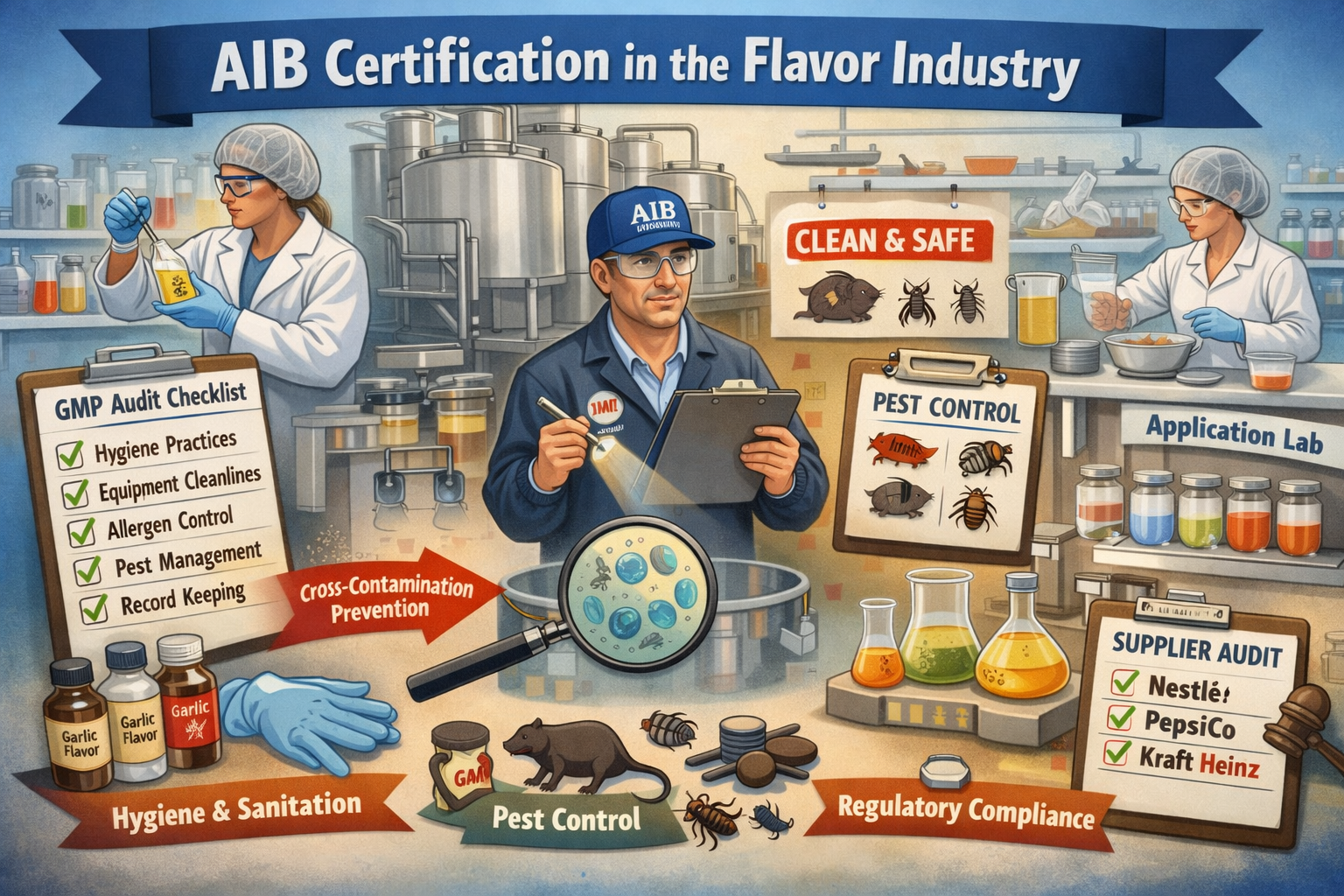
Below is a deep, beginner-friendly version of each key AIB concept—written so even a new flavorist trainee can clearly understand how it applies to real flavor work.
🏫 1. What the American Institute of Baking Really Stands For (Expanded)
At its core, AIB is about one thing:
👉 “Can this food (or flavor) be made safely, consistently, and without contamination?”
Think of AIB as:
- A health inspector + engineer + quality manager combined
- Focused on real-world operations, not just theory
Why this matters for flavorists:
Even if you are designing molecules and flavor systems:
- Your flavor will eventually go into real food
- That food must be safe, stable, and legally compliant
👉 AIB ensures your flavor survives the journey from:
Lab → Pilot → Factory → Consumer
🎯 2. AIB Certification Pillars (Expanded for Flavor Trainees)
2.1 Personnel Practices (Hygiene & Behavior)
What it means:
How people behave in a food/flavor facility.
Simple explanation:
👉 “Humans are the biggest contamination source.”
Examples:
- Not washing hands → introduces microbes
- Wearing perfume → contaminates flavor samples
- Touching ingredients → introduces foreign odors
In a flavor lab:
- You must avoid:
- Strong personal scents (perfume, deodorant)
- Eating near flavor materials
- Always:
- Wear gloves when needed
- Use clean tools (pipettes, spatulas)
👉 Why it matters for flavor:
Even tiny contamination can:
- Change aroma perception
- Create off-notes
- Ruin sensory evaluations
2.2 Maintenance for Food Safety (Equipment & Facility)
What it means:
All equipment must be:
- Cleanable
- Non-reactive
- In good condition
Simple explanation:
👉 “If equipment is dirty or damaged, it will contaminate your flavor.”
Examples:
- Rusty tank → metallic off-note
- Cracked tubing → microbial growth
- Plastic absorbing flavors → cross-contamination
In flavor work:
- Glassware must be:
- Odor-free
- Residue-free
- Mixing vessels:
- Should not retain previous flavors (e.g., garlic → vanilla contamination)
👉 Key concept: “Flavor memory” of equipment
Some materials absorb aroma compounds and release them later.
2.3 Cleaning Practices (Sanitation Systems)
What it means:
How you clean equipment, surfaces, and tools.
Simple explanation:
👉 “Cleaning is not just removing dirt—it’s removing invisible flavor residues.”
Types of cleaning:
- Physical cleaning → removes visible residues
- Chemical cleaning → removes oils and flavor compounds
- Sanitizing → kills microbes
Flavor-specific issue:
Many flavor compounds are:
- Lipophilic (oil-loving)
- Strongly adsorbing
👉 Example:
- Smoke flavor residues are extremely persistent
- Sulfur compounds linger even after cleaning
In practice:
- Use:
- Ethanol rinses
- Food-grade detergents
- Validate cleaning:
- Smell test (yes, seriously)
- Analytical checks (GC if needed)
👉 If cleaning fails:
You get “ghost notes” in your next batch.
2.4 Integrated Pest Management (IPM)
What it means:
Preventing insects, rodents, and contamination from the environment.
Simple explanation:
👉 “Pests bring contamination you cannot see.”
Why it matters in flavor:
- Insects carry:
- Microbes
- Off-odors
- Rodents introduce:
- Urine (strong odor contamination)
- Physical contamination
In flavor facilities:
- Keep:
- Raw materials sealed
- Storage dry and clean
- Monitor:
- Entry points
- Traps and logs
👉 Even trace contamination can:
- Destroy delicate top notes
- Cause product rejection
2.5 Operational Methods & Controls
What it means:
How the process is controlled step-by-step.
Simple explanation:
👉 “Every step must be predictable and repeatable.”
Includes:
- Ingredient weighing
- Mixing order
- Temperature control
- Batch tracking
In flavor formulation:
- Order matters:
- Adding volatile top notes too early → loss
- Temperature matters:
- Heat can destroy delicate compounds
👉 Example:
- Citrus terpenes oxidize easily if mishandled
- Esters hydrolyze in wrong conditions
🧪 3. Where AIB Applies in the Flavor Industry (Expanded)
3.1 Flavor Manufacturing
What happens here:
- Large-scale production of flavors
Risks:
- Cross-contamination between batches
- Microbial growth in natural extracts
- Oxidation during storage
AIB ensures:
- Controlled environment
- Clean production lines
- Proper storage
3.2 Application Labs
What happens here:
- Flavorists test flavors in real foods
Risks:
- Allergen contamination
- Poor hygiene affecting results
- Inconsistent preparation
AIB mindset:
- Treat lab like a mini factory
👉 Example:
If your test cake is contaminated:
- You may wrongly think the flavor is bad
3.3 Customer Requirements
Companies like:
- Nestlé
- PepsiCo
Require suppliers to:
- Pass audits
- Follow GMP
👉 If your flavor house fails:
- You lose business immediately
🧠 4. Why Society of Flavor Chemists Requires This Knowledge
Because a professional flavorist must understand:
Not just:
- Aroma chemistry
But also:
- Food safety
- Manufacturing realities
- Regulatory expectations
👉 A great flavor that is unsafe = useless commercially
⚗️ 5. Practical Flavorist Impact (Deep Dive)
5.1 Cross-Contamination
Example:
- You make garlic flavor
- Next batch: strawberry flavor
👉 Without proper cleaning:
- Strawberry smells like garlic
Solution:
- Dedicated lines or validated cleaning
5.2 Allergen Control
Example:
- Flavor uses dairy carrier
- Goes into “non-dairy” product
👉 Result:
- Legal issue + recall
Control:
- Labeling
- Segregation
- Cleaning validation
5.3 Microbial Stability
High-risk materials:
- Fruit extracts
- Botanical infusions
Why:
- Water + nutrients = microbial growth
Control:
- Reduce water activity
- Add preservatives
- Maintain sanitation
5.4 Shelf Life Protection
What can go wrong:
- Oxidation → rancid notes
- Hydrolysis → flavor loss
- Microbial spoilage → off-odors
AIB helps prevent:
- Poor storage
- Contamination
- Uncontrolled environments
🧩 6. AIB vs Other Systems (Beginner View)
- HACCP
👉 Focus: identifying risks - ISO 22000
👉 Focus: management systems - AIB
👉 Focus: what you actually see on the floor
Simple analogy:
- HACCP = plan
- ISO = system
- AIB = execution
🚨 7. Beginner Mistakes (Expanded)
Mistake 1: “This doesn’t apply to me”
👉 Wrong—every flavorist works with food systems
Mistake 2: Ignoring cleaning
👉 Leads to:
- Carryover
- Sensory confusion
Mistake 3: Ignoring water activity
👉 Leads to:
- Microbial spoilage
Mistake 4: Focusing only on flavor chemistry
👉 Missing:
- Safety
- Stability
- Scalability
📌 Final Mental Model (Very Important)
Think of AIB as:
👉 The invisible framework that protects your flavor
Without it:
- Your flavor may taste great in the lab
- But fail in real production
With it:
- Your flavor is:
- Safe
- Stable
- Scalable
- Commercially viable
###