American Institute of Baking (AIB): What Very Flavorist Needs to Know
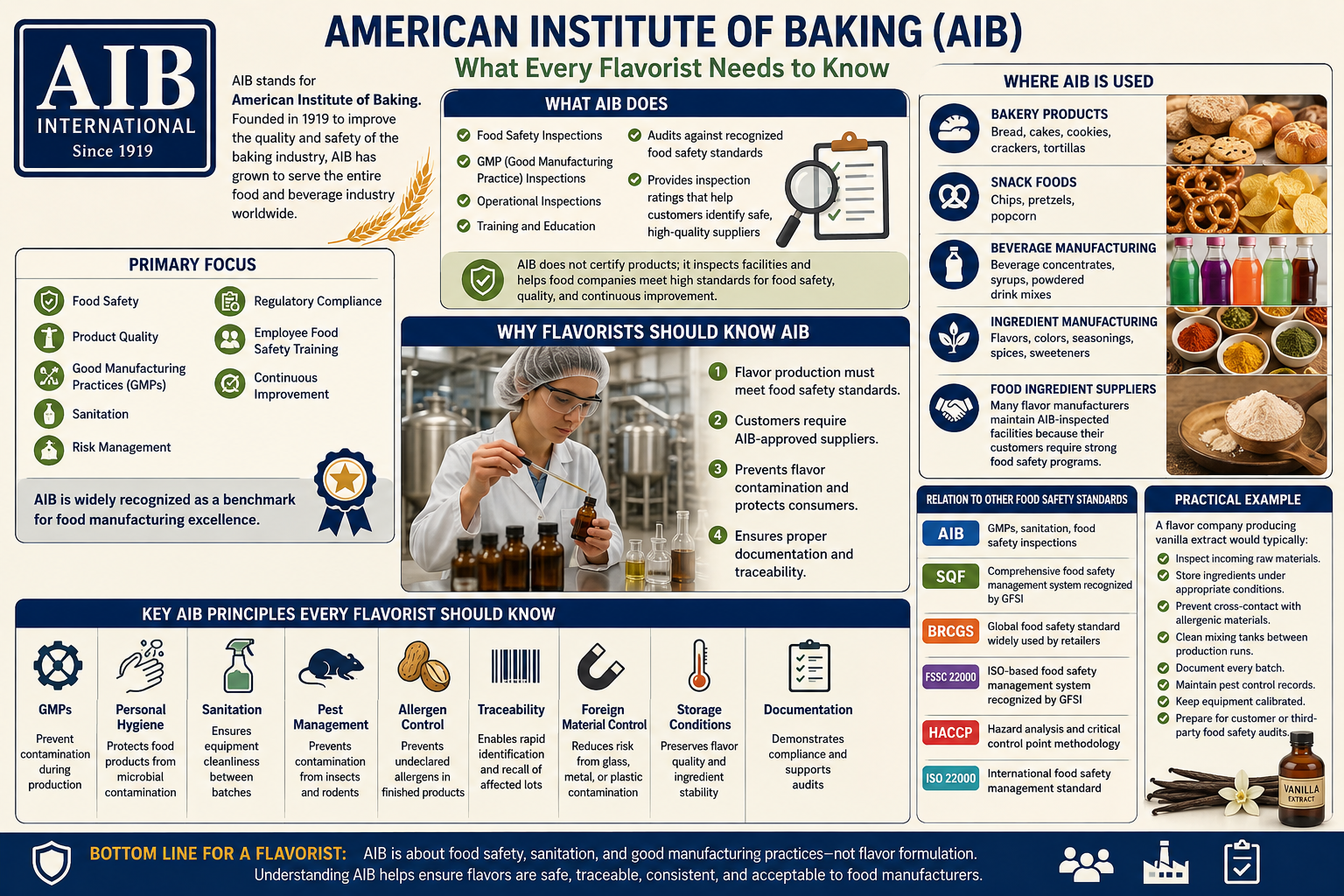
The American Institute of Baking (AIB) is an organization that develops food safety standards, provides training, and conducts inspections for food manufacturers. Today, it is commonly known as AIB International, reflecting its global role in food safety and quality assurance.
For a flavorist, AIB certification is less about flavor development and more about understanding the manufacturing environments where flavors are produced, stored, and used.
What AIB Stands For
- AIB = American Institute of Baking
- Founded in 1919 to improve the quality and safety of the baking industry.
- Has expanded beyond baking to serve many sectors of the food and beverage industry.
Primary Focus
AIB helps food companies maintain:
- Food safety
- Product quality
- Good Manufacturing Practices (GMPs)
- Sanitation
- Risk management
- Regulatory compliance
- Employee food safety training
AIB is widely recognized as a benchmark for food manufacturing excellence.
What AIB Certification Means
People often say "AIB Certified," but technically AIB does not certify products in the same way ISO or organic certification bodies do. Instead, AIB performs:
- Food Safety Inspections
- GMP inspections
- Operational inspections
- Training and education
- Audits against recognized food safety standards
Facilities that meet AIB requirements receive inspection ratings that customers often recognize and require.
Where AIB Is Used
AIB standards are commonly applied in manufacturing of:
Bakery Products
- Bread
- Cakes
- Cookies
- Crackers
- Tortillas
Snack Foods
- Chips
- Pretzels
- Popcorn
Beverage Manufacturing
- Beverage concentrates
- Syrups
- Powdered drink mixes
Ingredient Manufacturing
- Flavors
- Colors
- Seasonings
- Spices
- Sweeteners
Food Ingredient Suppliers
Many flavor manufacturers maintain AIB-inspected facilities because their customers require strong food safety programs.
Why Flavorists Should Know AIB
Although flavorists primarily formulate flavors, they also work with manufacturing, quality, regulatory, and customers. Understanding AIB helps because:
1. Flavor Production Must Meet Food Safety Standards
Liquid and powdered flavors are food ingredients.
Manufacturing requires:
- Hygienic processing
- Proper cleaning
- Allergen control
- Pest management
- Documentation
2. Customers Often Require AIB-Approved Suppliers
Large food companies frequently audit ingredient suppliers.
Examples include:
- Bakery companies
- Snack manufacturers
- Beverage companies
- Dairy manufacturers
Many purchasing specifications ask whether suppliers have:
- AIB inspection
- SQF certification
- BRCGS certification
- FSSC 22000 certification
3. Preventing Flavor Contamination
Flavorists should understand:
- Cross-contamination
- Allergen segregation
- Foreign material prevention
- Cleaning validation
- Ingredient storage
These factors influence both product safety and flavor integrity.
4. Documentation
AIB emphasizes complete documentation, including:
- Batch records
- Raw material traceability
- Cleaning logs
- Corrective actions
- Preventive maintenance
These records are essential for food safety investigations and customer audits.
Key AIB Principles Every Flavorist Should Know
| Topic | Why It Matters |
|---|---|
| Good Manufacturing Practices (GMPs) | Prevent contamination during production |
| Personal hygiene | Protects food products from microbial contamination |
| Sanitation | Ensures equipment cleanliness between batches |
| Pest management | Prevents contamination from insects and rodents |
| Allergen control | Prevents undeclared allergens in finished products |
| Traceability | Enables rapid identification and recall of affected lots |
| Foreign material control | Reduces risk from glass, metal, or plastic contamination |
| Storage conditions | Preserves flavor quality and ingredient stability |
| Documentation | Demonstrates compliance and supports audits |
Relation to Other Food Safety Standards
AIB is one of several respected food safety programs. Flavor manufacturers may also follow:
| Standard | Purpose |
|---|---|
| AIB | GMPs, sanitation, food safety inspections |
| SQF | Comprehensive food safety management system recognized by GFSI |
| BRCGS | Global food safety standard widely used by retailers |
| FSSC 22000 | ISO-based food safety management system recognized by GFSI |
| HACCP | Hazard analysis and critical control point methodology |
| ISO 22000 | International food safety management standard |
Many facilities use several of these systems together.
Practical Example
A flavor company producing vanilla extract would typically:
- Inspect incoming raw materials.
- Store ingredients under appropriate conditions.
- Prevent cross-contact with allergenic materials.
- Clean mixing tanks between production runs.
- Document every batch.
- Maintain pest control records.
- Keep equipment calibrated.
- Prepare for customer or third-party food safety audits.
These practices align with the principles emphasized by AIB.
Bottom Line for a Flavorist
AIB is primarily about food safety, sanitation, and good manufacturing practices, not flavor formulation itself. A flavorist should understand AIB because flavors are manufactured food ingredients, and customers expect them to be produced in facilities with robust food safety systems. Familiarity with AIB principles helps ensure flavors are safe, traceable, consistent, and acceptable to food manufacturers, making it an important part of a flavorist's professional knowledge.
####