Animal Broths, Stocks and Powders — Flavorist Training Guide
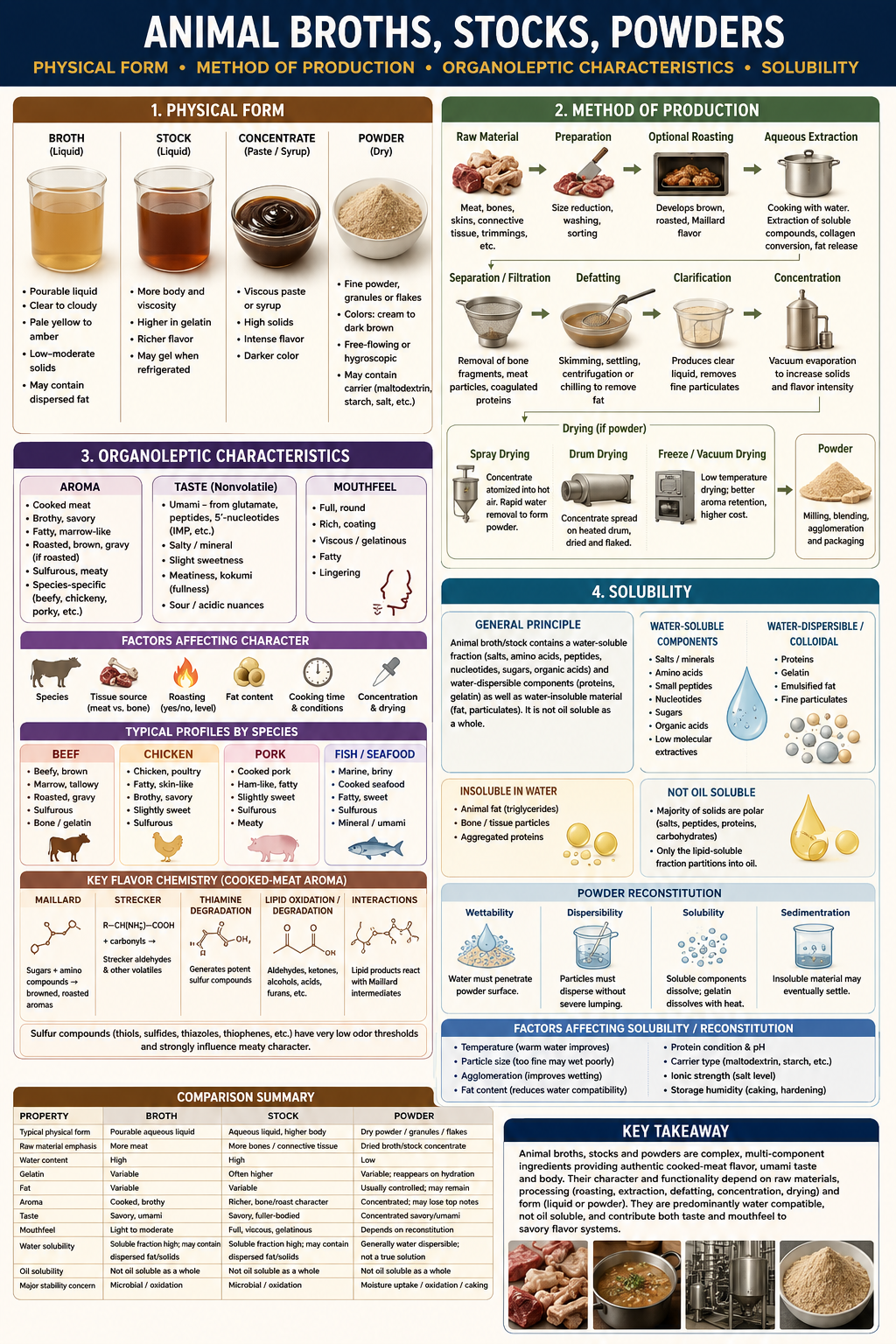
The Society of Flavor Chemists’ January 2026 syllabus specifically lists “Animal Broths, Stocks, Powders” among the flavoring-substance categories for which candidates should be able to explain physical form, method of production, organoleptic characteristics, and solubility. (Flavor Chemists)
For an examination or interview, I would learn this topic at two levels: first, a concise definition you can give immediately; second, enough chemistry and processing knowledge to handle follow-up questions.
1. The exam-level definition
Animal broths and stocks are aqueous extracts of animal tissues—meat, bones, skin, connective tissue and related edible materials—produced by heating them with water. During cooking, water-soluble flavor components and precursors are extracted, collagen may be converted to gelatin, fats may be released, and thermal reactions generate characteristic cooked-meat flavor.
The liquid can then be:
- used directly as a broth or stock;
- clarified and/or defatted;
- concentrated by evaporation into a liquid concentrate or paste;
- or dried, usually by spray drying, to produce a broth/stock powder.
Commercial terminology is not perfectly rigid. "Broth" and "stock" may be used interchangeably by suppliers. Conventionally, broth is associated more with meat extraction, while stock tends to contain more bones/connective tissue and therefore collagen/gelatin. Commercial meat stocks can also originate from protein-containing streams obtained during processing/rendering of meat, skins or bones, followed by fat separation, concentration and drying. (ScienceDirect)
2. What is actually in an animal broth?
Understanding composition makes the rest of the topic much easier.
A broth is not a single flavoring chemical. It is a complex multiphase mixture.
Water-soluble fraction
This can contain:
- free amino acids;
- small peptides;
- soluble proteins;
- glutamic acid/glutamate;
- nucleotides and nucleotide-degradation products, particularly compounds related to IMP/inosine metabolism;
- organic acids;
- sugars and carbohydrate degradation products;
- minerals and salts;
- creatine/creatinine;
- carnosine and anserine;
- Maillard-reaction products;
- water-soluble aroma compounds.
Molecular sensory work on meat broth has shown that minerals, nucleotides/nucleosides, amino acids, organic acids, carbohydrates and certain peptides contribute materially to broth taste. (PubMed)
Lipid fraction
Depending on how thoroughly it is defatted:
- triglycerides;
- phospholipids;
- free fatty acids;
- lipid-derived aroma compounds.
This is important because species character is strongly influenced by the lipid fraction. Beef, chicken, pork and lamb share many cooked-meat reaction products, but differences in fatty-acid composition and lipid oxidation contribute substantially to their different identities. (PubMed)
Collagen/gelatin fraction
Particularly important in bone- and connective-tissue-rich stocks.
During prolonged moist heating:
collagen → partially hydrolyzed collagen/gelatin
This gives:
- viscosity;
- body;
- coating mouthfeel;
- possible gel formation on cooling.
Insoluble/dispersed material
Depending on processing, there can also be:
- denatured protein;
- microscopic tissue particles;
- emulsified fat;
- bone-derived material;
- aggregates.
That is why saying “broth is completely water soluble” is usually too simplistic.
3. Physical form
You should be able to describe several commercial forms.
A. Liquid broth
Typically:
- low to moderate solids;
- pourable;
- water continuous;
- clear to cloudy;
- pale yellow through amber to brown depending on species and processing;
- may contain dispersed/emulsified fat.
A highly clarified, defatted chicken broth can be fairly clear and pale.
A less refined broth may be:
- turbid;
- fatty;
- opaque;
- sediment-forming.
4. Stock
Physically, stock is also an aqueous liquid, but conventionally it is often:
- richer in bone/connective-tissue extraction;
- higher in gelatin;
- fuller bodied;
- more viscous when concentrated;
- capable of setting or partially gelling when refrigerated.
A classical high-gelatin stock can therefore behave almost like a thermoreversible gel:
warm → liquid
cold → gel
This is a useful interview point because it links production directly to physical properties.
5. Concentrated broth/stock
After evaporation, the material may be sold as:
- concentrated liquid;
- syrup-like concentrate;
- viscous paste;
- meat extract;
- stock concentrate.
As water is removed:
- solids increase;
- viscosity increases;
- taste becomes more intense;
- salt/mineral perception increases;
- color usually becomes darker;
- gelatin effects become more obvious;
- aroma balance may change because volatiles are lost or thermally modified.
Commercial meat extracts can reach very high solids contents compared with ordinary stock. (ScienceDirect)
6. Broth/stock powder
The dry product may be:
- fine;
- dusty;
- fluffy;
- granular;
- agglomerated;
- flaky if drum dried;
- free-flowing or hygroscopic.
Colors can range broadly:
cream/off-white → beige → tan → brown → dark brown
depending on:
- species;
- meat versus bone content;
- degree of roasting;
- Maillard development;
- fat content;
- concentration;
- carrier;
- drying process.
Powders may contain a carrier such as:
- maltodextrin;
- starch-derived materials;
- salt;
- gums or other drying aids.
This becomes important when discussing both physical form and solubility.
7. Method of production
A useful flow diagram to memorize is:
Animal raw material
→ size reduction/preparation
→ optional roasting
→ aqueous cooking/extraction
→ separation/filtration
→ defatting
→ clarification
→ concentration
→ optional drying
→ powder
Now understand each step rather than just memorizing it.
Step 1 — Raw-material selection
Possible materials include:
- lean meat;
- meat trimmings;
- bones;
- frames/carcasses;
- skin;
- connective tissue;
- cartilage;
- tendons;
- poultry parts;
- fish frames/heads/trimmings;
- combinations of these materials.
The starting material profoundly affects both sensory character and physical behavior.
More lean meat
Generally provides more:
- soluble meat flavor precursors;
- amino acids;
- peptides;
- nucleotides;
- characteristic meat taste.
More bones/connective tissue
Generally provides more:
- collagen;
- gelatin;
- minerals;
- “stock/bone” character;
- body.
More fatty tissue
Provides more:
- richness;
- species identity;
- lipid-derived volatiles;
but also more:
- oxidation susceptibility;
- emulsion problems;
- insolubility;
- rancidity risk.
8. Optional roasting
This is an important flavorist distinction.
Raw bones/meat may first be:
- roasted;
- browned;
- baked.
Or they may go directly into water.
Unroasted material
Tends toward:
- boiled meat;
- poached meat;
- clean broth;
- light savory;
- marrow/bone;
- fatty;
- species-specific boiled notes.
Roasted material
Introduces more:
- browned;
- roasted;
- seared;
- gravy;
- crust;
- caramelized;
- Maillard;
- sulfurous roasted-meat character.
Why?
Because roasting permits much higher surface temperatures than an aqueous simmer.
High-temperature heating strongly promotes:
reducing sugar + amino compound → Maillard chemistry
including:
- Strecker degradation;
- sulfur chemistry;
- heterocycle formation;
- pyrazine formation;
- furan formation;
- thiazole/thiazoline chemistry.
By contrast, an ordinary aqueous broth extraction is dominated by moist-heat/"boiled meat" conditions.
9. Aqueous extraction
Water is added and the animal material is heated.
This accomplishes several things simultaneously.
Extraction
Water extracts:
- amino acids;
- salts;
- nucleotides;
- peptides;
- soluble proteins;
- organic acids;
- sugars;
- taste-active materials.
Protein changes
Proteins:
- denature;
- partially hydrolyze;
- release peptides/amino acids.
Collagen conversion
Long moist heating converts collagen toward gelatin.
Therefore:
longer extraction + more connective tissue → generally more gelatin/body
although actual commercial processes vary.
Fat release
Heating melts animal fat.
The fat can:
- float;
- emulsify;
- become entrained in broth;
- later be removed by centrifugation/skimming.
10. Flavor is also created during cooking
Raw meat itself does not possess the full aroma we recognize as cooked beef, chicken or pork.
Heating initiates several major flavor-generating pathways:
1. Maillard reaction
Between reducing sugars and amino compounds.
Produces many:
- meaty;
- roasted;
- savory;
- nutty;
- browned aromas.
2. Strecker degradation
Amino acids react with reactive carbonyls, generating Strecker aldehydes and other compounds.
3. Thiamine degradation
Thiamine is particularly important in cooked-meat chemistry because its thermal degradation can yield potent sulfur compounds.
4. Lipid oxidation/degradation
Produces:
- aldehydes;
- ketones;
- alcohols;
- acids;
- furans;
- other lipid-derived compounds.
5. Interactions between lipid and Maillard chemistry
The two pathways are not independent.
Lipid oxidation products can react with Maillard intermediates and change the final aroma pattern.
These are central mechanisms of cooked-meat flavor development. (PubMed Central (PMC))
11. Why sulfur compounds matter so much
A flavorist should be able to discuss this.
Sulfur-containing compounds often have extremely low odor thresholds.
Important families generated during meat cooking include:
- thiols;
- sulfides;
- disulfides;
- thiophenes;
- thiazoles;
- sulfur-containing furans.
For example, thermal degradation of thiamine and reactions involving cysteine can produce highly potent sulfurous/meaty odorants. (PubMed Central (PMC))
That means a broth can contain relatively little of a compound analytically but still have a major sensory impact.
12. Separation and clarification
After extraction, solids have to be separated.
Possible operations include:
- screening;
- filtration;
- settling;
- centrifugation.
These remove:
- bone fragments;
- meat particles;
- coagulated proteins;
- insoluble tissue.
Degree of clarification influences appearance and solubility later.
13. Defatting
Fat can be removed through:
- skimming;
- settling;
- centrifugation;
- chilling followed by mechanical removal.
This is a crucial processing step.
Why remove fat?
To improve:
- oxidative stability;
- water dispersibility;
- clarity;
- shelf life;
- spray-drying performance.
But removing too much fat can also reduce:
- richness;
- authenticity;
- characteristic species notes.
So there is often a sensory-versus-stability tradeoff.
14. Concentration
The broth is often concentrated before drying.
Commonly:
vacuum evaporation
is used.
Under reduced pressure, water boils at lower temperature.
Advantages include:
- less severe thermal exposure;
- energy efficiency;
- increased solids;
- easier subsequent drying.
But concentration still changes flavor.
Possible effects:
- volatile loss;
- increased cooked notes;
- concentration of salts;
- darker color;
- viscosity increase;
- increased oxidation if poorly controlled.
15. Powder production — spray drying
This is probably the drying method you should be most comfortable explaining.
The concentrated broth is:
- pumped to the dryer;
- atomized into small droplets;
- contacted with hot drying air;
- water evaporates rapidly;
- dry particles are collected.
Commercial meat stock proteins can be produced by separating fat from a protein-containing liquid stream, concentrating that stream and spray drying it. (ScienceDirect)
Spray drying has also been studied specifically for producing bone-broth powders, where carrier selection affects reconstitution properties including wettability, dispersibility and solubility. (PubMed Central (PMC))
Why use carriers?
Animal extracts can be difficult to spray dry because they may contain:
- protein;
- fat;
- salts;
- low-molecular-weight solids;
and can become:
- sticky;
- hygroscopic;
- poorly flowing.
Carriers can improve:
- drying;
- particle formation;
- handling;
- powder flow;
- reconstitution.
16. Other drying methods
Drum/roller drying
Concentrate is placed as a thin layer on a heated drum.
After drying:
- the sheet is scraped off;
- flakes are milled.
Compared with spray drying, drum drying involves stronger surface heat exposure and may produce:
- darker color;
- stronger cooked notes;
- toasted/browned notes.
Freeze drying
Water is frozen and removed primarily through sublimation under vacuum.
Advantages:
- excellent retention of delicate aroma;
- relatively low thermal damage.
Disadvantages:
- expensive;
- slower;
- less economical for commodity savory ingredients.
Vacuum drying
Can also be used where lower-temperature water removal is desirable.
For the SFC interview, relate this back to the broader syllabus: spray drying, vacuum drying, drum drying, freeze drying and agglomeration are themselves listed among dry flavor forms/processes candidates should understand. (Flavor Chemists)
17. Organoleptic characteristics
This is where candidates often give answers that are much too simple.
Do not say only:
“It smells and tastes like meat.”
Describe aroma, taste and mouthfeel separately.
A. Aroma
Typical general descriptors include:
- cooked meat;
- boiled meat;
- brothy;
- savory;
- fatty;
- marrow-like;
- animalic;
- roasted, if roasted;
- gravy-like;
- sulfurous;
- slightly caramelized/browned;
- species-specific.
The exact profile depends strongly on:
- species;
- tissue source;
- fat composition;
- cooking conditions;
- roasting;
- concentration;
- drying.
18. Beef broth/stock profile
Possible descriptors:
- beefy;
- boiled beef;
- brown;
- marrow;
- tallowy;
- fatty;
- roasted;
- gravy;
- sulfurous;
- slightly metallic/bloody depending on processing;
- bone/gelatin character.
Roasted beef stock may become much more:
- brown;
- crusty;
- seared;
- gravy-like.
Certain lipid-derived odorants are important in differentiating beef from other meats. More generally, research indicates that lipid-derived compounds help establish species-specific meat flavor. (PubMed)
19. Chicken broth/stock profile
Typically:
- poultry;
- boiled chicken;
- chicken fat;
- fatty;
- skin-like;
- sulfurous;
- brothy;
- savory;
- slightly sweet;
- roasted poultry if roasted.
Chicken fat is particularly important for recognizable chicken identity.
A very heavily defatted chicken stock may retain savory chicken character but lose some of the:
- fatty;
- skin;
- roasted poultry richness.
20. Pork broth/stock
Possible descriptors:
- cooked pork;
- boiled ham-like;
- fatty;
- slightly sweet;
- sulfurous;
- meaty;
- broth;
- roasted pork if browned.
Thiamine chemistry is especially interesting in pork because pork contains relatively high thiamine compared with several other meats, and thiamine degradation can contribute important sulfurous meat odorants. (PubMed Central (PMC))
21. Fish/seafood broths
Possible descriptors include:
- marine;
- fish;
- shellfish;
- cooked seafood;
- briny;
- fatty;
- sulfurous;
- sweet;
- mineral;
- umami.
Marine lipids are highly unsaturated, so oxidative control is particularly important.
Oxidation can rapidly turn desirable seafood character toward:
- stale fish;
- oxidized oil;
- cardboard;
- paint-like;
- rancid.
22. Taste
A good stock has far more taste activity than its aroma suggests.
Important sensations include:
Umami
Main contributors can include:
- glutamate;
- IMP and other nucleotide-related compounds;
- peptides.
A particularly important flavorist concept is synergy:
glutamate + 5′-nucleotides → greater umami than either alone
That is one reason real meat extracts can have very powerful savory impact.
23. Salty/mineral taste
Even without added sodium chloride, natural minerals contribute taste.
Commercial powders may contain considerable added salt, so distinguish:
pure broth solids
from
seasoned bouillon/stock powder.
They are not necessarily the same thing.
24. Peptide contribution
Peptides can provide:
- savory;
- kokumi-like/fullness effects;
- mouthfulness;
- continuity;
- sometimes bitterness.
Sensomics work on meat broth has identified peptides such as carnosine among compounds contributing to characteristic broth sensations. (PubMed)
25. Mouthfeel
Broth/stock can provide something an aroma chemical cannot:
body.
Possible mouthfeel descriptors:
- round;
- full;
- rich;
- coating;
- gelatinous;
- viscous;
- fatty;
- lingering.
Major contributors:
gelatin + proteins/peptides + fat + dissolved solids
This is one reason genuine stock often makes a flavor system seem more authentic even when it does not enormously increase headspace aroma.
26. Effect of roasting on organoleptic profile
This is a likely oral-exam comparison.
| Unroasted/light stock | Roasted stock |
|---|---|
| Boiled | Roasted |
| Brothy | Brown |
| Clean meat | Gravy |
| Light sulfur | More complex thermal notes |
| Fatty | Seared |
| Meat water | Crust/browned meat |
| Pale | Darker |
The scientific reason is increased high-temperature Maillard, Strecker and lipid/Maillard interaction chemistry. Cooked meat odorants span aldehydes, sulfur compounds, nitrogen heterocycles, oxygen heterocycles, ketones, alcohols and many other classes. (PubMed)
27. Effect of excessive processing
Candidates should recognize defects.
Too much heat
Can give:
- burnt;
- bitter;
- scorched;
- overly brown;
- sulfur degradation;
- loss of fresh meat top notes.
Oxidation
Can give:
- rancid;
- cardboard;
- oxidized fat;
- stale;
- painty;
- warmed-over flavor.
Excessive hydrolysis
Depending on process:
- bitterness;
- peptide character;
- loss of clean meat identity.
Poor drying/storage
Can produce:
- caking;
- oxidation;
- loss of aroma;
- stale fat;
- browning.
28. Solubility — the most important conceptual answer
A sophisticated answer is:
Animal broth solids are predominantly water dispersible and their low-molecular-weight taste components are highly water soluble, but the material as a whole may not form a true clear solution because it can contain fat, gelatin/protein aggregates and insoluble particles. It is generally not oil soluble as a whole.
That is much better than saying simply “water soluble.”
29. What is truly water soluble?
Highly water-soluble components include many:
- salts;
- amino acids;
- small peptides;
- sugars;
- organic acids;
- nucleotides;
- low-molecular-weight extractives.
These normally dissolve readily.
30. Protein behavior
Solubility depends upon:
- protein molecular weight;
- degree of hydrolysis;
- pH;
- ionic strength;
- thermal history;
- concentration.
Small peptides are generally more readily soluble than large denatured protein aggregates.
Commercial meat stock proteins can be extensively hydrolyzed, which alters their functional behavior. (ScienceDirect)
31. Gelatin behavior
Gelatin requires special explanation.
It can:
- hydrate in water;
- dissolve more readily with heat;
- produce viscosity;
- form a gel on cooling at sufficient concentration.
Therefore a stock powder can appear quite soluble when hot but become:
- viscous;
- hazy;
- gelled
after cooling.
That does not necessarily mean the ingredient has "precipitated."
32. Fat is not water soluble
This should be stated explicitly.
Animal fat is:
hydrophobic
and therefore does not form a true molecular solution in water.
Instead it can:
- float on the surface;
- form droplets;
- emulsify;
- create turbidity;
- form a fat ring;
- solidify when cooled.
Thus:
defatted broth → usually clearer and more water-compatible
full-fat broth → usually cloudier and more emulsion-like
33. Oil solubility
The overall broth or stock is not oil soluble.
Why?
Because most of its solids are polar:
- salts;
- peptides;
- amino acids;
- proteins;
- carbohydrates.
Only its lipid-soluble constituents and fat fraction preferentially enter an oil phase.
So in a flavor formulation:
water-soluble taste fraction → aqueous phase
fat/lipid fraction → oil phase
This partitioning is very important practically.
34. Powder reconstitution
Do not confuse these four concepts:
Wettability
Can water penetrate the powder surface?
Dispersibility
Can particles distribute through water without severe lumping?
Solubility
Do components actually dissolve?
Sedimentation
Does insoluble material eventually settle?
A powder can be highly dispersible but not produce a completely clear molecular solution.
Research on spray-dried bone broth powder specifically evaluates wettability, dispersibility and solubility as separate properties, which illustrates why flavorists should not use these terms interchangeably. (PubMed Central (PMC))
35. Factors affecting powder reconstitution
Temperature
Warm/hot water usually improves:
- wetting;
- gelatin dissolution;
- fat melting;
- dispersion speed.
Particle size
Very fine powders can paradoxically wet poorly because they:
- float;
- trap air;
- form surface clumps.
Agglomeration
Agglomerated particles often wet more readily than very fine spray-dried dust.
Fat content
High fat:
- decreases true water solubility;
- promotes floating;
- causes oiling-off;
- creates cloudiness.
Protein condition
Heat-denatured or aggregated proteins can generate:
- haze;
- sediment;
- poor reconstitution.
Carrier
Carriers such as maltodextrin can greatly improve:
- handling;
- water compatibility;
- drying;
- powder structure.
Storage humidity
Hygroscopic powder absorbs moisture and can:
- cake;
- harden;
- lose flowability;
- rehydrate unevenly.
36. What spray drying does to flavor
A good examination question is:
“Does a dried broth taste exactly like the original broth?”
No.
Spray drying can cause:
- loss of highly volatile top notes;
- concentration of nonvolatile taste;
- oxidation of lipids;
- changes in sulfur profile;
- formation or loss of thermal notes;
- dilution by carrier.
So powder often emphasizes:
savory/body/taste
relative to certain delicate fresh-broth volatiles.
37. Broth vs. stock vs. powder — memorize this comparison
| Property | Broth | Stock | Powder |
|---|---|---|---|
| Typical physical form | Pourable aqueous liquid | Aqueous liquid, often more gelatinous/body | Dry fine powder/granules/flakes |
| Typical raw-material emphasis | Meat ± bone | Bones/connective tissue ± meat | Dried broth/stock concentrate |
| Water content | High | High | Low |
| Gelatin | Variable | Often higher | Variable; reappears on hydration |
| Fat | Variable | Variable | Usually controlled; may remain |
| Production | Aqueous cooking/extraction | Longer/richer aqueous extraction; may include roasting | Concentration + drying |
| Aroma | Cooked/boiled/brothy | Brothy, richer, bone/roast depending process | Concentrated dried version; may lose top notes |
| Taste | Savory/umami | Savory, fuller-bodied | Concentrated savory/umami |
| Mouthfeel | Light to moderate | Fuller/gelatinous | Depends on reconstitution |
| Water solubility | Aqueous by nature but may contain dispersed fat/solids | Same, often greater gelatin effects | Generally water dispersible; soluble fraction high |
| Oil solubility | Poor as whole material | Poor | Poor as whole material |
| Major stability concern | Microbiology/oxidation | Microbiology/oxidation | Moisture uptake/oxidation/caking |
38. A more chemistry-focused sensory summary
A trainee should mentally separate taste chemistry from aroma chemistry.
Taste/nonvolatile fraction
Think:
G-PAN
- Glutamate
- Peptides
- Acids/amino acids
- Nucleotides + salts/minerals
These provide:
- umami;
- saltiness;
- sour/mineral nuances;
- mouthfulness;
- body.
Aroma/volatile fraction
Think:
M-L-S-T
- Maillard chemistry
- Lipid degradation
- Strecker degradation
- Thiamine degradation
These generate cooked-meat aroma.
That four-part answer is worth remembering. The major scientific literature on meat flavor consistently identifies Maillard chemistry, lipid degradation/oxidation, Strecker reactions and thiamine degradation among the central routes to cooked-meat aroma. (PubMed Central (PMC))
39. What determines animal species identity?
A very good oral-exam question is:
“If all meats undergo Maillard reactions, why doesn't chicken taste like beef?”
A strong answer:
The different species share many water-soluble meat flavor precursors and consequently many generic cooked-meat compounds. However, lipid composition differs significantly among species, especially the fatty-acid composition of phospholipids. Lipid oxidation products and their interactions with Maillard chemistry help modify the profile into recognizable beef, pork, chicken, lamb, etc. Species, feed, age and processing further influence the precursor pool. (PubMed)
That is a much stronger answer than “because beef contains beef flavor molecules.”
40. One distinction trainees should make: broth powder ≠ bouillon powder
Commercial terminology is messy.
A broth powder may mean concentrated actual animal broth that has been dried.
A bouillon powder/seasoning may be a compound mixture containing some combination of:
- salt;
- MSG;
- yeast extract;
- HVP;
- animal broth powder;
- fat;
- maltodextrin;
- onion;
- garlic;
- spices;
- reaction flavors;
- colors.
Therefore, if someone hands you a product labeled "chicken stock powder," do not assume its composition.
As a flavorist you ask:
What exactly is the ingredient statement and specification?
This is particularly important when evaluating:
- solubility;
- salt contribution;
- flavor strength;
- allergen status;
- regulatory status;
- vegetarian/vegan suitability;
- analytical data.
41. Likely interview questions
“What is the difference between broth and stock?”
A good answer:
Broth and stock are both aqueous animal-tissue extracts and the terms overlap commercially. Traditionally broth emphasizes meat and gives a lighter cooked-meat liquid, whereas stock more often emphasizes bones/connective tissue and tends to contain more gelatin and body. Stock may also be roasted before extraction. I would rely on the supplier specification rather than the product name alone.
“How do you make a broth powder?”
Animal material is cooked with water to extract soluble flavor and protein components and to generate cooked-meat character. Insoluble solids and usually much of the fat are separated. The broth is concentrated, commonly by vacuum evaporation, and the concentrate is then dried, most commonly by spray drying, often with a carrier. The resulting powder may subsequently be agglomerated or blended.
“Is chicken broth powder water soluble?”
Its low-molecular-weight extractive fraction is highly water soluble and the powder is normally designed to reconstitute in water, but I would not automatically describe the total ingredient as completely soluble. Residual fat, protein aggregates, gelatin and insoluble solids can produce haze, an emulsion or sediment. Warm water normally improves reconstitution.
Excellent answer.
“Is it oil soluble?”
Not as a complete ingredient. The bulk of the broth solids—salts, peptides, amino acids and carbohydrates—are polar and water soluble. Only the fat and lipophilic flavor fraction are oil compatible.
“Why does stock gel in the refrigerator?”
Collagen from connective tissue is thermally converted into gelatin during prolonged moist cooking. At sufficient concentration, hydrated gelatin forms a network on cooling and the stock gels; heating reverses the gel.
“What makes broth taste umami?”
Primarily free glutamate together with meat-derived 5′-nucleotide chemistry, particularly IMP-related material, plus peptides and other extractives. Glutamate and nucleotides exhibit strong umami synergy.
“What generates cooked-meat aroma?”
Primarily thermally induced Maillard reactions, Strecker degradation, thiamine degradation, lipid degradation/oxidation, and interactions between the lipid and Maillard pathways. Sulfur-containing heterocycles and thiols are especially important because many have very low odor thresholds.
“Why roast the bones first?”
Roasting creates additional high-temperature Maillard and lipid-derived compounds, producing darker color and stronger roasted, brown, gravy and seared character. A stock made without roasting will generally be cleaner, lighter and more boiled/brothy.
“What happens when you remove the fat?”
Water compatibility and oxidative stability generally improve, and the stock becomes clearer, but some richness, mouthfeel and species-specific fatty aroma may be reduced.
“Why spray dry instead of simply boiling it dry?”
Spray drying removes water extremely rapidly from atomized concentrate, giving a controllable powder and limiting the amount of prolonged bulk thermal exposure. Direct boiling to dryness would give severe thermal damage, poor control, possible scorching and major flavor changes.
42. Common examination traps
Trap 1: “Broth is soluble in water.”
Too crude.
Say:
“The bulk low-molecular-weight solids are water soluble; the complete product may be a solution plus colloidal/dispersed protein, gelatin and fat.”
Trap 2: “Stock is made from bones; broth is made from meat.”
Too absolute.
Say:
“That is the traditional distinction, but commercial terminology overlaps.”
Trap 3: “Powder is just dried meat.”
Wrong.
It is normally:
an extracted broth/stock that has been concentrated and dried
rather than simply pulverized raw meat.
Trap 4: “All meat flavor comes from Maillard reaction.”
Incomplete.
Remember:
Maillard + Strecker + thiamine + lipid degradation + interactions.
Trap 5: “Fat is a nuisance.”
Wrong from a flavorist perspective.
Fat can be undesirable technologically because of:
- oxidation;
- poor water solubility;
- drying difficulty;
but desirable organoleptically because it supplies:
- richness;
- mouthfeel;
- species identity;
- lipid-derived aroma.
Trap 6: “Powder should make a clear solution.”
Not necessarily.
A reconstituted animal stock can legitimately be:
- hazy;
- colloidal;
- emulsified;
- slightly sedimenting;
depending on specification.
43. A polished 60–90 second oral-exam response
If the interviewer simply says:
“Tell me about animal broths, stocks and powders.”
A strong response would sound approximately like this:
Animal broths and stocks are aqueous extracts of animal tissues such as meat, bones, skin and connective tissue. Traditionally broth is more meat-oriented whereas stock tends to contain more bone and connective tissue and therefore more collagen-derived gelatin, although commercial terminology overlaps. They range physically from thin liquids through concentrated viscous pastes, and they can be dried into fine or agglomerated powders.
Production normally involves aqueous cooking or extraction, sometimes after roasting. Heating extracts amino acids, peptides, nucleotides, salts and other water-soluble materials, converts collagen toward gelatin, releases fat and develops cooked-meat flavor through Maillard and Strecker chemistry, thiamine degradation and lipid reactions. The cooked liquor is separated from insoluble material, usually defatted and clarified, concentrated—often under vacuum—and may then be spray dried, sometimes with a carrier.
Organoleptically they are savory, brothy, meaty and umami, with species-specific beef, chicken, pork or seafood character. Roasting increases brown, roasted and gravy notes, while gelatin and fat contribute body and richness.
Regarding solubility, the amino acids, peptides, salts, nucleotides and other extractives are predominantly water soluble, but the whole ingredient may not form a true clear solution because residual fat is insoluble and gelatin, proteins and particulates can create viscosity, haze or sediment. Powders generally reconstitute better in warm water and are not oil soluble as a whole.
If a trainee can give that answer fluently and then defend every sentence, they are in good shape for this particular SFC syllabus item.
The chemistry behind it is worth knowing because current SFC expectations are framed as working knowledge, not just memorized definitions, and the syllabus also expects candidates to understand related reactions/processes and dry flavor technologies. (Flavor Chemists)
###