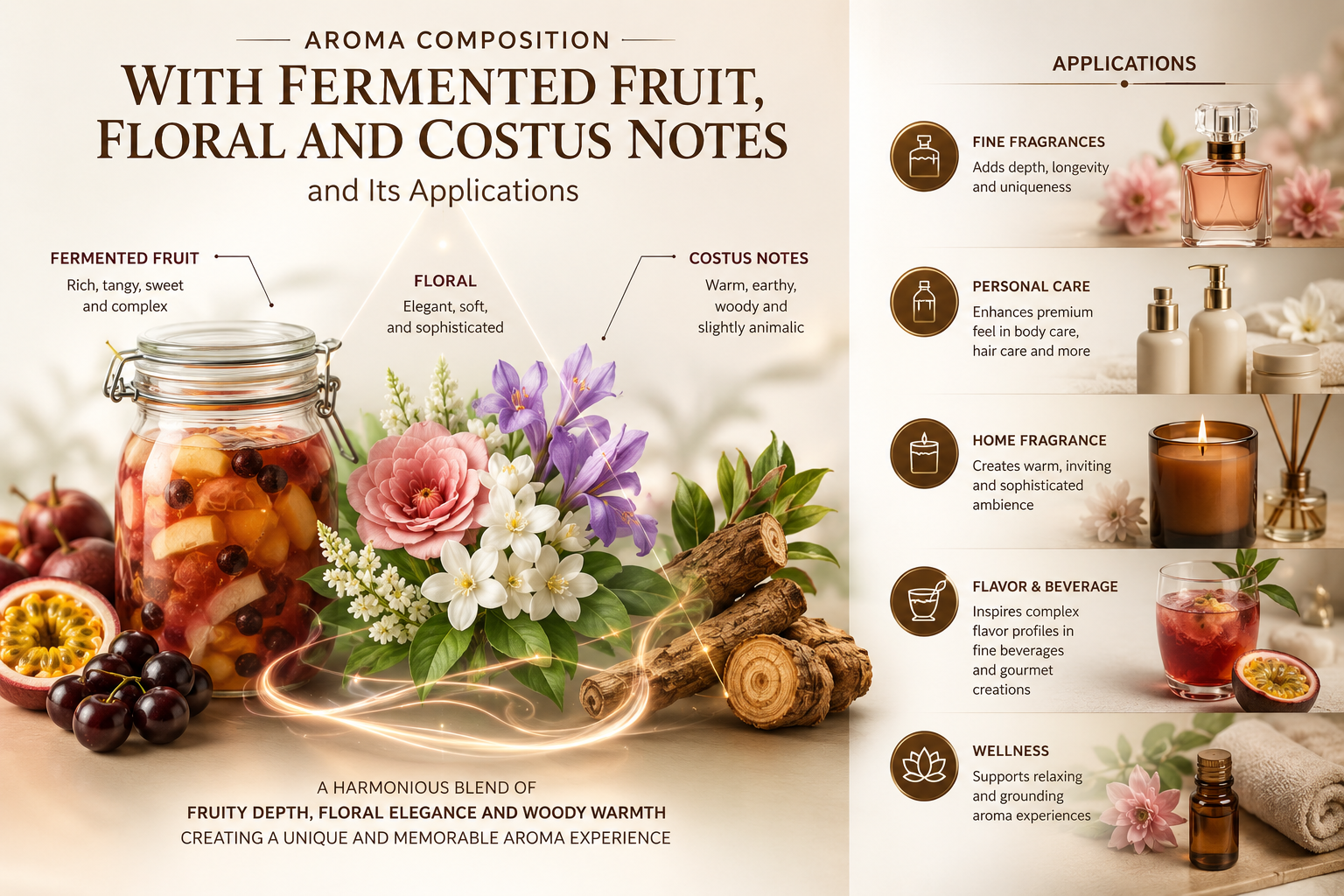
Patent Watch: Aroma Composition with Fermented Fruit, Floral, and Costus Notes and Its Applications
Patent Number: CN121868189A
Country: China
Status: Pending
Publication Date: January 14, 2026
Application Number: CN202610045040.0A
Priority Date: 2026
Inventors:
- 叶素芳 (Ye Sufang)
- 陈敬艺 (Chen Jingyi)
- 陈雅楠 (Chen Ya'nan)
Current Assignee:
- Xiamen Xin Milan Flavor And Fragrance Co., Ltd.
Worldwide Applications: 2026
Technical Field
This invention belongs to the technical field of spices and aromatics. Specifically, it relates to a spice composition that combines fermented fruit juice aroma, floral fragrance, and costus root notes. The invention also encompasses a preparation method for this composition and its various applications in daily chemical products.
Background
Creating perfume compositions with unique fragrance characteristics is a core objective of the perfumery industry. In recent years, market demand has evolved beyond single fragrance types towards complex, multi-layered scents that offer a complete olfactory journey and evoke deep emotional and cultural associations. For example, the unique, well-aged, and layered "fermented" aroma—reminiscent of fermented foods or beverages such as wine or fermented glutinous rice—has become a favored note in high-end perfumes and personal care products due to its uniqueness and complexity.
However, achieving a high-quality "fermented juice" aroma presents several significant challenges:
- Complexity of Formulation: This scent profile cannot be achieved with a single perfume ingredient. It requires precise compatibility and synergy among multiple materials. Improper combinations often result in an unpleasantly sweet, syrupy, or chemical odor, lacking the rich, mellow, and dynamically evolving character of natural fermentation.
- Designing the Full Olfactory Narrative: A critical aspect of formulation is designing the middle and base notes to seamlessly integrate with the fermented top note, thereby constructing a complete and harmonious fragrance story.
- Cultural and Conceptual Association: Associating an abstract fragrance with specific cultural concepts (e.g., life aesthetic scenes from historical periods like the Tang Dynasty) to enhance product value, added appeal, and differentiation is an area that has been insufficiently explored in prior art.
In view of these problems, there is a clear and urgent need to develop a novel fragrance composition that successfully and authentically delivers a fermented fruit juice profile while addressing all the above challenges.
Summary of the Invention
This application introduces a spice composition that successfully integrates fermented fruit juice, floral, and costus root aromas. It is specifically designed for use in daily chemical products, presenting a complete and refined fragrance framework:
- Top Note: Fermented fruit juice aroma
- Heart (Middle) Note: Dry petal aroma
- Base (Tail) Note: Deep, soothing, long-lasting woody and costus root scent
This structure aligns with the cultural and aesthetic image of a "Tang Dynasty noble feast" theme, achieving a subtle construction of aromatic layers and an accurate, evocative expression of an olfactory concept.
Technical Solutions
The application provides the following technical solutions:
- A perfume composition comprising specific core components.
- A method for preparing the aforementioned fragrance composition.
- The application of the spice composition in the preparation of daily chemical products.
Perfume Composition
The perfume composition comprises the following core components (in weight percent, wt%):
| Component | Weight Percentage (wt%) |
|---|---|
| Ethyl Isovalerate | 0.15 - 0.35 |
| Phenethyl Acetate | 0.15 - 0.35 |
| Ethyl Butyrate | 0.15 - 0.35 |
| Propionic Acid | 0.3 - 0.5 |
| Ethyl Propionate | 0.5 - 0.7 |
| Grapefruit Methane | 1.5 - 3.0 |
| Methyl Anthranilate | 3.0 - 5.0 |
| Citrus Essential Oil | 5.0 - 10.0 |
| Ethyl Levulinate | 0.2 - 0.4 |
| Ethyl Maltol | 1.0 - 2.0 |
| Lin Fei Muguet (NYMPHEAL™) | 0.15 - 0.35 |
| Methyl Dihydrojasmonate | 10.0 - 15.0 |
| Musk T | 10.0 - 15.0 |
| Ambergris (Oboblonga) | 0.15 - 0.35 |
The composition is completed with the balance consisting of auxiliary fragrances, dispersants, and/or stabilizers.
Optional Components (Auxiliary Fragrances)
The composition can be further enhanced with one or more co-perfumes from the following groups:
| Group | Olfactory Category | Examples | Typical Content (wt%) |
|---|---|---|---|
| A | Fruity / Floral | Propionoundecalactone, Propionolactone, 2,5-Trimethyl-5-pentylcyclopentanone, Terpinyl Acetate | 1 - 5 |
| B | Floral | Geranyl Acetate, Linalyl Acetate, Linalool | 1 - 5 |
| C | Green / Spicy | Damascone, Caryophyllene, Ligustral, Storax Acetate, Leaf Alcohol, Pink Pepper Essential Oil, Peppermint Oil | 1 - 5 |
| D | Sweet | Methyl Maltol | 0.1 - 1 |
| E | Woody / Amber / Animalic | Super Ambrox, o-tert-Butylcyclohexyl Acetate, Siberian Cedar Essential Oil, Cyclopentadecanolide | 1 - 5 |
Dispersants and Stabilizers
- Dispersants: Alcoholic and/or ester solvents such as Dipropylene Glycol, Isopropyl Myristate, and Propylene Glycol. The total dispersant content is typically 40-60 wt%.
- Stabilizers: Antioxidants such as 2,6-Di-tert-butyl-p-cresol (BHT), typically present at 0 to 0.1 wt%.
Detailed Description of Embodiments
1. Terminology and Definitions
- Numerical Intervals: Represented by hyphens "-" or wavy lines "~" and inclusive of endpoints.
- "Comprising," "including," etc.: Have a non-limiting meaning.
- "Combination": Means any two or more of the listed items are used together.
- "Composition": A substance composed of two or more components.
- "wt%": Weight percentage, unless otherwise specified.
- "Balance": The amount used to make up the composition to 100 wt%.
Dispersant: A substance that promotes uniform dispersion of components and maintains system homogeneity, functioning by dissolving, diluting, or carrying other components. Examples include but are not limited to:
- Alcohols: Benzyl alcohol, Ethanol, Dipropylene glycol, Propylene glycol
- Esters: Triethyl citrate, Diethyl phthalate
- Other conventional fragrance dispersants and mixtures thereof
Note: Certain materials (e.g., Benzyl alcohol, Triethyl citrate) may function as both dispersants and co-fragrances. Classification depends on context and the primary role understood by those skilled in the art.
Adjunct Fragrance: Fragrance components other than those specifically defined, which provide or modify the overall fragrance characteristics. Examples include alcohol fragrances, ester fragrances, ketone fragrances, terpene fragrances, natural essential oils, other conventional adjunct fragrances, and mixtures thereof.
Important Note: The classification of perfume components by odor in this application does not imply that such components possess only that single odor characteristic. Each component may have one or more odor manifestations, and their contributions vary based on concentration, interactions with other components, and volatility.
Stabilizer: Additives used to improve chemical or physical stability, including but not limited to:
- Antioxidants: BHT, BHA, Tocopherol
- UV stabilizers
- Metal ion chelating agents
Citrus Essential Oil: Volatile aromatic oils extracted from plants of the Rutaceae family, including but not limited to essential oils obtained from the pericarp, leaves, flowers, or whole plants of Citrus genus and other Rutaceae plants. Specific examples include:
- Orange essential oil, Bitter orange essential oil
- Lemon essential oil, Lime essential oil
- Grapefruit essential oil, Bergamot essential oil
- Tangerine essential oil, Clementine essential oil
- And combinations thereof
Fragrance Profile: The combined odor performance of volatile components in a fragrance composition as perceived olfactorily after application. This performance changes over time and is determined by:
- Fragrance Type: The main fragrance category (e.g., fruity, floral, woody) and more specific subcategories (e.g., litchi fruit, peony).
- Fragrance Quality: Evaluation of characteristic properties or detailed performance features, describing subtle differences in smell and sensory characteristics. Common quality descriptors include:
- Fermented Character: Sensory characteristic reminiscent of fermented substances, fruit juice fermentation, or fermented beverages (e.g., fruit wine, yeast, mature fermented juice)
- Sweetness: Olfactory association with sweetness, related to specific fruit or floral compounds
- Fullness: Sense of richness and plenitude in the aroma hierarchy
- Dryness: Slightly dry, stale, or aged characteristic
- Fragrance Intensity: Degree of olfactory perception, expressed via intensity scales (e.g., weak, medium, strong) or numerical scores.
The type, quality, and intensity of fragrance features are typically determined by professional fragrance evaluators or trained sensory panels, sometimes supported by standard controls or detection instrumentation.
Term Equivalents:
- Front fragrance = Front note = Top note
- Middle note = Middle note = Body note
- Tail note = Rear note = Base note
Homogeneously Stirred: The mixture has been brought to a visually homogeneous, non-delaminated state by mechanical stirring means.
Relative Density (25°C/25°C): The ratio of the mass of a sample at 25°C to the mass of the same volume of water at 25°C.
Embodiments and Examples
Raw Materials
The raw materials used in the application can be commercially purchased or synthesized. All examples were conducted at room temperature under light-shielding conditions unless otherwise specified.
Example 1: General Preparation Method
This example describes the specific procedure for preparing the perfume compositions of Examples 2-4 and Comparative Examples 1-2.
Step A: Preparation of First Mixture
Under room temperature and light-shielding conditions, the following first part of raw materials were weighed according to the formula:
- Phenethyl acetate
- Lin Fei Muguet (NYMPHEAL™, purchased from Qi Hua Du)
- Grapefruit methane
- Methyl dihydrojasmonate
- Optional adjunct fragrances: o-tert-butylcyclohexyl acetate, undecalactone, damascone, ambroxol, decalactone, 2,5-trimethyl-5-pentylcyclopentanone, geranyl acetate, linalyl acetate, terpinyl acetate, linalool, storax acetate, caryophyllene
These materials were added together with Dipropylene Glycol (as the first dispersant) to a stirring vessel. The mixture was stirred at 400 rpm for approximately 45 minutes until the system became a uniform transparent liquid. After standing for 50 minutes, the mixture was filtered through a fine filter (0.45 μm) to obtain the First Mixture.
Step B: Preparation of Second Mixture
Following the same general procedure, the following second part of raw materials were used:
- Oboblonga (purchased from IFF International Perfume)
- Musk T
- Citrus essential oil
- Optional adjunct fragrances: cyclopentadecanolide, super ambergris ether, pink pepper essential oil, siberian cedar essential oil, peppermint oil
Isopropyl Myristate was used as the second dispersant. The mixture was stirred at 400 rpm, stood for 30 minutes, and filtered (0.45 μm) to obtain the Second Mixture.
Step C: Preparation of Third Mixture
Following the same general procedure, the following third part of raw materials were used:
- Ethyl butyrate
- Ethyl levulinate
- Ethyl isovalerate
- Propionic acid
- Ethyl propionate
- Ethyl maltol
- Methyl anthranilate
- Optional adjunct fragrances: leaf alcohol, methyl maltol, ligustral
Propylene Glycol was used as the third dispersant. The mixture was stirred at 400 rpm, stood for 10 minutes, and filtered (0.45 μm) to obtain the Third Mixture.
Step D: Final Blending and Aging
The First, Second, and Third Mixtures were combined at room temperature under light-shielding conditions. The combined mixture was stirred at 200 rpm for approximately 15 minutes and filtered through a precision filter (0.45 μm).
Quality Control:
The clarified liquid was subjected to on-line quality sampling, including:
- Visual inspection: Pale yellow to yellow color
- Clarity confirmation: No turbidity, suspended matter, delamination, or sedimentation
- Relative density (25°C/25°C): 0.9960 - 1.0160
- Refractive index (20°C): 1.4660 - 1.4860
Aging:
The clarified liquid that passed quality inspection was immediately sealed and filled. The sealed product was placed in a light-proof environment at a temperature not exceeding 30°C for standing and aging for 24 hours to obtain the final spice composition.
Example 2: Composition with Core Components
Using the preparation method described in Example 1, a perfume composition was obtained with the following formulation:
| Component | wt% |
|---|---|
| Ethyl Isovalerate | 0.15 |
| Phenethyl Acetate | 0.15 |
| Ethyl Butyrate | 0.15 |
| Propionic Acid | 0.3 |
| Ethyl Propionate | 0.5 |
| Grapefruit Methane | 1.5 |
| Methyl Anthranilate | 3.0 |
| Citrus Essential Oil (Orange essential oil) | 5.0 |
| Ethyl Levulinate | 0.2 |
| Ethyl Maltol | 1.0 |
| Lin Fei Muguet | 0.15 |
| Methyl Dihydrojasmonate | 10.0 |
| Musk T | 10.0 |
| Oboblonga | 0.15 |
| Auxiliary Fragrances: | |
| Propionolactone | 0.2 |
| 2,5-Trimethyl-5-pentylcyclopentanone | 0.5 |
| Terpinyl Acetate | 0.6 |
| Geranyl Acetate | 0.4 |
| Linalyl Acetate | 0.4 |
| Linalool | 0.6 |
| Damascone | 0.2 |
| Caryophyllene | 0.25 |
| Ligustral | 0.4 |
| Storax Acetate | 1.0 |
| Leaf Alcohol | 1.0 |
| Pink Pepper Essential Oil | 0.2 |
| Peppermint Oil | 0.3 |
| Methyl Maltol | 0.4 |
| Super Ambrox | 0.25 |
| o-tert-Butylcyclohexyl Acetate | 0.3 |
| Siberian Cedar Essential Oil | 0.9 |
| Cyclopentadecanolide | 0.6 |
| Dispersants: | |
| Isopropyl Myristate | 14.15 |
| Propylene Glycol | 12.0 |
| Dipropylene Glycol | 33.0 |
| Stabilizer: | |
| BHT | 0.05 |
| TOTAL | 100.00 |
Example 3: Composition at Higher Concentration Range
Using the preparation method described in Example 1, a perfume composition was obtained with the following formulation:
| Component | wt% |
|---|---|
| Ethyl Isovalerate | 0.35 |
| Phenethyl Acetate | 0.35 |
| Ethyl Butyrate | 0.35 |
| Propionic Acid | 0.5 |
| Ethyl Propionate | 0.7 |
| Grapefruit Methane | 3.0 |
| Methyl Anthranilate | 5.0 |
| Citrus Essential Oil (Orange essential oil) | 10.0 |
| Ethyl Levulinate | 0.4 |
| Ethyl Maltol | 2.0 |
| Lin Fei Muguet | 0.35 |
| Methyl Dihydrojasmonate | 15.0 |
| Musk T | 15.0 |
| Oboblonga | 0.35 |
| Auxiliary Fragrances: | |
| Propionolactone | 0.1 |
| 2,5-Trimethyl-5-pentylcyclopentanone | 0.3 |
| Terpinyl Acetate | 0.5 |
| Geranyl Acetate | 0.3 |
| Linalyl Acetate | 0.3 |
| Linalool | 0.5 |
| Damascone | 0.1 |
| Caryophyllene | 0.15 |
| Ligustral | 0.3 |
| Storax Acetate | 0.5 |
| Leaf Alcohol | 0.6 |
| Pink Pepper Essential Oil | 0.1 |
| Peppermint Oil | 0.2 |
| Methyl Maltol | 0.2 |
| Super Ambrox | 0.3 |
| o-tert-Butylcyclohexyl Acetate | 0.2 |
| Siberian Cedar Essential Oil | 0.5 |
| Cyclopentadecanolide | 0.3 |
| Undecalactone | 0.1 |
| Dispersants: | |
| Isopropyl Myristate | 10.0 |
| Propylene Glycol | 10.0 |
| Dipropylene Glycol | 26.0 |
| Stabilizer: | |
| BHT | 0.08 |
| TOTAL | 100.00 |
Example 4: Composition with Mixed Citrus Essential Oils
Using the preparation method described in Example 1, a perfume composition was obtained with the following formulation:
- Citrus Essential Oil: 10.0 wt% (comprising 5.0 wt% Orange essential oil and 5.0 wt% Grapefruit essential oil)
- All other components and their contents remained the same as in Example 3.
Comparative Example 1: Simplified Fruit Aroma Components
Using the preparation method described in Example 1, a perfume composition was obtained with the following modifications from Example 2:
- Ethyl Isovalerate: 0.45 wt% (outside the claimed range)
- Methyl Anthranilate: 5.3 wt% (outside the claimed range)
- Omitted: Phenethyl acetate, Ethyl butyrate, Propionic acid, Ethyl propionate, and Grapefruit methane
- All other components and their contents remained the same as in Example 2.
Comparative Example 2: Reduced Musk T Content
Using the preparation method described in Example 1, a perfume composition was obtained with the following modifications from Example 2:
- Musk T: 5.0 wt% (significantly reduced from claimed range)
- Dipropylene Glycol: 38.0 wt% (adjusted to balance)
- All other components and their contents remained the same as in Example 2.
Comparative Example 3: One-Pot Preparation Method
Using the formulation of Example 2, a fragrance composition was prepared as follows:
All raw material components were weighed according to the formula. The weighed components were sequentially added to a stirring vessel at room temperature under light-shielding conditions. After addition was completed, the mixture was stirred at 400 rpm for 45 minutes until the system reached a uniform, clear liquid state. The uniformly mixed material was filtered through a fine filter (0.45 μm). The clarified liquid was subjected to on-line quality sampling (same standards as in Example 1) and immediately sealed and filled. The sealed product was placed in a light-proof environment at a temperature not exceeding 30°C for standing and aging for 24 hours to obtain the perfume composition of this comparative example.
Example 5: Sensory Evaluation Test
The aroma characteristics of the perfume compositions were evaluated through sensory evaluation tests.
Test Protocol:
- Panel: 6 groups of highly experienced perfume panelists, each group comprising 3 females and 3 males, all with years of perfume olfactory evaluation experience and uniformly trained to ensure scoring consistency.
- Test Design: Double-blind sensory testing. The perfume compositions from Examples 2-4 and Comparative Examples 1-3 were randomly numbered.
- Application: Each sample was applied to a glass slide at a dose of 100 μL. The slides were placed on a heated plate preheated to 32°C to simulate volatilization environment and thermal conditions after application on human skin.
- Evaluation Criteria: Panelists evaluated the following attributes at specified time points on a 0-5 scale:
- 0 = No sensation
- 1 = Very weak
- 2 = Weak
- 3 = Moderate
- 4 = Strong
- 5 = Very strong
Attributes Evaluated:
- Fruit Aroma: Fermentation feel, Sweet feel, Plump feel
- Floral Aroma: Dry feel
- Costus Root: Overall intensity
Time Points:
- Early stage: 0.5 hours after application
- Middle stage: 2 hours after application
- Late stage: 6 hours after application
- Extended: 12 hours after application (for residue check)
All evaluations were conducted without interference. Results were summarized by a recorder, and average scores were calculated.
Test Results
Table 1: Sensory Evaluation Test Results of Perfume Compositions
| Time Point | Attribute | Ex. 2 | Ex. 3 | Ex. 4 | Comp. 1 | Comp. 2 | Comp. 3 |
|---|---|---|---|---|---|---|---|
| 0.5 h | Fermentation Feel | 4.2 | 4.5 | 4.7 | 1.8 | 4.0 | 3.2 |
| Sweet Feel | 3.8 | 4.0 | 4.3 | 3.5 | 4.5 | 3.5 | |
| Plump Feel | 4.0 | 4.2 | 4.5 | 2.0 | 3.8 | 3.0 | |
| 2 h | Dry Petal Feel | 4.5 | 4.7 | 4.8 | 4.0 | 2.5 | 4.0 |
| 6 h | Costus Root Overall | 4.0 | 4.3 | 4.5 | 3.0 | 2.0 | 3.8 |
| 12 h | Residue Perception | 2.5 | 3.0 | 3.2 | 1.5 | 0.5 | 2.0 |
Interpretation of Results:
- Examples 2, 3, and 4 (Invention Compositions):
- Early Stage (0.5 h): All exhibited significantly high fullness of sweet fermented juice odor. Example 4, which employed two citrus essential oils (orange and grapefruit), achieved a fruitier odor with richer layering.
- Middle Stage (2 h): The fruity odor attenuated as highly volatile components dissipated. The overall aroma became dominated by a distinct dry petal note.
- Late Stage (6 h): The dominant aroma was costus root, demonstrating a stable and long-lasting woody tail.
- Extended (12 h): Weak costus residue was still perceivable, confirming excellent fragrance longevity.
- Comparative Example 1 (Simplified Fruit Components):
- Significantly reduced fermentation sensation in the top note.
- Markedly decreased plumpness.
- Conclusion: The specific combination of fruit flavor raw materials (Ethyl isovalerate, Phenethyl acetate, Ethyl butyrate, Propionic acid, Ethyl propionate, Grapefruit methane, Methyl anthranilate, and Citrus essential oils) is essential for achieving the desired fermented juice quality.
- Comparative Example 2 (Reduced Musk T):
- The dry feel of the middle floral fragrance was significantly reduced.
- The composition failed to effectively balance the sweet feel of the fruit, potentially leading to a greasy or chemical olfactory impression in practical use.
- The intensity of costus root was weakened.
- Overall fragrance retention time was shortened, with no perceptible fragrance remaining after 12 hours.
- Conclusion: Higher Musk T content is critical for enhancing the costus base note, balancing the sweetness, and extending fragrance longevity.
- Comparative Example 3 (One-Pot Preparation):
- The obtained composition could not achieve the same level of fruit flavor quality, particularly in fermentation feel and plumpness.
- Conclusion: The stepwise sectional stirring and standing process of the invention promotes superior mutual fusion and synergistic effects between components, resulting in higher overall aroma quality.
Claims
Claim 1: A perfume composition, characterized by comprising the following components in weight percentages:
- 0.15 - 0.35% Ethyl Isovalerate
- 0.15 - 0.35% Phenethyl Acetate
- 0.15 - 0.35% Ethyl Butyrate
- 0.3 - 0.5% Propionic Acid
- 0.5 - 0.7% Ethyl Propionate
- 1.5 - 3.0% Grapefruit Methane
- 3.0 - 5.0% Methyl Anthranilate
- 5.0 - 10.0% Citrus Essential Oil
- 0.2 - 0.4% Ethyl Levulinate
- 1.0 - 2.0% Ethyl Maltol
- 0.15 - 0.35% Lin Fei Muguet
- 10.0 - 15.0% Methyl Dihydrojasmonate
- 10.0 - 15.0% Musk T
- 0.15 - 0.35% Oboblonga
- And the balance consisting of auxiliary fragrances, dispersants, and/or stabilizers.
Claim 2: The perfume composition according to Claim 1, characterized in that the citrus essential oil is selected from the group consisting of orange essential oil, bitter orange essential oil, lemon essential oil, lime essential oil, grapefruit essential oil, bergamot essential oil, tangerine essential oil, clementine essential oil, and combinations thereof.
Claim 3: The perfume composition according to Claim 1, characterized in that the auxiliary fragrances are selected from one or more of Group A, Group B, Group C, Group D, and Group E auxiliary fragrances.
Claim 4: The perfume composition according to Claim 3, characterized in that:
- Group A auxiliary fragrances (fruity/floral) are selected from Propionoundecalactone, Propionolactone, 2,5-Trimethyl-5-pentylcyclopentanone, and Terpinyl Acetate.
- Group B auxiliary fragrances (floral) are selected from Geranyl Acetate, Linalyl Acetate, and Linalool.
- Group C auxiliary fragrances (green/spicy) are selected from Damascone, Caryophyllene, Ligustral, Storax Acetate, Leaf Alcohol, Pink Pepper Essential Oil, and Peppermint Oil.
- Group D auxiliary fragrances (sweet) comprise Methyl Maltol.
- Group E auxiliary fragrances (woody/amber/animalic) are selected from Super Ambrox, o-tert-Butylcyclohexyl Acetate, Siberian Cedar Essential Oil, and Cyclopentadecanolide.
Claim 5: The perfume composition according to Claim 4, characterized in that the auxiliary fragrances are present in the following amounts:
- Group A: 1 - 5 wt%
- Group B: 1 - 5 wt%
- Group C: 1 - 5 wt%
- Group D: 0.1 - 1 wt%
- Group E: 1 - 5 wt%
Claim 6: The perfume composition according to Claim 1, characterized in that the dispersant is selected from alcoholic solvents and/or ester solvents, preferably selected from Dipropylene Glycol, Isopropyl Myristate, Propylene Glycol, and combinations thereof, at a total content of 40 - 60 wt%.
Claim 7: The perfume composition according to Claim 1, characterized in that the stabilizer is an antioxidant, preferably 2,6-Di-tert-butyl-p-cresol, at a content of 0 - 0.1 wt%.
Claim 8: A method for preparing the perfume composition according to any of Claims 1-7, characterized by comprising the following steps:
a) Mixing a first part of perfume with a first dispersant, optionally adding a stabilizer, stirring uniformly, and allowing to stand for a first period to obtain a First Mixture;
b) Mixing a second part of perfume with a second dispersant, optionally adding a stabilizer, stirring uniformly, and allowing to stand for a second period to obtain a Second Mixture;
c) Mixing a third part of perfume with a third dispersant, optionally adding a stabilizer, stirring uniformly, and allowing to stand for a third period to obtain a Third Mixture;
d) Mixing the First Mixture, Second Mixture, and Third Mixture, optionally adding a stabilizer, stirring uniformly, and aging to obtain the perfume composition;
Characterized in that the first resting period is longer than the second resting period, and the second resting period is longer than the third resting period.
Claim 9: The preparation method according to Claim 8, characterized in that:
- The first dispersant is Dipropylene Glycol
- The second dispersant is Isopropyl Myristate
- The third dispersant is Propylene Glycol
- The first resting period is 40 - 60 minutes
- The second resting period is 20 - 39 minutes
- The third resting period is 5 - 19 minutes
- The aging period is 24 - 48 hours
Claim 10: The preparation method according to Claim 8, characterized in that:
- The first part of perfume comprises Phenethyl acetate, Lin Fei Muguet, Grapefruit methane, Methyl dihydrojasmonate, and optionally one or more co-perfumes selected from o-tert-butylcyclohexyl acetate, undecalactone, damascone, ambroxol, decalactone, 2,5-trimethyl-5-pentylcyclopentanone, geranyl acetate, linalyl acetate, terpinyl acetate, linalool, storax acetate, and caryophyllene.
- The second part of perfume comprises Oboblonga, Musk T, Citrus essential oil, and optionally one or more co-perfumes selected from cyclopentadecanolide, super ambergris ether, pink pepper essential oil, siberian cedar essential oil, and peppermint oil.
- The third part of perfume comprises Ethyl butyrate, Ethyl levulinate, Ethyl isovalerate, Propionic acid, Ethyl propionate, Ethyl maltol, Methyl anthranilate, and optionally one or more co-perfumes selected from leaf alcohol, methyl maltol, and ligustral.
Claim 11: Use of the perfume composition according to any of Claims 1-7 in the preparation of daily chemical products.
Claim 12: The use according to Claim 11, characterized in that the daily chemical product is selected from:
- Perfume products: Perfume, Eau de Toilette, Cologne, After Shave Lotion
- Personal care products: Shampoo, Conditioner, Body Wash, Hand Wash, Soap, Body Cream, Skin Cream, Shaving Cream, Deodorant, Antiperspirant
- Home care products: Laundry Detergent, Fabric Softener, Laundry Freshener, Liquid Detergent, Hard Surface Cleaner, Air Freshener, Scented Candle
- Cosmetics: Facial Cosmetics, Eye Cosmetics, Lip Cosmetics, Skin Care Cosmetics, Nail Products
###