Asafoetida: What the SFC Wants Every Flavorist to Know
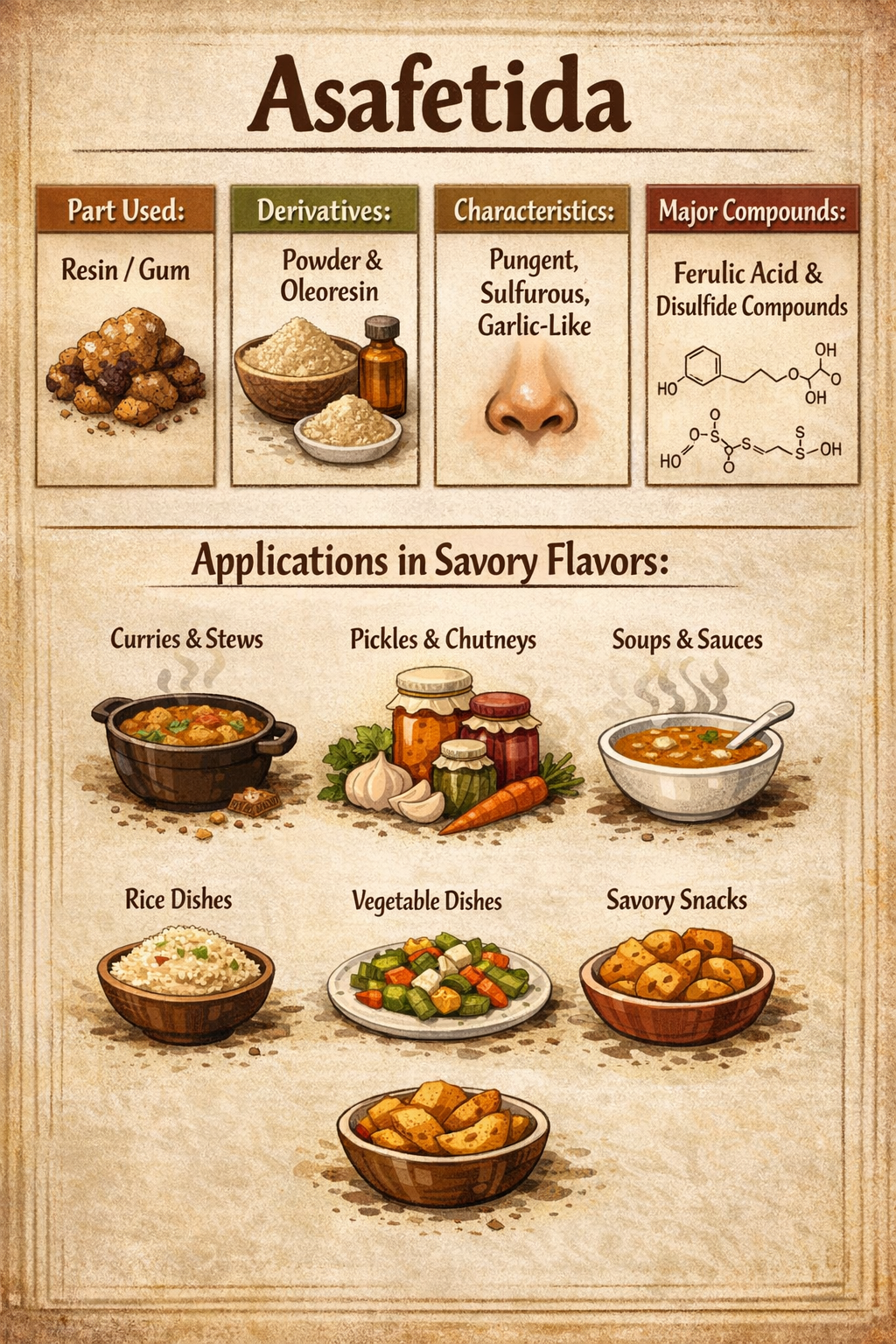
Identify the part(s) of the plant used, derivatives, organoleptic characteristics, and the major chemical component(s) which characterizes the aroma/flavor of Asafoetida.
Asafoetida (often spelled asafetida) is a powerful sulfurous spice obtained from plants of the genus Ferula, especially Ferula assa-foetida and related species in the Apiaceae family.
Asafoetida – Flavor Chemistry & Raw Material Profile
1. Plant Part(s) Used
- Oleogum resin exuded from the taproot and rhizome
- The resin is collected by cutting the root crown, allowing latex to exude and solidify.
Collected material consists of:
- Resin fraction
- Gum fraction
- Essential oil fraction
Typical composition:
| Fraction | Approx % |
|---|---|
| Resin | 40–65% |
| Gum | 20–25% |
| Essential oil | 5–17% |
2. Commercial Derivatives
Common industrial forms used in food and flavor manufacturing:
Raw Materials
- Tears / lumps (pure resin pieces)
- Mass asafoetida (agglomerated resin)
Processed Forms
- Asafoetida powder (resin diluted with starch or flour)
- Oleoresin asafoetida
- Essential oil of asafoetida
- Solvent extract
Flavor Industry Forms
- Oil-soluble extract
- Water-dispersible powder
- Spray-dried encapsulated flavor
3. Organoleptic Characteristics
Raw Resin Aroma
Extremely powerful and pungent:
- Strong sulfurous
- Garlic-like
- Onion-like
- Leek-like
- Roasted alliaceous
- Meaty / savory
- Slight musty resinous
After Cooking
The harsh sulfur note softens and becomes:
- Garlic/onion savory
- Umami-like
- Roasted onion
- Brothy / meat-like
- Slight caramelized vegetable
Taste
- Bitter
- Slightly acrid
- Strong umami-sulfur savory impact
4. Major Aroma-Active Chemical Components
The characteristic odor comes mainly from organosulfur compounds.
Dominant Character Impact Molecules
| Compound | Aroma Character |
|---|---|
| 2-Butyl-1-propenyl disulfide | Strong garlic/onion |
| 1-(Methylthio)propyl disulfide | Sulfurous onion |
| 2-Butyl-3-methylthiopropene | Harsh alliaceous |
| Sec-butyl propenyl disulfide | Onion/garlic |
| Di-sec-butyl disulfide | Cooked onion |
These molecules define the signature asafoetida odor.
5. Other Important Volatile Components
Sulfur Compounds
| Compound | Contribution |
|---|---|
| Dimethyl trisulfide | cooked onion/meat |
| Dimethyl disulfide | sulfur garlic |
| Allyl sulfides | alliaceous |
Terpenoids
| Compound | Contribution |
|---|---|
| α-Pinene | resinous |
| β-Pinene | woody |
| Carene | green |
| Limonene | citrus top |
These soften the sulfur harshness.
6. Non-Volatile Flavor Constituents
Resin Compounds
- Ferulic acid esters
- Umbelliferone derivatives
- Asaresinotannols
These give:
- Bitter background
- Medicinal warmth
- Lingering savory character
7. Typical Essential Oil Composition
| Class | Approx % |
|---|---|
| Sulfur compounds | 60–80% |
| Terpenes | 10–25% |
| Others | 5–10% |
8. Flavorist Use in Food Systems
Used in very low levels (ppm range) to create:
- Onion flavor
- Garlic flavor
- Savory bouillon
- Meat reaction flavors
- Curry bases
- Snack seasonings
Typical dosage:
| Application | Use level |
|---|---|
| Snack seasoning | 5–40 ppm |
| Curry / sauces | 10–80 ppm |
| Reaction flavors | trace |
✔ In short
Key odor driver:
➡ Butyl-propenyl disulfides
Flavor type:
➡ Garlic + onion + savory sulfur
Raw material:
➡ Oleogum resin from the taproot of Ferula species
Flavorist reconstruction formula for asafoetida aroma
Below is a typical flavor-chemist reconstruction approach for the aroma of Ferula assa-foetida (asafoetida). The profile is dominated by allylic and sec-butyl sulfur compounds that produce the characteristic garlic–onion–sulfur savory odor.
Because the real spice is extremely potent, reconstructions are usually prepared as very dilute stock solutions (0.1–1% in solvent) before evaluation.
Asafoetida Aroma Reconstruction
(Flavorist Laboratory Model Formula)
Target: pungent sulfurous, onion-garlic, cooked alliaceous note
Base Solvent
- Propylene glycol or ethanol: qs to 100
Core Impact Molecules
These define the signature asafoetida odor.
| Ingredient | % in concentrate | Odor role |
|---|---|---|
| 2-Butyl-1-propenyl disulfide | 28.0 | dominant asafoetida sulfur |
| sec-Butyl propenyl disulfide | 18.0 | onion / alliaceous |
| Di-sec-butyl disulfide | 10.0 | cooked onion body |
| Dimethyl trisulfide | 6.0 | cooked onion / meat |
| Dimethyl disulfide | 4.0 | sharp sulfur top |
Subtotal: 66%
Secondary Sulfur Complexity
| Ingredient | % | Role |
|---|---|---|
| Allyl methyl disulfide | 5.0 | garlic nuance |
| Allyl propyl disulfide | 4.0 | onion depth |
| Methyl propyl disulfide | 3.5 | cooked onion |
| Dipropyl disulfide | 2.5 | savory body |
Subtotal: 15%
Terpene Resin Background
The natural resin of Ferula species contains terpenes that soften the sulfur harshness.
| Ingredient | % | Role |
|---|---|---|
| α-Pinene | 3.0 | resinous lift |
| β-Pinene | 2.0 | woody background |
| Limonene | 2.5 | slight brightness |
| Myrcene | 1.5 | green terpene |
Subtotal: 9%
Savory / Cooked Vegetable Modifiers
| Ingredient | % | Role |
|---|---|---|
| Methional | 2.0 | cooked potato / savory |
| 2-Acetylthiazole | 1.2 | roasted nuance |
| Furfuryl mercaptan | 0.8 | roasted sulfur |
| 2-Methyl-3-furanthiol | 0.5 | meaty depth |
Subtotal: 4.5%
Trace Power Notes
| Ingredient | % |
|---|---|
| Hydrogen sulfide solution | 0.2 |
| Methanethiol | 0.15 |
| Dimethyl tetrasulfide | 0.15 |
Subtotal: 0.5%
Final Formula Balance
| Section | % |
|---|---|
| Core sulfur | 66 |
| Secondary sulfur | 15 |
| Terpenes | 9 |
| Savory modifiers | 4.5 |
| Trace notes | 0.5 |
| Total | 95 |
Add solvent to 100%
Aroma Profile of the Reconstruction
Top notes
- harsh sulfur
- onion
- garlic
Heart
- cooked onion
- leek
- roasted savory
Base
- meaty
- resinous
- warm sulfur
Typical Flavorist Usage Level
Because of potency:
| Application | Use Level |
|---|---|
| Snack seasoning | 0.5 – 5 ppm |
| Curry base | 1 – 10 ppm |
| Savory reaction flavors | trace |
✔ This reconstruction produces the characteristic "asafoetida punch" used in:
- curry flavors
- onion/garlic boosters
- vegetarian meat analog flavors
- snack seasonings
Applications of Asafoetida
Asafoetida (hing), obtained from the oleogum resin of Ferula assa-foetida and related species of the genus Ferula, has a wide range of applications across food, flavor, pharmaceutical, agricultural, and industrial sectors due to its powerful sulfurous, garlic–onion–savory aroma and bioactive compounds.
Below is a comprehensive application map used in the spice, flavor, and functional ingredient industries.
1. Food Applications
The largest use of asafoetida is as a savory spice and flavoring agent.
Spice & Culinary Uses
Common in South Asian and Middle Eastern cooking.
Applications include:
- Curry powders
- Lentil dishes (dal)
- Vegetable dishes
- Pickles
- Chutneys
- Sambar and rasam
- Spice blends (masala)
- Tempering oil (tadka)
- Vegetarian dishes replacing onion/garlic
Typical use level: trace to 0.1%
Snack & Processed Foods
Used as a savory enhancer because its sulfur compounds mimic onion and garlic.
Applications:
- Potato chips
- Extruded snacks
- Savory crackers
- Popcorn seasonings
- Instant noodle seasoning
- Snack dustings
Typical level: 1–20 ppm
Sauce & Condiment Flavoring
- Curry sauces
- Gravies
- Relish
- Ketchup variants
- Pickle brines
- Fermented sauces
Meat Analog / Vegetarian Foods
Because asafoetida contains alliaceous sulfur molecules, it helps replicate cooked savory flavors.
Applications:
- Plant-based meats
- Vegan sausage flavors
- Vegetarian bouillon
- Meatless gravies
- Savory seasoning bases
2. Flavor Industry Applications
Flavor houses use asafoetida extracts or reconstructions in many savory flavor systems.
Applications include:
Onion & Garlic Flavor Systems
Asafoetida provides the deep cooked sulfur character.
Used in:
- onion flavors
- garlic flavors
- leek flavors
Reaction Flavor Systems
Used in:
- roasted meat flavors
- chicken flavors
- beef flavors
- broth flavors
Sulfur compounds act as precursors or enhancers in Maillard systems.
Savory Flavor Boosters
Used to enhance:
- bouillon cubes
- soup bases
- seasoning powders
- instant food flavor packets
3. Pharmaceutical / Traditional Medicine
Asafoetida has long been used in traditional medicine systems such as Ayurveda and Unani.
Digestive Aid
Applications:
- anti-flatulence remedies
- carminative preparations
- digestive tonics
Antispasmodic
Used for:
- stomach cramps
- intestinal spasms
- irritable digestion
Respiratory Remedies
Used traditionally for:
- asthma
- bronchitis
- cough syrups
Nervous System Remedies
Historically used for:
- hysteria
- nervous disorders
- sedative preparations
4. Functional / Nutraceutical Uses
Bioactive compounds provide potential:
- antimicrobial effects
- antioxidant activity
- anti-inflammatory properties
- antifungal effects
Applications:
- herbal supplements
- digestive capsules
- functional foods
5. Agricultural Applications
Natural Pesticide
Asafoetida resin has strong odor and bioactivity.
Uses include:
- insect repellent
- pest deterrent sprays
- seed protection
Plant Protection
Sometimes used in traditional farming to repel:
- soil pests
- plant-eating insects
6. Animal Feed Applications
Used as a feed additive in small amounts.
Purposes:
- digestive improvement
- parasite control
- feed palatability modification
Applications:
- poultry feed
- cattle feed
- livestock supplements
7. Perfumery (Limited Use)
Due to its strong sulfur odor, asafoetida is rarely used in perfumery, but in trace levels it can create:
- animalic notes
- sulfuric realism
- savory accords
Occasionally used in:
- specialty experimental fragrances
- odor training kits
8. Chemical / Analytical Uses
Aroma Standards
Used in laboratories as a reference for:
- sulfur odor compounds
- alliaceous aroma studies
Flavor Research
Used in:
- sulfur chemistry research
- Maillard reaction flavor studies
- GC-MS aroma analysis
9. Religious / Cultural Uses
In some cultures asafoetida is used in:
- ritual incense
- spiritual purification
- traditional ceremonies
10. Household Uses (Traditional)
Historically used for:
- insect repellent
- pest deterrent
- preservation of grains
Summary: Major Application Categories
| Industry | Key Uses |
|---|---|
| Food | spice, seasoning, curry |
| Flavor industry | savory flavor systems |
| Pharmaceutical | digestive and respiratory remedies |
| Nutraceutical | functional supplements |
| Agriculture | natural pesticide |
| Animal feed | digestive additive |
| Perfumery | trace sulfur accords |
| Research | sulfur aroma studies |
| Cultural | incense/ritual use |
| Household | pest deterrent |
✔ Key reason for these applications:
The powerful sulfur compounds in asafoetida mimic garlic, onion, and cooked savory aromas, making it extremely valuable for savory flavor creation and digestive medicine.
Applications of Asafetida in savory flavors
Below are practical flavorist-style savory applications using asafoetida (hing), the oleogum resin from Ferula assa-foetida of the genus Ferula.
These examples show how flavor houses actually dose asafoetida or asafoetida flavor bases in savory systems.
Because of the extremely strong sulfur compounds, asafoetida is typically used at ppm levels.
1. Onion–Garlic Booster for Snack Seasoning
Application: potato chips, extruded snacks, crackers
Flavor Concentrate Formula
| Ingredient | % |
|---|---|
| Onion powder flavor | 35.0 |
| Garlic powder flavor | 20.0 |
| Yeast extract | 15.0 |
| MSG | 10.0 |
| Sugar | 7.0 |
| Salt | 7.0 |
| Asafoetida powder | 0.6 |
| Dimethyl disulfide | 0.15 |
| Dipropyl disulfide | 0.10 |
| Black pepper extract | 0.15 |
Total = 100
Usage
Apply 5–8 g seasoning per 100 g chips
Asafoetida gives:
- deeper cooked onion
- savory punch
- lingering garlic note
2. Curry Flavor Base
Application: curry sauces, instant noodles, spice pastes
Curry Flavor Concentrate
| Ingredient | % |
|---|---|
| Coriander flavor | 18 |
| Cumin flavor | 15 |
| Turmeric extract | 8 |
| Fenugreek flavor | 7 |
| Garlic flavor | 12 |
| Onion flavor | 15 |
| Ginger flavor | 6 |
| Capsicum extract | 3 |
| Yeast extract | 10 |
| Asafoetida oleoresin | 0.7 |
| Methional | 0.15 |
| Dimethyl trisulfide | 0.15 |
Total = 100
Usage
0.2–0.5% in finished sauce.
Asafoetida provides:
- authentic Indian curry aroma
- sulfuric garlic depth
- cooked vegetable notes.
3. Vegetarian Chicken Bouillon Flavor
Application: soup bases, bouillon cubes, seasoning powders
Reaction Flavor Style Formula
| Ingredient | % |
|---|---|
| Hydrolyzed vegetable protein | 30 |
| Yeast extract | 20 |
| Salt | 15 |
| Maltodextrin | 10 |
| Chicken reaction flavor | 15 |
| Onion flavor | 4 |
| Garlic flavor | 2 |
| Asafoetida powder | 0.4 |
| Dimethyl trisulfide | 0.2 |
| 2-Methyl-3-furanthiol | 0.15 |
| Methional | 0.25 |
Total = 100
Usage
0.5–1.2% in soup base.
Function of asafoetida:
- creates cooked chicken skin sulfur note
- enhances brothy depth
4. Plant-Based Meat Flavor
Application: vegan burgers, sausages, meat analogs
Meat Flavor System
| Ingredient | % |
|---|---|
| Yeast extract | 22 |
| Hydrolyzed vegetable protein | 20 |
| Roasted onion flavor | 10 |
| Garlic flavor | 8 |
| Smoke flavor | 5 |
| Mushroom extract | 12 |
| Soy sauce powder | 10 |
| Asafoetida extract | 0.5 |
| Dimethyl trisulfide | 0.25 |
| 2-Methyl-3-furanthiol | 0.2 |
| Guaiacol | 0.3 |
| Black pepper oil | 0.75 |
| Salt | 11 |
Total = 100
Usage
0.3–0.8% in plant-based meat matrix.
Contribution:
- replicates animalic sulfur
- strengthens meaty umami perception
5. Savory Instant Noodle Seasoning
Application: ramen or cup noodles
Seasoning Powder
| Ingredient | % |
|---|---|
| Salt | 30 |
| MSG | 18 |
| Sugar | 6 |
| Garlic powder | 8 |
| Onion powder | 12 |
| Chicken flavor | 12 |
| Soy sauce powder | 8 |
| Asafoetida powder | 0.4 |
| Dimethyl disulfide | 0.1 |
| White pepper | 1.5 |
| Sesame oil powder | 4 |
Total = 100
Usage
3–5 g seasoning per noodle serving.
Asafoetida effect:
- boosts onion-garlic authenticity
- improves broth savoriness
Why Flavorists Use Asafoetida
Key sulfur molecules (e.g., butyl-propenyl disulfides) create:
- cooked onion character
- garlic warmth
- savory meaty nuances
These properties make asafoetida extremely useful for:
- curry flavors
- onion/garlic boosters
- bouillon systems
- vegetarian meat flavors
- snack seasonings t
###