Asia Food & Flavor Regulatory Update: Key Legal and Regulatory Developments | August 1–September 15, 2026
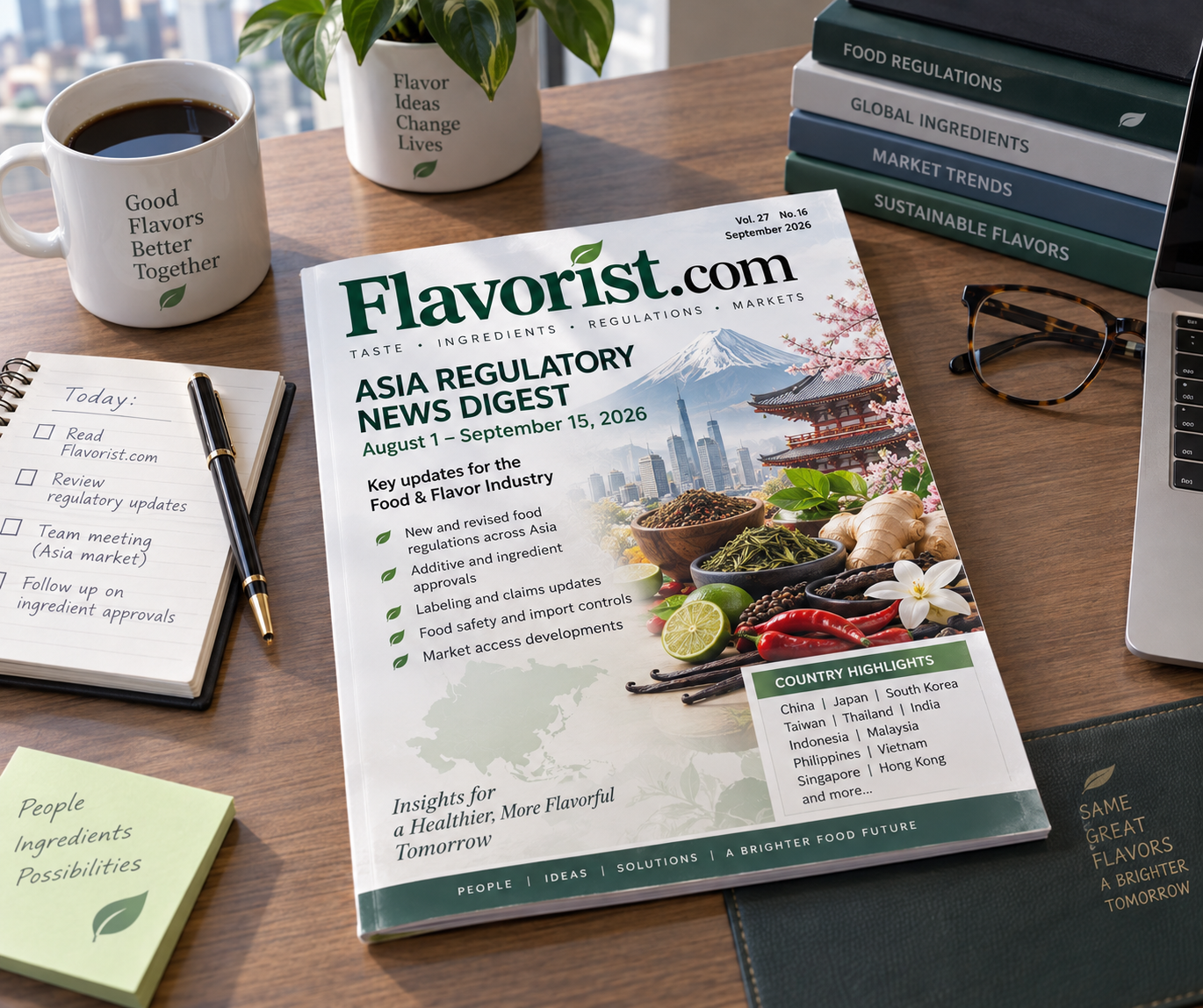
Asia Food & Flavor Regulatory Update
Key Legal and Regulatory Developments | August 1–September 15, 2026
The regulatory news digest collects noteworthy news from principal national food regulators, government gazettes, food-safety agencies and regulatory reporting across China, Japan, South Korea, Taiwan, Thailand, India, Indonesia, Malaysia, the Philippines, Vietnam, Bangladesh, Singapore, Hong Kong and the GCC for developments released from August 1 through September 15, 2026. The digest prioritizes measures affecting flavors, additives, colors, sweeteners, ingredients, functional foods, beverages, labeling, claims, packaging, novel foods, imports and food safety.
Because Asia contains dozens of jurisdictions and subnational regulators, “all” cannot literally be guaranteed. This is a best-effort comprehensive manufacturer-focused review of material developments identifiable in the period; routine recalls and ordinary inspections are generally excluded.
China
1. China intensifies nationwide enforcement against food-additive misuse — August 13
China's State Administration for Market Regulation reported results from its national campaign against excessive and unauthorized use of food additives. Regulators had handled 23,603 cases involving additives used beyond permitted food categories or maximum levels, with particular attention to preservatives, sweeteners and colors. Priority sectors include dairy, meat, aquatic products, starch products, edible oils, beverages and compound seasonings. SAMR said enforcement would continue against milk tea, cooked meats, bakery products, noodles and alcoholic beverages. Flavor and ingredient suppliers should verify additive permissions by exact GB food category, technological function and maximum level rather than relying on historical formulations. SAMR
China SAMR — Food-additive enforcement campaign
2. China publishes detailed implementation guidance for new food-label rules — August 28
SAMR issued an extensive Q&A explaining implementation of the Measures for Supervision and Administration of Food Labeling, which will operate alongside GB 7718-2025 and GB 28050-2025. The guidance clarifies requirements for the smallest sales unit, principal display panels, dates, ingredient information and transitional products. Particularly important is SAMR's statement that products made after implementation must comply with the new framework, while certain previously manufactured products may continue through shelf life. The guidance also reiterates restrictions affecting potentially misleading label statements such as “zero added.” Flavor suppliers should expect customers to request more precise ingredient and additive documentation. SAMR
China SAMR — Food Labeling Measures implementation Q&A
3. China receives a cluster of new food-additive applications — August 11–31
China's National Health Commission regulatory pipeline received several ingredient/additive applications during August. NHC officially recorded a new application for beta-carotene on August 11; regulatory tracking subsequently identified applications involving Amomum tsao-ko oil, L-ascorbic acid-2-glucoside, D-allulose-3-epimerase and naringin dihydrochalcone later in the month. The last item is especially interesting to flavor and sweetener companies because naringin dihydrochalcone is associated with sweetness modification. Acceptance is not approval: it means the applications entered China's regulatory review process. Ingredient companies should monitor NHC's subsequent technical-review and authorization stages before considering commercial use in Chinese-market foods. National Hurricane Center
NHC — Food-additive application notices
4. China launches major new food-safety standards work program — September 1
The National Health Commission published its 2026 National Food Safety Standards Project Plan, initiating revision or development of standards directly relevant to flavor and ingredient companies. The program includes revision of China's general Food Additive Use Standard plus standards covering carbon dioxide, glycerol esters of wood rosin/hydrogenated wood rosin, natural carotene, Sunset Yellow, Amaranth, Ponceau 4R and Erythrosine/aluminum lakes. Product standards including preserved meats and instant noodles are also within the program. These are projects rather than immediate rule changes, but they identify where China's national GB requirements are likely to evolve next. FoodMate Download Center
China NHC — 2026 food-safety national standards work program
Japan
5. Japan orders mandatory testing of Côte d’Ivoire sesame — August 13
Japan's Ministry of Health, Labour and Welfare imposed an inspection order on sesame seeds from Côte d’Ivoire after monitoring detected aflatoxin. The order requires testing of every affected import consignment under Japan's Food Sanitation Act before normal distribution. Sesame is widely used in seasonings, sauces, oils, bakery products and savory flavor systems, making the measure relevant beyond whole-seed importers. Flavor manufacturers using roasted sesame, sesame paste or sesame oil should determine whether their supply chains originate in Côte d’Ivoire and anticipate possible testing, documentation and clearance delays. Alternative sourcing or additional inventory may be warranted while the inspection order remains active. Ministry of Health, Labour and Welfare
Japan MHLW — Inspection order for Côte d’Ivoire sesame
6. Japan proposes another round of pesticide-residue changes — August 20
Japan opened consultation on revisions to food residue limits involving five pesticide/veterinary substances, including imidacloprid. The consultation ran through September 18. Maximum residue limits can directly affect herbs, spices, fruits, vegetables, tea and botanical ingredients used by flavor manufacturers, particularly where Japanese limits differ from Codex or exporting-country tolerances. Companies supplying natural extracts and agricultural ingredients should map Japanese MRLs against pesticide-use patterns in their source countries. Changes to an MRL can create import compliance issues even when a crop was legally treated in its country of origin. The proposal should therefore be incorporated into supplier and residue-monitoring programs. Civil Aviation Authority of Japan
Japan Consumer Affairs Agency — Food-standard consultations
7. Japan revises specifications for two enzyme food additives — August 28
Japan amended its official food-additive specifications for glutaminase and fructosyltransferase. The changes revise analytical procedures following changes in availability of testing reagents and establish or modify L-glutamic-acid measurement solutions used in the methods. Authorities emphasized that the amendments improve test practicability rather than relax safety requirements or change the permitted quality of the additives. Both enzymes are relevant to ingredient manufacturing: glutaminase is associated with savory/umami applications, while fructosyltransferase is used in production of fructooligosaccharides and related functional ingredients. Suppliers should ensure internal and third-party analytical methods correspond to Japan's revised official specifications. Civil Aviation Authority of Japan
Japan Consumer Affairs Agency — August 28 additive specification amendments
8. Japan proposes authorization of potassium acetate as a food additive — September 1
Japan opened consultation on amendments that would newly designate potassium acetate as an authorized food additive and establish corresponding specifications and standards of use. The consultation runs through October 1. Because Japan operates a positive-list approach to designated additives, a substance generally cannot be used simply because it is permitted in another major market. The proposal is therefore relevant to manufacturers using potassium salts for acidity regulation, preservation, buffering or other technological functions. Ingredient suppliers should wait for final designation and conditions of use before commercializing Japanese applications and should compare the proposed specification with their existing material specifications and analytical certificates. Public Comment
Japan e-Gov — Potassium acetate/additive consultation
9. Japan revises pesticide MRLs and removes chlorpyrifos-specific limits — September 10
Japan amended food residue standards for quinoclamine, spirodiclofen, spiropidion and propamocarb and deleted established chlorpyrifos MRLs for numerous foods. The chlorpyrifos changes affect a wide range of commodities, including grains, citrus, fruit, sesame, nuts, tea, coffee, spices, herbs, meat, seafood and corn oil. Many affected changes have a one-year transition, after which foods without a specific MRL generally fall under Japan's 0.01 ppm uniform limit. This is highly relevant to natural-flavor and botanical supply chains because trace residues acceptable elsewhere can become Japanese-market compliance failures. Supplier pesticide programs should be reassessed accordingly. Ministry of Health, Labour and Welfare
Japan MHLW — September 10 residue-standard amendments
South Korea
10. South Korea proposes earlier GMO labeling for sugars and edible oils — August 5
MFDS proposed accelerating implementation of expanded genetically modified food labeling for sugars and edible oils/fats. Under the proposal, the implementation date for these categories would move from December 31, 2027 to December 31, 2026. The measure is intended to give consumers information about GM-derived ingredients sooner. This can affect flavor and ingredient manufacturers because sugars, syrups, oils and fats frequently serve as carriers, processing inputs or components of compounded flavors. Companies selling into Korea should determine the biological origin of these ingredients and whether their supplier documentation can support the required GMO/non-GMO determination once the expanded labeling rules become applicable. MFDS
South Korea MFDS — Proposed GMO labeling implementation change
11. South Korea proposes four new mandatory allergens and tougher advertising controls — August 7
MFDS proposed adding sesame, perilla seed, almond and cashew nut to Korea's mandatory allergen-labeling list. The same proposal strengthens penalties for misleading food advertising, including claims implying endorsements or recommendations by doctors, pharmacists, university professors and other professionals. It also addresses AI-generated audio, images or videos that could make consumers believe a professional endorsed a food. This is highly relevant to flavor companies because sesame, nuts and nut-derived materials can appear within compound flavors and seasoning systems. Suppliers should begin assessing allergen declarations and customer specifications rather than waiting until final implementation to identify affected formulas. MFDS
South Korea MFDS — Allergen and advertising amendment proposal
12. South Korea proposes changes to functional-ingredient recognition and safety assessment — August 14
MFDS proposed amendments to its rules governing recognition of health functional food ingredients. The proposal updates application forms to reflect increased regulatory review fees and revises the safety-assessment decision tree following changes to Korea's definition of synthetic substances. The revised framework would more explicitly examine whether a synthetic material occurs naturally and whether it may already be used as a food or food additive. Functional flavor and ingredient companies should review the proposal carefully because regulatory classification can determine both the evidence required and the commercial pathway for innovative substances. Comments were invited through October 13. MFDS
South Korea MFDS — Functional ingredient recognition proposal
13. South Korea selects ten functional ingredients for 2027 reassessment — August 21–24
MFDS announced that ten health-functional-food ingredients will undergo periodic reassessment in 2027. Korea's reassessment program can result in revisions to specifications, permitted intake, precautions, functionality claims or other conditions when newer scientific evidence warrants change. The announcement therefore matters to supplement and functional-food manufacturers even though it does not immediately prohibit any ingredient. Companies using ingredients on the reassessment list should prepare safety, intake, efficacy and adverse-event documentation and monitor the resulting reviews. Flavor houses serving functional foods should also check whether any customer concepts depend on affected ingredients because subsequent restrictions can require reformulation, revised claims or new label language. MFDS
South Korea MFDS — 2027 functional-ingredient reassessment announcement
14. South Korea changes health-functional-food identification logos — September 15
MFDS finalized amendments to the Health Functional Food Labeling Standards to redesign the official health-functional-food and GMP symbols. Regulators said existing symbols could resemble the HACCP symbol used on ordinary foods, potentially causing consumers to confuse conventional foods with regulated health functional foods. The revised designs are intended to make the regulatory category more visually distinct. Manufacturers should update packaging artwork according to applicable implementation and transition provisions, while ingredient and private-label suppliers should ensure customers do not continue using outdated artwork beyond permitted periods. The change is especially relevant to supplements, functional beverages and other products marketed under Korea's health-functional-food framework. MFDS
South Korea MFDS — Health Functional Food labeling amendment
Taiwan
15. Taiwan establishes rules for enzyme-produced inulin — August 12
Taiwan FDA established use restrictions and labeling requirements for inulin produced using fructosyltransferase, effective immediately. The action gives manufacturers a specific regulatory pathway for this form of inulin while imposing conditions on commercialization and labeling. Inulin is particularly relevant to beverage, nutrition, prebiotic and reduced-sugar product development because it contributes fiber, mouthfeel and solids and can affect sweetness and flavor perception. Flavor and ingredient manufacturers should identify how the inulin used in their formulations is produced rather than treating all commercial inulin as regulatory equivalents. Specifications, supplier statements and finished-product labels should be checked against Taiwan's new production-process-specific requirements. FDA Taiwan
Taiwan FDA — Inulin use and labeling requirements
16. Taiwan proposes revised analytical methods for three additives — August 14
TFDA proposed revisions to official specification-testing methods for L-ascorbyl stearate, nicotinamide and methylcellulose. These measures do not newly authorize or prohibit the additives; instead, they modify how regulatory laboratories establish compliance with identity or specification requirements. This distinction matters commercially because a change in extraction, instrumentation, reagents or acceptance procedures can affect whether supplier material passes official testing. Methylcellulose is used as a stabilizer and texture modifier, while nicotinamide is common in fortified foods and beverages. Ingredient companies should compare certificates of analysis and internal methods against Taiwan's proposals and consider whether laboratories need method validation or procedural updates. FDA Taiwan
Taiwan FDA — Additive analytical-method consultation
17. Taiwan revises regulated health-food evaluation methods — August 20
TFDA revised its official assessment methods for health foods making blood-glucose regulation and blood-lipid regulation claims. The titles were also updated to emphasize health-care efficacy evaluation. Taiwan's health-food framework requires regulatory substantiation for approved health-effect claims, so changes in assessment methodology can affect product-development studies and registration strategies. Companies developing functional beverages, nutritional foods or supplements positioned around glucose or lipid management should review whether existing studies remain aligned with the updated protocols. Flavor houses supporting these categories should also recognize that customer claims may depend on successful regulatory evaluation rather than ordinary nutrition or marketing substantiation alone. FDA Taiwan
Taiwan FDA — Health-food evaluation method updates
18. Taiwan updates multiple official food/additive testing methods — August 25–September 2
TFDA issued several laboratory-method changes during the period, including revisions concerning carbon dioxide, pyridoxine hydrochloride (vitamin B6), veterinary-drug residues, mango identification, titanium dioxide and Food Red No. 7 aluminum lake. Some methods took effect immediately, while the revised antibiotic/metabolite multi-residue method has a later implementation date. These are technical rather than formulation authorizations, but they matter because official test methods determine how compliance is demonstrated during surveillance and import testing. Ingredient suppliers should compare their quality-control methods with Taiwan's official procedures, especially where certificates of analysis support food-additive specifications or identity claims. FDA Taiwan
Taiwan FDA — Food and additive analytical-method announcements
Thailand
19. Thailand establishes dedicated goat-milk and flavored-goat-milk rules — August 5
Thailand's Ministry of Public Health Notification No. 470 B.E. 2569 on goat milk and flavored goat milk entered into force August 5 after publication in the Royal Gazette. The measure creates a dedicated regulatory framework rather than relying solely on standards developed for conventional cow-milk products. It is particularly relevant to flavor companies developing chocolate, vanilla, coffee, fruit or other flavored goat-milk beverages. Manufacturers and exporters should review definitions, composition, ingredient use, applicable additives, product registration and labeling against the new goat-milk standard and should not assume that formulas previously developed under general dairy requirements automatically comply. กองอาหาร
Thailand FDA — Goat milk and flavored goat milk regulation
20. Thailand tightens controls on nitrite-salt additive mixtures — August 7–10
Thailand FDA announced stronger controls for compound food-additive products containing edible salt and nitrites, particularly products sold directly to consumers, food preparers and foodservice operators. The agency subsequently opened consultation on labeling and quality/specification requirements. FDA said the initiative followed incidents involving incorrect nitrite use and highlighted potential severe health consequences from overdosing. Proposed controls include clearer warnings and measures to distinguish curing salt visually, including pink coloration. Suppliers of meat-curing systems, seasonings and compound additives should examine nitrite concentration, dosing instructions, pack sizes, warnings and intended-user classifications and should ensure GMP and product-registration requirements are properly documented. กองอาหาร
Thailand FDA — Nitrite-salt control initiative
21. Thailand substantially revises permitted herbal-tea materials — August 19/25
Ministry of Public Health Notification No. 471 B.E. 2569 expanded Thailand's list of plants and plant parts permitted as raw materials for herbal tea by 99 entries, bringing the list to items 202–300. At the same time, Thailand removed licorice from the herbal-tea list because of safety concerns associated with glycyrrhizin, including effects on blood pressure, kidney function and potassium levels. Previously authorized licorice-containing herbal teas receive a one-year transition and may potentially be reclassified as beverages. Botanical, tea, extract and flavor companies should immediately review formulas containing licorice or newly authorized plants. กองอาหาร
Thailand FDA — Herbal Tea Notification No. 471
22. Thailand introduces specific conditions for methanol as a processing aid — August 19
Thailand's Notification No. 472 B.E. 2569, effective August 20, amended rules governing substances used in food manufacturing and imports. The principal industry-facing change establishes conditions under which methyl alcohol/methanol may be used as a processing aid for specified safety-evaluated food applications. The measure should not be interpreted as general permission to add methanol to food. It is particularly relevant to flavor, extract and botanical manufacturers because solvents used during extraction or processing can fall within processing-aid regulation even when they have no technological function in the finished food. Manufacturers should review solvent specifications, residues, supplier documentation and process validation. กองอาหาร
Thailand FDA — Notification No. 472 processing-aid requirements
23. Thailand proposes dedicated GMP rules for cultivated meat — September 15
Thailand FDA opened consultation on manufacturing rules for animal-cell-cultured foods/cultivated meat. The proposal would establish a specific definition and require dedicated GMP controls covering facilities, equipment, sanitation, personnel and manufacturing operations. More specialized requirements address starting cells, cell banks, cell multiplication and differentiation, bioreactors, aseptic conditions and monitoring of residues. Production sites would require qualified supervisors, while imported cultivated foods would need evidence that overseas manufacturing systems meet equivalent standards. This is an important early regulatory framework for cell-based foods and also matters to flavor houses because cultivated-meat products will require flavor, color, fat and texture systems during commercialization. กองอาหาร
Thailand FDA — Draft GMP requirements for cultivated meat
India
24. FSSAI publishes regulatory position on “identical flavours” in alcoholic beverages — August 7
FSSAI published an official regulatory position addressing the use of “identical flavours” in alcoholic beverages. The announcement is directly relevant to flavor houses because terminology used to classify natural, nature-identical, identical or synthetic flavoring substances can affect ingredient eligibility, finished-product descriptions and regulatory documentation. Companies supplying spirits, flavored alcoholic beverages, RTDs and similar products should ensure that flavor declarations used in technical documents and customer specifications match FSSAI terminology rather than relying on EU, U.S. or other international classification conventions. Finished-product manufacturers should also review labels and marketing descriptions that could imply natural origin when the underlying flavor classification does not support that representation. FSSAI
FSSAI — Position on identical flavours in alcoholic beverages
25. India proposes definitions for foods high in added fat, sugar or salt in schools — August 11
FSSAI published draft amendments to its Safe Food and Balanced Diets for Children in School Regulations to introduce definitions for foods high in added fat, added sugar or salt. The proposal is important because formal HFSS-type definitions can determine which foods face restrictions in school environments and may eventually influence formulation and marketing strategies beyond schools. Snack, beverage, confectionery, bakery and flavor companies serving children's products should compare product nutrient profiles with the proposed thresholds and monitor how the definitions interact with existing restrictions on sales, promotion and availability around schools. Reformulation could affect sweetness, saltiness, mouthfeel and flavor-delivery requirements. FSSAI
FSSAI — Draft school-food amendment regulations
26. India finalizes packaging amendment for pan masala — August 10
FSSAI published the final Food Safety and Standards (Packaging) Amendment Regulations, 2026, adding the prescribed list of packaging materials applicable to pan masala. Although narrower than India's broader food-labeling proposals, the amendment illustrates FSSAI's increasing use of product-specific packaging controls. Packaging suppliers and manufacturers of pan masala should verify that materials used for direct food contact appear within the permitted framework and that migration and other safety requirements continue to be satisfied. Ingredient and flavor suppliers are indirectly affected where they provide products to pan-masala manufacturers, because noncompliant packaging can prevent an otherwise compliant formulation from legally entering the market. FSSAI
FSSAI — 2026 Packaging Amendment Regulations
27. India's proposed front-of-pack warning regime faces Supreme Court challenge — September 7
A legal challenge was filed over India's developing proposal for red front-of-pack warning symbols on foods high in concerning nutrients. According to Reuters, the proposal would initially require a warning when a product exceeds thresholds for at least two of three categories—added sugar, salt or saturated fat—rather than issuing a separate warning whenever any one nutrient is high. Public-health petitioners challenged that approach before India's Supreme Court, while industry groups have separately raised concerns about the breadth of warning-label coverage. The litigation creates uncertainty for food companies planning packaging, reformulation and nutrient-reduction strategies while FSSAI's policy develops. Reuters
Indonesia
28. Indonesia begins applying new nutrition-label regulation to registrations — August 4
BPOM announced that new processed-food registration applications received from August 3, 2026 should comply with Regulation No. 10/2026 on nutrition information for processed-food labels. The regulation includes Indonesia's developing Nutri-Level front-of-pack system, which communicates sugar, sodium and total-fat profiles through levels A through D. Although the underlying regulation was issued earlier, the August announcement marks an important implementation step for manufacturers and importers. Food and beverage companies submitting new registrations should ensure nutritional calculations, label artwork and supporting documentation align with the new system. Flavor companies may see reformulation requests as customers seek improved nutrient profiles. Registrasi Pangan
Indonesia BPOM — Nutrition-label implementation for food registrations
29. Indonesia rolls out new food-packaging regulation — August 24
BPOM publicized Regulation No. 11/2026 on Food Packaging, replacing the 2019 framework and updating food-contact requirements in response to scientific, technological and international regulatory developments. BPOM emphasized migration risk: substances from packaging can transfer into foods and create chemical-safety concerns. The regulation is relevant to virtually every food manufacturer, but flavor and ingredient companies should pay particular attention to packaging for concentrated flavors, essential oils, extracts and acidic or fatty formulations, which can interact aggressively with packaging materials. Supplier declarations, migration testing, material specifications and packaging-change controls should be reviewed against the new Indonesian requirements. Pemerintah Indonesia
Indonesia BPOM — Regulation No. 11/2026 on Food Packaging
30. Indonesia creates conformity checks for imported halal products — August 10 / September 5
Indonesia's BPJPH issued Regulation No. 4/2026 governing conformity assurance for foreign halal products entering, circulating and being traded in Indonesia. The regulation was promulgated August 10 and publicly highlighted September 5. It is intended to provide a structured mechanism for confirming that imported products relying on overseas halal certification meet Indonesian requirements. This is particularly important to flavor houses because compounded flavors can contain alcohol carriers, emulsifiers, enzymes, animal-derived processing aids and other materials whose halal status depends on source and processing. Exporters should review overseas-certification recognition, documentation and pre-import conformity procedures before Indonesian shipment. BPJPH
Indonesia BPJPH — Regulation No. 4/2026 for imported halal products
Malaysia
31. Malaysia introduces food-safety assurance requirement for imported foods — August 26
Malaysia gazetted the Food (Amendment) (No. 3) Regulations 2026, P.U. (A) 298, effective March 1, 2027. A new Part IIB provides that imported food may not be imported, advertised or sold unless it is prepared at premises operating a food-safety assurance program recognized by Malaysia's Ministry of Health. The amendment also corrects the energy conversion factor in a nutrition provision and removes specified residue entries for carbofuran, chlorpyrifos and paraquat from the Sixteenth Schedule. Foreign food, beverage, flavor and ingredient manufacturers should begin determining how their manufacturing food-safety systems will demonstrate recognition before implementation. mylaw.my
Malaysia Ministry of Health — Food regulation amendments
Philippines
32. Philippines modernizes adoption of Codex food-additive and processing-aid rules — August 2026
The Philippine FDA issued Administrative Order 2026-0011, titled “Revised Guidelines on the Adoption of Codex General Standard for Food Additives (GSFA) and Processing Aids,” replacing Administrative Order 88-A of 1984. The measure modernizes the country's framework for using Codex GSFA as a regulatory reference for permitted food additives and addresses processing aids within the updated system. This is highly significant for flavor houses because additive permissions, technological functions and food-category classifications often determine whether carriers, preservatives, colors, emulsifiers and other substances may be used. Companies should reconcile Philippine formulations with the revised Codex-based approach rather than relying on the superseded 1984 framework. Food and Drug Administration
Philippines FDA — Administrative Order 2026-0011
Vietnam
33. Vietnam advances replacement of its Food Safety Law — August 3–6
Vietnam notified the WTO of a draft replacement for the 2010 Food Safety Law, representing one of the region's most consequential regulatory projects during the period. The draft was notified August 3, with comments requested through September 17 and planned submission to the National Assembly in October. The proposed law is expected to modernize Vietnam's framework for food safety management as manufacturing, imports, e-commerce and newer food categories expand. Companies operating in Vietnam should map existing product registrations, food-safety certifications, traceability, labeling and import responsibilities against the developing legislation rather than waiting for enactment, since implementation was being targeted for 2027. EBS PublicNow
Vietnam draft Food Safety Law regulatory notice
Bangladesh
34. Bangladesh issues Import Policy Order 2026–2029 — August 24
Bangladesh's Import Policy Order 2026–2029 took effect August 24 and establishes the country's new overarching import-control framework through 2029. For foods, it introduces or consolidates requirements including certificates confirming fitness for human consumption, package marking, product-specific health and quarantine documentation and conformity with applicable Bangladesh Standards and Testing Institution requirements. Products may be freely importable, controlled or prohibited, and some require approval before letters of credit are opened. Food, beverage, flavor and ingredient exporters should review the new order by product and HS classification rather than assuming that requirements under the previous import policy remain unchanged. ChemLinked
Bangladesh Import Policy Order 2026–2029 summary and source documents
Singapore
35. Singapore takes action against foods adulterated with pharmaceutical substances — August 4
The Singapore Food Agency announced that three marketed food products contained pharmaceutical substances not permitted in foods. Testing detected tadalafil in a honey product, sennosides in a botanical beverage/barley-seedling powder product and dexamethasone in another marketed food. SFA directed sellers to stop sales and worked to remove online listings. The case is a strong compliance signal for botanical beverages, functional foods, wellness honey and similar categories that can be vulnerable to deliberate adulteration. Flavor and ingredient companies supporting these markets should strengthen supplier qualification and consider targeted screening where raw materials or claims create elevated adulteration risk. Default
Singapore Food Agency — August 4 food adulteration enforcement
36. Singapore approves Brunei as a new frozen-poultry source — August 19
The Singapore Food Agency approved Brunei Darussalam as a source country for frozen poultry, initially approving one Bruneian establishment for exports to Singapore. Singapore tightly controls overseas sources for meat and other higher-risk animal products, so source-country and establishment approval are meaningful regulatory market-access decisions rather than ordinary commercial announcements. The measure may create new sourcing options for Singaporean poultry processors and manufacturers of meat products. Savory flavor companies could see downstream implications for chicken extracts, broths, meat preparations and other poultry-based ingredients where customers require material from SFA-approved supply chains. Importers should verify establishment approval rather than relying solely on country approval. Default
Singapore Food Agency — Brunei frozen-poultry approval
Hong Kong
37. Hong Kong proposes major modernization of sweetener regulation — September 4
Hong Kong opened a three-month consultation on amendments to the Sweeteners in Food Regulations (Cap. 132U). The proposal would bring polyhydric alcohols within the regulatory framework, expand the list of permitted sweeteners, establish maximum permitted levels for specific sweetener-food combinations and make technical amendments. Authorities said the proposal draws primarily on Codex's General Standard for Food Additives and would include an 18-month transition period after completion of the legislative process. This is particularly important to beverage, confectionery and flavor companies using high-intensity sweeteners, sugar alcohols or sweetness-modifying systems. Existing formulations should be mapped against the proposed food-category-specific limits. Food Hygiene Dept
Hong Kong CFS — Proposed amendments to Sweeteners in Food Regulations
GCC / Gulf markets
38. GCC develops technical regulation for gluten-free and reduced-gluten foods — August 19
A GCC draft technical regulation would establish harmonized requirements for gluten-free and reduced-gluten foods. Regulatory reporting indicates that foods labeled “gluten-free” would be limited to no more than 20 mg/kg gluten, while reduced-gluten products would contain more than 20 but no more than 100 mg/kg. The proposal also addresses GMP controls, documented raw-material supply chains and periodic analytical verification using immunological testing such as the R5 ELISA approach. If adopted regionally, the measure could influence compliance across Gulf markets and would be particularly relevant to bakery, cereal, flavor, seasoning and ingredient companies handling wheat-derived materials or cross-contact risks. ChemLinked
GCC gluten-free/reduced-gluten draft regulatory summary
What matters most to flavor and ingredient companies
Across these 38 developments, the most direct formulation and market-access issues are China's upcoming additive-standard overhaul, Japan's chlorpyrifos and additive changes, Korea's allergen/GMO proposals, Taiwan's inulin rule, Thailand's herbal-tea and processing-aid changes, India's flavor classification, Indonesia's packaging and halal-import requirements, Malaysia's imported-food assurance requirement, the Philippines' Codex-based additive framework, and Hong Kong's proposed sweetener overhaul.
The common regional trend is increasingly clear: Asian regulators are moving toward positive-list ingredient control, tighter additive enforcement, more granular allergen and GMO disclosure, stronger functional-claim substantiation, modernized food-contact rules and closer oversight of imported products. For a multinational flavor house, regulatory clearance increasingly needs to be conducted at the level of country + food category + technological function + use level + ingredient origin + claim, rather than treating an ingredient approved in one Asian market as automatically acceptable elsewhere.
###