Asia Food & Flavor Regulatory Update: Key legal and regulatory developments released August 1–14, 2026
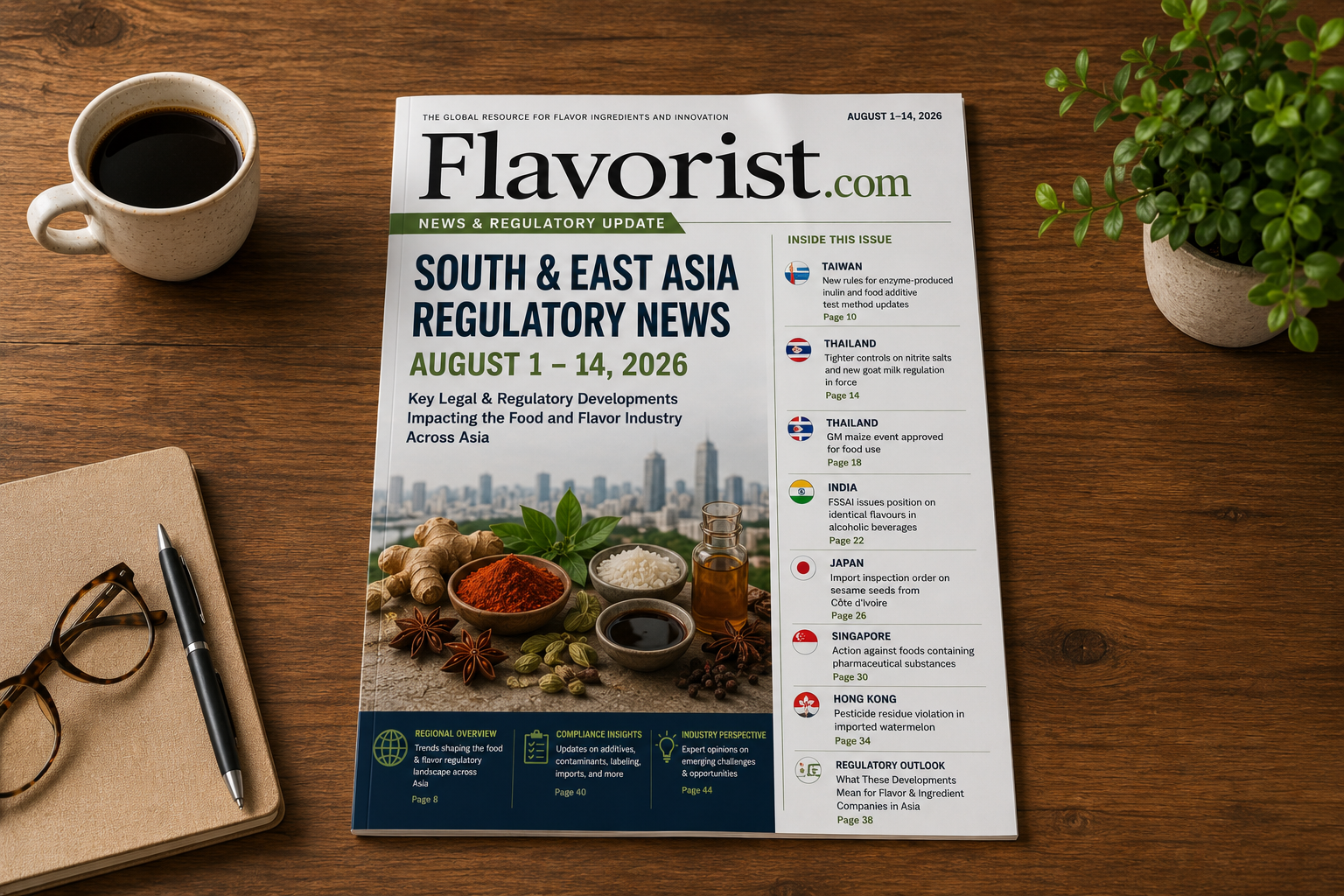
News items below result from a search of principal food-regulatory sources across China, Japan, South Korea, India, Taiwan, Thailand, Singapore, Hong Kong and selected Southeast Asian markets for material developments released between August 1 and August 14, 2026. Prioritized measures are those affecting flavors, food additives, ingredients, botanicals, novel foods, beverages, labeling, contaminants, pesticide residues, imports, food safety and manufacturing.
The strongest flavor-specific activity during the period came from Taiwan, Thailand and India, while Japan, Singapore and Hong Kong issued noteworthy import or enforcement measures.
1. Taiwan establishes use and labeling requirements for enzyme-produced inulin
Taiwan | August 12, 2026 | Final Regulation | Very High relevance to ingredient companies
Taiwan FDA formally established restrictions and labeling requirements for inulin produced using fructosyltransferase, with the rule taking effect immediately on August 12. The action specifically addresses inulin manufactured through the enzymatic process identified by TFDA, giving manufacturers a clearer legal basis for using this ingredient in food while also defining the conditions that must accompany commercialization. TFDA listed the measure as a newly enacted food-ingredient requirement rather than merely a draft consultation. (FDA Taiwan)
Industry impact: This is particularly important for manufacturers of fiber-enriched foods, beverages, nutrition products, prebiotic preparations and functional formulations. Flavor houses increasingly work with soluble fibers such as inulin because they can influence sweetness perception, mouthfeel and flavor delivery. Taiwanese and exporting manufacturers should confirm whether their inulin production process falls within the new rule, update ingredient specifications and ensure finished-product labels comply with the required terminology and use conditions.
Official source: Taiwan FDA – Inulin use restrictions and labeling requirements (FDA Taiwan)
2. Taiwan proposes revised analytical methods for three food additives
Taiwan | August 14, 2026 | Draft Test-Method Revisions | High relevance to additives
TFDA proposed revisions to official specification and testing methods for L-ascorbyl stearate, nicotinamide and methylcellulose on August 14. These are analytical-method changes rather than new permissions or prohibitions, but official methods determine how regulators and laboratories establish whether additives comply with Taiwanese identity, purity or specification requirements. TFDA separately listed draft revisions for L-ascorbyl stearate and nicotinamide and a second proposal for methylcellulose. (FDA Taiwan)
Industry impact: Ingredient producers and food manufacturers should not dismiss analytical-method amendments as purely technical. Differences in extraction, instrumentation, calibration or acceptance criteria can change whether an ingredient passes regulatory testing. Methylcellulose is widely used for stabilization, thickening and texture control, while nicotinamide is common in fortified foods and beverages. Flavor companies using these substances in carriers, emulsions or functional delivery systems should compare internal and supplier test methods with Taiwan's proposed revisions and assess whether certificates of analysis will remain aligned with regulatory expectations.
Official source: Taiwan FDA – Food additive analytical-method proposals (FDA Taiwan)
3. Taiwan proposes modernization of pesticide-residue testing for animal products
Taiwan | August 12, 2026 | Draft Analytical Regulation | Medium–High Impact
TFDA proposed replacing and updating pesticide-residue testing approaches for livestock and other animal products. The agency announced a draft revision of the existing multi-residue analytical method for pesticide residues in livestock products, proposing to rename and broaden it as a multi-residue method for animal products. At the same time, TFDA proposed withdrawing the older organophosphate-specific testing method. (FDA Taiwan)
Industry impact: Although this does not itself change pesticide maximum residue limits, it can materially affect enforcement. Broader multi-residue methods allow regulatory laboratories to identify more compounds efficiently and may increase the probability of detecting unexpected residues. Manufacturers sourcing milk, dairy powders, meat ingredients, fats, animal proteins or savory flavor precursors from international suppliers should ensure pesticide and veterinary-residue monitoring programs are sufficiently broad. Flavor houses producing meat, dairy or cheese profiles should also confirm that upstream animal-derived ingredients have robust residue specifications and supplier testing documentation.
Official source: Taiwan FDA – Proposed pesticide-residue testing revisions (FDA Taiwan)
4. Thailand tightens controls on mixed food additives containing nitrite salts
Thailand | August 7–10, 2026 | Control Measure + Draft Rules | Very High relevance to additives
Thailand FDA announced new controls on compound food-additive products containing edible salt and nitrites, commonly referred to as nitrite salt mixtures. On August 7, the Food Division publicized control measures covering such products when sold directly to consumers, food preparers or food vendors. On August 10, the agency opened consultation on a draft Ministry of Public Health notification addressing their labeling, and a parallel draft covering quality or specification requirements for compound food additives. (FDA Food)
Industry impact: Nitrites are technologically important in cured meats but have a narrow safety margin and are closely regulated. Premixed curing salts can reduce dosing errors, but composition and labeling are critical. Suppliers of curing systems, meat flavors, seasoning blends and compound additives should examine concentration specifications, warnings, intended-user restrictions and labeling language. Manufacturers serving Thailand may need separate pack formats or labels depending on whether the product is supplied industrially or directly to foodservice operators and consumers.
Official source: Thailand FDA Food Division – Nitrite-salt additive controls and consultations (FDA Food)
5. Thailand brings new goat milk and flavored goat milk regulation into force
Thailand | August 5, 2026 | Final Regulation | High relevance to dairy/flavor companies
Thailand's Ministry of Public Health Notification No. 470 B.E. 2569 concerning goat milk and flavored goat milk entered into force on August 5, 2026. Thailand FDA specifically publicized implementation of the measure that day, and its regulatory database confirms that Notification No. 470 is legally in force. (FDA Food)
The rule creates a dedicated regulatory framework for goat-milk products and flavored variants, making it particularly relevant to companies developing chocolate, fruit, vanilla, coffee or other flavored dairy beverages.
Industry impact: Flavor suppliers should verify how the regulation defines goat milk and flavored goat milk, including compositional standards, permitted ingredients and labeling requirements. Finished-product companies should reassess formulas and specifications against the new standard rather than assuming that cow-milk beverage rules apply. Exporters into Thailand should also review product registration documentation, nutritional composition, additive usage and ingredient declarations before shipment.
Official source: Thailand FDA – Ministry of Public Health Notification No. 470 (FDA Food)
6. Thailand authorizes a new stacked genetically modified maize event for food use
Thailand | August 6, 2026 | Food Safety Authorization | High relevance to corn-derived ingredients
Thailand FDA authorized the genetically modified stacked maize event MON 89034 × TC1507 × MIR162 × NK603 × DAS-40278-9 for human food use on August 6. The food-safety assessment was conducted by Thailand's National Center for Genetic Engineering and Biotechnology using Codex-consistent principles. The assessment concluded that the stacked event is expected to be as safe as its previously assessed parental single events. (FDA Food)
Industry impact: Corn is a major input for food and flavor production through starch, glucose syrups, maltodextrin, dextrose, alcohol, fermentation substrates and carrier systems. Authorization can expand the pool of legally acceptable corn-derived supply in Thailand, subject to applicable GM food labeling and traceability rules. Ingredient suppliers should confirm identity-preservation requirements where customers request non-GM material, while commodity-based manufacturers may gain additional sourcing flexibility.
Official source: Thailand FDA – GM maize authorization (FDA Food)
7. India issues regulatory position on “identical flavours” in alcoholic beverages
India | August 7, 2026 | Regulatory Interpretation | Very High relevance to flavor houses
India's Food Safety and Standards Authority published an official “Position of FSSAI on the use of identical flavours in Alcoholic Beverages” on August 7. The announcement is directly significant to alcoholic-beverage formulation because regulatory terminology surrounding natural, nature-identical or otherwise identical flavoring substances can determine both ingredient eligibility and how a beverage may be described to consumers. (FSSAI)
Industry impact: Flavor companies selling to Indian spirits, flavored alcoholic beverages, ready-to-drink cocktails or other alcoholic applications should review the FSSAI position closely before approving new formulas or claims. The regulatory classification of a flavor can affect product standards, ingredient declarations and possibly descriptors suggesting authenticity or natural origin. Beverage manufacturers should align procurement specifications with FSSAI terminology instead of relying solely on global or EU/US flavor classifications. Regulatory teams should also make sure commercial documents, flavor declarations and finished-product labels describe the flavor consistently.
Official source: FSSAI – Position on identical flavours in alcoholic beverages (FSSAI)
8. Japan orders increased testing of sesame seeds imported from Côte d’Ivoire
Japan | August 13, 2026 | Import Inspection Order | High relevance to seed, spice and flavor supply chains
Japan's Ministry of Health, Labour and Welfare imposed an import inspection order on sesame seeds from Côte d’Ivoire on August 13. Inspection orders are among Japan's stronger import-control measures: targeted products must satisfy prescribed testing requirements before they can enter normal commercial distribution. MHLW's imported-food monitoring page identifies the Côte d’Ivoire sesame measure as the principal new inspection order published during the August 1–14 period. (Ministry of Health, Labour and Welfare)
Industry impact: Sesame is used extensively in seasonings, sauces, bakery products, oils, tahini-type preparations and savory flavor systems. Importers should expect additional testing, documentation and potentially longer clearance times for affected consignments. Flavor manufacturers purchasing sesame oil, roasted sesame ingredients or downstream concentrates should ask suppliers whether materials originate from the targeted supply chain. Alternative sourcing, increased safety stock or adjusted lead times may be prudent until the inspection status changes.
Official source: Japan MHLW – Import food inspection orders (Ministry of Health, Labour and Welfare)
9. Singapore takes enforcement action against foods containing pharmaceutical substances
Singapore | August 4, 2026 | Enforcement | High relevance to functional foods
The Singapore Food Agency announced that three marketed food products contained medicinal substances not permitted for use in foods. Testing detected tadalafil in B Solution Honey, sennosides in Shaio-Ge Xian Li 365 S1 Botanical Beverage Mix Barley Seedling Powder, and dexamethasone in Jus Tuan Haji 1921. SFA worked with sellers to remove online listings and directed them to stop sales immediately. (SFA)
Industry impact: The action provides a strong warning to companies developing functional beverages, botanical powders, honey products, sexual-wellness foods, weight-management concepts or supplements marketed as foods. Flavor companies frequently support these categories and should ensure that customer formulas do not contain drug substances or botanicals effectively being used to deliver pharmacological effects. Supplier qualification should include adulterant screening for high-risk ingredients. Marketing claims also deserve scrutiny because aggressively therapeutic positioning can attract regulatory attention even before laboratory testing identifies an undeclared pharmaceutical.
Official source: Singapore Food Agency – Three food products found adulterated (SFA)
10. Hong Kong detects pesticide residue above the legal limit in imported watermelon
Hong Kong | August 13, 2026 | Enforcement | Medium–High relevance
Hong Kong's Centre for Food Safety reported that an imported watermelon sample contained clothianidin at 0.12 mg/kg, exceeding the applicable maximum residue limit of 0.02 mg/kg under the Pesticide Residues in Food Regulation. The CFS instructed the vendor to stop selling the affected product and initiated source tracing and additional follow-up testing. CFS noted that, at the detected concentration, adverse health effects were considered unlikely under normal consumption. (Food Hygiene Dept)
Industry impact: Although the incident concerns fresh watermelon rather than flavor ingredients directly, it reinforces Hong Kong's enforcement of pesticide MRLs at import. Juice processors, fruit-purée suppliers, natural flavor houses and botanical extract manufacturers should recognize that raw agricultural inputs can become noncompliant before processing begins. Ingredient specifications should therefore incorporate origin-specific pesticide monitoring rather than rely solely on finished flavor or concentrate testing.
Official source: Hong Kong CFS – Clothianidin in watermelon (Food Hygiene Dept)
11. Hong Kong continues implementation guidance for revised metallic-contaminant limits
Hong Kong | August 2026 regulatory guidance | High relevance to cocoa, syrups, mushrooms and seafood
Hong Kong's Centre for Food Safety continued regulatory implementation work around the Food Adulteration (Metallic Contamination) amendments, which update maximum levels for metals in multiple food categories. CFS guidance specifically addresses issues important to food manufacturers, including cadmium limits in chocolate based on cocoa-solids content, lead limits for corn syrups, metal limits in dried edible fungi, and methylmercury limits for specified fish species. (Food Hygiene Dept)
For dried foods, CFS explains that legal maximum levels may need proportional adjustment based on concentration occurring through drying or dehydration. For chocolates, however, the cadmium limit is interpreted directly according to the declared percentage of cocoa solids rather than through a conversion factor. (Food Hygiene Dept)
Industry impact: Chocolate flavors, cocoa ingredients, mushroom extracts, corn-syrup carriers and seafood-derived flavor ingredients are directly implicated. Manufacturers should incorporate applicable metal limits into specifications and supplier-testing programs.
Official source: Hong Kong CFS – Metallic contamination compliance guidance (Food Hygiene Dept)
What matters most for the Asian flavor industry
For a flavor or ingredient company, the highest-priority August 1–14 developments are:
- India's position on identical flavours in alcoholic beverages — directly affects flavor classification and beverage compliance. (FSSAI)
- Taiwan's new inulin rule — immediately relevant to functional ingredients and prebiotic formulations. (FDA Taiwan)
- Thailand's nitrite-salt controls and proposed labeling requirements — directly affects compound additives, meat seasonings and curing systems. (FDA Food)
- Thailand's goat-milk regulation — creates new formulation and labeling requirements for flavored dairy products. (FDA Food)
- Thailand's GM maize authorization — important to starch, sweetener, fermentation and carrier supply chains. (FDA Food)
- Taiwan's additive analytical-method revisions — potentially significant for compliance testing of methylcellulose, nicotinamide and L-ascorbyl stearate. (FDA Taiwan)
- Japan's sesame inspection order — immediate supply-chain implication for sesame, seasonings and savory flavor systems. (Ministry of Health, Labour and Welfare)
- Singapore's pharmaceutical-adulteration enforcement — important warning for botanical and functional-food development. (SFA)
There was any comparably material new national food/flavor rule released in China or South Korea during the exact August 1–14 window that met the relevance threshold used here. China did have ongoing food-safety standards activity, but the principal national standards project consultation located was issued outside this date range, while China's August 14 food-standard activity was primarily administrative/educational rather than a new ingredient or labeling requirement. (National Health Commission)
Coverage note: “All” Asian regulatory news cannot be guaranteed literally because Asia includes dozens of jurisdictions and thousands of provincial or municipal regulators. This review focuses on the major national food regulators and commercially material developments identifiable during August 1–14, 2026, excluding routine recalls, ordinary inspections and older regulations unless a new August implementation or enforcement development materially affects the food or flavor industry.
###