Beef Fat Flavor Paste Patent CN122556620A: Can Enzymatic Hydrolysis and Maillard Reactions Deliver Longer-Lasting Meat Flavor?
Beef Fat Flavor Paste Patent CN122556620A: Can Enzymatic Hydrolysis and Maillard Reactions Deliver Longer-Lasting Meat Flavor?
A technical review of a new Chinese patent application that aims to strengthen beef aroma, use less tallow and hold flavor through long cooking times.
Keeping beef flavor alive in the pot
Beef tallow is a staple of savory food manufacturing, particularly in Chinese hotpot bases, spicy soup seasonings, braising sauces and meat-flavored condiments. It gives richness and mouthfeel, but it also carries many of the aroma compounds that make cooked beef smell like cooked beef.
For formulators, tallow brings two problems. It is high in saturated fat, which matters to manufacturers trying to improve the nutritional profile of their products. And its aroma does not last: volatile compounds evaporate, break down or change chemically under prolonged heat. In hotpot, where a broth may simmer for an hour or more, keeping a steady beef aroma from the first ladle to the last is genuinely difficult.
A Chinese patent application published on August 14, 2026, offers one approach. CN122556620A, titled A Beef Fat Flavor Paste, Its Preparation Method and Its Application, describes a concentrated savory ingredient made by combining position-specific enzymatic hydrolysis, Maillard reaction chemistry and vacuum concentration. The goal is a stronger beef tallow flavor that lets manufacturers use less conventional tallow in compound seasonings. The applicant also proposes a slow-release mechanism that would keep the characteristic meat aroma present throughout long cooking.
It is a notable development in reaction flavors, though its claimed advantages have yet to be confirmed independently.
The patent at a glance
The application was filed on July 10, 2026, by Chengdu Leweijia Biotechnology Co., Ltd. Its stated aim is a concentrated beef fat flavor paste that delivers an intense, persistent beef aroma even in seasonings that contain less tallow than usual.
| Patent information | Details |
|---|---|
| Publication number | CN122556620A |
| Title | A Beef Fat Flavor Paste, Its Preparation Method and Its Application |
| Applicant | Chengdu Leweijia Biotechnology Co., Ltd. |
| Inventors | Zhang Rui, Liu Bo, Chen Ruizhe |
| Filing date | July 10, 2026 |
| Publication date | August 14, 2026 |
| Jurisdiction | China |
| Reported status | Pending |
| Technical field | Food seasoning and savory flavor processing |
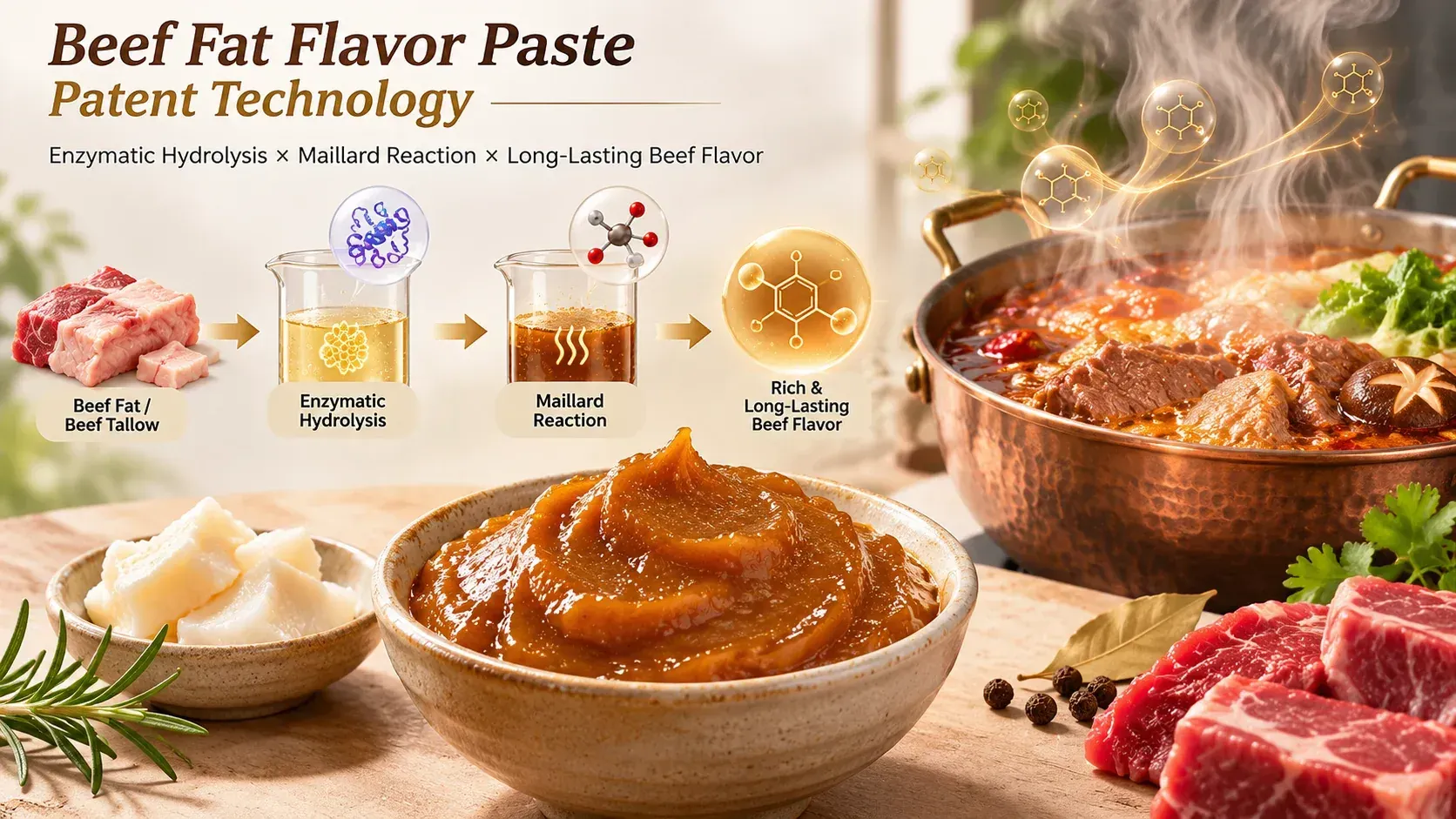
The process has three main stages:
- Selective hydrolysis of beef fat with an sn-1,3-specific lipase.
- Heating the resulting hydrolysate with reducing sugars and amino acids.
- Vacuum concentration to produce a flavor-rich, semi-solid paste.
None of these steps is new on its own. What the applicant claims is the way they are combined to improve flavor generation, physical stability and aroma persistence.
How the process works
1. Selective enzymatic hydrolysis of beef fat
Edible fats are made mostly of triglycerides: three fatty acids attached to a glycerol backbone at positions labeled sn-1, sn-2 and sn-3. An sn-1,3-specific lipase cuts mainly at the two outer positions, leaving a mixture of free fatty acids, monoacylglycerols, diacylglycerols and some unreacted triglycerides.
Each of these plays a part in the flavor system the patent describes. Free fatty acids can contribute to aroma directly or go on to oxidize into aldehydes, ketones and other volatiles typical of cooked fat and meat. Mono- and diacylglycerols are surface-active, so they can help the product disperse and keep emulsions stable.
The patent specifies hydrolysis at about 37–45 °C for 4–8 hours at near-neutral pH. According to the inventors, keeping the hydrolysis under control produces useful flavor precursors without breaking the fat down so far that rancid notes appear.
2. Building meat aroma through the Maillard reaction
The second stage relies on the Maillard reaction, one of the central processes in food flavor. When reducing sugars and amino compounds are heated together, their initial products rearrange, fragment and condense through a large network of reactions, producing many of the compounds behind roasted, savory, caramelized and meaty notes.
The preferred reducing sugars in CN122556620A are xylose and glucose, and the preferred amino acids are cysteine and lysine. Cysteine matters most here: its sulfur atom feeds into the formation of some of the most potent meat-like odorants known. The patent refers to sulfur-containing compounds such as thiazoles and thiophenes, along with pyrazines and other aroma molecules. These families are linked with roasted, cooked-meat, nutty and savory aromas, although what any of them actually contributes depends on which specific molecules form and in what amounts.
The reaction runs at 110–115 °C for roughly 1–2 hours, a range chosen to develop flavor without heavy browning, burnt notes or bitterness.
3. Vacuum concentration and aroma retention
After the Maillard stage, the mixture is concentrated under reduced pressure to a solids content of at least 25%, with example temperatures of around 40–60 °C. Lowering the pressure lets water boil off well below 100 °C, which reduces heat stress on the product, though it does not stop every volatile from escaping.
The result is a semi-solid paste containing fat-derived components and Maillard reaction products. The inventors suggest that mono- and diacylglycerols, together with larger Maillard-derived molecules, form a structured oil–water interface that slows the escape of volatile aroma compounds. Combined with aroma compounds that may continue to form or be released from reaction intermediates during cooking, this could explain a longer-lasting meat flavor. The proposed interfacial slow-release mechanism has not been directly confirmed, however, and would need structural and kinetic studies to verify it.
How it differs from conventional beef flavorings
Most savory reaction flavors are made by heating amino acids, peptides or protein hydrolysates with reducing sugars. Other meat flavor systems draw on animal fats, lipid oxidation products, yeast extracts or blends of individual flavor molecules. CN122556620A tries to bring several of these approaches into one process.
Its most distinctive feature is that selective fat hydrolysis is used for more than modifying the lipid. It also lays the groundwork for both developing and retaining aroma. In effect, the inventors are trying to design the chemical makeup of the aroma and the physical environment that controls its release at the same time, which could be especially useful for products that are heated for long periods.
Results reported in the patent
The patent includes several preparation examples and comparative tests covering flavor composition, retention under heat and performance in finished seasonings.
More flavor compounds detected
Volatile compounds were analyzed by headspace solid-phase microextraction with gas chromatography–mass spectrometry (HS-SPME-GC-MS). The applicant reports the following:
| Flavor characteristic | Conventional refined beef tallow | Patented flavor paste |
|---|---|---|
| Total volatile compounds detected | 37 | 62–73 |
| Characteristic heterocyclic compounds detected | 6 | 22–28 |
Under the reported test conditions, the combined enzymatic and Maillard process produced a much more varied volatile profile than ordinary refined tallow. A longer list of compounds is not the same as a better flavor, though. How something actually tastes and smells depends on odor thresholds, concentrations, interactions between compounds and the food they are in.
Better retention during heating
The most commercially relevant result concerns aroma after long heating. Five formulations of the paste reportedly retained about 81.6–86.8% of their total measured volatile signal after 60 minutes at 100 °C. In one direct comparison, a formulation retained 83.3%, against 28.4% for an otherwise similar formulation made without the enzymatic hydrolysis step.
Those are large differences within the applicant's own testing. They come from chromatographic measurements, however, not from measuring how people perceive the aroma while actually eating hotpot. They are best read as promising indicators rather than proof that the same retention will hold in every commercial product.
Using less tallow in seasonings
The patent also tests the paste as a partial replacement for tallow. Starting from a formula with 100 parts tallow, the inventors propose swapping out 15–30 parts of tallow for about 5–10 parts of flavor paste. Applications described include beef tallow hotpot seasoning, spicy soup bases, braising sauces and compound savory condiments.
A trained panel of 12 assessors reportedly scored samples on beef fat flavor intensity, meat flavor, richness, persistence and overall acceptability. Some reduced-tallow formulations containing the paste scored higher for beef fat flavor intensity after prolonged cooking than the full-tallow versions, which points to more flavor per unit of fat.
Using less tallow does not automatically mean an equivalent cut in total fat, saturated fat or calories. The net nutritional effect depends on the paste's composition and dose and on whatever other fats the recipe contains.
Where the invention sits in the history of meat flavor
The chemistry behind this application is not new. Meat-like flavors have been produced industrially from amino compounds and reducing sugars for decades, and that history helps pin down what is actually distinctive about CN122556620A.
Early reaction flavors: US3930046A
US3930046A, Process for Preparing a Meat Flavoring, was granted to The Procter & Gamble Company in 1975. It describes a meat-flavored composition made from hydrolyzed whey protein, xylose and cysteine, together with a separately prepared thiamine-derived flavor component. It shows that sugar–amino acid reactions were already recognized as a practical route to meat aroma, and it is an early example of blending different reaction flavors for a more rounded profile.
Relevance to CN122556620A: Using xylose and cysteine to create meat-like aroma is established technology. The newer application differs in combining position-specific hydrolysis of beef fat, a defined Maillard stage and vacuum concentration, with a focus on flavor persistence during long cooking.
Heme-assisted meat flavor: EP2943072
The EP2943072 patent family covers methods for changing the flavor and aroma profile of consumable products by combining heme-containing proteins with flavor precursors to produce cooked-meat characteristics. The precursors include sugars, amino acids, fatty acids and other compounds involved in thermal flavor chemistry. This work shows how meat flavor engineering has moved beyond simple sugar–amino acid reactions to include catalysts and additional reaction pathways.
Relevance to CN122556620A: Both recognize that meat aroma comes from interacting precursor systems rather than a single molecule. Their methods differ: heme-assisted systems rely on cooking reactions between heme proteins and precursors, while CN122556620A centers on enzymatic processing of real beef fat and on keeping the resulting aroma through extended heating.
Reaction flavors for plant-based meat: US12677856B2
US12677856B2, Flavoring Compositions of Improving Plant-Based Meat Flavor, Method of Making and Application Thereof, is a recent example of how central Maillard reaction products remain in flavor formulation. It describes reaction flavors made from sugars and amino compounds, including xylose with sulfur-containing amino acids, and identifies specific sulfur compounds associated with desirable meaty notes. Its target is better-tasting plant-based meat.
Relevance to CN122556620A: Both inventions use controlled thermal reactions to produce savory aroma molecules, but for different ends. US12677856B2 aims to improve plant-based meat, while CN122556620A targets beef fat-based compound seasonings and long-lasting aroma. Taken together, they suggest that differentiation in reaction flavors will increasingly come from precursor choice, process integration, delivery systems and performance in specific applications.
Why lipid–Maillard interactions matter
One of the more significant aspects of CN122556620A is its attempt to link lipid chemistry with Maillard pathways. In cooked meat, several chemical processes run at once. The Maillard reaction produces carbonyl compounds, nitrogen-containing heterocycles and sulfur-containing aromas, while thermal oxidation of lipids produces aldehydes and other reactive intermediates. These products react with one another and shift the overall balance of volatiles, so the aroma of cooked meat cannot be explained by either lipid oxidation or the Maillard reaction alone.
The patent builds on this by first releasing fatty acids enzymatically and then subjecting the mixture to controlled thermal flavor generation. Some embodiments add an intermediate oxidation step at about 120–150 °C to introduce extra lipid-derived carbonyl precursors that can influence later flavor formation.
Controlled oxidation is a balancing act. A little can add to cooked-fat aroma, while too much produces rancid notes and lowers quality. Getting this balance right will likely be one of the key variables in turning the patented process into a consistent commercial ingredient.
Possible applications
Hotpot and spicy soup seasonings
Hotpot bases are the obvious first target, since repeated or continuous heating changes aroma intensity over the course of a meal. A concentrated tallow flavor paste could help manufacturers keep the aroma more consistent while adjusting how much conventional beef fat they use.
Ready meals and retort foods
The paste could also be tried in ready meals, stews and shelf-stable meat sauces, which often go through several heating stages and long storage. The patent's boiling tests, however, say nothing about stability under retort sterilization or long-term ambient storage. Both would need to be tested separately.
Sauces and bouillons
As a concentrated paste, the product may suit braising sauces, gravy bases, concentrated soups and culinary pastes, where flavor retention and compatibility with complex oil–water systems are useful.
Fat-optimized seasoning systems
The technology could also be used to get more perceived beef flavor from each unit of tallow, supporting reformulation aimed at reducing particular ingredients without losing intensity. Any nutritional claim would still need compositional analysis of the finished product.
Technical and commercial hurdles
The results are promising, but several questions remain open.
- Scale-up: Commercial production would need consistent lipase activity, uniform mixing, reliable temperature control and reproducible flavor from batch to batch.
- Oxidation control: The optional oxidation step can add complexity to the flavor, but it also adds quality and process-control risks.
- Flavor stability: The retention data are encouraging, but storage stability, packaging compatibility and behavior in different food matrices still need to be studied.
- Mechanism: The proposed link between Maillard-derived macromolecules and slow aroma release is plausible but needs more direct evidence.
- Safety and regulation: Food-grade enzyme preparations, reaction conditions, process contaminants and the ingredient's flavor classification must all be assessed against the rules of each target market. Controlled heating alone does not guarantee that no unwanted reaction products form.
- Patentability and freedom to operate: Selective lipases, reaction flavors and aroma retention technologies all have extensive prior art. How much of this application is protectable will depend on the claims that are finally allowed after examination.
How innovative is CN122556620A?
The application tackles a real industrial problem: keeping a strong beef fat flavor through long heating without depending on large amounts of tallow. Its building blocks are all familiar, since lipase-based fat modification, Maillard flavor generation, controlled lipid oxidation and vacuum concentration are long-established food-processing tools. The potential inventive step lies in combining them into a beef fat-derived paste designed specifically for long-cooking applications.
The applicant reports gains in volatile diversity, chromatographic flavor retention and sensory performance, which justify further investigation. The slow-release mechanism, however, cannot be considered proven on the evidence presented. Useful next steps would include direct measurement of emulsion microstructure, studies of how aroma compounds bind to the matrix, time-resolved headspace release analysis and replicated sensory trials. It would also help to separate three possible explanations: true slow release, new aroma forming during heating, and simply less loss of the volatiles already present. For manufacturers, the distinction matters because each one points to different choices in process design, ingredient selection and target products.
Conclusion
CN122556620A reflects a growing trend in savory flavor development: designing ingredients not only for the aroma they produce at the start, but for how that aroma holds up as food cooks. By combining selective enzymatic hydrolysis of beef fat, Maillard chemistry and vacuum concentration, the applicant proposes a concentrated paste that may deliver a lasting beef fat aroma with less tallow.
The reported results are encouraging, especially for hotpot and other long-simmered seasonings. But the underlying chemistry has a long history, and the application's real commercial and legal significance will depend on reproducibility, independent validation, regulatory compliance and how its claims fare against existing technology during examination. More broadly, it suggests that future savory ingredients may compete not just on flavor intensity, but on how well they control the generation, retention and release of aroma during cooking.
Frequently asked questions
What is patent CN122556620A about?
It describes a beef fat flavor paste made by selective enzymatic hydrolysis, a Maillard reaction step and vacuum concentration. Intended uses include hotpot seasonings, spicy soups and savory sauces.
How does enzymatic hydrolysis improve beef flavor?
Hydrolysis breaks triglycerides down into free fatty acids and partial glycerides. These products feed into the later heating reactions and also change the physical properties of the finished paste.
Why is cysteine used in meat flavor production?
Cysteine contains sulfur, and its reactions produce powerful sulfur-containing aroma compounds associated with cooked meat.
Can the flavor paste reduce beef tallow use?
The inventors report replacing part of the tallow in seasoning formulas while keeping or improving certain measured flavor attributes. The actual effect on fat and calorie content would need a separate nutritional assessment.
What sets this technology apart from conventional meat flavoring?
Its distinguishing idea is the combination of position-specific fat hydrolysis, Maillard flavor development and a proposed mechanism for keeping aroma present during extended heating.
Is CN122556620A a granted patent?
No. The kind code "A" indicates a published Chinese patent application, and the record consulted lists it as pending.
References and further reading
- CN122556620A: A Beef Fat Flavor Paste, Its Preparation Method and Its Application. Chengdu Leweijia Biotechnology Co., Ltd. Published August 14, 2026. https://patents.google.com/patent/CN122556620A/en
- US3930046A: Process for Preparing a Meat Flavoring. The Procter & Gamble Company. Granted December 30, 1975. https://patents.google.com/patent/US3930046A/en
- EP2943072: Methods for Affecting the Flavour and Aroma Profile of Consumables. European patent family covering heme-related meat flavor technologies. https://patents.google.com/patent/EP2943072B2/en
- US12677856B2: Flavoring Compositions of Improving Plant-Based Meat Flavor, Method of Making and Application Thereof. Granted July 14, 2026. https://patents.google.com/patent/US12677856B2/en
Editorial note: This article reviews technical and patent literature. It is not an independent laboratory validation or a legal opinion on patent validity, infringement or freedom to operate.