Book Review: The Maillard Reaction: Chemistry, Biochemistry and Implications
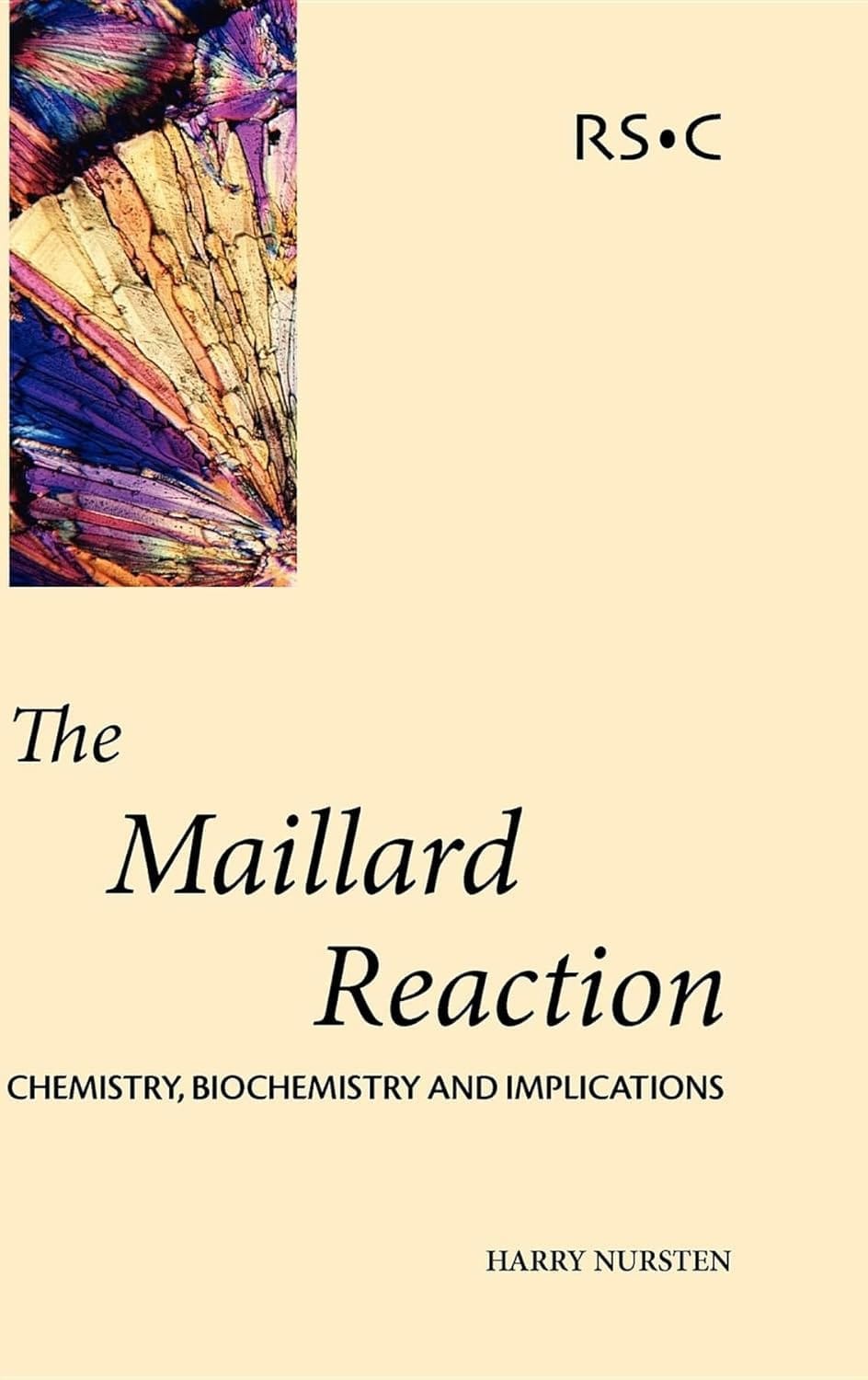
Book Review
The Maillard Reaction: Chemistry, Biochemistry and Implications
by H. E. Nursten
Introduction
The Maillard Reaction: Chemistry, Biochemistry and Implications is a rigorous and comprehensive monograph that examines one of the most significant chemical reactions in food science: the non-enzymatic reaction between reducing sugars and amino compounds that produces browning, flavor, aroma, and a wide range of biologically active products. Authored by H. E. Nursten, a respected food chemist, the book aims to integrate chemistry, biochemistry, nutrition, toxicology, and technological implications into a unified treatment of the Maillard reaction.
Rather than presenting a simplified culinary overview, Nursten delivers a detailed mechanistic and analytical exploration designed for scientists, advanced students, and professionals working in food chemistry, biochemistry, nutrition, and related disciplines. The result is a dense but authoritative reference work that bridges fundamental chemistry and real-world implications.
Scope and Organization
The book is structured to move from foundational chemistry toward broader biological and technological implications. It begins with historical context, tracing the discovery and early understanding of the Maillard reaction, then progresses into detailed mechanistic pathways. Subsequent sections examine:
- Early-stage reactions (Schiff base formation, Amadori rearrangement)
- Intermediate degradation pathways
- Advanced stages leading to melanoidin formation
- Flavor generation and volatile compounds
- Nutritional consequences
- Toxicological concerns
- Physiological and biomedical implications
One of the book’s defining strengths is its integrative scope. The Maillard reaction is not treated merely as a browning phenomenon in foods but as a complex network of reactions relevant to aging, chronic disease, and protein glycation in living systems.
Scientific Depth and Chemical Rigor
Nursten’s treatment of the chemistry is detailed and systematic. Reaction pathways are carefully delineated, with attention to:
- Carbonyl–amine condensation mechanisms
- Rearrangement chemistry
- Strecker degradation
- Formation of heterocyclic compounds
- Polymerization leading to high-molecular-weight melanoidins
The mechanistic explanations are supported by structural reasoning and reaction logic, which makes the book particularly valuable for chemists who wish to understand not just what products form, but why they form under specific thermal and pH conditions.
Unlike many edited volumes, this single-author monograph offers conceptual continuity. Terminology is consistent, reaction schemes are logically sequenced, and cross-referencing is coherent. This unified authorship avoids redundancy and fragmentation common in multi-author compilations.
However, the depth of chemical detail may be challenging for readers without a strong background in organic chemistry. Reaction schemes are not always simplified for accessibility, and readers expecting a more applied or culinary perspective may find the technical density demanding.
Treatment of Flavor Chemistry
For food scientists and flavor chemists, the book’s discussion of volatile compound formation is particularly valuable. Nursten connects Maillard intermediates to the generation of:
- Pyrazines (roasted, nutty notes)
- Pyrroles and furans
- Thiophenes and sulfur heterocycles
- Strecker aldehydes
- Nitrogen-containing aroma compounds
He emphasizes the importance of precursor composition (specific amino acids and sugars) in determining flavor outcomes. The discussion highlights how subtle variations in conditions—temperature, water activity, pH—dramatically influence product distribution.
Importantly, the book does not romanticize flavor formation. It acknowledges that desirable aroma compounds are produced alongside potentially harmful species, including reactive carbonyls and advanced glycation end products (AGEs). This balanced treatment reinforces the dual nature of the Maillard reaction: essential for flavor development, yet chemically complex and sometimes problematic.
Nutritional and Biological Implications
One of the book’s most significant contributions lies in its discussion of nutritional consequences. The Maillard reaction reduces the bioavailability of certain amino acids—particularly lysine—through early glycation products. This has implications for protein quality in heat-processed foods.
Nursten also addresses:
- Loss of essential amino acids
- Digestibility alterations
- Formation of crosslinked protein structures
- Potential toxicity of advanced reaction products
The transition from food chemistry to biological systems is handled with care. The book explores non-enzymatic glycation in vivo, linking food chemistry concepts to aging and chronic disease processes. While not a medical text, it provides a scientifically grounded overview of how similar chemistry occurs within the human body.
For readers interested in the intersection between food processing and health, this section is particularly valuable. It demonstrates that the Maillard reaction is not confined to the kitchen or industrial processing lines—it is also a biochemical phenomenon relevant to physiology.
Technological Relevance
The practical implications for food processing are woven throughout the book. Nursten discusses:
- Browning control strategies
- Factors influencing reaction rate
- Water activity effects
- Thermal processing optimization
- Industrial implications
Rather than providing step-by-step industrial recipes, the text offers conceptual tools for predicting and managing Maillard outcomes. It emphasizes that the reaction is highly sensitive to environmental conditions and ingredient composition.
For product developers and formulation scientists, the book provides theoretical insight rather than operational manuals. Its value lies in deep understanding rather than practical quick fixes.
Writing Style and Accessibility
The writing style is scholarly and analytical. Sentences are often information-dense, and the prose assumes familiarity with chemical terminology. Figures and reaction schemes support the text, but the presentation remains academic rather than pedagogical.
Strengths of the writing include:
- Logical progression
- Clear mechanistic explanations
- Consistent terminology
- Historical contextualization
Limitations include:
- Limited simplification for non-specialists
- Few illustrative real-world case studies
- Minimal use of summary diagrams for complex networks
This is not a casual read. It functions best as a reference or advanced course text rather than introductory material.
Pros
- Comprehensive Scope
Covers chemistry, biochemistry, nutrition, and implications in a unified framework. - Single-Author Coherence
Provides conceptual consistency absent from many edited volumes. - Mechanistic Depth
Detailed reaction pathways enhance scientific understanding. - Balanced Perspective
Addresses both beneficial (flavor, color) and potentially harmful outcomes. - Interdisciplinary Relevance
Bridges food chemistry and biomedical glycation research. - Authoritative Tone
Demonstrates mastery of the literature and historical development of the field.
Cons
- High Technical Density
Demands a strong background in organic and food chemistry. - Limited Pedagogical Features
Few summaries, learning aids, or simplified diagrams. - Less Focus on Modern Analytical Techniques
Depending on the reader’s needs, newer instrumental methods may not be as extensively covered as in more recent publications. - Minimal Culinary Context
Readers seeking applied gastronomic explanations may find the treatment abstract. - Advanced Level Target Audience
Not well suited for beginners or general readers.
Comparison to Other Works
Compared to edited conference volumes on Maillard chemistry, this monograph stands out for its cohesion. It offers deeper conceptual integration rather than collections of specialized chapters. However, readers seeking the most current developments in analytical instrumentation or clinical AGE research may need to supplement it with more recent literature.
Its strength lies in providing a foundational understanding of Maillard chemistry as a system of interrelated reactions, rather than as isolated phenomena.
Overall Evaluation
The Maillard Reaction: Chemistry, Biochemistry and Implications is best described as a foundational reference text. It is not introductory, nor is it primarily practical. Instead, it is a rigorous scholarly examination of one of the most important chemical processes in food science and biological chemistry.
For:
- Graduate students in food chemistry
- Researchers studying non-enzymatic browning
- Flavor chemists
- Nutritional biochemists
- Scientists exploring glycation mechanisms
the book provides a deep and reliable framework.
For:
- Culinary enthusiasts
- Entry-level students
- Readers seeking simplified explanations
it may be overly technical.
Final Verdict
This monograph remains a significant contribution to the literature on non-enzymatic browning. Its value lies in intellectual depth, interdisciplinary reach, and coherent authorship. While demanding in its technical rigor, it rewards serious readers with a nuanced understanding of a reaction that shapes the sensory qualities of food and influences biological systems.
Rating (professional scientific perspective): 4.5 / 5
Highly recommended as a core reference for advanced study of Maillard chemistry, with the caveat that it is best approached with a solid background in organic and food chemistry.