Boronia: What the SFC Expects Every Flavorist to Know
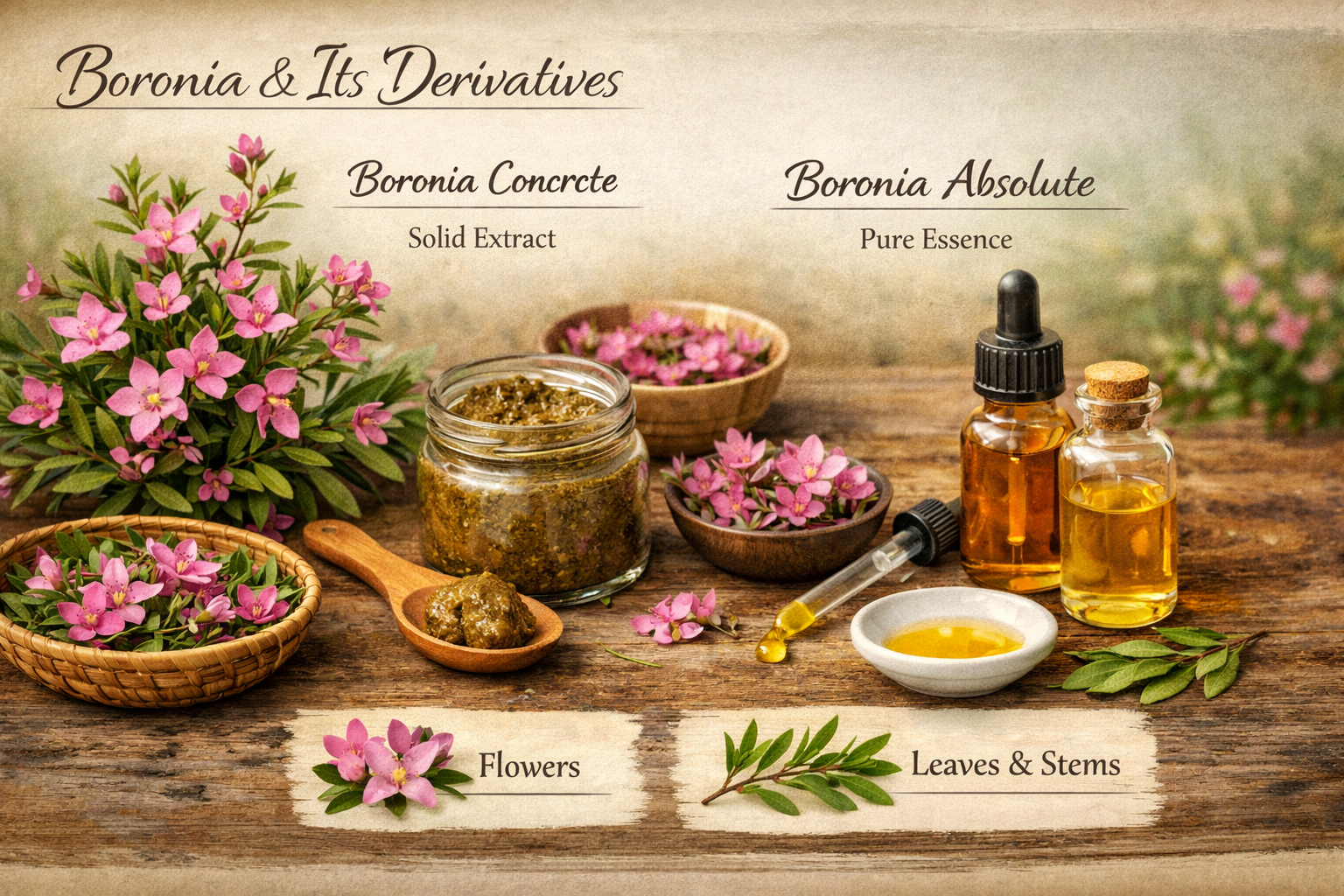
Basics of Bornia
Below is a deep, flavorist-level presentation of boronia (primarily Boronia megastigma), with added technical detail, typical ranges, processing nuances, and structure–function relationships.
🌿 1. Plant Parts Used (Detailed)
✅ Primary Raw Material: Flowers
- Botanical fraction used: fully developed flowers at peak bloom
- Harvest timing:
- Early morning → highest volatile content
- Short window (often a few weeks per season)
- Moisture content: ~70–80% at harvest → affects extraction efficiency
- Handling constraints:
- Extremely delicate → rapid enzymatic degradation if bruised
- Must be processed within hours
🔬 Why flowers only?
- Ionones and damascones are concentrated in petal tissue
- Leaves contain:
- More green/grassy terpenes
- Less of the characteristic tea–violet complexity
🧪 2. Derivatives (Process + Composition Differences)
• Concrete (Primary Industrial Intermediate)
Process:
- Non-polar solvent extraction (e.g., hexane)
- Temperature kept low to preserve thermolabile compounds
Composition:
- 40–60% waxes, pigments (chlorophyll, carotenoids)
- 40–60% aromatic fraction
Sensory:
- Dark, भारी (heavy), green, less diffusive
• Absolute (Key Flavor/Fragrance Material)
Process:
- Concrete dissolved in ethanol
- Chilling → wax precipitation
- Filtration → ethanol removal
Composition:
- Highly enriched in:
- Ionones
- Damascones
- Volatile ketones
Sensory:
- Cleaner, more floral, more diffusive
- Reduced green/waxy harshness
👉 Flavor use almost always = absolute (diluted)
• Essential Oil (Steam Distilled, Rare)
Process limitations:
- Heat (100°C+) causes:
- Degradation of damascenone precursors
- Loss of sulfur nuance
- Hydrolysis of esters
Result:
- Flatter profile:
- More woody/terpenic
- Less fruity/tea-like
👃 3. Organoleptic Characteristics (Layered with Volatility)
🔝 Top Notes (Highly Volatile; fast release)
- Green (cis-3-hexenol-like effect, though minor)
- Fresh herbal
- Light fruity (apple/berry)
Molecular drivers:
- Light esters
- Trace green volatiles
- Small terpenols (e.g., linalool)
❤️ Heart Notes (Core Identity)
- Violet floral
- Mimosa-like powdery sweetness
- Black tea infusion nuance
Molecular drivers:
- α-ionone, β-ionone
- Ionone epoxides
- Damascone traces
🔻 Base Notes (Low volatility; long persistence)
- Woody
- Tobacco-like
- Slight leather
- Dried fruit / raisin
Molecular drivers:
- Ionone derivatives (less volatile)
- Ketones
- Trace sulfur/nitrogen compounds
🧠 Sensory Paradox (Why Boronia is Unique)
Simultaneously expresses:
- Fresh + dark
- Floral + savory
- Fruity + tea-like
👉 This is due to cross-category molecules (ionones + sulfur traces) activating multiple olfactory pathways.
🧬 4. Key Chemical Components (Deep Dive)
🔑 A. Ionones (Structural Backbone)
Main molecules:
- α-ionone
- β-ionone
- dihydro-β-ionone
Formation:
- Derived from carotenoid degradation
Sensory role:
- Violet / orris-like
- Woody-fruity bridge
- Fixative effect (extends aroma)
Typical contribution:
- Dominant family (~30–60% of aroma impact)
🔑 B. Damascones & Damascenone (Ultra-potent traces)
Key molecule:
- β-damascenone (threshold ~0.002 ppb in water)
Sensory:
- Stewed apple
- Plum
- Rose-jam
Function:
- Adds volume and diffusion
- Creates “natural fruitiness” even at trace levels
🔑 C. Sulfur Compounds (Trace but निर्णायक)
Types:
- Thiols
- Sulfides
Sensory:
- Black tea
- Slight savory/meaty depth
Role:
- Prevents aroma from being:
- Too “clean”
- Too perfumey
👉 Without sulfur → boronia smells like “violet candy,” not natural tea
🔑 D. Esters (Top Note Lifters)
Examples:
- Ethyl esters (minor)
Role:
- Add:
- Juicy brightness
- Berry/apple lift
🔑 E. Terpenoids
Minor components:
- Linalool
- α-terpineol
Role:
- Floral freshness
- Volatile lift
🔑 F. Nitrogen-containing Compounds (Trace)
- Possibly heterocycles (very low concentration)
👉 Add:
- Earthy complexity
- Tea/tobacco realism
🧩 5. Aroma System Interaction (Professional View)
Boronia is best understood as a network, not a list:
Core محور (axis):
- Ionones → floral/woody backbone
Modulators:
- Damascenone → fruity amplification
- Sulfur compounds → realism + tea note
Topnote enhancers:
- Esters + terpenols
📊 Functional Matrix
| Function | Molecule Class | Effect |
|---|---|---|
| Structure | Ionones | Body, persistence |
| Diffusion | Damascenone | Lift, bloom |
| Naturalness | Sulfur traces | Tea realism |
| Freshness | Esters/terpenes | Top note sparkle |
⚠️ 6. Flavor Use (Advanced Considerations)
Dosage
- Typical: 0.1–5 ppm in finished product
- Overdose effect:
- Muddy
- Overly leathery
- Bitter/harsh
Stability Issues
Sensitive to:
- Oxidation
- Ionones → epoxides → off-notes
- Light
- Damascenone degradation
- Acidic media
- Ester hydrolysis
Matrix Interactions
Works well in:
- Tea systems (binds with tannin perception)
- Fruit flavors (enhances ripeness)
- Tobacco accords
Conflicts with:
- High citrus terpene systems (can get masked)
- Very clean profiles (appears “dirty”)
Functional Roles in Formulation
- “Naturalizer” (adds realism)
- “Bridge note” (links floral + fruity)
- “Depth builder” (adds low-end complexity)
✅ Final Technical Summary
Boronia (Boronia megastigma) is defined by:
1. Source
- Flower-derived, solvent-extracted absolute
2. Core Chemistry
- Ionones (structure)
- Damascenone (impact)
- Sulfur traces (authenticity)
3. Sensory Identity
- Violet + tea + fruity + woody
4. Functional Role
- Ultra-potent modifier used at trace levels to:
- Add realism
- Create tea/fruit depth
- Enhance natural complexity
A boronia reconstruction formula (with ratios)
Below is a professional-style boronia reconstruction inspired by the profile of Boronia megastigma. This is not a full replication (natural boronia is too complex), but a functional reconstruction that captures its key facets: violet–ionone core, tea nuance, fruity lift, and warm depth.
🧪 Boronia Reconstruction Formula (Concentrate)
📊 Target profile:
- Violet / ionone floral backbone
- Tea-like dryness
- Subtle fruity (apricot/berry) lift
- Warm woody–tobacco base
🔬 Formula (100.0 parts total)
🔹 Core Floral–Woody Backbone (Ionones)
- Alpha-ionone → 22.0
- Beta-ionone → 18.0
- Dihydro-beta-ionone → 8.0
👉 Provides:
- Violet floral identity
- Woody-fruity depth
- Persistence
🔹 Fruity / Diffusive Impact
- Beta-damascenone (1% in ethanol) → 2.0 (= 0.02 active)
- Beta-damascone (1% in ethanol) → 1.5 (= 0.015 active)
- Ethyl phenylacetate → 4.0
👉 Provides:
- Apple/plum jam nuance
- Diffusion and lift
- Honeyed floral-fruity tone
🔹 Tea / Naturalness Modifiers
- Phenylacetaldehyde → 3.0
- Benzyl acetate → 6.0
- Methyl jasmonate (10% dilution) → 5.0 (= 0.5 active)
👉 Provides:
- Tea-like character
- Floral realism
- Slight green nuance
🔹 Green / Fresh Top Notes
- Linalool → 6.0
- Cis-3-hexenol (10% dilution) → 3.0 (= 0.3 active)
👉 Provides:
- Fresh leafy lift
- Natural top note
🔹 Warm / Base / Tobacco Nuance
- Isobutyl quinoline (1% dilution) → 2.0 (= 0.02 active)
- Coumarin → 5.0
- Vanillin → 2.5
👉 Provides:
- Hay / tobacco / dry tea impression
- Warmth and softness
🔹 Sulfur Trace Effect (Critical for realism)
- Dimethyl sulfide (0.1% dilution) → 0.5 (extremely powerful)
👉 Provides:
- Black tea realism
- Slight savory depth
⚠️ Must be dosed very carefully
🔹 Solvent / Balance
- Ethanol or triacetin → 12.5
🧩 Functional Structure
Backbone:
- Ionones (~48%) → define boronia identity
Impact enhancers:
- Damascenone/damascone → fruity bloom
Naturalness:
- Sulfur + phenylacetaldehyde → tea realism
Top balance:
- Linalool + green notes → freshness
Base:
- Quinoline + coumarin → tobacco/hay depth
⚙️ Usage Guidelines
Dilution for flavor use:
- Prepare a 1% solution of this concentrate
- Use at:
- 0.05–0.5 ppm in finished product
Adjustment Options
If too floral:
- Reduce alpha-ionone slightly
- Increase coumarin or quinoline
If too heavy:
- Increase linalool
- Add small amount of benzyl alcohol
If lacking tea character:
- Slightly increase:
- Dimethyl sulfide (very carefully)
- Phenylacetaldehyde
If lacking fruit:
- Increase damascenone slightly (very small increments)
⚠️ Important Notes
- This is a high-impact system → small changes have large effects
- Sulfur component is essential but dangerous to overdose
- Real boronia contains many trace compounds not fully replicated here
✅ Summary
This reconstruction works because it recreates the three defining axes of boronia:
- Ionone floral–woody core
- Damascenone-driven fruity lift
- Sulfur-modulated tea realism
A boronia replacement system (important due to cost and regulatory limits)
Here is a practical boronia replacement system designed for flavor work when true material from Boronia megastigma is unavailable, too costly, or restricted.
The goal is not a single formula, but a modular system you can tune depending on application (tea, fruit, tobacco, etc.).
🧩 1. Concept: How to Replace Boronia
Boronia’s identity comes from three interacting axes:
Core محور (structure)
- Ionone floral–woody backbone
Impact axis
- Damascenone / damascone fruity diffusion
Naturalness axis
- Sulfur + tea-like notes
👉 A good replacement must recreate all three, not just floral notes.
🧪 2. Base Replacement System (Modular Concentrate)
📊 Master Blend (100 parts)
🔹 A. Floral–Woody Backbone (Essential)
- Alpha-ionone → 20.0
- Beta-ionone → 15.0
- Dihydro-beta-ionone → 6.0
👉 Mimics violet/woody body
🔹 B. Fruity Diffusion
- Beta-damascenone (1% dilution) → 2.5
- Beta-damascone (1% dilution) → 1.5
- Ethyl phenylacetate → 5.0
👉 Provides:
- Apple/plum jam effect
- Lift and bloom
🔹 C. Tea / Naturalness Core
- Phenylacetaldehyde → 3.5
- Benzyl acetate → 5.0
- Methyl jasmonate (10%) → 4.0
👉 Builds:
- Tea-like softness
- Floral realism
🔹 D. Green / Fresh Lift
- Linalool → 6.0
- Cis-3-hexenol (10%) → 2.5
🔹 E. Depth / Tobacco / Dryness
- Coumarin → 6.0
- Isobutyl quinoline (1%) → 1.5
- Maltol → 2.0
🔹 F. Sulfur Trace (Critical)
- Dimethyl sulfide (0.1%) → 0.4
⚠️ This is the “secret” to tea realism
🔹 G. Solvent
- Ethanol or triacetin → 19.6
🧠 3. System Logic (Why This Works)
| Boronia Effect | Replacement Strategy |
|---|---|
| Violet floral | Ionones |
| Fruity depth | Damascenone/damascone |
| Tea nuance | Phenylacetaldehyde + sulfur |
| Natural complexity | Jasmonate + trace sulfur |
| Warm base | Coumarin + quinoline |
👉 Missing even one block → result feels artificial
⚙️ 4. Application-Specific Modifications
🍵 A. Tea Flavors
- Increase:
- Phenylacetaldehyde (+1–2)
- Dimethyl sulfide (+0.05 max)
- Reduce:
- Ethyl phenylacetate
👉 Result: stronger black tea authenticity
🍑 B. Stone Fruit (Apricot/Peach)
- Increase:
- Damascenone (+0.5)
- Ethyl phenylacetate (+2)
- Reduce:
- Quinoline
👉 Result: juicy fruit with boronia-style depth
🍓 C. Berry Systems
- Add:
- Raspberry ketone (1–2 parts)
- Increase:
- Damascone
👉 Result: natural berry richness
🚬 D. Tobacco / Dark Profiles
- Increase:
- Quinoline (+0.5–1)
- Coumarin (+2)
- Reduce:
- Linalool
👉 Result: dry, leathery, tea-tobacco tone
🌼 E. Floral Systems
- Increase:
- Linalool
- Benzyl acetate
- Reduce:
- Sulfur slightly
👉 Result: cleaner floral with boronia nuance
⚠️ 5. Critical Control Points
Sulfur dosing
- Must remain extremely low
- Overdose → cabbage / off-notes
Ionone balance
- Too much alpha-ionone → too powdery
- Too much beta-ionone → too woody
Damascenone
- Very powerful → always pre-diluted
🧪 6. Simplified Low-Cost Version (Quick Substitute)
If materials are limited:
Minimal Formula (100 parts)
- Alpha-ionone → 25
- Beta-ionone → 20
- Ethyl phenylacetate → 10
- Phenylacetaldehyde → 5
- Linalool → 8
- Coumarin → 7
- Dimethyl sulfide (0.1%) → 0.3
- Solvent → balance
👉 This gives:
- “Boronia-like” effect
- Less complexity but still functional
✅ 7. Practical Usage
Dilution:
- Prepare 1% solution
Dosage:
- 0.05–0.5 ppm in final product
🧾 Final Takeaway
A successful boronia replacement system must recreate:
- Ionone backbone (structure)
- Damascenone fruit lift (impact)
- Sulfur-modulated tea realism (authenticity)
👉 Most failed substitutes miss the sulfur + tea interaction, which is why they smell “floral” but not like true boronia.
Applications of Boronia and its derivatives
Here is a comprehensive, flavorist-level overview of how boronia and its derivatives (mainly from Boronia megastigma) are used across flavor applications, including why it works in each system and how it is typically applied.
🧩 1. Role of Boronia in Flavor Systems
Boronia is rarely a “main flavor.” Instead, it functions as:
- Naturalizer → makes flavors taste less artificial
- Bridge note → connects floral, fruity, and brown notes
- Depth enhancer → adds low-level complexity
- Tea modifier → introduces realistic infusion character
👉 Used at trace levels (ppb–low ppm)
🍵 2. Tea Flavors (Primary Application)
🔹 Use Case
- Black tea
- Green tea (very low levels)
- Herbal tea blends
🔬 Function
- Recreates fermented leaf nuance
- Adds:
- Slight bitterness perception
- Dryness
- Brewed authenticity
🧪 Typical Use Level
- 0.05–0.3 ppm
⚙️ Why it works
- Ionones → woody-tea body
- Sulfur traces → infusion realism
- Phenylacetaldehyde synergy → honeyed tea note
👉 Without boronia, tea flavors often taste:
- Flat
- Too clean
- Lacking “brewed” character
🍑 3. Stone Fruit Flavors (Apricot, Peach)
🔹 Use Case
- Apricot
- Peach
- Nectarine
🔬 Function
- Adds:
- Jammy depth
- Skin nuance
- Ripeness perception
🧪 Typical Use Level
- 0.1–0.5 ppm
⚙️ Why it works
- Damascenone synergy → enhances fruit body
- Ionones → bridge fruit + floral
- Trace sulfur → prevents candy-like effect
👉 Especially important for:
- “Natural” fruit profiles
🍓 4. Berry Flavors
🔹 Use Case
- Raspberry
- Strawberry
- Blackberry
🔬 Function
- Adds:
- Dark berry depth
- Slight fermented nuance
- Seed/skin realism
🧪 Typical Use Level
- 0.05–0.2 ppm
⚙️ Why it works
- Damascones + ionones → berry richness
- Tea-like undertone → reduces artificial sharpness
🍊 5. Citrus Modulation (Advanced Use)
🔹 Use Case
- Orange
- Mandarin
- Bergamot-style tea systems
🔬 Function
- Softens sharp citrus top notes
- Adds:
- Peel depth
- Slight floral warmth
🧪 Typical Use Level
- Very low (0.01–0.05 ppm)
⚙️ Why it works
- Ionones act as fixatives
- Adds mid-note body to otherwise top-heavy systems
👉 Overuse → dull, muddy citrus
🌼 6. Floral Flavors
🔹 Use Case
- Violet
- Rose
- Jasmine
- Osmanthus-type profiles
🔬 Function
- Adds:
- Natural complexity
- Slight green/tea undertone
- Warmth
🧪 Typical Use Level
- 0.05–0.2 ppm
⚙️ Why it works
- Ionones → violet/orris bridge
- Jasmonate synergy → floral realism
- Sulfur trace → avoids “perfumey” effect
🍯 7. Honey & Sweet Brown Notes
🔹 Use Case
- Honey flavors
- Caramel blends
- Syrup notes
🔬 Function
- Adds:
- Floral top to honey
- Slight hay/tobacco nuance
🧪 Typical Use Level
- 0.05–0.15 ppm
⚙️ Why it works
- Phenylacetaldehyde synergy → honey note
- Coumarin-like effect → hay sweetness
🚬 8. Tobacco & Dark Flavor Systems
🔹 Use Case
- Tobacco flavors
- Smoke accords
- Dark beverage profiles
🔬 Function
- Adds:
- Dry leafy character
- Fermented nuance
- Slight leather tone
🧪 Typical Use Level
- 0.1–0.5 ppm
⚙️ Why it works
- Ionones → woody body
- Quinoline-like notes → tobacco dryness
- Sulfur → cured leaf realism
🥤 9. Beverage Applications
🔹 Use Case
- RTD tea
- Functional drinks
- Botanical beverages
🔬 Function
- Enhances:
- Aroma release over time
- Perceived authenticity
⚠️ Challenges
- Stability:
- Oxidation of ionones
- Loss of sulfur notes
💡 Solution
- Use encapsulation or emulsions
🍫 10. Chocolate & Cocoa Modulation (Niche Use)
🔹 Function
- Adds:
- Floral lift
- Slight fruit nuance
🧪 Use Level
- Extremely low (<0.05 ppm)
👉 Helps reduce:
- Flat cocoa perception
🧁 11. Bakery & Confectionery
🔹 Use Case
- Fruit fillings
- Floral candies
🔬 Function
- Adds:
- Depth to fruit fillings
- Natural complexity
👉 Rare due to cost, but used in premium products
🧬 12. Derivative-Specific Roles
Boronia Absolute
- Full profile
- Used for:
- Premium tea
- Fine flavor systems
Boronia Concrete
- Rare in flavor
- More used in fragrance
Reconstructed Boronia Bases
- Most common in flavor industry
- Provide:
- Cost control
- Consistency
- Regulatory compliance
⚠️ 13. Key Formulation Considerations
1. Dose control
- Very narrow optimal range
- Overdose → muddy, leathery, bitter
2. Matrix sensitivity
- Strong in:
- Tea
- Fruit
- Weak in:
- High terpene citrus
3. Stability
- Sensitive to:
- Light
- Oxygen
- Heat
✅ Final Summary
Boronia (Boronia megastigma) is used in flavors primarily as a trace-level complexity builder, especially in:
Core applications:
- Tea flavors (most important)
- Stone fruit and berry systems
- Tobacco and dark profiles
Supporting roles:
- Floral enhancement
- Citrus modulation
- Honey and brown notes
🎯 Key Insight
Boronia is not about a single flavor note.
👉 It is used to create:
- Depth
- Naturalness
- Bridging between flavor domains
A detailed formula for each application (tea, peach, berry, etc.)
Below are practical, flavorist-style formulas showing how boronia (from Boronia megastigma, typically as a 1% dilution of the absolute or a reconstruction) is used in real systems.
Each formula is given as a concentrate (100 parts) → then diluted into the final product.
🍵 1. Black Tea Flavor (RTD / Instant Tea)
🎯 Profile
Dry, slightly bitter, brewed leaf, natural tea aroma
🧪 Formula (100 parts)
- Linalool → 12.0
- Geraniol → 6.0
- Phenylacetaldehyde → 8.0
- Benzyl alcohol → 5.0
- Beta-ionone → 6.0
- Alpha-ionone → 5.0
- Methyl jasmonate (10%) → 10.0
- Coumarin → 4.0
- Dimethyl sulfide (0.1%) → 0.8
- Boronia absolute (1% dilution) → 2.0
- Ethanol / solvent → balance (41.2)
⚙️ Use level
- 0.1–0.3 ppm boronia equivalent in beverage
🍑 2. Apricot Flavor
🎯 Profile
Juicy, ripe, slightly jammy with skin nuance
🧪 Formula (100 parts)
- Gamma-undecalactone → 18.0
- Gamma-decalactone → 10.0
- Benzaldehyde → 3.0
- Ethyl butyrate → 8.0
- Beta-damascenone (1%) → 3.0
- Beta-ionone → 5.0
- Alpha-ionone → 4.0
- Ethyl phenylacetate → 6.0
- Boronia absolute (1%) → 1.5
- Vanillin → 2.5
- Solvent → balance (39.0)
⚙️ Effect
- Adds skin realism + jam depth
🍓 3. Raspberry Flavor
🎯 Profile
Natural, slightly dark berry with depth
🧪 Formula (100 parts)
- Raspberry ketone → 15.0
- Ethyl maltol → 6.0
- Beta-damascone (1%) → 3.0
- Beta-ionone → 6.0
- Linalool → 5.0
- Geraniol → 4.0
- Phenylacetaldehyde → 4.0
- Boronia absolute (1%) → 1.0
- Solvent → balance (56.0)
⚙️ Effect
- Reduces candy-like sharpness
- Adds “dark berry” realism
🍊 4. Orange Flavor (Natural Style)
🎯 Profile
Fresh juice with peel depth
🧪 Formula (100 parts)
- d-Limonene → 45.0
- Myrcene → 5.0
- Octanal → 4.0
- Decanal → 3.0
- Linalool → 6.0
- Citral → 4.0
- Beta-ionone → 1.5
- Boronia absolute (1%) → 0.5
- Ethanol → balance (31.0)
⚙️ Effect
- Adds peel/body depth
- Smooths sharp citrus edges
🌼 5. Violet Floral Flavor
🎯 Profile
Powdery violet with natural softness
🧪 Formula (100 parts)
- Alpha-ionone → 25.0
- Beta-ionone → 15.0
- Methyl ionone → 10.0
- Linalool → 6.0
- Benzyl acetate → 8.0
- Phenylacetaldehyde → 5.0
- Boronia absolute (1%) → 1.2
- Solvent → balance (29.8)
⚙️ Effect
- Adds realism and warmth
- Prevents “cosmetic” note
🍯 6. Honey Flavor
🎯 Profile
Floral, slightly waxy, natural honey
🧪 Formula (100 parts)
- Phenylacetaldehyde → 20.0
- Benzaldehyde → 4.0
- Linalool → 6.0
- Hotrienol → 3.0
- Coumarin → 6.0
- Ethyl maltol → 5.0
- Boronia absolute (1%) → 0.8
- Solvent → balance (55.2)
⚙️ Effect
- Adds floral complexity + hay nuance
🚬 7. Tobacco Flavor
🎯 Profile
Dry leaf, slightly sweet, cured tobacco
🧪 Formula (100 parts)
- Beta-ionone → 10.0
- Alpha-ionone → 8.0
- Isobutyl quinoline (1%) → 5.0
- Coumarin → 10.0
- Vanillin → 6.0
- Phenylacetaldehyde → 4.0
- Boronia absolute (1%) → 2.5
- Solvent → balance (54.5)
⚙️ Effect
- Adds cured leaf realism
- Enhances dryness and depth
🥤 8. RTD Tea Beverage System
🎯 Profile
Stable tea aroma in aqueous system
🧪 Formula (100 parts, emulsion base)
- Tea flavor base → 60.0
- Gum acacia → 12.0
- Propylene glycol → 10.0
- Boronia absolute (1%) → 1.0
- Antioxidant (ascorbic acid) → 0.5
- Water → balance (16.5)
⚙️ Effect
- Maintains aroma through shelf life
🍫 9. Cocoa / Chocolate Modifier
🎯 Profile
Richer cocoa with floral lift
🧪 Formula (100 parts)
- Cocoa extract → 40.0
- Vanillin → 8.0
- Maltol → 6.0
- Beta-ionone → 2.0
- Boronia absolute (1%) → 0.3
- Solvent → balance (43.7)
⚙️ Effect
- Adds top note complexity
- Reduces flatness
🧁 10. Fruit Filling (Bakery)
🎯 Profile
Cooked fruit with natural depth
🧪 Formula (100 parts)
- Ethyl butyrate → 10.0
- Gamma-decalactone → 8.0
- Benzaldehyde → 3.0
- Beta-damascenone (1%) → 2.5
- Beta-ionone → 4.0
- Boronia absolute (1%) → 1.2
- Solvent → balance (71.3)
⚙️ Effect
- Enhances cooked fruit realism
⚠️ General Usage Notes
Dilution
- Boronia always used as:
- 0.1–1% dilution before blending
Dosage in final product
- Typically:
- 0.01–0.5 ppm
Overdose effects
- Muddy
- Leathery
- Bitter
✅ Key Insight Across All Formulas
Boronia (Boronia megastigma) consistently functions as:
👉 A trace-level modifier that:
- Adds realism
- Bridges flavor notes
- Enhances depth
###