Chicory as a Natural Flavoring: A Comprehensive Technical Guide
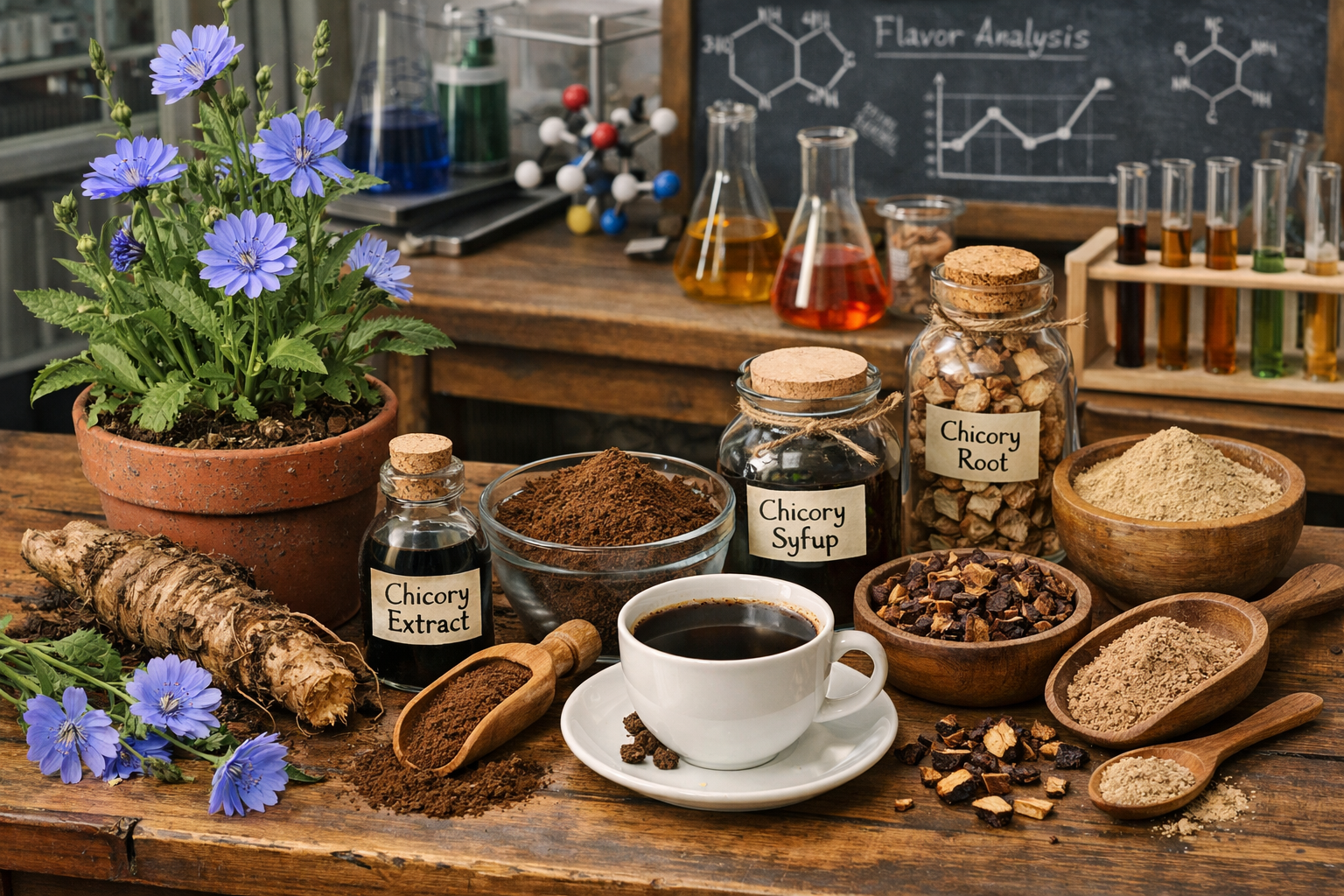
Here is a comprehensive technical guide for Chicory, structured in the same format as the previous guides. All key information for flavorists has been incorporated.
Chicory as a Natural Flavoring: A Comprehensive Technical Guide
The Society of Flavor Chemists requires certified flavorists to be able to identify the plant part used, derivatives, organoleptic characteristics, and major chemical component(s) characterizing the aroma and flavor of the 80 natural flavorings listed on its syllabus for the qualification test and interview. Chicory is included among these essential items.
Introduction
Chicory (Cichorium intybus L.) is a perennial herbaceous plant in the Asteraceae (daisy) family, native to Europe and Asia but now naturalized worldwide. While the leaves are known as radicchio or endive in culinary contexts, the root is the part of greatest interest to flavorists. Chicory root has a long history of use as a coffee substitute and extender, particularly in times of scarcity, and remains a valuable natural flavoring for its roasted, bitter, coffee-like, and nutty character.
For flavorists, chicory is prized for its ability to add depth, bitterness, roasted notes, and a coffee-like complexity to a wide range of applications. The root contains inulin (a prebiotic fiber) and, upon roasting, develops a complex array of volatile compounds—including pyrazines, furans, and pyrroles—that contribute to its characteristic aroma. Chicory is used in coffee blends, savory systems, baked goods, beverages, and increasingly in natural flavor formulations seeking a roasted, nutty, or bitter note.
A critical distinction for flavorists is the difference between raw chicory root (which has a mild, slightly sweet, and earthy character) and roasted chicory root (which develops the characteristic bitter, coffee-like, and nutty profile). Most commercial chicory ingredients are roasted to develop the desired flavor.
Plant Parts Used
The root is the plant part used for flavoring purposes. The following characteristics are notable:
- Source Plant: Cichorium intybus L.
- Root Description: Large, fleshy taproot, similar in appearance to a carrot, white to pale yellow in color. The root can grow up to 20–30 cm in length.
- Harvesting: Roots are harvested in the autumn of the first year of growth (chicory is a biennial). They are washed, sliced, and then dried or roasted.
- Processing: For flavor applications, the roots are typically roasted (similar to coffee beans) to develop the characteristic aroma. Roasting temperatures and times significantly affect the final flavor profile.
The dried, roasted root is ground to a powder (chicory "coffee") or further processed to produce extracts, soluble solids, and flavor concentrates.
Derivatives
Chicory is commercially available in several forms, each with different applications and technical specifications.
Roasted Chicory Root (Ground)
Production Method: Harvested roots are washed, sliced, dried, and then roasted (typically at 180–220°C). The roasted root is then ground to a powder.
Description: Dark brown to black powder with a characteristic roasted, bitter, coffee-like, nutty aroma. The flavor is intensely roasted, bitter, and slightly sweet.
Technical Notes: The roasted powder is hygroscopic and should be stored in airtight containers away from light and moisture. It is used in coffee blends, dry mixes, and as a flavor base.
Chicory Extract (Liquid)
Production Method: Hot water extraction of roasted chicory root, followed by concentration.
Description: Dark brown viscous liquid with a characteristic roasted, bitter, coffee-like aroma. The extract is highly concentrated and may be standardized to a specific Brix or solids content.
Technical Notes: Typical concentration is 40–70% solids. The extract is water-soluble and easy to incorporate into liquid systems. It contains inulin, fructooligosaccharides, and roasted flavor compounds.
Chicory Soluble (Powdered Extract)
Production Method: Hot water extraction of roasted chicory root, followed by concentration and spray-drying.
Description: Light brown to dark brown free-flowing powder with a characteristic roasted, bitter, coffee-like aroma. Highly soluble in water.
Technical Notes: The powder is hygroscopic and should be stored in airtight containers. It is used in dry mixes, instant beverages, and as a flavor carrier.
Chicory Fiber (Inulin)
Production Method: Hot water extraction of raw (unroasted) chicory root, followed by purification and drying.
Description: White to off-white free-flowing powder with a neutral, slightly sweet taste. Inulin is a prebiotic dietary fiber.
Technical Notes: While not a flavoring itself, inulin is often used as a texturant, fat replacer, and prebiotic fiber. It has a neutral flavor and does not contribute the characteristic roasted chicory notes.
Chicory Tincture
Production Method: Alcohol extraction of roasted chicory root.
Description: Dark brown liquid with characteristic roasted, bitter aroma.
Technical Notes: Less common than water-based extracts due to the water-solubility of the roasted compounds.
Organoleptic Characteristics
Aroma Profile (Roasted Chicory)
When evaluated, roasted chicory reveals a complex, warm, and intense aromatic profile:
- Primary Note: Roasted, bitter, coffee-like
- Coffee: Distinct, rich, dark-roast coffee character
- Nutty: Hazelnut, almond, toasted nut notes
- Caramel: Sweet, burnt-sugar, caramelized notes
- Bitter: Pronounced, pleasant, coffee-like bitterness
- Earthy: Woody, root-like, slightly smoky undertones
- Bready: Toasted bread, malt-like notes
- Sweet: Subtle, lingering sweetness
The overall aroma is often described as "roasted, bitter, coffee-like with nutty, caramel, and earthy undertones."
Taste Characteristics
At typical usage levels, roasted chicory provides:
- Bitter: Pronounced, coffee-like, pleasant bitterness
- Roasted: Deep, warm, dark-roasted character
- Nutty: Toasted nut, hazelnut-like notes
- Caramel: Sweet, burnt-sugar notes
- Earthy: Rooty, woody, grounding character
- Sweet: Slight, lingering sweetness (from inulin breakdown products)
- Astringent: Slight drying sensation
The Key to Chicory's Unique Flavor
Chicory's characteristic roasted, bitter, coffee-like flavor is the result of the Maillard reaction and caramelization that occur during the roasting process. Raw chicory root has a mild, earthy, and slightly sweet flavor with no roasted notes. Roasting transforms the inulin (a fructan) and other carbohydrates, as well as the protein content, into a complex mixture of volatile and non-volatile compounds:
Key Volatile Compounds (Formed During Roasting):
- Pyrazines (e.g., 2-methylpyrazine, 2,5-dimethylpyrazine): Contribute roasted, nutty, coffee-like notes
- Furans (e.g., furfural, 5-methylfurfural): Contribute caramel, sweet, burnt notes
- Pyrroles: Contribute nutty, roasted, slightly earthy notes
- Ketones and Aldehydes: Contribute to the overall roasted profile
Key Non-Volatile Compounds:
- Inulin and Fructooligosaccharides: Contribute body, mouthfeel, and slight sweetness
- Chicoric Acid and other Phenolic Compounds: Contribute bitterness and antioxidant properties
- Minerals: Potassium, calcium, magnesium
The bitterness of roasted chicory is more mellow and less acidic than coffee, making it a popular coffee extender and substitute.
Major Chemical Components
Key Volatile Aroma Compounds (Roasted Chicory)
| Component | Typical Contribution | Organoleptic Contribution | CAS No. |
|---|---|---|---|
| 2-Methylpyrazine | Major | Roasted, nutty, coffee-like | 109-08-0 |
| 2,5-Dimethylpyrazine | Major | Roasted, nutty, earthy | 123-32-0 |
| 2,6-Dimethylpyrazine | Major | Roasted, nutty | 108-50-9 |
| 2-Ethylpyrazine | Moderate | Roasted, nutty, coffee-like | 13925-00-3 |
| Furfural | Major | Sweet, caramel, bready | 98-01-1 |
| 5-Methylfurfural | Moderate | Caramel, spicy, sweet | 620-02-0 |
| 2-Acetylfuran | Moderate | Sweet, caramel, coffee-like | 1192-62-7 |
| 2-Acetylpyrrole | Moderate | Nutty, roasted, earthy | 1072-83-9 |
| Hydroxymethylfurfural (HMF) | Moderate | Sweet, caramel, bready | 67-47-0 |
| Phenol | Trace | Smoky, medicinal | 108-95-2 |
Key Non-Volatile Components (Raw and Roasted Chicory)
| Component | Raw Root | Roasted Root | Function |
|---|---|---|---|
| Inulin | 60–75% | 30–50% (partially degraded) | Prebiotic fiber, body, sweetness |
| Fructooligosaccharides (FOS) | 5–15% | 20–40% (from inulin degradation) | Sweetness, prebiotic |
| Free Fructose/Glucose | 2–5% | 5–15% (from inulin degradation) | Sweetness |
| Chicoric Acid | 0.5–1.5% | 0.3–1.0% | Bitterness, antioxidant |
| Caffeic Acid | 0.1–0.5% | 0.1–0.4% | Bitterness, antioxidant |
| Protein | 3–5% | 3–5% | Maillard reaction precursor |
Applications in Flavoring
Regulatory Status
Chicory and its derivatives are approved as natural flavoring substances and food ingredients:
- United States: Roasted chicory root is generally recognized as safe (GRAS). It is listed under 21 CFR §182.20 as a natural flavoring substance (FEMA No. 2280 for chicory root).
- European Union: Permitted for use in food flavorings under Regulation (EC) No 1334/2008. Chicory inulin and FOS are approved as dietary fibers.
- China: Approved food ingredient under GB standards.
Typical Usage Levels (mg/kg or %)
The following usage levels are based on industry standards:
| Application | Roasted Chicory Extract (mg/kg solids) | Roasted Chicory Powder (%) |
|---|---|---|
| Non-alcoholic beverages | 50–500 | 0.1–1.0 |
| Alcoholic beverages | 100–1,000 | N/A |
| Baked goods | 500–5,000 | 1–10 |
| Confectionery | 200–2,000 | 0.5–5 |
| Frozen dairy | 200–1,500 | 0.5–3 |
| Coffee blends | 1,000–10,000 | 10–50 (as extender) |
| Soups and sauces | 500–3,000 | 1–5 |
| Meat products | 500–2,000 | 1–4 |
| Cereals and bars | 500–3,000 | 1–6 |
Note: These ranges represent typical industry usage. Actual concentrations vary based on formulation goals and regulatory requirements.
Usage & Dosage Best Practices
Flavorists should observe the following guidelines when working with chicory:
Roasting Level Matters: Chicory can be roasted to varying degrees (light, medium, dark). Light roasts are less bitter and more nutty; dark roasts are more intense, bitter, and smoky. Select the appropriate roast level for the target application.
Water Solubility: Roasted chicory extracts and soluble powders are highly water-soluble, making them easy to incorporate into aqueous systems. The roasted powder can be used directly in dry blends.
Bitterness Balance: Chicory's bitterness is a key functional attribute. In applications where bitterness is undesirable, chicory can be used at lower levels or in combination with sweeteners (sugar, honey, maltodextrin) to balance the profile.
Flavor Synergies: Roasted chicory pairs exceptionally well with:
- Coffee: The classic pairing; enhances body and complexity
- Chocolate: Adds roasted, bitter depth
- Caramel and Toffee: Enhances sweet, burnt notes
- Nuts: Almond, hazelnut, walnut (complements nutty notes)
- Vanilla: Adds warmth and rounds bitterness
- Spices: Cinnamon, nutmeg, cardamom, ginger
- Tobacco: Used in tobacco flavor formulations
- Maple: Enhances sweet, woody notes
- Malt: Complements bready, roasted notes
Flavor Applications: Roasted chicory serves as a primary flavor or modifier in:
- Coffee blends: Coffee substitute and extender
- Beverages: Herbal "coffees," coffee alternatives, flavored lattes, chicory sodas, root beer
- Baked goods: Adds roasted, nutty notes to breads, cookies, cakes
- Confectionery: Chocolates, caramels, toffees, nougat
- Savory systems: Soups (especially onion and mushroom), sauces, gravies, meat glazes
- Cereals and bars: Adds roasted, nutty character
- Dairy: Ice cream, yogurt, custards
Fragrance Applications
Chicory is not commonly used in fine fragrance but may appear in:
- Gourmand fragrances: For roasted, coffee-like notes
- Novelty scents: In niche or culinary-inspired fragrances
Example Formula: Coffee-Chicory Beverage Base
The following formula demonstrates the use of roasted chicory in a coffee-style beverage application.
Coffee-Chicory Beverage Concentrate (Liquid)
| Component | Percentage (%) | Function | Technical Note |
|---|---|---|---|
| Chicory extract (40% solids) | 30.0 | Primary flavor | Roasted, bitter, coffee-like |
| Coffee extract (30% solids) | 20.0 | Coffee character | Adds complexity |
| Sugar | 15.0 | Sweetener | Balances bitterness |
| Caramel color | 5.0 | Color | Adds dark brown color |
| Vanillin (natural) | 1.0 | Sweet enhancement | Rounds the profile |
| Water | 29.0 | Carrier | Deionized |
| Total | 100.0 |
Usage Instructions: Dilute at a ratio of 1:5 to 1:10 with water or milk. Serve hot or cold.
Alternative: Roasted Chicory Flavor for Baked Goods (Dry Blend)
| Component | Percentage (%) | Function |
|---|---|---|
| Chicory soluble powder | 60.0 | Primary roasted, bitter note |
| Maltodextrin (carrier) | 20.0 | Carrier |
| Natural hazelnut flavor | 10.0 | Nutty enhancement |
| Vanilla powder | 5.0 | Sweet rounding |
| Salt | 5.0 | Flavor enhancer |
| Total | 100.0 |
Usage Instructions: Add at 1–5% to dry mixes for cookies, cakes, and breads.
Alternative: Chicory Tincture
| Component | Percentage (%) | Function |
|---|---|---|
| Roasted chicory root (ground) | 20.0 | Active ingredient |
| Ethanol (190 proof) | 60.0 | Solvent |
| Water | 20.0 | Co-solvent |
| Total | 100.0 |
Method: Combine ground roasted chicory with alcohol and water. Allow to macerate for 7–14 days, shaking daily. Filter. Store in amber glass bottles.
Usage Instructions: Use 0.1–1.0% in finished products.
Shelf Stability & Storage
Understanding the stability of chicory ingredients is critical for maintaining flavor quality.
Roasted Chicory Root (Ground)
Storage Recommendation: Store in airtight containers in a cool, dry place away from light. The powder is hygroscopic.
Stability Notes: Roasted chicory powder will absorb moisture from the air, leading to clumping and potential flavor degradation. It also loses volatile aromatics over time. Shelf life is typically 12–18 months when properly stored.
Chicory Extract (Liquid)
Storage Recommendation: Store in airtight containers in a cool, dry place. Refrigeration after opening is recommended.
Stability Notes: Liquid extracts are stable but may develop mold if contaminated. High solids content (40–70%) provides osmotic stability. Shelf life is typically 12–24 months.
Chicory Soluble (Powdered Extract)
Storage Recommendation: Store in airtight containers in a cool, dry place. The powder is hygroscopic.
Stability Notes: Soluble powder is more stable than the ground root. Shelf life is typically 18–24 months when properly stored.
Stability in Finished Products
- Heat stability: Chicory flavor is relatively heat-stable; suitable for baked goods and processed products.
- pH stability: Stable across typical food pH range (3–8). The roasted notes are not affected by moderate acidity.
- Moisture sensitivity: Chicory powder and extract are hygroscopic; protect from moisture.
Safety Considerations
General Safety
Chicory and its derivatives are generally recognized as safe (GRAS) for use as flavorings and food ingredients. Chicory inulin is widely used as a dietary fiber.
Important Considerations
- Allergies: Chicory is in the Asteraceae (Compositae) family. Individuals allergic to ragweed, chamomile, or other members of this family may experience cross-reactivity.
- Gastrointestinal Effects: Inulin is a prebiotic fiber and can cause gas, bloating, and digestive discomfort in sensitive individuals, particularly at high consumption levels.
- Pregnancy: Safe in food amounts; concentrated extracts should be used with caution during pregnancy.
- Gallstones: Chicory may stimulate bile production; individuals with gallstones should consult a healthcare provider.
- Birch Pollen Cross-Reactivity: Some individuals with birch pollen allergy may experience oral allergy syndrome with chicory.
Quality Control & Sourcing
Flavorists should implement the following quality checks when sourcing chicory ingredients.
Essential Requirements for Certificates of Analysis (COA)
For Roasted Chicory Root:
- Botanical identity: Confirmation of Cichorium intybus L.
- Origin: Specify country of origin (France, Belgium, Netherlands, Poland, South Africa, USA)
- Roast level: Light, medium, or dark (specify)
- Moisture content: <5%
- Inulin content: 30–50% (after roasting)
- Ash content: 5–10%
- Microbiological: Free from pathogenic microorganisms
For Chicory Extract (Liquid):
- Solids content: 40–70% (specify)
- pH: 4.5–5.5
- Color: Dark brown
- Flavor profile: Characteristic roasted, bitter, coffee-like
For Chicory Soluble (Powder):
- Solubility: Complete in water
- Moisture content: <5%
- Inulin content: 30–50%
Common Adulteration Risks
- Roasted chicory powder: Adulteration with roasted barley, roasted rye, or other cereal coffees; addition of caramel color; use of lower-grade roots
- Chicory extract: Dilution with maltodextrin or other carriers; addition of synthetic flavor compounds
Sourcing Considerations
| Origin | Characteristics |
|---|---|
| France | Traditional producer; high-quality, well-balanced profile |
| Belgium | Traditional producer; high-quality |
| Netherlands | Large-scale production; consistent quality |
| Poland | Good quality; competitive pricing |
| South Africa | Increasing production; good quality |
| USA (Michigan, Nebraska) | Domestic production; varying quality |
Traditional and Culinary Applications
Traditional Uses
- Coffee Substitute/Extender: Originated in France during the Napoleonic blockade; remains popular in New Orleans-style coffee, French "café au lait," and Indian "filter coffee."
- Culinary: Used in soups (especially in Belgium and France), braised dishes, and as a vegetable (chicory leaves are radicchio, endive).
- Medicinal: Traditionally used as a digestive aid, liver tonic, and mild laxative.
- Forage: Used as animal feed.
Culinary Pairings
Roasted chicory pairs well with:
- Beverages: Coffee, espresso, lattes, hot chocolate, root beer
- Spices: Cinnamon, nutmeg, cardamom, ginger, star anise
- Sweeteners: Brown sugar, honey, maple syrup, molasses
- Nuts: Hazelnut, almond, walnut
- Chocolate: Dark chocolate, cocoa
- Dairy: Cream, milk, butter
- Savory: Onions, mushrooms, meat glazes, barbecue sauces
Sustainability and Sourcing
Cultivation Practices
Chicory is cultivated worldwide as a root crop:
- France: Traditional European producer; high-quality roots
- Belgium: Known for both root production and witloof (endive) production
- Netherlands: Large-scale production for inulin extraction
- Poland: Major producer for roasted chicory
- South Africa: Growing producer for export
- USA: Grown in Michigan, Nebraska, and other regions
Quality Considerations
When sourcing chicory, consider:
- Origin: European chicory is traditionally considered highest quality for flavor applications.
- Roast level: Light roasts are nuttier, less bitter; dark roasts are more intense, bitter, and smoky.
- Processing: Proper roasting develops optimal flavor; over-roasting can produce burnt, acrid notes.
- Certifications: Organic, non-GMO, fair trade, Kosher, Halal.
Sustainability Challenges
- Arable land: Chicory requires good soil; competition with other crops.
- Processing energy: Roasting and extraction require significant energy input.
- Water use: Moderate water requirements.
Summary
Chicory (Cichorium intybus) is a versatile natural flavoring prized for its roasted, bitter, coffee-like character. The root, when roasted, develops a complex array of pyrazines, furans, and pyrroles through Maillard reaction and caramelization, providing a warm, nutty, caramelized, and pleasantly bitter profile that is used as a coffee extender, substitute, and flavor modifier across a wide range of applications.
Key characteristics:
- Primary components (roasted): Pyrazines, furans, inulin-derived sugars
- Aroma profile: Roasted, bitter, coffee-like, nutty, caramel, earthy
- Typical usage: Extract 50–10,000 mg/kg solids; powder 0.1–10%
- Primary applications: Coffee blends, beverages, baked goods, confectionery, savory systems
Critical considerations for flavorists:
- Roast level affects flavor: Light roasts are nuttier; dark roasts are more intense and bitter.
- Water solubility: Extracts and soluble powders are highly water-soluble and easy to use.
- Bitterness balance: Chicory's bitterness can be balanced with sweeteners.
- Flavor synergies: Pairs with coffee, chocolate, nuts, caramel, spices.
- Allergen status: Asteraceae family; potential cross-reactivity with ragweed.
References and Further Reading
The information presented in this guide is synthesized from:
- Regulatory documents from FDA, FEMA (No. 2280), and international food safety authorities.
- Published scientific literature on Cichorium intybus and roasted chicory chemistry.
- Standard textbooks on natural flavoring materials.
- Industry technical data from major suppliers.
- Traditional culinary knowledge documented in public domain sources.
Key References:
- FEMA Flavor Ingredient Library: Chicory Root (FEMA 2280)
- Journal of Agricultural and Food Chemistry: Volatile compounds in roasted chicory
- Food Chemistry: Maillard reaction products in roasted chicory
- TGSC Information System: Chicory Extract
Disclaimer: This article is for informational purposes only. When using chicory in commercial products, always verify current regulatory status in your jurisdiction, conduct appropriate safety assessments, and source ingredients from reputable suppliers who can provide documentation of botanical identity, origin, roast level, and quality. Roasted and raw chicory have different flavor profiles; select the appropriate form for your application. The formulas and usage levels provided are illustrative examples and may require adjustment based on specific product requirements and regulatory compliance.
###