Chobani Zero Sugar Lawsuit Explained: Why the Allulose Labeling Dispute Matters
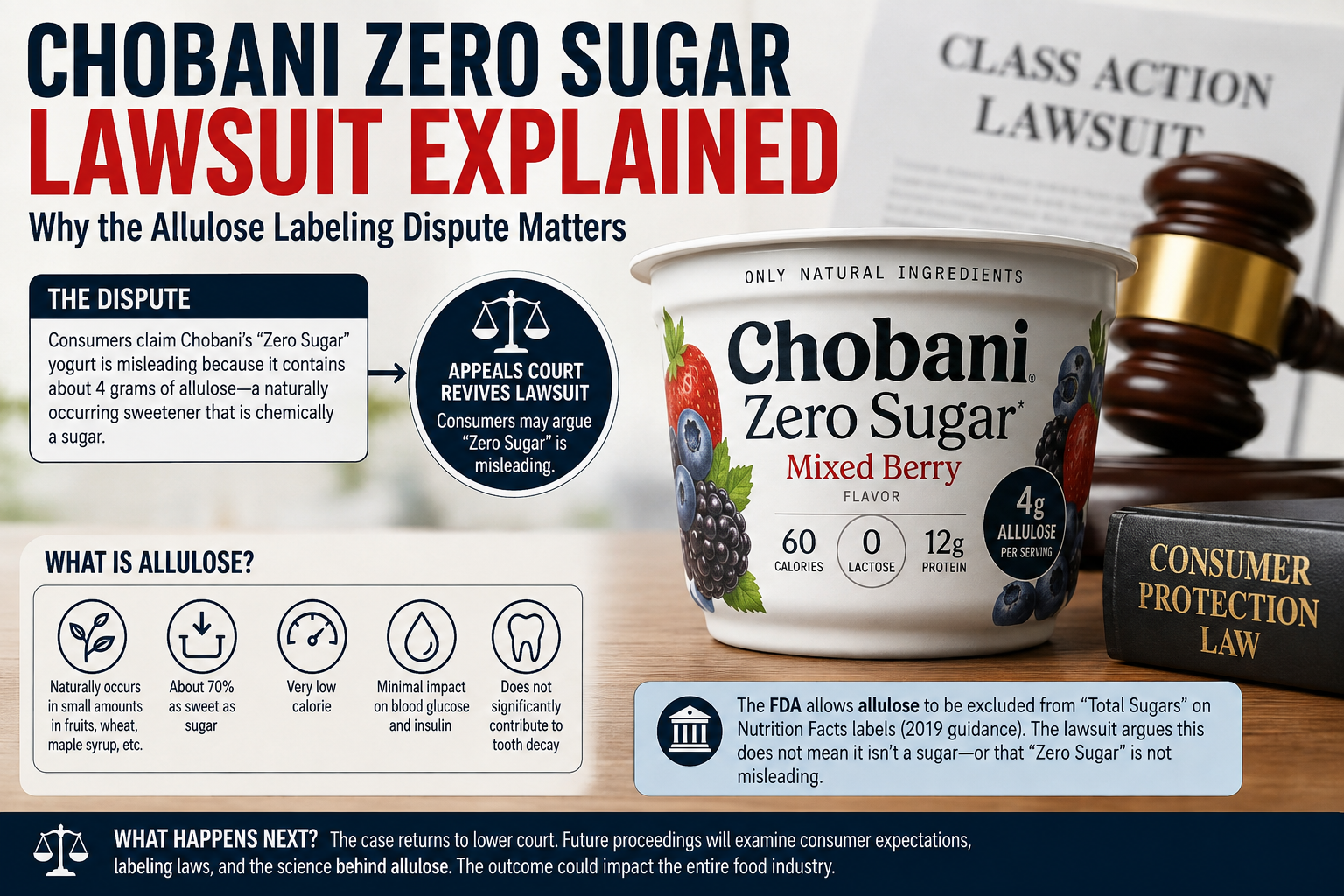
Thursday, Aug 6, 2026 - A federal appeals court has revived a consumer lawsuit against Chobani over its popular Zero Sugar yogurt line, putting the spotlight on one of the food industry's most debated ingredients: allulose. The case raises broader questions about food labeling, consumer expectations, and how emerging sweeteners fit into existing FDA regulations. (Reuters)
While the lawsuit does not determine that Chobani misled consumers, it allows the plaintiffs' claims to move forward, making it a significant legal development for food manufacturers that use allulose and similar sugar alternatives.
What Is the Chobani Zero Sugar Lawsuit About?
The lawsuit was originally filed by consumers who alleged that Chobani's Zero Sugar yogurt is deceptively labeled because each serving contains approximately 4 grams of allulose, a naturally occurring sweetener that is chemically classified as a monosaccharide (a simple sugar).
According to the plaintiffs, consumers reasonably interpret "Zero Sugar" to mean a product contains no sugar whatsoever. Because allulose is chemically a sugar, they argue the labeling is misleading under state consumer protection laws. (Justia Law)
Chobani, however, maintains that its labeling complies with FDA guidance and accurately reflects the way allulose is treated on Nutrition Facts labels.
Understanding Allulose
Allulose has become increasingly popular among food manufacturers looking to reduce calories and traditional sugar without sacrificing sweetness.
Unlike table sugar (sucrose), allulose:
- Occurs naturally in small amounts in foods such as figs, raisins, wheat, and maple syrup.
- Tastes about 70% as sweet as sugar.
- Contains only a fraction of the calories of regular sugar.
- Has minimal impact on blood glucose and insulin levels.
- Does not significantly contribute to tooth decay.
Because of these characteristics, allulose has become a favored ingredient in products marketed toward people following ketogenic, low-carb, diabetic-friendly, or reduced-sugar diets.
Why FDA Guidance Created Confusion
The heart of the legal dispute lies in an unusual regulatory situation.
In 2019, the U.S. Food and Drug Administration announced that manufacturers could exclude allulose from the "Total Sugars" and "Added Sugars" values on Nutrition Facts panels because the body metabolizes it differently from conventional sugars.
The FDA reasoned that listing allulose alongside traditional sugars could discourage manufacturers from using an ingredient that may help reduce overall sugar consumption. However, this guidance was issued as an exercise of enforcement discretion, not as a formal change to the underlying food-labeling regulations. (Justia Law)
That distinction ultimately became central to the lawsuit.
The Earlier Court Decision
In 2025, a federal district judge dismissed the case.
The court concluded that FDA guidance effectively authorized Chobani's labeling approach and found that federal law preempted the plaintiffs' state-law consumer protection claims.
Under that reasoning, because the FDA permitted manufacturers to exclude allulose from declared sugars, consumers could not use state law to impose different labeling requirements. (Reuters)
At that point, it appeared the litigation had effectively ended.
Appeals Court Revives the Lawsuit
Everything changed in July 2026.
The Seventh U.S. Circuit Court of Appeals reversed the lower court's dismissal and ruled that the lawsuit may proceed.
The appeals court concluded that:
- Federal regulations defining "total sugars" still include all monosaccharides, including allulose.
- FDA enforcement guidance does not formally rewrite those regulations.
- Because the plaintiffs seek to enforce standards that mirror federal regulations, their state consumer protection claims are not automatically preempted.
- The consumers have plausibly alleged that reasonable shoppers could interpret "Zero Sugar" literally and therefore believe the product contains no sugars of any kind. (Justia Law)
Importantly, the appeals court did not decide that Chobani violated the law. Instead, it held only that the consumers presented sufficient allegations to continue litigating their claims.
Why This Case Matters Beyond Chobani
Although the lawsuit focuses on one yogurt product, its implications extend across the food industry.
Many manufacturers now formulate products using:
- Allulose
- Monk fruit
- Stevia
- Erythritol
- Other alternative sweeteners
Food companies have increasingly invested in these ingredients because consumers continue to demand products with lower sugar content while maintaining familiar taste and texture.
If courts ultimately determine that labeling products as "Zero Sugar" is misleading when they contain allulose, companies may need to reconsider how they market products that rely on this ingredient.
The Consumer Perspective
From a consumer standpoint, the lawsuit highlights a common challenge in modern food labeling.
Many shoppers interpret claims such as:
- Zero Sugar
- Sugar Free
- No Added Sugar
- Reduced Sugar
as having similar meanings, even though federal regulations define these terms differently.
Consumers may also assume that "Zero Sugar" means:
- no sugars are present,
- blood sugar will not rise,
- or the product contains no sweetening ingredients.
In reality, those assumptions may not always match either food science or FDA labeling rules.
The Chobani case illustrates the growing gap between regulatory definitions and consumer expectations.
The Industry Perspective
Food manufacturers argue that allulose deserves unique treatment because it behaves differently from traditional sugars inside the human body.
Unlike glucose or sucrose, allulose contributes very few calories and produces minimal glycemic response. Public health experts have suggested that encouraging the use of ingredients like allulose could help reduce overall sugar consumption in the American diet.
Companies therefore contend that forcing allulose to be treated identically to conventional sugar on labels could discourage innovation in healthier food formulations. (Reuters)
What Happens Next?
The appeals court has simply returned the case to the lower court.
During future proceedings, both sides will likely present evidence regarding:
- how reasonable consumers understand "Zero Sugar" claims,
- whether shoppers were actually misled,
- the scientific characteristics of allulose,
- FDA regulatory history,
- and consumer survey evidence regarding labeling expectations.
The litigation could ultimately result in:
- a settlement,
- a trial,
- additional appeals,
- or future FDA regulatory clarification.
Given the growing use of alternative sweeteners, many legal experts expect the outcome to influence future food-labeling disputes.
Final Thoughts
The Chobani Zero Sugar lawsuit represents much more than a disagreement over one yogurt label. It reflects the broader challenge of regulating innovative food ingredients within labeling rules that were largely written before many modern sugar alternatives became widely available.
At its core, the case asks a deceptively simple question: When a package says "Zero Sugar," what should consumers reasonably expect?
The answer could shape how food manufacturers market reduced-sugar products for years to come.
For consumers, the dispute is also a reminder that terms such as "Zero Sugar," "Sugar Free," and "No Added Sugar" each have distinct regulatory meanings. Reading both the front-of-package claims and the Nutrition Facts panel remains the best way to understand what's actually in a product.
As the case proceeds, it will continue to be closely watched by food companies, regulators, consumer advocates, and anyone interested in the evolving landscape of healthier food products. (Justia Law)

###