Patent Technical Review: Coffee Aroma Stabilization: Key Insights for Flavorists
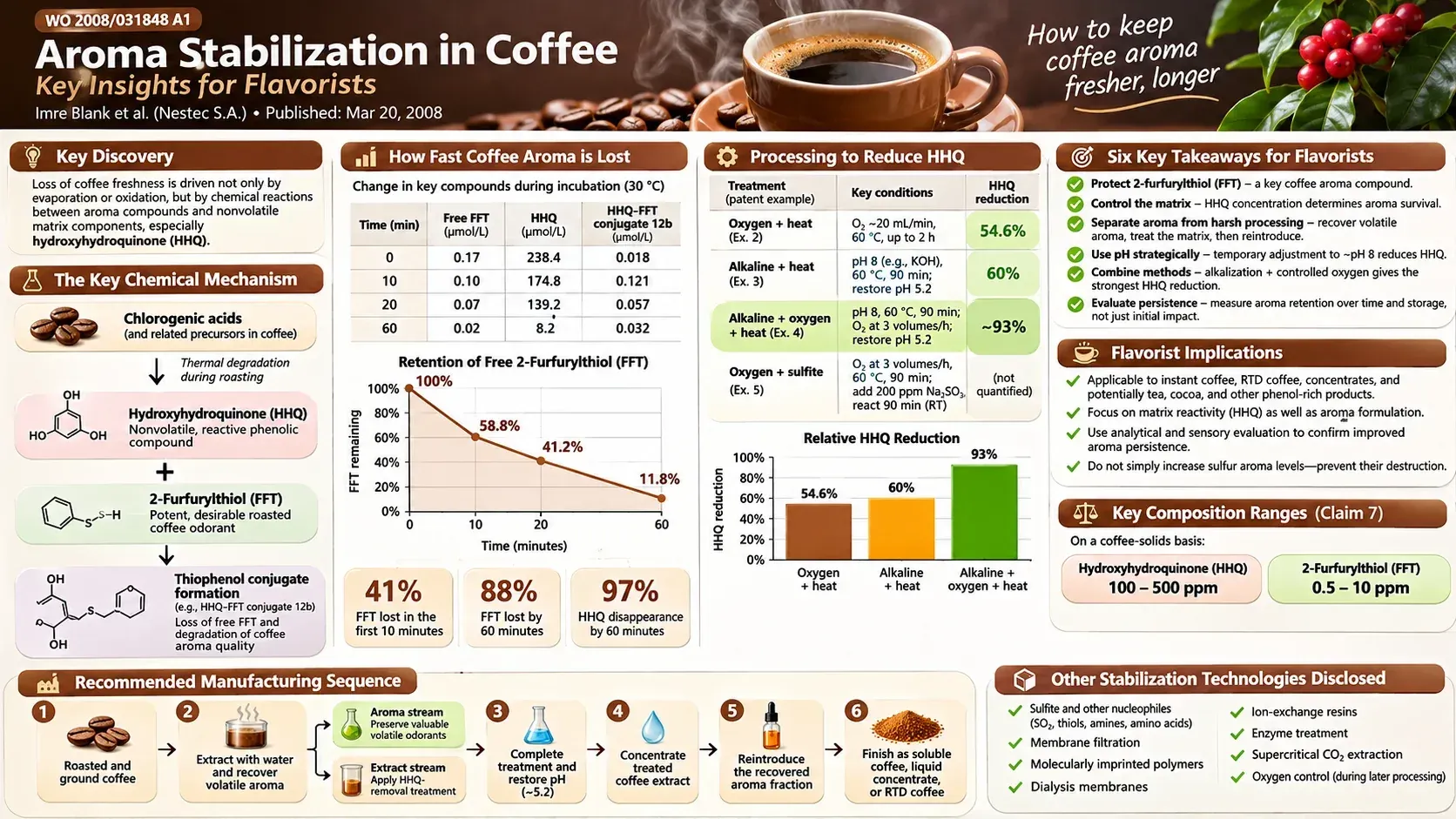
Coffee Aroma Stabilization: Key Insights for Flavorists
How hydroxyhydroquinone affects the survival of 2-furfurylthiol, and what patent WO 2008/031848 A1 teaches about preserving fresh-roasted coffee aroma.
Patent: WO 2008/031848 A1 · Published March 20, 2008 · Imre Blank and co-inventors · Applicant: Nestec S.A.
Summary: the central finding
Coffee loses its freshness for more reasons than volatile escape or oxidation. Important aroma molecules can also react with nonvolatile components of the coffee matrix. Patent WO 2008/031848 A1 identifies hydroxyhydroquinone (HHQ) as a major contributor to the disappearance of 2-furfurylthiol (FFT), a potent fresh-roasted coffee odorant.
Formulation principle: Removing or transforming reactive matrix components before adding valuable aroma back can work better than compensating for aroma loss with a higher dosage.
The proposed process separates the vulnerable volatile aroma from a coffee extract, treats the extract to reduce HHQ, then recombines the aroma with the treated matrix. The order of these steps matters.
- Protect FFT: Track a key sulfur-containing coffee odorant.
- Control the matrix: HHQ can shorten aroma persistence.
- Separate first: Keep aroma away from harsh matrix treatments.
- Adjust pH temporarily: Example treatments use pH 8, then restore pH to about 5.2.
- Combine methods: Alkalization, oxygen and heat together give the largest reported HHQ reduction.
- Measure over time: Initial aroma intensity alone is not a reliable stability measure.
Key aroma compounds and reactive chemicals
| Compound | Significance | Practical relevance |
|---|---|---|
| 2-Furfurylthiol (FFT) | Potent sulfur-containing, fresh-roasted coffee odorant | Primary aroma compound to protect and monitor |
| Hydroxyhydroquinone (HHQ) | Reactive trihydroxybenzene formed during roasting | Main matrix-derived antagonist identified in the patent |
| Pyrogallol | Trihydroxybenzene | Additional potential thiol-reactive phenol |
| Catechol | Dihydroxybenzene | Additional contributor to phenol–thiol reaction chemistry |
| 3-Methylcatechol, 4-methylcatechol, 4-ethylcatechol | Substituted catechols | Other phenolic compounds examined |
| 5-O-Caffeoylquinic acid | Coffee chlorogenic acid | Relevant HHQ precursor during roasting |
| Hydrogen peroxide | Oxidative reaction species | Possible contributor to degradation of other flavor constituents |
Chemical mechanism
During roasting, chlorogenic-acid-related precursors can contribute to HHQ formation. HHQ then takes part in reactions that consume free FFT and form sulfur-containing phenolic conjugates, along with accompanying oxidative chemistry. The patent examines HHQ–FFT conjugate 12b, 4-((furan-2-ylmethyl)sulfanyl)hydroxyhydroquinone.
HHQ matters mainly because of its indirect effect on aroma, not because it is an intense off-odorant that needs masking. The patent does not show identical reaction rates for every coffee sulfur odorant.
How quickly coffee aroma can disappear
In Example 1 of the patent, 54 g of roast-and-ground coffee was extracted with about 1 L of water at 95°C, and the resulting beverage was incubated at 30°C. Phenols, free FFT and selected phenol–FFT conjugates were measured at 0, 10, 20 and 60 minutes.
| Incubation | Free FFT (µmol/L) | HHQ (µmol/L) | HHQ–FFT conjugate 12b (µmol/L) |
|---|---|---|---|
| 0 min | 0.17 | 238.4 | 0.018 |
| 10 min | 0.10 | 174.8 | 0.121 |
| 20 min | 0.07 | 139.2 | 0.057 |
| 60 min | 0.02 | 8.2 | 0.032 |
Values from patent Example 1, Table 1. Percent retention below is calculated relative to the 0-minute reading.
- 41% of FFT lost after 10 minutes
- 88% of FFT lost after 60 minutes
- 97% of HHQ gone after 60 minutes
Free FFT falls from 0.17 to 0.02 µmol/L over 60 minutes. The measured HHQ–FFT conjugate rises sharply by 10 minutes and then declines. The disappearance of HHQ on its own does not show that aroma was preserved, because the desired thiol may already have reacted.
Other measured phenols
| Compound | Initial (µmol/L) | At 60 min (µmol/L) |
|---|---|---|
| Pyrogallol | 22.2 | 22.1 |
| Catechol | 42.9 | 40.5 |
| 4-Ethylcatechol | 8.5 | 8.1 |
| 4-Methylcatechol | 2.4 | 2.6 |
| 3-Methylcatechol | 9.8 | 9.8 |
These largely stable readings make HHQ the clearest processing target in the coffee tested. They do not mean that every other phenolic reaction is irrelevant.
Processing conditions and reported HHQ reduction
| Example | Conditions | HHQ result | Reported aroma outcome |
|---|---|---|---|
| 2: Oxygen + heat | 700 mL extract; O₂ ~20 mL/min; 60°C; up to 2 h | 21.6 → 9.8 mg/L (~54.6% reduction) | Fresher, longer-lasting aroma |
| 3: Alkaline + heat | pH 8 (preferably KOH); 60°C; 90 min; closed system; restore to pH 5.2 | ~60% reduction (40% remaining) | Fresher, longer-lasting aroma |
| 4: Alkaline + oxygen + heat | pH 8; 60°C; 90 min; oxygen feed 3 extract volumes/h; restore pH 5.2 | ~93% reduction (~7% remaining) | Fresher, longer-lasting aroma |
| 5: Oxygen + sulfite | 10–14% solids; O₂ 3 volumes/h at 60°C for 90 min; 200 ppm sodium sulfite; another 90 min at room temperature | No numerical reduction given | Fresher, longer-lasting aroma |
Largest reported reduction: Example 4 reports about 93% HHQ reduction using combined pH, oxygen and heat treatment. The examples were not run as a controlled head-to-head comparison, so this does not establish the best commercial process.
An oxygen feed of three extract volumes per hour equals a nominal 3 L O₂/h for 1 L of extract. Actual dissolved-oxygen exposure depends on gas–liquid mass transfer, mixing, pressure and equipment design, which the patent does not fully specify. Restoring the pH to about 5.2 is important so the finished coffee does not keep an alkaline profile.
Other stabilization technologies disclosed
| Approach | Mechanism or purpose | Evidence in patent |
|---|---|---|
| Controlled oxygen exposure | Oxidatively transform HHQ before aroma return | Quantitative coffee example |
| Temporary alkalization | Promote HHQ conversion, then restore pH | Quantitative coffee example |
| Heat treatment | Facilitate conversion (broad 20–100°C range discussed) | Used in examples with other treatments |
| Oxygen + alkaline treatment | Combination matrix treatment | Strongest numerical example |
| Sulfite / other nucleophiles | Chemical trapping; SO₂, thiols, amines, amino acids including cysteine discussed | Sulfite example and other proposed options |
| Membrane filtration and dialysis | Physical separation of selected constituents | Disclosed; no comparable quantitative example |
| Molecularly imprinted polymers | Selective phenol capture | Disclosed |
| Ion-exchange / metal-chelate resins | Selective matrix treatment | Disclosed |
| Enzyme treatment | Enzymatic modification | Disclosed |
| Supercritical CO₂ extraction | Extract or remove target materials | Disclosed |
| Downstream oxygen control | Limit later aroma damage | Disclosed as an additional measure |
Using oxygen to pretreat an aroma-depleted fraction does not make oxygen exposure protective in general. Once vulnerable aroma molecules have been added back, oxygen can still promote deterioration.
Recommended manufacturing sequence
- Roast and grind coffee. Select and characterize raw materials and roasting conditions.
- Extract and recover volatile aroma. Separate an aroma-rich stream by steam stripping, condensation or related recovery methods.
- Treat the aroma-depleted extract. Reduce HHQ by a suitable process, then restore pH and manage residual treatment conditions.
- Concentrate the treated extract. Apply processing appropriate to the intended product.
- Reintroduce recovered aroma. Return the protected volatiles once the aggressive matrix treatment is complete.
- Finish the product. Examples include soluble coffee, liquid concentrates and RTD beverages.
The patent discusses aroma handling approaches including partial condensation, rectification, membrane concentration, freeze concentration and cryogenic aroma frost. Finished soluble coffee may be spray-dried or freeze-dried.
Analytical methods for flavor chemists
Measure HHQ
Compare untreated and treated extracts on a consistent concentration basis. The patent cites an analytical method by C. Müller and colleagues in Journal of Agricultural and Food Chemistry (2006), vol. 54, pp. 10086–10091.
HHQ reduction (%) = [(C0 − Ct) / C0] × 100
Measure free FFT by headspace GC–MS
| Parameter | Patent-described condition |
|---|---|
| Incubation | 30°C; observations over 10–60 min |
| Optional FFT spike | 1 mL solution containing 500 µg FFT (analytical addition, not formulation guidance) |
| Spike solvent | 0.1 mol/L phosphate buffer, pH 5.7 |
| Sampling | Sealed container; 1–2.5 mL headspace sampled by gas-tight syringe |
| Analysis | High-resolution GC–MS; selected ions m/z 114 or 81 |
| Reference | FFT in 0.1 mol/L phosphate buffer, pH 5.7 |
Where methods allow, monitor both free FFT and FFT–phenol conjugates to tell simple physical aroma loss apart from matrix-driven chemistry. For product development, include matched controls, sensory panels and storage testing.
Claimed coffee composition ranges
Claim 7 gives the following amounts on a coffee-solids basis:
| Compound | Claimed amount |
|---|---|
| Hydroxyhydroquinone (HHQ) | 100–500 ppm |
| 2-Furfurylthiol (FFT) | 0.5–10 ppm |
These are claim ranges, not recommended flavor addition rates. For a beverage containing 1% coffee solids, they correspond on a mass basis to about 1–5 mg HHQ and 5–100 µg FFT per kg of beverage, assuming no later losses.
Practical implications for flavor formulation
| Application | Flavorist opportunity | Key evaluation concern |
|---|---|---|
| Instant coffee | Preserve roasted top notes through aroma recovery and HHQ reduction | Concentration and drying losses |
| RTD coffee | Improve stability of native and added coffee thiols | Reactions during processing and storage |
| Coffee concentrate | Reduce matrix reactivity before final aromatization | pH, oxygen, solids level and time |
| Coffee syrups | Study compatibility of aroma and phenol-containing extracts | Stability in sweetened and acidified systems |
| Dairy coffee beverages | Evaluate coffee extracts before dairy incorporation | Additional protein and fat interactions |
| Cocoa or tea products | Investigate whether related mechanisms exist | Not quantitatively demonstrated in these matrices |
The broader lesson is that flavor performance depends on both the aroma dosed and the reactivity of the matrix it goes into. Applying the approach to other categories needs its own testing.
Experiments worth prioritizing
- FFT recovery and persistence: add identical aroma to matched untreated and HHQ-reduced extracts, then compare retention at 0, 10, 20 and 60 minutes and over relevant storage intervals.
- Minimum effective removal: test a range of HHQ reduction levels, where technically feasible, to find the lowest treatment intensity that gives a meaningful sensory benefit.
- Aroma addition timing: compare reintroducing aroma before and after matrix treatment under matched conditions.
- Cross-matrix validation: test cocoa, tea or other roasted beverages with suitable chemistry and aroma markers rather than assuming coffee results carry over.
These are suggested development experiments based on the patent, not results reported in it.
Limitations and commercialization cautions
- The strongest quantitative evidence concerns coffee, not other beverages.
- Sensory results are described qualitatively, without full panel statistics or numerical sensory scores.
- The examples do not establish a specific shelf-life extension in days, weeks or months.
- Maximum HHQ reduction does not automatically mean the best sensory quality, cost, processing yield or safety profile.
- Alkaline or oxidative treatment may create new reaction products that need quality and safety evaluation.
- Sulfites and other processing agents require jurisdiction-specific food-use and labeling review.
- A published patent and its claims are neither regulatory approval nor assurance of freedom to operate. Check the patent family's status in each territory.
Conclusions for flavorists
The patent provides quantitative evidence that coffee aroma can fade quickly because desirable volatile molecules react with nonvolatile matrix components. It makes a case for preserving aroma by engineering the matrix, rather than treating stability purely as a matter of how much flavor is added.
Practical next steps include checking HHQ levels in coffee extracts that lose aroma quickly, tracking free FFT over time, evaluating treatment of the aroma-depleted matrix, and confirming that better analytical retention translates into better sensory performance.
A powerful odorant only adds value while it remains available to contribute to aroma. Preserving it can matter as much as adding it.
Patent references and further reading
Primary patent: WO 2008/031848 A1, Aroma Stabilizing Method, Imre Blank et al., published March 20, 2008.
This article is a practical interpretation of the published patent. It distinguishes the patent's disclosed experiments from proposed flavor-development applications and is not regulatory, legal or process-safety advice.