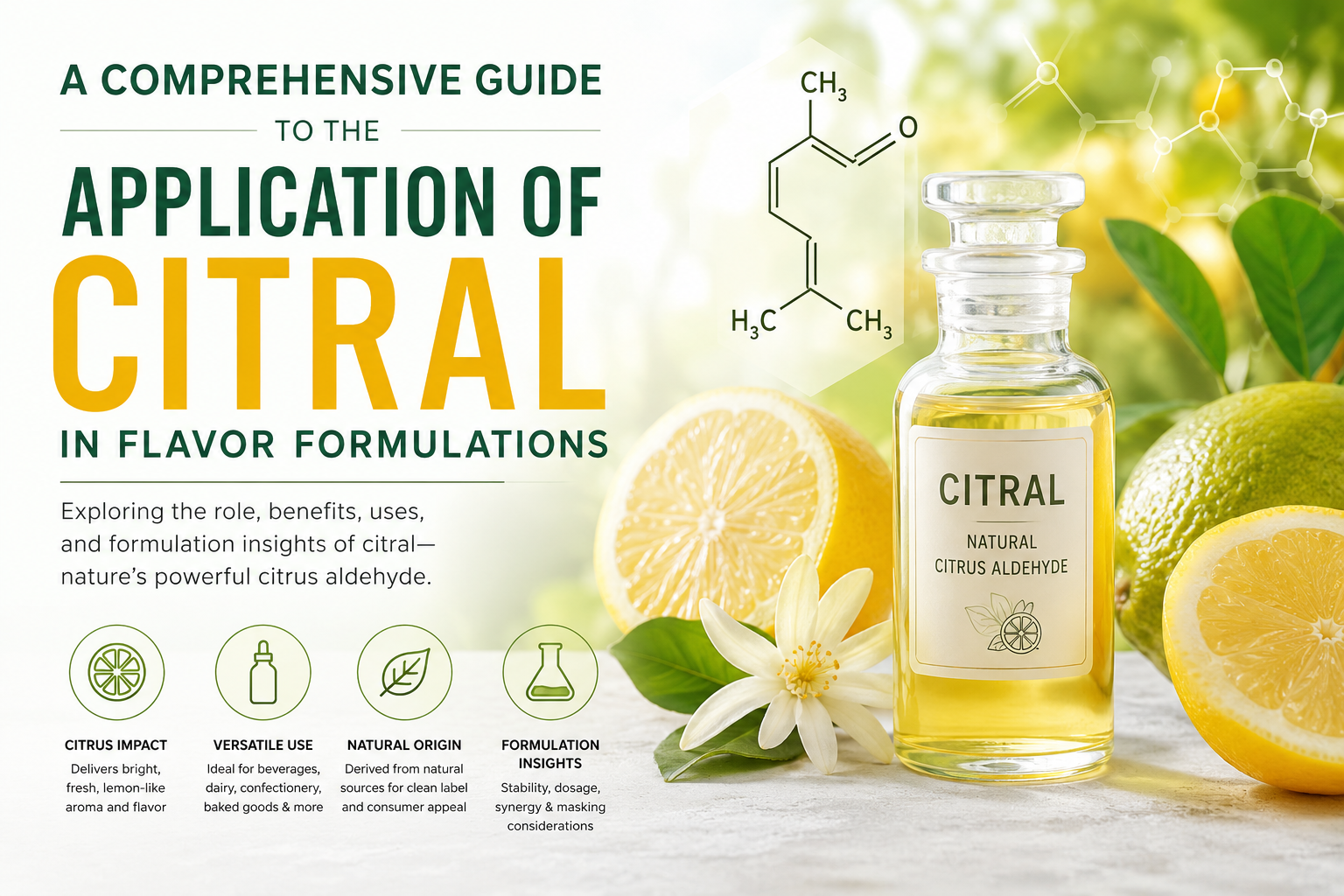
Comprehensive Guide to the Application of Citral in Flavor Formulations
1. Introduction
Citral is one of the most important citrus flavor ingredients used in the food, beverage, pharmaceutical, and oral care industries. It consists of two geometric isomers:
- Geranial (Citral A, trans-citral) – stronger, sharper lemon note
- Neral (Citral B, cis-citral) – softer, sweeter lemon note
Commercial citral normally contains:
- Geranial: 55–70%
- Neral: 30–45%
Flavor profile
- Fresh lemon peel
- Bright citrus
- Clean aldehydic
- Slightly sweet
- Green
- Zesty
- Slight floral nuances
Citral is naturally present in:
- Lemongrass oil
- Litsea cubeba oil
- Lemon myrtle oil
- Lemon oil
- Lime oil
- Verbena oil
2. Primary Functions of Citral in Flavor Systems
| Function | Description |
|---|---|
| Citrus character | Main source of fresh lemon note |
| Top note enhancer | Adds freshness and brightness |
| Flavor lifter | Makes dull flavors more vibrant |
| Freshness enhancer | Creates perception of freshly squeezed juice |
| Green modifier | Adds peel-like green freshness |
| Masking agent | Reduces medicinal, bitter, sulfur or chemical notes |
| Bridge note | Links citrus with fruit flavors |
| Naturalizer | Makes artificial citrus taste more natural |
| Aroma impact | High volatility provides immediate aroma release |
3. Stability Characteristics
Citral is:
- Highly volatile
- Sensitive to oxidation
- Sensitive to heat
- Sensitive to alkaline pH
- Sensitive to light
Most stable at:
- pH 3–5
- Low oxygen
- Cool storage
- Presence of antioxidants
Common stabilizers:
- Tocopherol
- Ascorbyl palmitate
- BHT (where permitted)
- Rosemary extract
4. Typical Dosage Levels
These are typical formulation ranges. The optimum level depends on the overall flavor profile, processing conditions, and regulatory limits.
| Application | Typical dosage (ppm in finished product) |
|---|---|
| Carbonated beverages | 2–15 |
| Lemon soda | 8–20 |
| Orange beverages | 1–6 |
| Lime beverages | 3–12 |
| Fruit juices | 5–20 |
| Energy drinks | 2–10 |
| Sports drinks | 2–8 |
| Tea beverages | 1–6 |
| Dairy drinks | 0.5–3 |
| Yogurt | 1–5 |
| Ice cream | 2–8 |
| Candy | 10–40 |
| Gummies | 15–60 |
| Hard candy | 20–80 |
| Chewing gum | 20–150 |
| Baked goods | 5–25 |
| Cookies | 3–10 |
| Cakes | 5–15 |
| Fillings | 10–30 |
| Jams | 2–10 |
| Pharmaceutical syrups | 3–10 |
| Lozenges | 5–30 |
| Toothpaste | 5–30 |
| Mouthwash | 2–15 |
Log in to view more information on the subject