Condensation Reactions in Flavor Chemistry
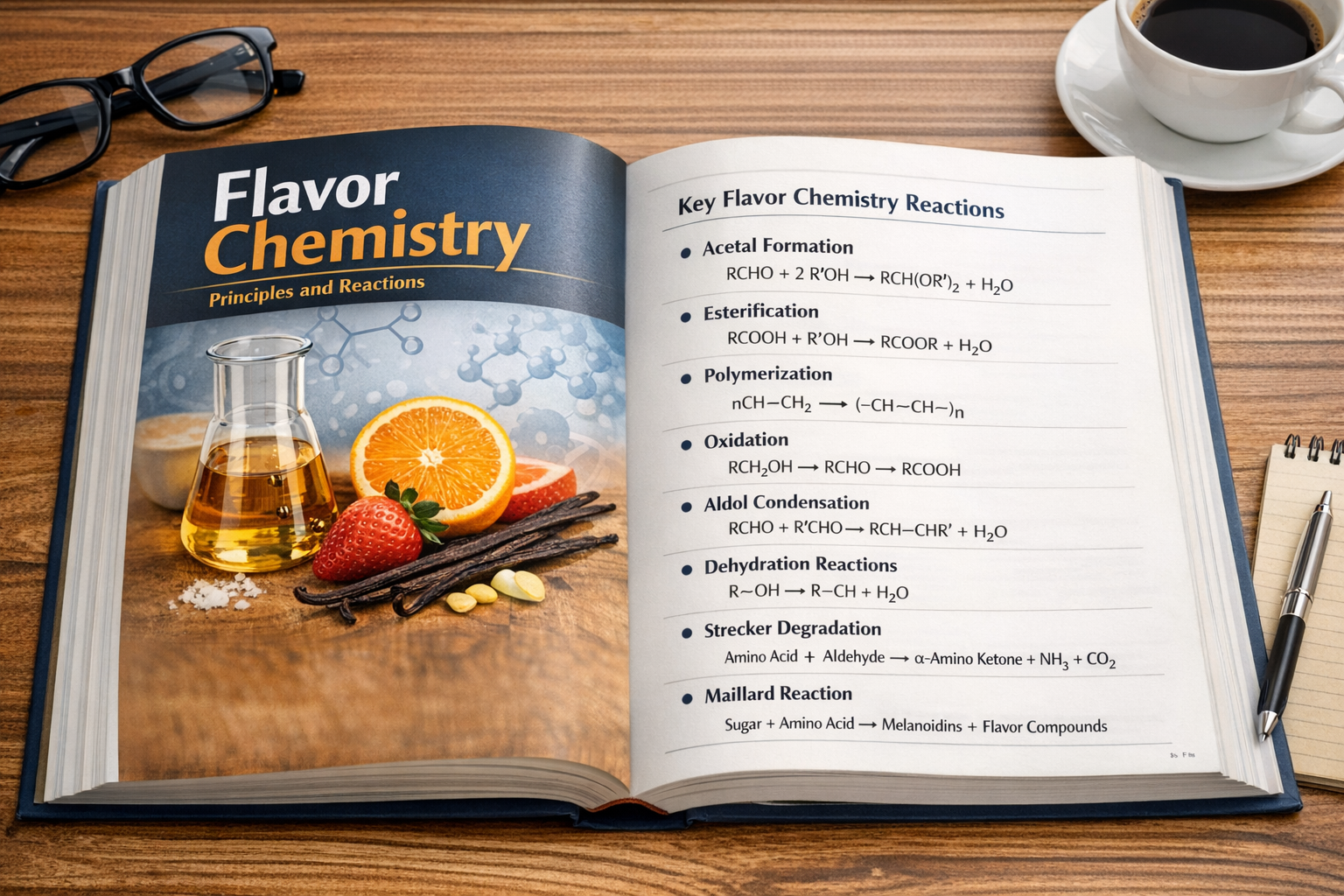
Condensation is one of a handful reactions the Society of Flavor Chemists requires flavorists to understand and consider when formulating flavors.
Here is a detailed explanation of condensation reactions in the context of flavor chemistry.
1. Chemical Groups Involved and Conditions Required
A condensation reaction is a class of organic reaction where two molecules combine to form a larger molecule, with the simultaneous loss of a small molecule (the condensate). In flavor chemistry, the most common condensate is water, but it can also be methanol, ethanol, or acetic acid.
Chemical Groups Involved
The most relevant condensation reactions in flavor systems occur between the following functional groups:
- Carbonyls and Amines/Amino Acids:
- Groups: Aldehyde or Ketone (from flavor compounds or lipid oxidation) + Primary Amine (from amino acids, proteins).
- Reaction: This forms an imine (specifically a Schiff base when a primary amine reacts with an aldehyde or ketone). This is a crucial step in the Maillard reaction.
- Example: R-CH=O + H₂N-R' → R-CH=N-R' + H₂O
- Carbonyls and Alcohols:
- Groups: Aldehyde or Ketone + Alcohol.
- Reaction: This forms a hemiacetal (unstable) and further condenses to an acetal (or ketal), eliminating water. Acetals are common in nature and used in fragrances for their stability.
- Example: R-CH=O + 2 R'-OH → R-CH(OR')₂ + H₂O
- Carboxylic Acids and Alcohols (Esterification):
- Groups: Carboxylic Acid + Alcohol.
- Reaction: This forms an ester and water. This is fundamental to the character of many fruit flavors (e.g., ethyl butyrate = pineapple).
- Example: R-COOH + R'-OH ⇌ R-COO-R' + H₂O
- Carboxylic Acids and Amines (Amide Formation):
- Groups: Carboxylic Acid + Amine.
- Reaction: Forms an amide and water. This is less common in simple flavor mixtures but critical in protein chemistry and can lead to loss of volatile amines.
Conditions Required
For these reactions to proceed at a rate significant for flavor change, specific conditions are typically required:
- Energy Input (Heat): Condensation reactions are generally endothermic and have a significant activation energy. At room temperature, they are slow. The rate increases exponentially with temperature, which is why cooking, pasteurization, or even storage in a warm warehouse dramatically accelerates flavor degradation via condensation.
- Catalysts: While many condensation reactions can occur spontaneously, they are accelerated by:
- Acids: Protonation of the carbonyl group or the leaving group (e.g., -OH) is a common catalytic mechanism.
- Bases: Can deprotonate nucleophiles (like alcohols or amines), making them more reactive.
- Removal of Condensate: The reactions are reversible. According to Le Châtelier’s principle, removing the small molecule byproduct (e.g., water) drives the equilibrium toward the product. In open systems, evaporation of water accelerates condensation.
- Water Activity ($a_w$): This is a critical condition. While water is often a product, a minimal amount of water is required as a solvent for reactants to meet. However, in low-moisture systems ($a_w$ 0.3-0.6), condensation reactions (like the Maillard reaction) are often maximized because reactants are concentrated and the reverse reaction (hydrolysis) is suppressed.
2. Factors Accelerating or Inhibiting the Reaction, and Considerations During Formulation
Factors Accelerating Condensation
- High Temperature: The most powerful accelerator. Storage temperature is the primary determinant of shelf-life regarding condensation reactions.
- Low Water Activity ($a_w$): Paradoxically, while water is a product, removing water to a point where reactants are highly concentrated (e.g., in a dry powder or a high-sugar syrup) massively accelerates bimolecular condensation reactions like the Maillard reaction.
- Extreme pH: Both strongly acidic and strongly basic conditions catalyze specific condensations. Schiff base formation, for example, is fastest at slightly acidic to neutral pH.
- Light (UV Radiation): Light can initiate free radical formation, which leads to the formation of reactive carbonyls (aldehydes, ketones) from unsaturated lipids. These newly formed carbonyls are then available for condensation with amines or alcohols.
- Presence of Catalytic Metal Ions: Trace amounts of iron ($Fe{2+}/Fe{3+}$) or copper ($Cu^{2+}$) catalyze oxidation, which produces the carbonyl substrates needed for condensation.
Factors Inhibiting Condensation
- Low Temperature: Refrigeration or freezing dramatically slows reaction kinetics.
- High Water Activity ($a_w$ > 0.9): In dilute solutions, reactants are too dispersed to interact efficiently. Furthermore, high water activity favors the reverse reaction (hydrolysis).
- Chelating Agents: Compounds like EDTA bind metal ions, preventing the oxidation that generates reactive carbonyls.
- Antioxidants: By preventing the formation of aldehydes from lipid oxidation (e.g., BHA, BHT, tocopherols), antioxidants remove one of the key classes of reactants for condensation.
- pH Optimization: Formulating at a pH where the nucleophile (e.g., the amine) is protonated ($-NH_3^+$) rather than free ($-NH_2$) inhibits its reactivity. For Maillard reactions, pH below 4.5 significantly slows the reaction.
- Use of Stable Precursors: Using acetal forms of aldehydes instead of the free aldehyde can prevent condensation until the acetal is hydrolyzed (e.g., in the presence of water at point of use).
Considerations During Formulation
- Ingredient Selection: A formulator must choose ingredients strategically. If a long shelf-life is desired, combining reducing sugars (glucose, fructose) with sources of free amino groups (amino acids, hydrolyzed proteins) in a low-moisture matrix is avoided unless browning and flavor change (Maillard) are intended.
- Encapsulation: Volatile aldehydes (e.g., citral, vanillin) are often encapsulated in spray-dried starches or cyclodextrins. This physically separates reactive groups, preventing condensation with other matrix components until the capsule is dissolved.
- Solvent Systems: In liquid flavors, using propylene glycol or ethanol instead of water can inhibit condensation reactions that require water as a leaving group or medium.
- Sequestering: The addition of citric acid or phosphates serves a dual purpose: pH adjustment and metal chelation to prevent metal-catalyzed oxidation that feeds condensation.
3. Examples of Condensation
- Maillard Reaction (Strecker Degradation & Beyond): The quintessential example. A reducing sugar (e.g., glucose) condenses with an amino acid (e.g., valine). This initial condensation (forming a glycosylamine) initiates a cascade of rearrangements, dehydrations, and cyclizations that produce hundreds of flavor compounds, including pyrazines (nutty, roasted), furans (caramel), and thiophenes (meaty).
- Acetal Formation (Flavor Protection): Citral (lemony aldehyde) is highly susceptible to condensation and subsequent degradation (cyclization to p-cymene) in acidic beverages. Formulators often react it with ethanol and propylene glycol to form citral dimethyl acetal and citral diethyl acetal. These acetals are more stable, possess a softer lemon-lime note, and release the parent aldehyde slowly upon dilution or hydrolysis.
- Aldol Condensation (Off-Flavor Formation): In dairy or citrus flavors, acetaldehyde (green, pungent) can undergo aldol condensation with itself to form 2-butenal (crotonaldehyde) or with other aldehydes. While some of these products are intermediates in flavor generation, uncontrolled aldol condensation in a stored product often leads to harsh, solvent-like, or stale notes.
- Esterification in Alcoholic Beverages: During the aging of wine and spirits, the condensation of carboxylic acids (from oxidation) with ethanol forms ethyl esters. For example, the reaction of acetic acid with ethanol yields ethyl acetate (fruity, solvent-like). While desirable in small amounts, excessive esterification can dominate and ruin a delicate flavor profile.
4. Understanding How the Reaction Impacts Aging of a Flavor and Shelf Life
Condensation reactions are a primary driver of flavor degradation and shelf-life limitation. Their impact is twofold: the loss of desirable compounds and the generation of undesirable ones.
1. Loss of Desired Character (Decrease in Potency)
Many key flavor molecules are highly reactive nucleophiles or electrophiles.
- Aldehydes: Compounds like vanillin (vanilla), citral (lemon), and benzaldehyde (cherry) are essential for their top notes. They are also highly susceptible to condensation with amines from proteins or other degradation products. As they condense into imines or acetals, their volatility and characteristic odor are lost. The product tastes "flat" or "stale."
- Thiols: Though not a direct condensation group, thiols (grapefruit, passionfruit) are often lost via Michael addition reactions with unsaturated carbonyls formed by condensation pathways.
2. Generation of Off-Flavors (Color Changes)
The products of condensation can introduce new, often undesirable, sensory characteristics.
- Browning (Non-enzymatic Browning): The Maillard reaction, a condensation-driven cascade, leads to darkening. While desirable in baked goods, it is a defect in dried milk powders, dehydrated vegetables, and shelf-stable sauces, indicating a loss of nutritional value and a shift to a "cooked," caramelized, or burnt flavor.
- Stale/Cardboard Notes: As unsaturated fatty acids oxidize, they form volatile aldehydes (hexanal, nonenal). These aldehydes can undergo condensation reactions with themselves (aldol) or with amines. The resulting compounds contribute to the "painty," "cardboard," or "grassy" off-notes that define the end of shelf life for products like nuts, crackers, and oils.
- Solvent/Plastic Notes: The formation of cyclic condensation products (e.g., from acetaldehyde or citral degradation) can result in compounds with medicinal, plastic-like, or solvent-like aromas that render the product unpalatable.
3. Strategic Implications for Shelf Life
Understanding these reactions allows formulators to predict and control shelf life.
- Predictive Modeling: Since condensation reactions follow Arrhenius behavior, accelerated shelf-life testing (ASLT) at elevated temperatures is used to predict how fast the key aldehyde or amine concentration will drop at room temperature.
- Formulation Strategy: A product with a 12-month shelf life in an ambient warehouse (25°C) might have a 3-month shelf life if stored in a tropical environment (40°C). To mitigate this, formulators might reduce the pH to 3.5 (if product allows) to protonate amines and slow Schiff base formation, or they might switch to acetal-protected flavor systems.
- Packaging: Oxygen scavengers in packaging inhibit lipid oxidation, thereby reducing the supply of reactive carbonyls available for condensation. Barrier films (low oxygen transmission rate) are essential for products prone to oxidative condensation.
In summary, condensation reactions are not merely a chemical footnote but the central mechanism governing the stability, aging, and eventual sensory failure of most formulated flavors and food products.
###