Defining and Controlling Earthy Notes in Food Flavor
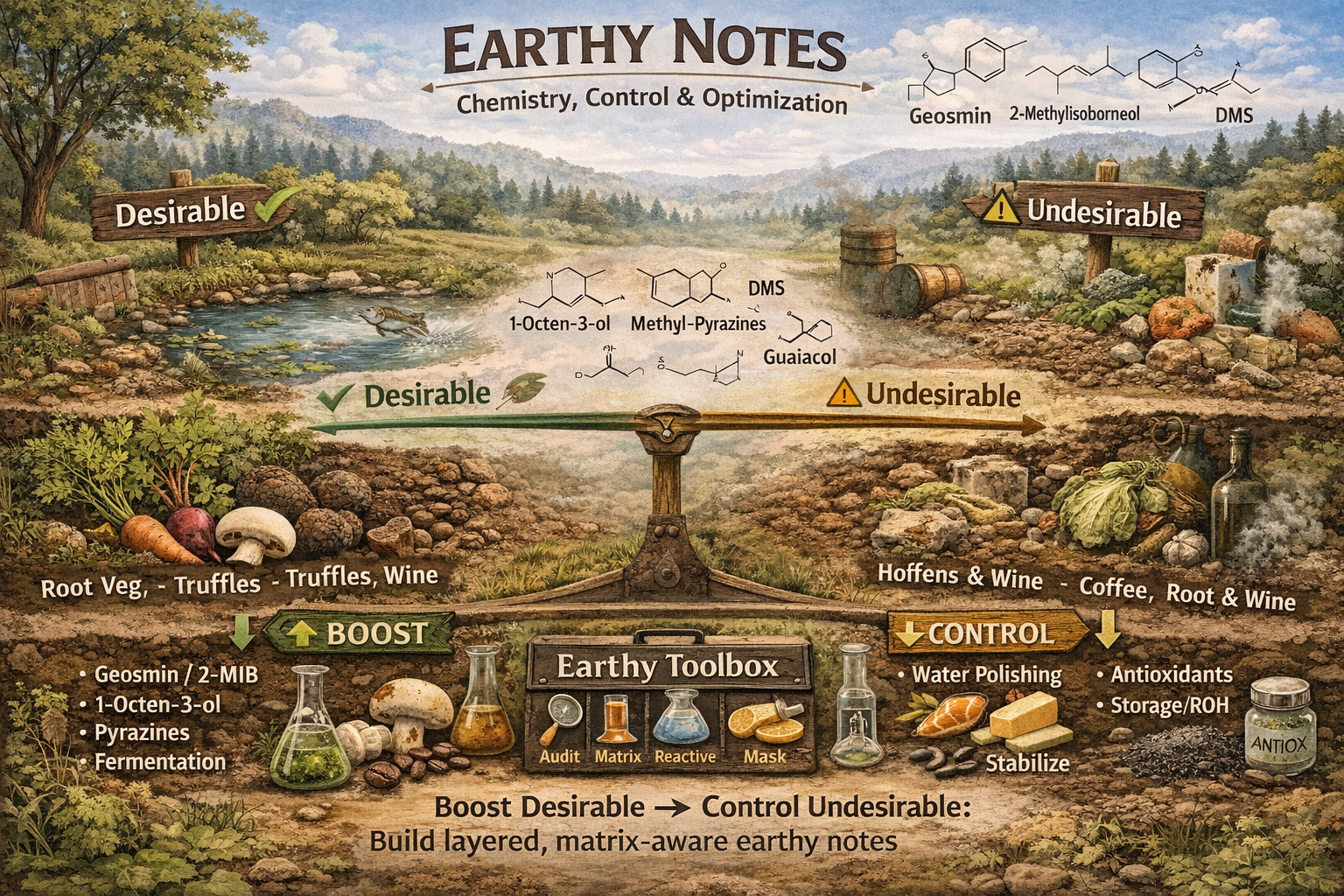
Earthy Note in the Context of SFC’s 25 Core Flavor Notes
The Society of Flavor Chemists (SFC) mandates that all Certified Flavor Chemists master a lexicon of 25 primary flavor notes—earthy among them—as part of a standardized sensory vocabulary. This shared language ensures precision when formulating, replicating, or troubleshooting complex food flavors across the industry.
Within this lexicon, the earthy note is defined as the characteristic aroma of damp soil, wet clay, fresh mushrooms, raw beets, or geosmin-tainted water. It is distinct from related notes like musty (mold-driven), woody (lignin-derived), or peaty (smoke-associated). Flavor chemists must be able to identify earthy notes at very low thresholds—geosmin, for example, is perceptible to most humans at concentrations as low as 5–10 parts per trillion.
In practical application, earthy notes serve dual roles. Desirable earthiness anchors savory flavors (truffle oil, beet concentrates, fermented teas like pu-erh) and adds complexity to plant-based meats. Conversely, undesirable earthiness can ruin delicate products like dairy beverages, white fish, or spring water, requiring masking or removal.
Certified chemists use the SFC framework to systematically adjust earthy notes via:
- Boosting: Adding pyrazines, geosmin, or caryophyllene oxide at ppm levels.
- Dampening: Employing vanillin, diacetyl, or citrus terpenes as suppressants.
- Matrix engineering: Modulating fat, starch, or protein content to control release kinetics.
Mastery of this note—like all 25—is essential for proper use of ingredients, product consistency, and competitive formulation in the global flavor industry.
An earthy note is one of the most distinctive and polarizing flavor attributes—ranging from pleasant “forest floor / root vegetable / mushroom” to undesirable “musty / moldy.” It is chemically diverse, spanning terpenoids, heterocycles, and microbial metabolites with extremely low odor thresholds.
🌱 1) Key Compounds That Define Earthy Notes
A. Ultra-potent “true earthy” markers (ppt–ppb range)
- Geosmin
- Signature: wet soil after rain (“petrichor”)
- Source: actinomycetes, cyanobacteria
- Threshold: ~5–10 ppt (!!)
- 2-Methylisoborneol (2-MIB)
- Signature: musty, damp cellar
- Often linked to off-notes in water/fish
👉 These two dominate true earthy perception even at trace levels.
B. Mushroom / forest floor earthy
- 1-Octen-3-ol
- “Mushroom alcohol” → damp, fungal, green-earthy
- 1-Octen-3-one → sharper metallic-earthy
- 3-Octanol → softer earthy-fatty
C. Root vegetable / beet earthy
- Methoxypyrazines (e.g., IBMP)
- Green-earthy, خاکی, bell pepper-like
- Minor geosmin contribution (in beet, carrot)
D. Woody / dry earthy / dusty
- **Vetiverol / vetiveryl acetate
- Patchoulol
- Guaiacol (adds smoky-earthy dryness)
E. Animalic / truffle-like earthy
- Dimethyl sulfide (low levels → earthy richness)
- Truffle markers:
- 2,4-dithiapentane
- Methanethiol (trace)
⚙️ 2) How to INCREASE Earthy Note
Strategy 1: Add key impact compounds
- Micro-dose geosmin / 2-MIB (extreme caution)
- Use 1-octen-3-ol for safer mushroom earthy
Strategy 2: Build a layered earthy system
- Base: mushroom alcohol (1-octen-3-ol)
- Mid: pyrazines (green-earthy)
- Top trace: geosmin (ppt–ppb)
Strategy 3: Reaction pathways
- Lipid oxidation → C8 mushroom volatiles
- Maillard (low temp, low sulfur) → pyrazines
- Fermentation (fungal/bacterial) → geosmin-like notes
Strategy 4: Matrix engineering
- Slight water activity (aw 0.6–0.8) enhances earthy perception
- Mild oxidation → increases earthy complexity
🧪 3) How to REDUCE Earthy Note
A. Remove root causes
- Activated carbon (removes geosmin/2-MIB)
- Distillation / stripping
- Ozone (water treatment context)
B. Masking strategies
- Add:
- Citrus terpenes (limonene)
- Sweet esters (ethyl butyrate)
- Lactones (creamy rounding)
C. Chemical suppression
- Lower pH → reduces perception of musty notes
- Increase volatility contrast (bright top notes)
D. Binding / partitioning
- Proteins & fats can trap earthy compounds
- Emulsions reduce headspace release
🔄 4) Compounds That BOOST or DAMPEN Earthy
Boosters (synergistic)
- Pyrazines → amplify soil/green perception
- Sulfur traces (DMS) → deepen realism
- Phenolics (guaiacol) → dry earthy complexity
Dampeners (suppress perception)
- Fruity esters → override earthy
- High sweetness → masks dirt notes
- Strong acids → sharpen profile away from earthy
- Mint/cooling → perceptual reset
🍲 5) Food Matrix Effects (Critical!)
Matrices that MAINTAIN earthy notes
- Low-fat aqueous systems (water, broth)
- Root vegetable purees (beet, carrot)
- Mushroom-based systems
- Fermented foods (soil-like complexity retained)
Matrices that REDUCE earthy perception
- High-fat systems (cream, butter) → partitioning
- High sugar → masking
- Highly volatile systems → rapid loss
Ideal “earthy-preserving” matrix:
- Moderate water activity
- Low competing top notes
- Slight umami (glutamate enhances earthy realism)
🧠 Practical Flavorist Toolkit (Industrial)
Earthy Base Template (ppm-level concept)
- 1-Octen-3-ol → 5–50 ppm
- Pyrazine mix → 0.1–5 ppm
- Geosmin → 0.001–0.01 ppm (!!)
- Guaiacol → 0.05–1 ppm
Control knobs
- Too muddy → reduce geosmin first
- Too mushroom → reduce C8 alcohols
- Too green → reduce pyrazines
⚠️ Key Insight
👉 Earthy flavor is non-linear and threshold-driven
A tiny increase in geosmin can shift a flavor from:
- “natural / root-like” → “dirty / moldy” instantly
Below is a ppm-precision earthy flavor library used by flavorists to build, tune, or troubleshoot earthy notes across 20 key applications.
All doses are final concentration in finished product (ppm unless noted). Ultra-potent materials are clearly marked.
🌍 Master Earthy Reference Compounds (Anchor Set)
Use these across all systems:
- Geosmin → 0.0005–0.02 ppm (ppt–low ppb)
- 2-Methylisoborneol → 0.001–0.05 ppm
- 1-Octen-3-ol → 1–50 ppm
- Pyrazines (mixed) → 0.05–5 ppm
- Guaiacol → 0.05–2 ppm
- Dimethyl sulfide (DMS) → 0.01–0.5 ppm
☕ 1. Coffee (roasted / brewed)
Profile: dry, woody-earthy, slightly smoky
- Guaiacol → 0.2–1.5
- Pyrazines → 0.5–3
- 1-Octen-3-ol → 1–5
- Geosmin → 0.001–0.005
👉 Too much geosmin = “muddy coffee defect”
🥩 2. Roasted Meat
Profile: savory-earthy, umami depth
- Pyrazines → 1–5
- DMS → 0.05–0.3
- Guaiacol → 0.1–0.8
- 1-Octen-3-ol → 2–10
🥕 3. Root Vegetables (carrot, beet)
Profile: soil-like, sweet-earthy
- Geosmin → 0.002–0.02
- Methoxypyrazines → 0.01–0.5
- 1-Octen-3-ol → 1–5
🍄 4. Mushroom
Profile: wet, fungal, green-earthy
- 1-Octen-3-ol → 10–50
- 1-Octen-3-one → 0.5–5
- Geosmin → 0.001–0.01
🍫 5. Cocoa / Dark Chocolate
- Pyrazines → 0.5–3
- Guaiacol → 0.1–1
- Geosmin → 0.0005–0.003
👉 Adds “dark cocoa depth”
🍷 6. Red Wine (terroir earthy)
- Geosmin → 0.001–0.01
- Methoxypyrazines → 0.005–0.2
- DMS → 0.02–0.1
🍺 7. Beer (especially ale / lager defects)
- Geosmin → 0.001–0.01
- 2-MIB → 0.002–0.02
- DMS → 0.05–0.3
🧀 8. Cheese (aged / rind)
- 1-Octen-3-ol → 1–10
- DMS → 0.05–0.5
- Geosmin → 0.001–0.005
🍄🟫 9. Truffle
Profile: sulfur-earthy, luxurious
- DMS → 0.1–1
- 2,4-Dithiapentane → 0.01–0.5
- Geosmin → 0.001–0.01
🥬 10. Leafy Greens (spinach, kale)
- 1-Octen-3-ol → 1–10
- Pyrazines → 0.05–1
- Geosmin → 0.001–0.005
🥔 11. Potato (boiled / baked)
- Methoxypyrazines → 0.01–0.2
- 1-Octen-3-ol → 1–5
- DMS → 0.05–0.2
🌽 12. Corn (sweet corn earthy)
- DMS → 0.1–0.5
- Pyrazines → 0.05–1
🍞 13. Bread Crust
- Pyrazines → 1–5
- Guaiacol → 0.1–0.5
🍜 14. Broth / Stock
- DMS → 0.05–0.3
- 1-Octen-3-ol → 1–5
- Pyrazines → 0.2–2
🐟 15. Fish (earthy defect control)
- Geosmin → <0.002 (target)
- 2-MIB → <0.005
👉 Above this = muddy off-note
🍵 16. Green Tea / Matcha
- 1-Octen-3-ol → 1–5
- Methoxypyrazines → 0.01–0.2
- Geosmin → 0.001–0.003
🌿 17. Herbs (parsley, cilantro root)
- 1-Octen-3-ol → 1–8
- Pyrazines → 0.05–0.5
🥜 18. Nuts (roasted peanut, hazelnut)
- Pyrazines → 1–5
- Guaiacol → 0.05–0.3
🥫 19. Processed Savory (soups, sauces)
- 1-Octen-3-ol → 2–10
- Pyrazines → 0.5–3
- DMS → 0.05–0.2
🧃 20. Vegetable Juice / Smoothie
- Geosmin → 0.002–0.01
- 1-Octen-3-ol → 1–5
- Pyrazines → 0.05–1
⚙️ Cross-Application Control Rules
1. Geosmin rule (critical)
- 0.001 ppm → pleasant earthy
- 0.01 ppm → borderline
0.02 ppm → defect (muddy/moldy)
2. Mushroom control
- Increase 1-octen-3-ol → fresh earthy
- Increase 1-octen-3-one → metallic/harsh
3. Depth vs dirt
- Pyrazines + guaiacol = “dry earthy sophistication”
- Geosmin excess = “wet dirt defect”
🧠 Industrial Insight
👉 Earthy systems require multi-layer balancing:
- Top: trace geosmin (identity)
- Mid: mushroom alcohols (body)
- Base: pyrazines + phenolics (structure)
###