Distillates, Fruits, Cocoa, Coffee & Tea: Production, Sensory Characteristics, Physical Form and Solubility
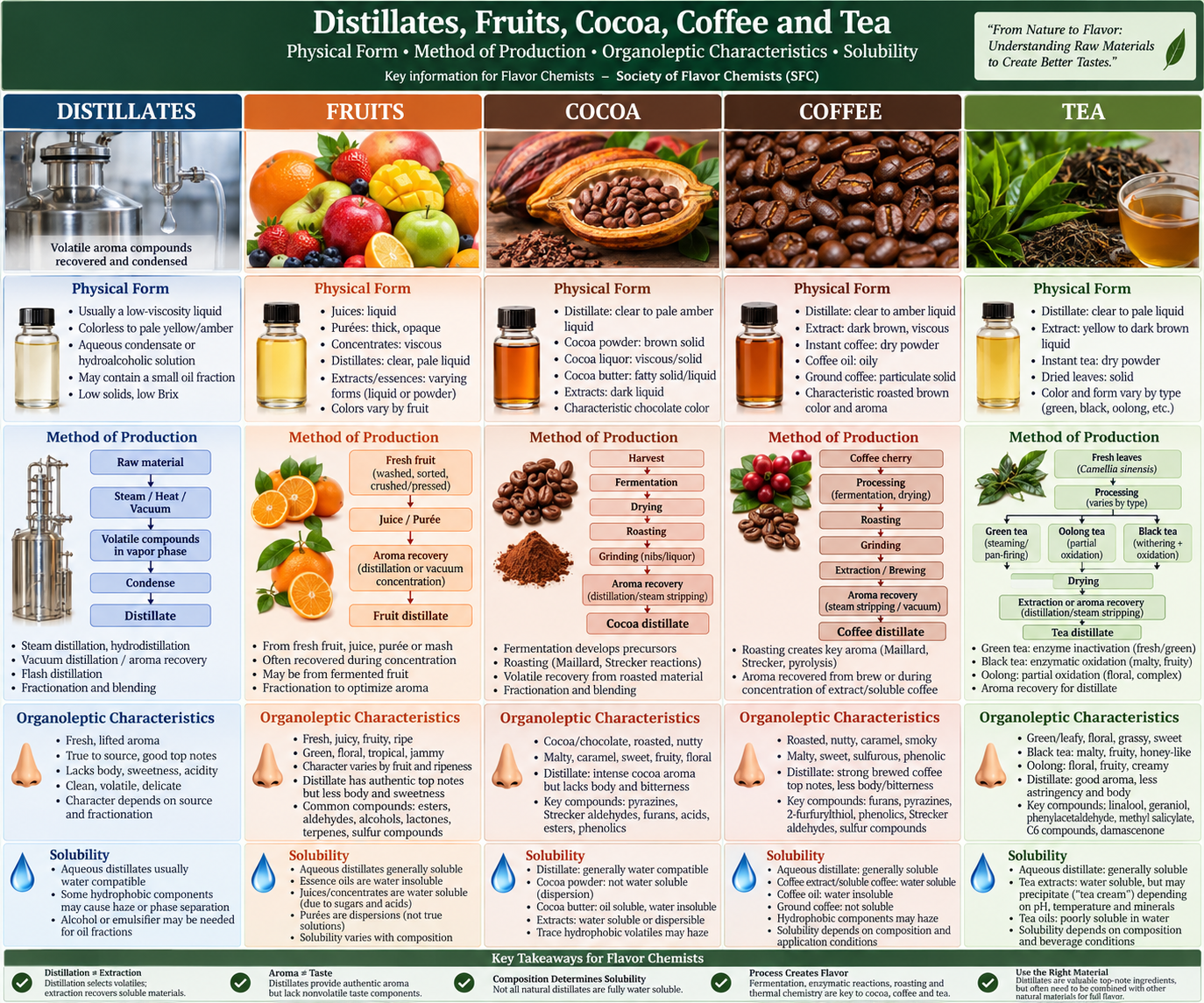
This topic is explicitly part of the January 2026 Society of Flavor Chemists syllabus. SFC expects flavorist candidates to be able to explain the physical form, method of production, organoleptic characteristics, and solubility of “Distillates, Fruits, Cocoa, Coffee, Tea.” The same syllabus says the interview may probe raw materials, laboratory practices, production, applications, regulations and economics—not merely definitions. (Flavor Chemists)
1. First: what exactly is a distillate?
A flavor distillate is the volatile flavor fraction obtained when volatile components from a natural source are transferred into a vapor phase and then condensed.
The source might be fruit or juice, roasted coffee, roasted cocoa, tea, herbs, fermented materials, dairy materials, etc. Steam distillation, hydrodistillation, vacuum stripping, flash aroma recovery, or related vapor-condensation systems may be used.
The fundamental idea is:
source material → heating/steam/vacuum → volatile compounds enter vapor → vapor is separated → cooled/condensed → flavor distillate
This is very different from an extract.
An extract dissolves material into a solvent. A distillate selectively transfers compounds according to volatility and vapor/liquid partition behavior.
It is also different from a juice concentrate. A concentrate contains sugars, acids, minerals, pigments and other nonvolatile solids; a fruit aroma distillate generally does not.
This distinction is central to an SFC answer.
Physical form of distillates
Most commercial flavor distillates are low-viscosity liquids. They may be colorless, nearly colorless, straw-colored, pale amber or occasionally darker depending on the source and subsequent processing.
An aqueous distillate normally has very low soluble solids compared with the original food. It may therefore have:
- very low Brix,
- relatively low viscosity,
- much less color,
- no pulp or suspended plant tissue,
- virtually none of the original sugar/starch/protein load.
A distillate can nevertheless be slightly hazy or even biphasic if hydrophobic volatile oils are present.
That is an important professional point:
“Distillate” does not automatically mean “completely water soluble.”
Steam will carry hydrophobic aroma chemicals as well as hydrophilic ones. After condensation, sufficiently hydrophobic material may form an oil phase, haze or ring.
Production chemistry
Volatility controls what transfers. Lower molecular weight materials frequently transfer readily, but normal boiling point alone does not determine recovery. Polarity, vapor pressure, temperature, pressure, interaction with water and matrix binding are all important.
Steam distillation is especially useful because an organic aroma material can co-distill with water at a temperature below its own normal boiling point.
Vacuum distillation/aroma recovery lowers the operating temperature. This is valuable for fruit, coffee and tea because excessive heat can create cooked notes and destroy delicate top notes.
A flavorist should also understand fraction cuts.
The earliest condensate may be enriched in extremely volatile aldehydes, sulfur compounds, alcohols and light esters. Middle fractions may contain the best-balanced character. Late fractions contain less-volatile compounds and can become heavier, phenolic, cooked or less desirable.
Consequently, manufacturers may blend fractions back together.
Organoleptic behavior
Distillates are often excellent top-note materials.
They can smell remarkably true to the source because they contain genuine source-derived volatile components. At the same time, they often lack the complete taste impression of the food because sugars, acids, peptides, tannins, caffeine, cocoa polyphenols and many other nonvolatile components have been left behind.
Therefore:
aroma authenticity can be high while body/taste authenticity is low.
That sentence is worth remembering for an interview.
Solubility
The answer should never simply be “water soluble.”
A more professional answer is:
Solubility depends on the chemical composition and on whether the commercial distillate is an aqueous condensate, hydroalcoholic product or separated aroma/oil fraction.
Lower alcohols, many low-MW acids and some carbonyls are relatively water compatible. Hydrocarbons and terpenes generally are not. Esters vary considerably. Phenolics, pyrazines and sulfur compounds vary according to structure.
A water-rich distillate may be readily miscible in water but still create haze when diluted because trace hydrophobic aroma components come out of solution.
Alcohol, propylene glycol or an emulsification system may sometimes be required when using more lipophilic fractions.
2. Fruits
Fruit flavor chemistry is particularly important because SFC also expects a flavorist to be capable of creating and modifying fruit flavors. The current syllabus specifically lists attributes such as ripe, fresh, juicy, jammy, green, pulpy and tropical among modifications a candidate should understand. (Flavor Chemists)
Fruit aroma is not one chemical class. Major classes include esters, alcohols, aldehydes, ketones, lactones, terpenoids and sulfur compounds. Their proportions vary enormously by fruit, cultivar and ripeness. (PubMed Central (PMC))
Physical forms encountered professionally
Fruit raw materials used by flavorists include fresh juice, purée, concentrate, essence, distillate, extract, fermentation-derived material and powders.
For SFC purposes, distinguish these especially well:
| Material | What it contains | Typical physical character |
|---|---|---|
| Fruit juice | Water + sugars + acids + aroma + soluble solids | Colored liquid |
| Purée | Juice plus suspended/insoluble fruit tissue | Thick, opaque |
| Juice concentrate | Much of water removed; nonvolatile solids retained | Viscous, high Brix |
| Fruit essence/distillate | Primarily recovered volatiles | Thin, usually clear/pale |
| Essence oil | Hydrophobic aroma fraction | Oily, water-insoluble |
| Fruit powder | Dried juice/purée/extract on carrier or dried fruit | Free-flowing/particulate solid |
Production of a fruit distillate
Fruit is washed, sorted and crushed or pressed. Depending upon the material, aroma may be recovered directly from juice, purée or mash.
Commercial operations frequently recover aroma during juice concentration. Under vacuum, volatile fruit components leave with evaporated water. The vapor stream can be condensed and the aroma concentrated or fractionated rather than allowing those compounds to disappear from the finished juice.
Some fruit distillates may come from fermented fruit substrates. Fermentation introduces additional alcohols, esters and other metabolites, so a fermented fruit distillate can smell very different from a fresh-fruit distillate.
Fruit organoleptic chemistry
A flavorist should think in sensory groups.
Green/fresh: hexanal, trans-2-hexenal, cis-3-hexenol and related C6 compounds are classic contributors. Mechanical tissue disruption activates pathways capable of producing these fresh-cut/green volatiles. (PubMed Central (PMC))
Ripe/fruity: esters become extremely important in many fruits. Examples include ethyl butyrate, methyl butyrate, ethyl hexanoate, hexyl acetate and related structures depending upon the fruit.
Peach/apricot/creamy fruit: lactones, especially γ- and δ-lactones, are important.
Floral fruit: linalool, geraniol, nerol and other terpenoid materials may become important.
Tropical fruit: sulfur-containing compounds can become extremely important even at trace concentrations.
A major professional principle is:
Concentration is not the same as sensory importance.
A compound present at ppm may be less important than a compound present at ppb if the latter has an extremely low odor threshold. Flavorists therefore think in terms of odor activity, not simply GC peak size.
Strawberry is an excellent illustration. Numerous volatiles are present, but characteristic compounds include esters, furaneol/mesifurane, linalool, γ-decalactone and green aldehydes/alcohols. (PubMed Central (PMC))
Organoleptic character of a fruit distillate
A well-made fruit distillate is often:
fresh, lifted, volatile, juicy-smelling and recognizable, but comparatively thin in taste.
A strawberry distillate, for example, may give beautiful strawberry top notes without supplying the sweetness, acidity, pulpiness and long-lasting body necessary for a complete strawberry flavor.
Therefore a flavorist may use the distillate as an authenticity/top-note component and build body using other natural flavoring materials or aroma chemicals.
Fruit solubility
Aqueous fruit distillates are usually suitable for water-based applications, but hydrophobic esters, terpenes and other compounds can cause haze.
An essence oil is normally oil soluble and poorly soluble in water.
Juice concentrate is generally water dispersible/soluble because of its sugar/acid matrix.
Purée is not a true solution; it is a heterogeneous dispersion containing solids.
Exam trap
Do not say:
“Fruit flavor is mainly esters.”
Say instead:
“Esters dominate many fruit profiles, but important aldehydes, alcohols, lactones, terpenes, ketones, furanones and sulfur compounds may determine character depending on the fruit.”
That sounds much more like a practicing flavorist.
3. Cocoa
Cocoa gives one of the best examples of how fermentation + drying + roasting chemistry creates flavor.
The characteristic chocolate/cocoa profile is not simply present in the fresh bean. Fermentation generates important flavor precursors, while roasting drives Maillard reactions and Strecker chemistry that create many characteristic aroma compounds. (PubMed Central (PMC))
Physical forms
A flavorist may encounter cocoa as fermented/dried beans, nibs, cocoa liquor/mass, cocoa powder, cocoa butter, extract and cocoa aroma/distillate.
Their physical properties are dramatically different.
Cocoa liquor is a dark, fatty, viscous or solid/semi-solid material depending upon temperature.
Cocoa powder is a brown particulate solid.
Cocoa butter is a fat.
A cocoa distillate is instead usually a much thinner, lighter-colored volatile-aroma preparation.
Cocoa production relevant to flavor chemistry
The sequence to know is:
harvest → pod opening → fermentation → drying → roasting → breaking/winnowing → nibs → grinding into liquor
Fermentation is essential because microorganisms convert sugars in the pulp and create ethanol, organic acids and numerous secondary metabolites. Acetic acid penetrates the beans; biochemical changes release amino acids, peptides and reducing-sugar precursors.
During roasting, amino acids/reducing sugars participate in Maillard reactions, while Strecker degradation produces characteristic aldehydes.
Roasting creates much of the recognizable cocoa/nutty/roasted profile. Pyrazines are especially important. (PubMed Central (PMC))
A cocoa aroma distillate can then be obtained by volatile recovery/steam stripping or distillation of processed cocoa material.
Cocoa organoleptic characteristics
Good cocoa can contain:
cocoa/chocolate, roasted, nutty, malty, caramel, sweet, fruity and floral dimensions.
Important chemical groups include:
Pyrazines: roasted, nutty, cocoa-like.
Strecker aldehydes: 2-methylpropanal, 2-methylbutanal and 3-methylbutanal contribute malty/chocolate/nutty nuances.
Phenylacetaldehyde: honey/floral character.
Alcohols/esters: fermentation-derived fruity/floral complexity.
Acetic acid: characteristic fermentation-derived acidity, but excessive levels create sharp vinegar/sour off-notes.
Furans/furanones/pyrroles: contribute sweet, caramel, brown and roasted dimensions.
Research on cocoa aroma consistently identifies alcohols, aldehydes, acids, ketones, esters, pyrazines, terpenes, furans and sulfur-containing compounds among important groups. (PubMed Central (PMC))
Cocoa defects a flavorist should recognize
Under-fermented cocoa may be overly bitter, astringent, raw or green.
Excessive fermentation or poor handling can produce unpleasant fermented, putrid or acidic notes.
Insufficient drying can retain excessive volatile acidity.
Smoke contamination can generate phenolic/smoky or ham-like notes.
Excessive roasting moves the profile toward burnt, acrid, carbonized or excessively bitter notes.
Cocoa distillate versus cocoa powder
This distinction is excellent interview material.
A cocoa powder contains large quantities of nonvolatile cocoa solids and contributes color, bitterness, astringency, fat-dependent character and mouthfeel.
A cocoa distillate contains predominantly volatile aroma.
Therefore, cocoa distillate may smell intensely chocolate-like but cannot reproduce all of the taste and body of cocoa powder.
Solubility
Cocoa powder is not truly water soluble. It is largely a dispersion.
Cocoa butter is oil/fat soluble and water insoluble.
A water-based cocoa extract may be water soluble or dispersible depending upon processing.
An aqueous cocoa distillate is ordinarily much more compatible with water than cocoa butter or cocoa powder, though trace hydrophobic volatile components can create haze.
Also remember:
theobromine, caffeine, most polyphenols and many bitterness/astringency components are nonvolatile and therefore are not major constituents of a normal aroma distillate.
That is a strong SFC-level distinction.
4. Coffee
Coffee flavor chemistry is another classic thermal reaction system.
Green coffee does not smell like brewed roasted coffee. Roasting transforms carbohydrates, amino acids, proteins, chlorogenic-acid-related components and other precursors by Maillard reactions, Strecker degradation, caramelization and pyrolysis. More than a thousand volatile compounds have been reported in roasted coffee. (PubMed Central (PMC))
Physical forms
Professional materials include green beans, roasted beans, ground coffee, coffee extract/concentrate, soluble coffee powder, coffee oil and coffee aroma distillate/condensate.
A coffee aroma distillate is generally a low-viscosity liquid and much lighter in color than coffee extract.
Coffee extract can be dark brown, viscous and high in dissolved solids.
Coffee oil is an oil phase and is not water soluble.
Instant coffee is a dry soluble solid obtained by drying a concentrated coffee extract.
Coffee production
The simplified sequence is:
coffee cherry → processing/fermentation/drying → green bean → roasting → grinding → extraction/brewing
For soluble coffee production, roasted ground coffee is extracted with water. Because valuable aroma would otherwise be lost during concentration and drying, manufacturers can recover volatile aroma separately using steam stripping, vacuum systems or other aroma-recovery operations.
The recovered condensate may then be returned to soluble coffee or used as a flavoring material.
This is a very practical example of industrial aroma recovery.
Organoleptic chemistry
A good coffee profile contains many interacting impressions:
roasted, nutty, caramel, sweet, malty, sulfurous, smoky, phenolic, fruity and sometimes floral.
Important compounds/classes include:
2-Furfurylthiol: one of the highest-impact freshly roasted coffee odorants; characteristic roasted/coffee character.
Pyrazines: roasted, nutty, earthy/toasted.
Furans/furanones: caramelized, sweet, toasted/bready.
Guaiacol and related phenolics: smoky/phenolic.
Strecker aldehydes: malty/nutty dimensions.
Diketones such as diacetyl: buttery/brown nuances.
β-Damascenone and related materials: fruity/sweet complexity.
Sulfur compounds: extraordinarily powerful and essential in realistic coffee despite occurring at low levels.
Current reviews emphasize that coffee aroma depends heavily on furans/furanones, pyrazines and sulfur materials, with 2-furfurylthiol particularly important to freshly roasted character. (PubMed Central (PMC))
Organoleptic character of coffee distillate
Coffee distillate is normally very aromatic and “headspace-like.”
It may give:
freshly brewed, roasty, sulfurous, nutty and volatile coffee top notes.
However, compared with coffee extract, it usually lacks much of the:
bitterness, acidity, body and dark coffee solids character.
Why?
Because caffeine, chlorogenic-acid derivatives and most coffee solids are nonvolatile.
Again:
coffee distillate = aroma-heavy / body-light
while
coffee extract = aroma + nonvolatile taste/body solids.
Solubility
An aqueous coffee aroma condensate is usually intended for water-based systems.
Coffee oil is water insoluble.
Soluble coffee powder is highly water soluble because it consists of dried aqueous coffee extract solids.
Ground roasted coffee is obviously not soluble; brewing extracts only part of the material.
Important stability issue
Coffee top notes, especially reactive sulfur compounds, are notoriously sensitive to oxidation and evaporation.
Headspace, oxygen, heat and repeated opening of containers can substantially alter sensory quality.
Consequently, good handling means minimizing unnecessary air exposure, keeping containers tightly closed and following supplier storage conditions.
Coffee defects to recognize
A flavorist should recognize stale/cardboard/oxidized coffee, excessive smoky/burnt character, overly fermented notes and green/under-roasted notes.
A useful advanced example is the potato defect, associated with very potent methoxypyrazines that can produce raw potato/earthy character. (PubMed Central (PMC))
5. Tea
Tea is an excellent interview topic because it tests whether the candidate understands the difference between raw botanical chemistry, enzymatic processing and extraction.
The plant is generally Camellia sinensis, but processing produces markedly different tea styles.
Physical forms
Flavorists may encounter dried tea leaves, tea powder, water extracts, concentrated extracts, instant tea, tea aroma condensates/distillates and specialty extracts.
A tea aroma distillate is typically a thin, clear to pale liquid.
A tea extract can range from pale to very dark and contains substantial nonvolatile solids.
The major tea processing distinction
Green tea
Leaves are heated relatively early—by steaming or pan-firing—to inactivate oxidative enzymes.
This preserves more green/fresh leaf character.
The general sequence is:
plucking → fixation/kill-green → rolling/shaping → drying
Black tea
The general sequence is:
plucking → withering → rolling/maceration → enzymatic oxidation → drying/firing
The traditional tea-industry word “fermentation” is commonly used for this stage, but chemically it is primarily enzymatic oxidation rather than microbial fermentation.
That distinction is a very good interview answer.
Oolong tea
Oolong undergoes controlled partial oxidation, giving an organoleptic position between typical green and black teas, often emphasizing floral and fruity notes.
Post-fermented/dark teas are a separate situation in which microbial activity can genuinely be important.
Tea aroma chemistry
Important tea aroma compounds include:
Linalool/linalool oxides: floral.
Geraniol/nerol: floral, rosy.
Phenylacetaldehyde/2-phenylethanol: honey, floral.
β-Damascenone and ionone-related compounds: sweet, fruity/floral.
Methyl salicylate: sweet, minty/wintergreen nuance.
Hexanal, trans-2-hexenal and cis-3-hexenol: green/leafy.
Indole and jasmine-like materials: important in certain floral tea profiles.
Black-tea processing increases numerous volatile floral and fruity compounds. Published reviews identify linalool, linalool oxides, geraniol, phenylacetaldehyde, phenylethanol, methyl salicylate and related compounds among major aroma contributors. (PubMed Central (PMC))
Green tea organoleptic profile
Depending on origin and process, expect:
fresh, green, leafy, grassy, steamed/vegetal, seaweed-like, sweet, floral, nutty or roasted/chestnut-like.
Pan-firing promotes more roasted/nutty character; steaming tends to preserve greener/fresher notes. (PubMed Central (PMC))
Black tea profile
Typical descriptors include:
malty, floral, fruity, sweet, honey-like, woody and fermented/oxidized-tea-like, with substantial variation by origin and manufacture.
Oolong profile
Frequently:
floral, fruity, creamy, honey-like, peach/orchid-like or roasted, depending on oxidation and firing.
Tea distillate versus tea extract
This is analogous to coffee.
Tea aroma distillate carries mostly volatile tea aroma.
Tea extract also contains:
- catechins,
- caffeine,
- theanine/amino acids,
- theaflavins/thearubigins in black tea,
- minerals and other soluble solids.
Consequently, a tea distillate may give excellent floral/leafy aroma but very little of tea's characteristic astringency, bitterness, body or umami.
Solubility
Aqueous tea distillates are normally suitable for water-based products, subject again to the possibility of haze from hydrophobic volatiles.
Tea extracts are primarily water soluble, but concentrated tea systems can present an important formulation phenomenon: tea cream/precipitation.
Polyphenols, caffeine and other tea constituents can associate and precipitate as temperature, concentration, pH and mineral conditions change. A beverage flavorist must therefore distinguish “chemically extracted into water” from “guaranteed clear under every beverage condition.”
Tea aroma oils or highly lipophilic fractions have much poorer water solubility.
6. The highest-yield comparison for the SFC interview
| Property | Fruit distillate | Cocoa distillate | Coffee distillate | Tea distillate |
|---|---|---|---|---|
| Typical form | Clear/pale thin liquid | Clear–pale amber thin liquid | Clear–amber aromatic liquid | Clear–pale liquid |
| Main source of character | Native/ripening fruit volatiles | Fermentation + roasting aroma | Primarily roasting aroma | Leaf metabolism + tea processing |
| Important chemistry | Esters, aldehydes, alcohols, lactones, terpenes, sulfur | Pyrazines, Strecker aldehydes, acids, esters, furans | Furans, pyrazines, sulfur compounds, aldehydes, phenols | Terpene alcohols, C6 compounds, carotenoid degradation products, aromatics |
| Primary contribution | Fresh/ripe top note | Cocoa/roast/nutty top note | Fresh brewed/roasted top note | Floral/leafy/tea top note |
| Mostly missing from distillate | Sugars/acids/pulp | Cocoa solids/fat/polyphenols/theobromine | Caffeine/coffee solids/most bitterness | Catechins/caffeine/theanine/theaflavins |
| Water solubility | Usually good for aqueous distillate; oils may haze | Usually good for aqueous distillate | Usually good for aqueous condensate | Usually good for aqueous condensate |
| Major risk | Loss of fresh top notes | Excess acid/roast imbalance | Oxidation/loss of sulfur top notes | Oxidation/aroma loss |
7. Solubility: how a flavorist should answer professionally
Do not memorize “soluble” or “insoluble” as an absolute property of a natural preparation.
Ask:
What is the carrier? What is the composition? At what concentration? In what finished matrix? At what pH, alcohol level, temperature and ionic strength?
For example, a fruit distillate supplied as an aqueous condensate might remain crystal clear at 0.05% in a soft drink but haze when concentrated twentyfold.
Similarly, hydrophobic aroma compounds can appear soluble in an alcoholic flavor concentrate yet precipitate when the flavor is diluted into a low-alcohol beverage.
Therefore a flavorist distinguishes:
true solubility → colloidal dispersion → emulsion → temporary dispersion → phase separation.
That distinction matters tremendously in commercial formulation.
8. Quality control a professional flavorist should associate with these materials
For incoming fruit, cocoa, coffee or tea preparations, sensory evaluation against an approved standard is fundamental. Depending on the product, QC can additionally include appearance/color, odor, density/specific gravity, refractive index, Brix or solids, pH, alcohol content, moisture, microbial status and chromatographic fingerprinting.
SFC currently specifically expects candidates to understand instruments/methods including refractometry/Brix, density, pH, Karl Fischer/moisture, GC, GC-O, FID, mass spectrometry, liquid chromatography and other methods, including their relevance and limitations. (Flavor Chemists)
For natural distillates, GC-MS tells you what may be present; GC-O helps tell you which peaks actually matter to the nose.
That is a key distinction.
A giant GC peak does not necessarily dominate flavor.
9. Storage and stability points flavorists should know
These natural materials can change through:
oxidation, volatilization, ester hydrolysis, acid/base effects, sulfur oxidation, polymerization or interactions with the finished food matrix.
Aldehydes can oxidize to acids. Reactive sulfur materials can disappear rapidly. Esters may hydrolyze depending on pH and storage. Terpenes can oxidize into materially different-smelling products.
Heat and oxygen generally accelerate loss of delicate fruit, coffee and tea top notes.
For that reason, flavorists normally evaluate not only the flavor concentrate but the finished application after processing and shelf life.
A distillate that smells perfect from the bottle may be useless after UHT processing; conversely, heavier components that smell unimpressive neat may survive processing and become valuable in the finished product.
10. Regulatory point worth knowing
Under current U.S. 21 CFR 101.22, the definition of a natural flavor explicitly encompasses an essential oil, oleoresin, essence or extractive, protein hydrolysate, distillate, or products of roasting, heating or enzymolysis, provided the flavoring constituents come from qualifying natural sources and their significant function is flavoring rather than nutrition. (eCFR)
That is especially relevant here because cocoa and coffee roasting products and natural distillates can fit directly into the regulatory concept of natural flavor, subject of course to the complete formula, source, processing and applicable regulatory requirements.
For professional work, never infer regulatory status merely from the marketing name “natural distillate”; verify supplier documentation, source/process and jurisdiction.
11. What the SFC examiner is really looking for
The best answer is not:
“Coffee distillate is a brown liquid made from coffee and is water soluble.”
That is too shallow.
A flavorist-quality answer sounds more like:
“A coffee distillate is the condensed volatile fraction obtained from roasted coffee or coffee extract, commonly through steam stripping or vacuum aroma recovery. It is generally a low-viscosity aqueous aromatic liquid, much lower in nonvolatile solids and color than coffee extract. Organoleptically it supplies freshly brewed, roasty, sulfurous, nutty and caramel top notes arising from materials such as furfurylthiol, pyrazines, furans, phenolics and Strecker compounds. It normally lacks much of the caffeine, chlorogenic-derived bitterness and body because those constituents are nonvolatile. An aqueous distillate is generally water compatible, but solubility must be confirmed because hydrophobic aroma components can cause haze. It is useful for restoring volatile top notes to coffee products but requires protection against oxidation and aroma loss.”
If you can answer fruit, cocoa and tea at that same level, you are answering like a working flavorist.
12. Important SFC examination strategy
The current SFC process is substantial: the syllabus states that candidates normally receive approximately one hour for a 25–30-question free-response written examination, followed by roughly one hour of verbal interview, and the written exam includes odor-identification exercises. Apprentice candidates are allowed no more than 20% incorrect/incomplete written responses; Certified candidates no more than 10%. The verbal discussion is then weighted partly toward the candidate's actual professional experience. (Flavor Chemists)
For every natural flavoring material, train yourself to answer in this order:
- What is it?
- What physical form does it have?
- What raw material/part of plant is used?
- How is it manufactured?
- What chemical reactions occur during production?
- What does it smell and taste like?
- Which chemical classes/key odorants create that profile?
- Is it water soluble, oil soluble, dispersible or potentially hazy?
- How does it differ from a related extract/oil/concentrate?
- Where would I use it and why?
- What can go wrong in formulation or storage?
- How would I QC it?
That framework works not only for these five topics but also for essential oils, oleoresins, absolutes, concretes, CO₂ extracts, vanilla, spices, citrus, enzyme-modified cheese, yeast extracts, smoke condensates and the other raw-material categories in the SFC syllabus. (Flavor Chemists)
The five distinctions I would memorize above everything else
Distillation ≠ extraction. Distillation selects primarily by volatility; extraction selects by solvent affinity.
A distillate ≠ a concentrate. Distillates emphasize aroma; concentrates retain nonvolatile solids.
Aroma ≠ taste. Coffee aroma distillate does not reproduce caffeine bitterness; tea aroma distillate does not reproduce catechin astringency; cocoa distillate does not reproduce cocoa-solids body; fruit distillate does not reproduce sugar/acid/pulp balance.
Abundance ≠ sensory importance. Low-threshold odorants can determine character at trace concentrations.
“Water-soluble natural flavor” is a formulation property, not something you should infer just because a product is called a distillate.
Those concepts will help both in the SFC interview and in daily flavor creation.
###