Dolf DeRovira's The Dictionary of Flavors: Industry Reference Book Review
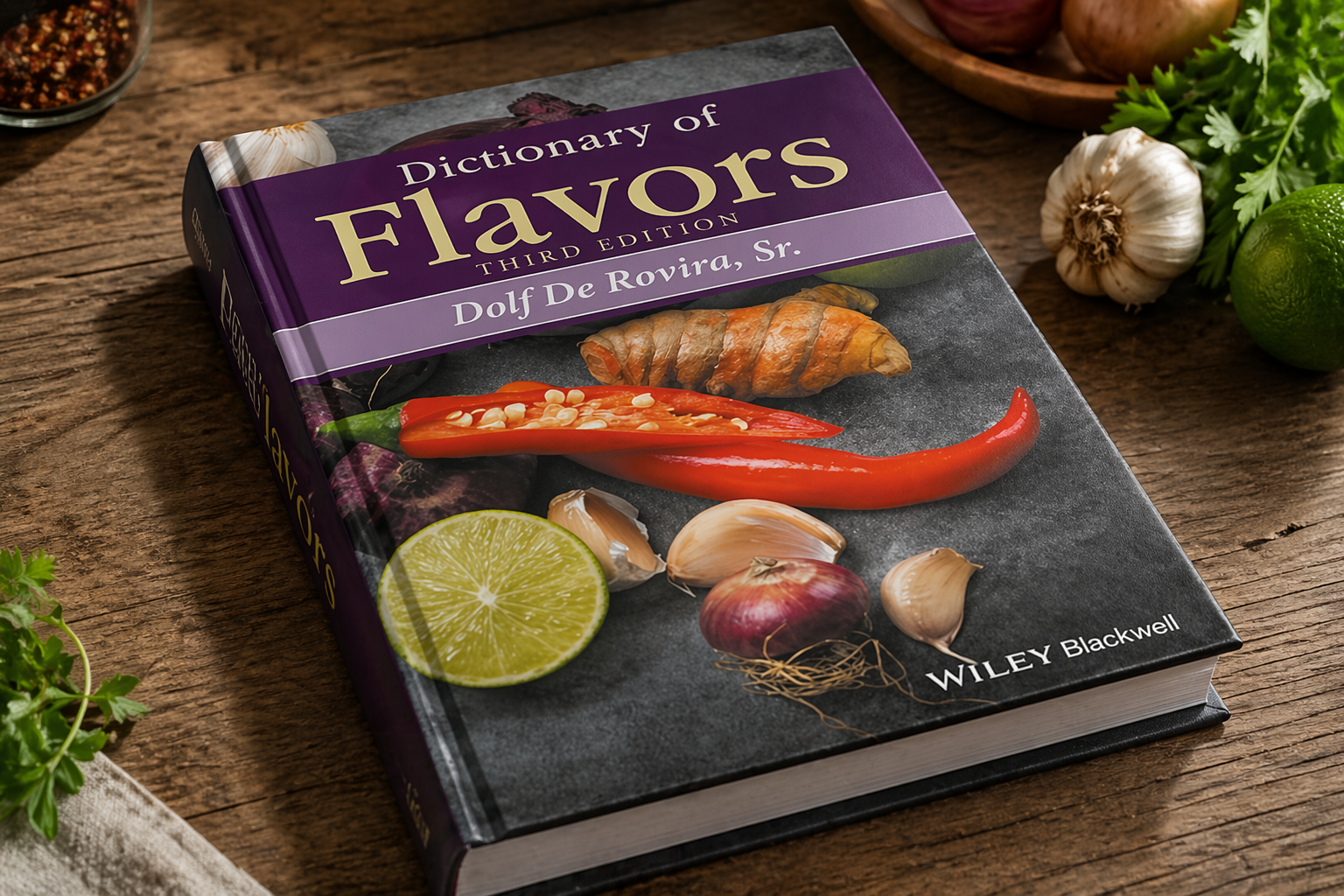
Dictionary of Flavors is is one of a dozen books the Society of Flavor Chemists recommends that flavorists read.
The Dictionary of Flavors by Dolf DeRovira: An In-Depth Review (2026)
Rating: ★★★★☆ (4.7/5)
Best for: Flavor chemists, food scientists, product developers, culinary professionals, and students.
Not ideal for: Absolute beginners with no chemistry background or home cooks looking for recipe ideas.
Quick Summary
If you work in the food, beverage, or flavor industry, The Dictionary of Flavors is not just a book—it’s a professional toolkit. Written by Dolf DeRovira, a certified flavor chemist with over 40 years of industry experience, this reference guide stands apart from simple glossaries. Instead of listing terms alphabetically, DeRovira organizes information by chemical families and sensory profiles, teaching you how to think like a flavorist.
The third edition (2017) is the most comprehensive, spanning 1,160 pages and covering everything from GRAS ingredients and regulatory standards to modern concerns like food allergens and natural vs. artificial flavor labeling.
What Makes This Book Different?
Most dictionaries define words. This one defines flavor through:
- Comparative flavor chemistry – Ingredients are grouped by chemical structure, which predicts aroma. Learn one compound in a family, and you understand the sensory profile of the whole group.
- Cross-disciplinary coverage – Includes regulatory (FDA, FEMA, EU), sensory science, microbiology, pharmacology, and even marketing psychology.
- Real-world experience – DeRovira admits that much of flavor creation is passed down through mentorship. He gives you his hard-won insights but encourages you to develop your own creative style.
Key Topics Covered
✅ Flavor ingredients – Over 1,500+ entries on natural and synthetic compounds
✅ Off-flavors & taints – How to identify and prevent them
✅ Regulatory guidelines – GRAS status, labeling laws, and global standards
✅ Allergen management – How to formulate without common allergens
✅ Application-specific flavors – Beverages, dairy, savory, confectionery, tobacco, and pet food
✅ Sensory science – How humans perceive taste, aroma, and texture
Pros & Cons
Pros 👍
- Exceptionally comprehensive – One of the few books covering both natural and artificial flavor chemistry in depth.
- Practical learning structure – Chemical family grouping makes memorization and application faster.
- Industry insider perspective – Written by a working flavorist, not just an academic.
- Updated for modern challenges – Third edition includes allergen avoidance, natural flavor substantiation, and international regulatory changes.
- Usable across roles – Useful for R&D, quality control, regulatory affairs, and marketing teams.
Cons 👎
- Dense and technical – Not a light read. Requires basic organic chemistry knowledge.
- Weak for beginners – No introductory chapter on fundamentals of flavor chemistry.
- Pricey – The hardcover third edition typically retails between $150–$250.
- No digital companion – No online database or searchable app version (as of 2026).
Who Should Buy This Book?
| Role | Value |
|---|---|
| Flavor Chemist | Essential desk reference |
| Food Scientist | High – for product development |
| Culinary Professional | Medium – useful for pairing and troubleshooting |
| Student (Food Science) | High – but pair with a textbook |
| Marketing/Management | Medium – helps understand technical constraints |
| Home Cook | Low – too technical |
Comparison to Other Flavor References
| Book | Focus | Best for |
|---|---|---|
| The Dictionary of Flavors – DeRovira | Chemical families & application | Industry professionals |
| Flavor Chemistry – Reineccius | Academic theory | Graduate students |
| The Flavor Thesaurus – Segnit | Pairings & creativity | Chefs & writers |
| Fenaroli’s Handbook of Flavor Ingredients | Ingredient data | Regulatory & lab work |
DeRovira’s book sits between Fenaroli (pure data) and Reineccius (pure theory), offering applied knowledge you can use immediately in a lab or kitchen.
Verdict: Is It Worth Buying?
Yes, if you work with flavors professionally.
No other single volume combines dictionary-style lookup with structured learning based on chemical families. DeRovira’s experience-driven approach saves years of trial and error.
No, if you’re a casual reader or just starting out.
Start with a general food science textbook or an online flavor course before investing in this reference.
Where to Buy
- Wiley (publisher) – Direct, often with academic discounts
- Amazon – New & used copies available (check for third edition)
- SpringerLink – Institutional access
- AbeBooks – Older editions for budget buyers
Pro tip: Look for the third edition (2017, ISBN 978-1118854516) – it’s significantly updated over the 1999 first edition.
Keywords
Flavor dictionary, flavor chemistry book, Dolf DeRovira, food science reference, GRAS ingredients, flavorist handbook, natural flavors guide, off-flavor identification, flavor regulatory compliance, best books for food scientists 2026.
###