Europe Regulatory Roundup: Food & Flavor Law News, July 13–31, 2026
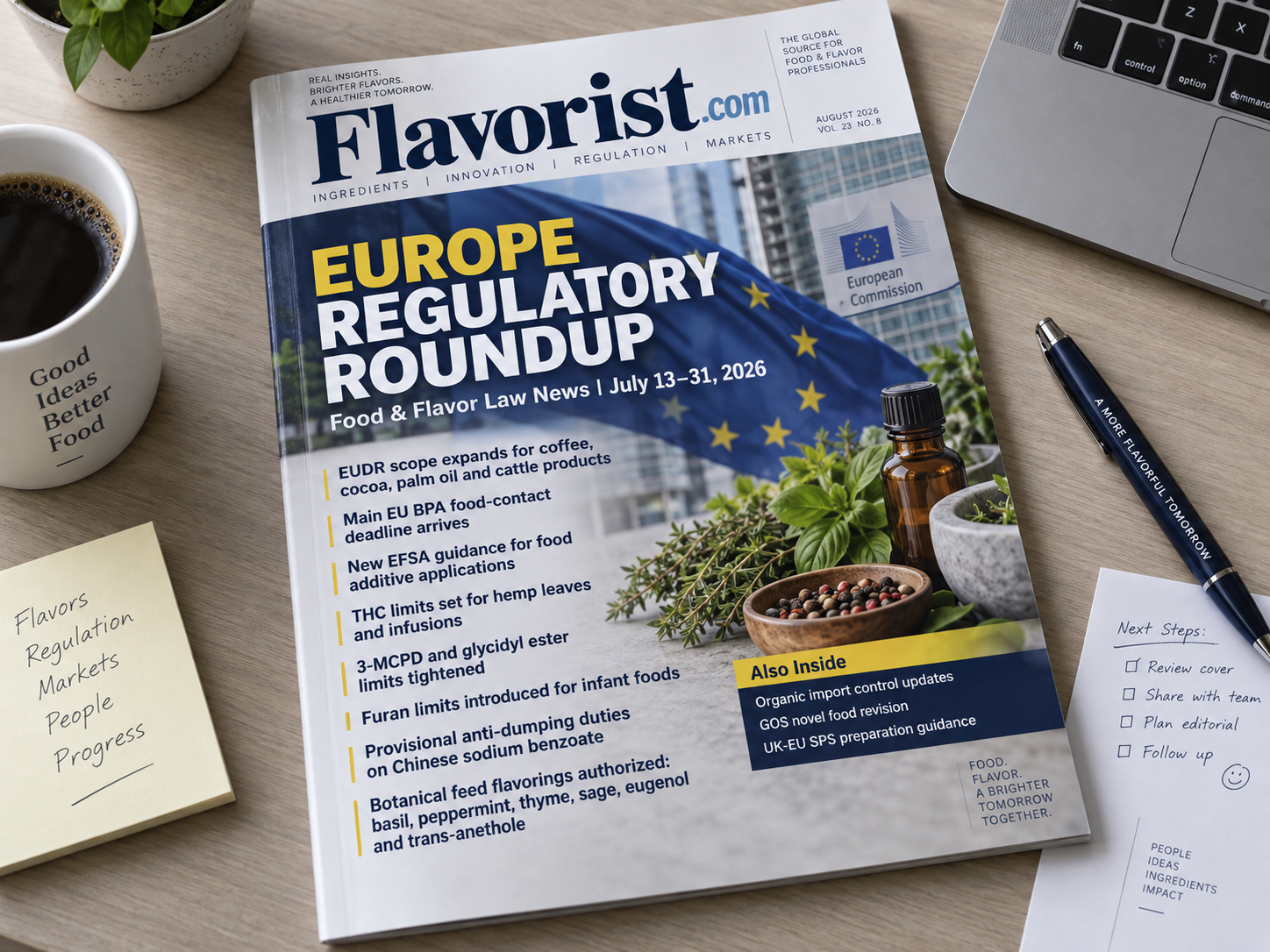
The new digest covers 21 material regulatory developments with direct or meaningful implications for food, beverage, ingredient, flavor, botanical, feed-flavor, packaging, or agrifood businesses in Europe.
Scope note: this is a comprehensive EU-level plus UK regulatory overview, supplemented by specialist regulatory reporting where a July publication flagged implementation of an earlier law. I excluded routine product recalls, individual restaurant enforcement actions, animal-disease zoning notices, routine single-pesticide MRL opinions, and ordinary feed enzyme/amino-acid authorizations unless they had a clear sensory/flavor relevance.
- 13 July — EU adjusts EUDR product scope and information-system rules — Binding/implementing legislation
The European Commission adopted a two-part implementation package for the EU Deforestation Regulation (EUDR), important to food companies sourcing coffee, cocoa, palm oil, soy and cattle-derived products. A delegated act updates which products fall within the regulation, notably bringing soluble coffee and certain additional palm-oil and cattle products into scope, while clarifying exclusions for samples, waste, second-hand goods and some packaging-related items. A companion implementing regulation modifies how due-diligence statements and simplified declarations are handled in the EUDR Information System, including arrangements for smaller primary operators and system contingencies. The main EUDR obligations are scheduled to apply from 30 December 2026 for large and medium businesses and certain operators already covered by the EU Timber Regulation, with another small/micro-business deadline in 2027. Flavor houses buying cocoa, coffee derivatives or palm-derived carriers/emulsifiers should reassess tariff classifications, supplier data and traceability requirements. (Environment)
Sources: European Commission — EUDR implementation measures, 13 July 2026 · EUR-Lex — Implementing Regulation (EU) 2026/1565 · Commission Delegated Act C(2026) 4920
- 20 July — Main EU BPA food-contact-material transition period expires — Implementation deadline
A major transition point under the EU's BPA food-contact restrictions arrived on 20 July 2026. For most food-contact articles manufactured using bisphenol A, the general transitional period allowing first placement on the EU market ended on that date. The underlying restrictions stem from Regulation (EU) 2024/3190, with subsequent legislation clarifying transition arrangements. Specific exceptions remain for certain single-use articles, including selected metal packaging used for preserved fruits, vegetables and fishery products, and some articles where BPA-containing varnish or coating is applied only to the external metal surface. Longer sell-through arrangements also apply to qualifying repeat-use articles. For food and flavor manufacturers, the immediate compliance issue is packaging, processing equipment and other contact materials—not the formulation itself. Companies should ensure declarations of compliance and supplier specifications demonstrate that newly marketed articles meet the BPA rules and that any continued use genuinely falls within a transitional derogation. (Food Packaging Forum)
Sources: Food Packaging Forum — BPA transition deadline, 20 July 2026 · EUR-Lex — Regulation (EU) 2026/250 transitional provisions
- 20 July — New EFSA scientific guidance for food-additive applications becomes applicable — Regulatory guidance
EFSA's revised scientific guidance for preparing applications concerning food additives became applicable on 20 July 2026. Applications submitted from this date should follow the new framework; the preceding guidance remained usable only for dossiers submitted before the cut-off. The updated approach spells out the evidence EFSA expects on additive identity, chemical composition, manufacturing process, specifications, stability, reaction and fate in food, proposed technological uses, dietary exposure and toxicological safety. Genotoxicity and other toxicology requirements are integrated into a more structured risk-assessment framework, together with environmental information where relevant. Although food flavorings operate under their own specific authorization framework, the update is important to companies whose portfolios span additives, carriers, stabilizers, preservatives, colors or multifunctional flavor-system ingredients. It also provides a useful benchmark for the quality of analytical and exposure data EU assessors increasingly expect from applicants. Regulatory teams filing new additive or use-extension dossiers after 20 July should update dossier templates accordingly. (European Food Safety Authority)
Sources: EFSA — Food additive application procedure and guidance · EFSA — Scientific data requirements
- 20 July — EU revises authorized conditions for galacto-oligosaccharides (GOS) — Binding novel-food legislation
Commission Implementing Regulation (EU) 2026/1749 revised the Union-list entry for galacto-oligosaccharides (GOS) as an authorized novel food. The measure rationalizes and updates permitted food categories so they align better with current EU terminology for dairy products, fruit products, beverages, cereals and foods intended for particular groups. It also restructures categories that had previously bundled several product types together, improving clarity for manufacturers determining whether a particular GOS-containing formulation falls within an authorized use. The underlying application sought broader uses across areas including drink bases, confectionery, beverages, juice preparations, whey/protein products, coffee-based products, flavored milk beverages and cocoa preparations. The regulation therefore matters particularly to functional beverage, dairy, nutrition and flavor-system developers working with prebiotic formulations. Manufacturers should compare existing GOS applications against the revised Union-list wording and maximum-use conditions rather than relying on historical category names. The regulation followed the EU novel-food authorization procedure and took effect in August 2026. (EUR-Lex)
Source: EUR-Lex — Commission Implementing Regulation (EU) 2026/1749 on GOS
- 20 July — Commission terminates six novel-food procedures, including monk fruit — Novel-food regulatory decisions
The European Commission published a batch of six terminated novel-food procedures under Article 10(6) of the Novel Food Regulation. The files concerned Lasius fuliginosus ants; oxygen-enriched saltwater; Siraitia grosvenorii (monk fruit) as a traditional food from a third country; an extension of use for chia seeds; changed conditions of use for migratory locust; and changed conditions for yellow mealworm larvae. Termination means the Commission closed the procedure without amending the Union list of authorized novel foods; it should therefore not be interpreted as an authorization. Monk fruit is particularly significant to the flavor and sweetener sector because the fruit and its extracts are widely associated with sweetness modulation outside Europe. Businesses should distinguish carefully between the regulatory status of a botanical itself, extracts or flavoring preparations and any existing permitted flavor use. The decisions also illustrate the Commission's willingness to close applications where the evidence or procedural basis does not justify a Union-list update. (Food Safety)
Source: European Commission — Terminated novel-food applications, including July 2026 decisions
- 22 July — EESC opinion published on EU “food and feed safety simplification” package — Legislative proposal / policy process
The Official Journal published the European Economic and Social Committee's opinion on the Commission's proposed food and feed safety simplification package, sometimes described as the food/feed “omnibus.” The underlying Commission proposals seek to reduce administrative burden while retaining existing health and safety objectives. Areas under review include plant-protection products, biocides, pesticide maximum-residue procedures, genetically modified microorganisms used in fermentation, feed additives and overlapping hygiene/notification obligations. For ingredient and flavor businesses, the GMM-fermentation and feed-additive elements are particularly relevant because regulatory procedures can affect enzymes, cultures, fermentation-derived ingredients and sensory additives. The EESC publication does not itself create binding rules; rather, it forms part of the EU legislative process and signals stakeholder views before the Parliament and Council settle the final text. The Council was also advancing discussions during July, with the presidency seeking progress on the package. Regulatory teams should therefore treat this as a developing simplification initiative rather than current compliance law. (EUR-Lex)
Sources: Official Journal — EESC opinion on food and feed safety simplification · European Commission — underlying simplification proposal
- 22 July — EFSA lowers the safe dietary intake level for trifluoroacetic acid (TFA) — Scientific-regulatory development
EFSA announced a substantially lower health-based guidance value for trifluoroacetic acid (TFA), an environmental contaminant that can arise from degradation of certain pesticides and fluorinated substances and may enter groundwater, soil and crops. EFSA set an acceptable daily intake of 0.014 mg/kg body weight per day, down from the previous 0.05 mg/kg value. This is not itself a statutory food maximum, but it provides the scientific basis that the European Commission and member states can use in future risk-management decisions. The development is important to food companies because increasingly stringent toxicological benchmarks can influence pesticide approvals, residue assessments, environmental monitoring, drinking-water controls and ultimately raw-material specifications. Botanical, tea, fruit, vegetable and ingredient suppliers may see heightened attention to TFA occurrence data. The immediate regulatory action for manufacturers is therefore monitoring rather than reformulation: track forthcoming EU risk-management discussions and ensure contaminant and pesticide surveillance programs can respond if legal limits or analytical expectations subsequently change. (European Food Safety Authority)
Source: EFSA — New assessment of trifluoroacetic acid, 22 July 2026
- 23 July — EU authorizes basil tincture as a feed flavoring — Binding flavor legislation
Commission Implementing Regulation (EU) 2026/1786 authorized basil tincture from Ocimum basilicum L. as a sensory feed additive in the functional group “flavouring compounds” for all animal species. This is directly relevant to botanical and aroma suppliers serving the European feed sector. The authorization reflects EFSA's assessment of the tincture's composition and includes controls associated with naturally occurring constituents such as methyleugenol and estragole, which are toxicologically relevant aromatic compounds. Conditions of use address maximum exposures and combinations with other sources of the same constituents. The authorization does not extend to use in drinking water because the applicable feed-additive framework does not provide for flavoring compounds to be used that way. Transitional periods allow stocks manufactured and labeled under the previous framework to continue through specified 2027 dates. Manufacturers should confirm botanical identity, extraction specifications, marker-compound levels and labeling against the new authorization rather than relying on historical “existing product” status. (EUR-Lex)
Source: EUR-Lex — Commission Implementing Regulation (EU) 2026/1786, basil tincture
- 23–24 July — EU updates recognized control bodies for organic-food imports — Binding organic-import legislation
Commission Implementing Regulation (EU) 2026/1789 amended the lists of third countries, competent authorities and control bodies recognized for importing organic products into the EU. Among the changes, the regulation recognizes Control Union Argentina S.A. for relevant Argentine organic certification activities and reflects Australia's withdrawal of recognition for NASAA Certified Organic under the listed code. The regime covers categories that can include unprocessed plant products, processed food, feed, seeds and other agricultural materials. The significance for food and flavor companies is practical: an otherwise technically compliant organic botanical, spice, extract or food ingredient can encounter import problems if its certification chain no longer corresponds to an EU-recognized authority or control body. Procurement and regulatory teams should therefore verify certification-body codes appearing on certificates of inspection and supplier documentation, particularly when sourcing from jurisdictions affected by an updated recognition list. The regulation entered into force shortly after its Official Journal publication. (EUR-Lex)
Source: EUR-Lex — Commission Implementing Regulation (EU) 2026/1789 on organic import controls
- 24 July — EU renews carvacrol/cinnamaldehyde/capsicum-oleoresin feed additive — Binding ingredient legislation
Commission Implementing Regulation (EU) 2026/1777 renewed the authorization of a preparation containing carvacrol, cinnamaldehyde and capsicum oleoresin for chickens for fattening. Although classified legally as a zootechnical additive rather than a flavoring, its active materials are highly familiar to the flavor and aroma sector. The renewed preparation contains specified proportions of carvacrol, cinnamaldehyde and capsicum oleoresin, including controlled concentrations of capsaicin and dihydrocapsaicin, and is authorized at 100 mg/kg complete feed. The regulation also restricts simultaneous use with other sources of the same active substances, helping control cumulative exposure. It replaces the earlier authorization under Implementing Regulation 2015/1490 and establishes another ten-year authorization period, accompanied by transitional provisions for existing additive, premixture and feed stocks. Suppliers serving both food-flavor and animal-nutrition markets should treat the legal classification carefully: food-grade status or flavoring recognition does not automatically satisfy the specifications and labeling required for an EU-authorized feed additive. (EUR-Lex)
Source: EUR-Lex — Regulation (EU) 2026/1777, carvacrol/cinnamaldehyde/capsicum preparation
- 24 July — EU authorizes eugenol and trans-anethole as feed flavorings — Binding flavor legislation
Commission Implementing Regulation (EU) 2026/1811 authorized eugenol and trans-anethole as sensory feed additives for poultry and ornamental birds and renewed applicable authorization conditions for trans-anethole. Both compounds are core aroma materials: eugenol provides the characteristic clove/spicy note, while trans-anethole is strongly associated with anise and fennel profiles. The eugenol specification covers material extracted from clove-derived sources and controls impurities such as methyleugenol; the authorization also establishes maximum feed concentrations and conditions designed to avoid excessive combined exposure when the same compounds arise from multiple additives. For trans-anethole, the Commission simplified the authorized name to “trans-anethole,” replacing a longer chemical synonym in the regulatory entry. The legislation took effect in August 2026 and establishes authorization through 2036. Flavor manufacturers supplying feed applications should update product dossiers, specifications, labels and cross-formulation calculations to the newly published entries, especially where botanical extracts provide overlapping quantities of these aroma compounds. (EUR-Lex)
Source: EUR-Lex — Commission Implementing Regulation (EU) 2026/1811, eugenol and trans-anethole
- 24 July — Peppermint, wild thyme and sage tinctures authorized as EU feed flavorings — Binding flavor legislation
Commission Implementing Regulation (EU) 2026/1822 authorized tinctures of peppermint (Mentha × piperita), wild thyme (Thymus serpyllum) and sage (Salvia officinalis) as sensory feed additives in the “flavouring compounds” functional group for all animal species. The measure is particularly relevant to producers of herb extracts, botanical flavors and natural sensory ingredients that operate across both food and animal-nutrition markets. As with other re-evaluated botanical feed flavorings, the authorization translates previously marketed products into defined EU specifications and conditions of use based on EFSA's safety assessment. It also establishes operator-protection measures where exposure to the concentrated preparations may create occupational risks. The regulation became applicable in August, with transition periods extending into 2027 for additives, premixtures and feed produced under the previous regime. Businesses should ensure that the botanical species, extraction system, analytical profile and relevant constituent limits of commercial tinctures correspond precisely to the authorized entries; a generic “peppermint” or “sage” description alone is insufficient for regulatory equivalence. (EUR-Lex)
Source:
- 27 July — EU imposes provisional anti-dumping duties on Chinese sodium benzoate — Trade regulation with major food-industry impact
Commission Implementing Regulation (EU) 2026/1854 imposed provisional anti-dumping duties on imports of sodium benzoate originating in China. Sodium benzoate is a major preservative used across beverages, sauces, fruit preparations and other food systems and is also commonly handled by flavor and ingredient distributors. The provisional rates are substantial: 57.6% for Wuhan Youji, 75.4% for Tianjin Dongda, 63.8% for Shandong TongTaiWeiRun, and 116.4% for other Chinese producers covered by the residual rate. Release for free circulation is subject to a security corresponding to the provisional duty. The Commission concluded at this stage that there was no compelling Union-interest reason to refrain from imposing the measures. This is not a change to E-number authorization or food-safety specifications; it is a trade remedy. Nevertheless, it can materially alter landed costs and supply-chain economics. European preservative users should review supplier origin, TARIC classification, customs exposure, contract clauses and alternative sourcing options. (EUR-Lex)
Source:
- 27 July — EFSA updates food-risk assessment of emerging brominated flame retardants — Scientific-regulatory development
EFSA published an updated assessment of 27 emerging and novel brominated flame retardants (BFRs) potentially occurring in food. Available exposure data indicated no health concern for several evaluated substances—including BEH-TEBP, EH-TBB and DBDPE—at estimated dietary exposures, but EFSA emphasized that information was too limited to complete robust risk assessments for many other BFRs. Certain compounds raised genotoxicity or carcinogenicity questions, and the Panel could not establish health-based guidance values for several substances because toxicological and occurrence data remain inadequate. EFSA called for more food-occurrence data, biomonitoring and toxicological research and indicated that future work should consider combined exposure to BFR mixtures, rather than assessing each chemical entirely in isolation. No new maximum food limits were enacted on 27 July. The significance for food and ingredient businesses is forward-looking: EFSA opinions frequently shape subsequent EU contaminant monitoring and risk-management priorities, particularly for high-fat foods where persistent environmental contaminants may accumulate. (European Food Safety Authority)
Sources: ·
- 27 July — Food-packaging sector flags imminent EU PPWR application date — Implementation alert
A July regulatory update highlighted the approaching 12 August 2026 application date of the EU Packaging and Packaging Waste Regulation (PPWR), Regulation (EU) 2025/40. Although the PPWR itself was adopted earlier, the July implementation alert is highly relevant to food and flavor manufacturers preparing packaging compliance. Unlike the previous directive-based framework, the regulation applies directly across member states and introduces increasingly harmonized requirements concerning packaging design, recyclability, waste prevention, labeling and restricted substances. Of particular significance for food-contact packaging, the PPWR restricts PFAS above specified thresholds in food-contact packaging placed on the market. Official EU material confirms the 12 August 2026 general application date and the food-contact PFAS provisions. Flavor and ingredient producers should not view PPWR solely as a packaging-supplier issue: sample containers, retail packs, sachets, pouches, closures and coated paper formats can all affect downstream compliance. Supplier declarations and packaging specifications therefore need alignment with PPWR requirements and staged future obligations. (Flex Frontier)
Sources: · ·
- 28–29 July — EU establishes THC limits for hemp leaves and hemp infusions — Binding contaminant legislation
Commission Regulation (EU) 2026/1828 amended the EU contaminants framework to establish maximum levels for delta-9-tetrahydrocannabinol (Δ9-THC) equivalents in hemp leaves and products prepared from them for infusion. The measure responds to increasing consumption of hemp-herbal infusions and EFSA's acute reference dose for THC. In addition to maximum contaminant levels, the regulatory approach distinguishes leaves intended specifically for preparation with water and incorporates use information designed to limit exposure, especially for vulnerable age groups and preparation practices that can increase THC extraction. The new limits apply from 1 January 2027, giving suppliers a short implementation period for specifications, sampling plans, analytical testing and labels. This matters directly to botanical-tea, natural-flavor and hemp-ingredient businesses: compliant cannabinoid status under narcotics law does not remove the separate obligation to meet EU contaminant limits in foods. Suppliers should also ensure laboratories report against the precise THC-equivalent definition used in the EU contaminants regulation rather than relying solely on generic cannabinoid certificates. (EUR-Lex)
Source:
- 29 July — EU publishes new rules intended to strengthen farmers in the food supply chain — Binding agrifood-market legislation
Regulation (EU) 2026/1739, published in the Official Journal on 29 July, amends Common Agricultural Policy/Common Market Organisation rules with the goal of strengthening farmers' bargaining position in the food supply chain. A central element is broader use of written contracts for deliveries of agricultural products from farmers, producer organizations or their associations to processors, distributors and retailers, subject to specified derogations. Contracts are expected to address matters such as price or objective price-calculation mechanisms, quantity and quality, duration, payment, delivery and force-majeure provisions. Longer arrangements may require revision mechanisms, while member states can introduce additional contract-related requirements and must provide mediation or comparable dispute-resolution possibilities in relevant circumstances. Food processors and flavor manufacturers purchasing fruit, herbs, spices, dairy inputs and other agricultural raw materials should review procurement templates, particularly formula-price and cost-index clauses. The measure is supply-chain regulation rather than food-safety law, but it can materially affect ingredient purchasing practices and commercial relationships with European producers. (EUR-Lex)
Source:
- 29–30 July — EU authorizes thyme essential oil as a feed flavoring — Binding flavor legislation
Commission Implementing Regulation (EU) 2026/1865 authorized thyme essential oil from Thymus vulgaris L. and/or Thymus zygis L. as a sensory feed additive for all animal species. The authorized material is categorized as a flavoring compound and characterized through constituents such as thymol, p-cymene, γ-terpinene and linalool. EFSA concluded that the oil could be safely used subject to species-specific conditions, while also identifying occupational hazards such as irritation and sensitization that require user-protection measures. The regulation does not authorize the flavoring for drinking-water use. Significantly for the flavor sector, the Commission noted that a separate demonstration of efficacy was unnecessary because thyme and its preparations are already recognized for flavoring food—the sensory function is well established. The regulation entered into force in August 2026 and includes transition periods extending through 2027. Producers should align essential-oil chemotype, specification and contaminant profile with the precise EU authorization rather than treating all thyme oils as interchangeable. (EUR-Lex)
Source:
- 29–30 July — EU tightens 3-MCPD and glycidyl-ester limits, especially for infant foods — Binding contaminant legislation
Commission Regulation (EU) 2026/1825 amended Regulation 2023/915 on contaminants by revising maximum levels for 3-monochloropropane-1,2-diol (3-MCPD), its fatty-acid esters and glycidyl fatty-acid esters in foods. These contaminants can form during high-temperature refining of vegetable oils and therefore affect oils, fats, compound foods and products formulated with refined lipid ingredients. The new regime is particularly important for baby foods, processed cereal-based foods for infants and young children, and oils intended for manufacturing those products, where tighter limits will apply from 1 January 2027. For example, the legislation lowers the future glycidyl-ester limit for oils intended for baby-food production compared with the preceding value. Products lawfully marketed before the new application date receive sell-through treatment until their best-before or use-by dates. Oil refiners, infant-nutrition manufacturers and flavor-system suppliers using lipid carriers should reassess supplier specifications, refining controls, analytical LOQs and contaminant guarantees well before January 2027. (EUR-Lex)
Source:
- 29–30 July — EU sets limits for furan and methylfurans in foods for infants and young children — Binding contaminant legislation
Commission Regulation (EU) 2026/1890 introduced EU maximum levels for the sum of furan, 2-methylfuran and 3-methylfuran, expressed as furan, in specified foods for infants and young children. Furans are process contaminants associated particularly with heat treatment, sterilization and other thermal processing. The regulation sets limits of 40 μg/kg for processed cereal-based foods, 30 μg/kg for certain dairy- or fruit-based baby foods and mixtures containing at least 80% dairy and/or fruit ingredients, and 80 μg/kg for other baby foods. The limits are scheduled to apply from 1 January 2028, providing manufacturers with a comparatively long period to optimize processes and establish analytical controls. For flavor companies, the regulation is relevant where roasted, thermally processed or concentrated ingredients contribute to the finished product's total furan burden. Infant-food producers should therefore assess both processing-generated contamination and ingredient contributions, rather than assuming the contaminant arises only during final sterilization or packaging. (EUR-Lex)
Source:
- 30 July — UK updates industry preparation guidance for future UK–EU SPS agreement — UK regulatory-policy development
The UK government updated its guidance on preparations for a prospective UK–EU sanitary and phytosanitary (SPS) agreement on 30 July, incorporating findings from its industry call for information. The planned agreement is intended to cover trade and movement in plants, plant products, animals, animal products, feed and food and forms part of the wider UK–EU strategic partnership. The government says the objective is for the SPS agreement to take effect around mid-2027, although timing depends on negotiations and the final legal arrangements. The July update stresses that agrifood businesses should prepare for potential changes while recognizing that the precise future regime is not yet settled. For flavor and ingredient businesses trading between Great Britain and the EU, a future SPS agreement could materially change export certification, border inspection and regulatory-alignment requirements for products containing animal, plant or composite ingredients. Companies should therefore distinguish the prospective arrangement from current law: existing border and certification requirements continue until legally changed. (GOV.UK)
Source:
Practical reading of the July 2026 period
For a food-and-flavor company, the highest-priority items are the EUDR changes, BPA transition deadline, new EFSA additive dossier guidance, sodium-benzoate anti-dumping duties, PPWR/PFAS packaging requirements, and the new THC, 3-MCPD/glycidyl ester and furan contaminant rules. For companies active in animal nutrition, July was unusually important for flavoring regulation because basil, peppermint, wild thyme, sage, thyme essential oil, eugenol and trans-anethole all received new or renewed EU regulatory treatment.
The dates above refer to the regulatory release, adoption, Official Journal publication, guidance update, or material implementation announcement occurring between 13 and 31 July 2026;
###