🌍 European Flavour Association (EFFA): Structure, Industry Role, Member Benefits, and Pathways to Membership
🌍 European Flavour Association (EFFA): A Complete Guide for Flavorists
🏛️ What is EFFA?
The European Flavour Association (EFFA) is the official trade association representing the flavor industry across Europe. It brings together national flavor associations and major flavor companies operating within the European Union (EU) and surrounding regions.
- Founded: 1961
- Headquarters: Brussels, Belgium
- Scope: Pan-European (EU + associated countries)
- Members: National flavor associations + leading flavor manufacturers
👉 Think of EFFA as the central voice of the European flavor industry, similar to how other regions have their own associations (e.g., FEMA in the U.S.).
🎯 Core Purpose of EFFA
EFFA exists to represent, protect, and guide the flavor industry in Europe. Its mission revolves around three major pillars:
1. Regulatory Representation
EFFA works closely with European regulatory bodies such as:
- European Commission
- European Food Safety Authority
It ensures that:
- Flavor regulations are science-based and practical
- Industry concerns are heard during policy development
- Companies remain compliant with EU law
2. Safety & Scientific Guidance
EFFA plays a key role in:
- Evaluating flavoring substances safety
- Supporting toxicological and exposure data
- Providing scientific input for risk assessments
This often aligns with EFSA evaluations under EU regulations such as:
- EC No 1334/2008 (flavorings regulation)
👉 For flavorists, this means:
- Many compounds you use are approved or evaluated through EFFA-supported frameworks
- Safety data often originates from EFFA-coordinated industry submissions
3. Industry Advocacy & Harmonization
EFFA helps:
- Harmonize rules across EU member states
- Reduce trade barriers
- Promote innovation in flavor creation
It ensures that a flavor developed in one EU country can be:
- Legally used across the EU
- Consistent in labeling and safety
🧪 Where EFFA is Used in the Flavor Industry
EFFA is not something flavorists "use" directly like a raw material—but it influences nearly every aspect of your work.
🔬 1. Flavor Formulation & Ingredient Selection
EFFA impacts:
- Which flavoring substances are approved
- Maximum usage levels
- Restrictions on certain compounds
👉 Example:
- If you formulate with aldehydes, esters, or sulfur compounds, their legal status in Europe is often tied to:
- EFSA evaluation
- EFFA industry data submissions
🏭 2. Flavor Manufacturing & Compliance
EFFA guidelines help companies:
- Maintain Good Manufacturing Practices (GMP)
- Ensure traceability and documentation
- Align with EU safety standards
📦 3. Labeling & Product Development
EFFA influences:
- Use of terms like “natural flavoring”
- Labeling compliance under EU law
- Clean label strategies
👉 Example:
- Whether a flavor can be labeled as “natural strawberry flavor” depends on EU definitions that EFFA helps interpret and communicate.
🌍 4. International Trade
EFFA is critical when:
- Exporting flavors into Europe
- Aligning non-EU formulations with EU rules
👉 For global flavor companies:
- EFFA acts as the gateway to EU market compliance
📚 Why EFFA Matters for Flavorists (Especially Beginners)
If you're training or working toward professional certification (e.g., Society of Flavor Chemists level), EFFA knowledge is essential because:
✔ You must understand:
- EU regulatory frameworks for flavorings
- Safety evaluation processes
- Differences between EU vs. US regulations
✔ Practical impact:
- Prevents formulation with non-compliant ingredients
- Helps design flavors that are globally marketable
- Improves communication with regulatory teams
⚖️ Key Differences vs Other Regions
| Region | Organization | Role |
|---|---|---|
| Europe | European Flavour Association | Regulatory + advocacy |
| United States | FEMA | GRAS determination |
| Global | IFRA (fragrance) | Safety standards (not flavor-specific) |
👉 EFFA is more regulatory-integrated due to strict EU laws.
🧠 Simple Analogy (For Easy Understanding)
Think of EFFA as:
“The rulebook + spokesperson + scientific advisor for flavors in Europe.”
- It helps write the rules
- It talks to regulators
- It ensures flavors are safe and legal
🧾 Summary
The European Flavour Association is a central authority shaping the European flavor industry through:
- Regulatory advocacy with EU institutions
- Scientific support for flavor safety
- Harmonization of laws across Europe
- Guidance on labeling and compliance
👉 For flavorists, EFFA defines:
- What you can use
- How you can use it
- How you can sell it in Europe
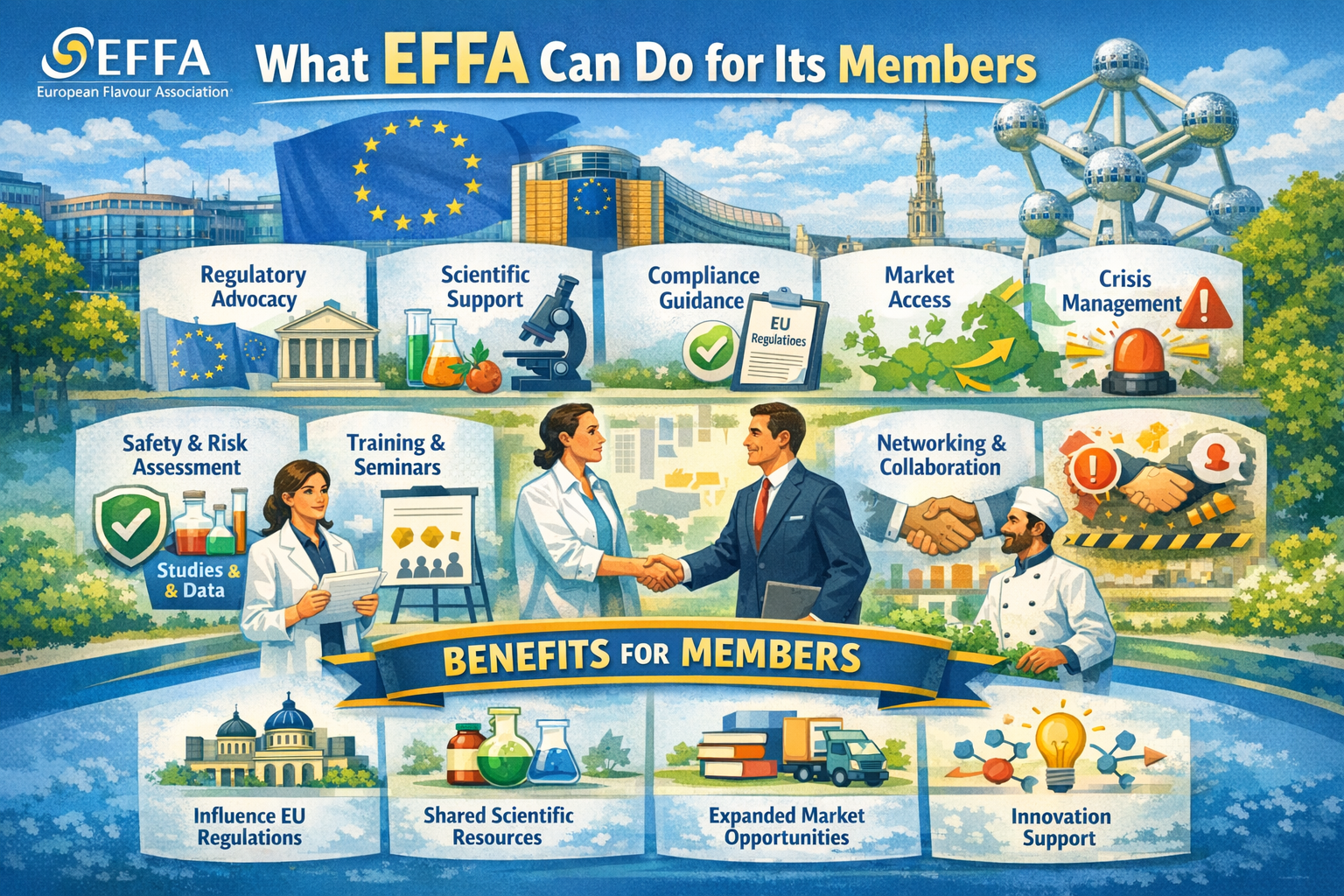
🌍 What the European Flavour Association Can Do for Its Members
For companies in the flavor industry, EFFA is far more than a trade group—it acts as a regulatory shield, scientific partner, and strategic enabler. Below is a clear, practical breakdown of how EFFA supports its members.
🏛️ 1. Regulatory Protection & Advocacy
EFFA represents member interests directly to EU authorities such as:
- European Commission
- European Food Safety Authority
What this means for members:
- Influence on new laws: EFFA participates in shaping regulations before they are finalized
- Early warnings: Members get advance notice of regulatory changes
- Defense of key ingredients: EFFA can argue for continued use of important flavor compounds
👉 Example: If a compound faces restriction, EFFA may submit scientific data to support its safe use.
🧪 2. Scientific & Safety Support
EFFA coordinates industry-wide scientific work, including:
- Toxicology studies
- Exposure assessments
- Risk evaluations
Benefits to members:
- Shared cost of research (instead of each company funding studies alone)
- Access to high-quality safety data
- Support for EFSA submissions
👉 This is critical because EU approval often depends on robust scientific dossiers.
📊 3. Regulatory Guidance & Compliance Tools
EFFA helps members navigate complex EU laws such as:
- Flavorings Regulation (EC No 1334/2008)
- REACH chemical regulations
Practical support:
- Guidance documents and interpretation notes
- Compliance checklists
- Clarification on ambiguous rules
👉 For a flavor company, this reduces:
- Risk of non-compliance
- Costly reformulations
- Product launch delays
🌐 4. Market Access & Trade Facilitation
EFFA helps ensure flavors can move freely across Europe.
Member advantages:
- Harmonized standards across EU countries
- Fewer regulatory barriers between markets
- Easier cross-border product launches
👉 Without EFFA, companies might face:
- Different rules in each country
- Repeated approvals
- Increased costs
🏭 5. Industry Representation & Reputation Building
EFFA promotes the flavor industry to:
- Regulators
- Consumers
- NGOs
What members gain:
- A unified industry voice
- Protection against negative public perception
- Advocacy for safe and responsible flavor use
👉 This is especially important during:
- Public debates on food additives
- Clean-label trends
- Natural vs artificial discussions
📚 6. Technical Knowledge & Training
EFFA provides:
- Workshops and seminars
- Regulatory updates
- Technical papers
Benefits:
- Keeps teams up to date on EU requirements
- Helps train junior flavorists and regulatory staff
- Improves internal decision-making
🤝 7. Networking & Industry Collaboration
EFFA connects:
- Flavor houses
- Ingredient suppliers
- Regulatory experts
Value for members:
- Collaboration on industry challenges
- Access to expert working groups
- Benchmarking against competitors
⚠️ 8. Crisis Management & Risk Mitigation
When issues arise (e.g., ingredient bans, safety concerns), EFFA:
- Coordinates industry response
- Communicates with regulators
- Provides unified messaging
Member protection:
- Faster, coordinated action
- Reduced reputational damage
- Clear guidance during uncertainty
💡 9. Innovation Support
EFFA encourages innovation by:
- Clarifying regulatory pathways for new ingredients
- Supporting novel flavor technologies
- Advocating for science-based approval processes
Impact:
- Faster commercialization of new flavors
- Reduced uncertainty in R&D
🧠 Simple Way to Understand EFFA’s Value
Think of EFFA as:
Your company’s “regulatory, scientific, and strategic partner” in Europe
It helps you:
- Stay legal
- Stay competitive
- Stay informed
- Stay protected
🧾 Final Summary
Membership in the European Flavour Association provides:
- ✅ Direct influence on EU regulations
- ✅ Shared scientific resources and safety data
- ✅ Practical compliance guidance
- ✅ Easier access to the European market
- ✅ Strong industry representation
- ✅ Continuous technical education
- ✅ Crisis support and risk management
👉 In short:
EFFA allows flavor companies to focus on innovation and business, while it helps manage the complex regulatory and scientific landscape of Europe.
🌍 How to Become a Member of the European Flavour Association
Becoming a member of EFFA is not the same as joining a typical open association. It follows a structured, tiered system, because EFFA primarily represents the industry at a national and corporate level rather than individual professionals.
🧭 1. Understand the Membership Structure
EFFA has two main pathways for membership:
🏢 A. National Association Membership (Most Common Route)
Most companies join EFFA indirectly through their country’s flavor association.
👉 Example structure:
- Your company joins a national body (e.g., flavor association in France, Germany, UK)
- That association is already a member of EFFA
- You are then represented at the European level
✔ Why this route is preferred:
- Easier access
- Lower administrative burden
- Immediate integration into EFFA network
🏭 B. Direct Company Membership
Large multinational flavor companies can apply for direct membership.
Requirements typically include:
- Significant presence in the European flavor market
- Strong regulatory and compliance capability
- Alignment with EFFA’s code of practice
👉 This route is usually for:
- Global flavor houses
- Major ingredient suppliers
- Companies deeply involved in EU regulatory processes
📋 2. Meet the Basic Eligibility Criteria
Regardless of the route, companies must:
✔ Operate in the flavor industry
- Flavor manufacturers
- Ingredient suppliers
- Flavor-related technology companies
✔ Comply with EU regulations
- Food safety laws
- Chemical regulations (e.g., REACH)
- Flavorings Regulation (EC No 1334/2008)
✔ Follow ethical and safety standards
- Good Manufacturing Practices (GMP)
- Responsible sourcing and labeling
📝 3. Application Process (Step-by-Step)
Step 1: Choose Your Route
- Contact your national flavor association (recommended)
- Or apply directly to EFFA if eligible
Step 2: Submit Application
Typical application includes:
- Company profile
- Description of activities in flavors
- Regulatory compliance status
- Commitment to EFFA guidelines
Step 3: Review & Approval
- Application reviewed by EFFA committees
- May require:
- Additional documentation
- Clarifications
- Internal voting (for direct members)
Step 4: Membership Confirmation
Once approved:
- You gain access to EFFA resources
- You can participate in:
- Working groups
- Scientific committees
- Regulatory discussions
🤝 4. What Happens After You Join?
As a member, your company can:
- Join technical and regulatory working groups
- Access confidential industry data and guidance
- Participate in EU-level discussions
- Network with other leading flavor companies
👉 This is where the real value of EFFA membership begins
⚠️ Important Notes (Very Common Misunderstanding)
❌ Individuals cannot join EFFA directly
- It is not a personal membership organization
- Flavorists join through their employers or national associations
❌ Small companies may not qualify for direct membership
- But they can still access EFFA via national associations
🧠 Simple Way to Understand It
Think of joining EFFA like this:
Local → National → European
- You join locally
- Your association connects nationally
- EFFA represents you at the European level
🧾 Summary
To become part of the European Flavour Association:
- ✅ Most companies join through national flavor associations
- ✅ Large companies may apply directly to EFFA
- ✅ Must meet regulatory, safety, and industry standards
- ❌ Individuals cannot join independently
###