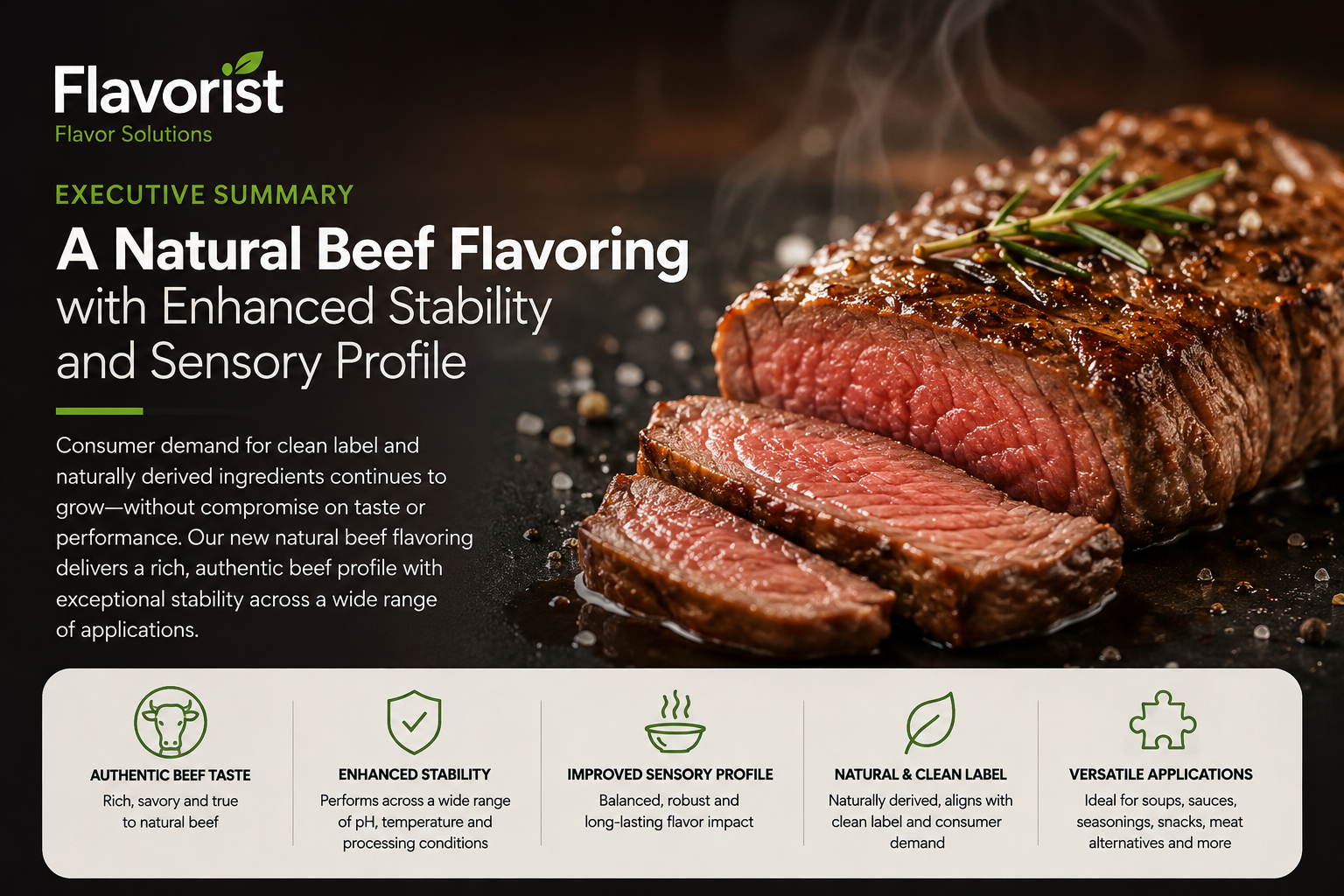
Executive Summary: A Natural Beef Flavoring with Enhanced Stability and Sensory Profile
 Loyda et al.
Based on the patent document CN121942877A, here is a detailed extraction of the important message, including compounds, formulas, processes, and results, structured for clarity.
Executive Summary: A Natural Beef Flavoring with Enhanced Stability and Sensory Profile
The invention, CN121942877A, addresses significant shortcomings in current natural beef flavoring production, including insufficient flavor complexity, poor flavor harmony (lack of top, body, and base note integration), rapid flavor degradation and browning during storage due to oxidation, and flavor loss during high-temperature sterilization. To overcome these, the patent proposes a novel natural beef flavoring and its preparation method. The core innovations are:
- A comprehensive raw material formulation that builds beef flavor through a multi-component synergistic system.
- A multi-stage enzymatic hydrolysis process using a combination of neutral protease, alkaline protease, and lipase to generate a richer array of flavor precursors.
- A "stepwise feeding" approach during the Maillard reaction, carefully controlling the order and timing of ingredient addition to promote flavor development and harmony.
- A synergistic antioxidant system combining water-soluble rosemary extract and ascorbic acid to protect flavor, color, and extend shelf life.
- A gentle two-step pasteurization method to sterilize the product while minimizing damage to heat-sensitive flavor compounds.
The resulting natural beef flavoring is described as having a strong, characteristic stewed beef flavor that is soft, natural, mellow, and smooth, with a stable color and a fresh, mild taste.
1. Key Compounds and Raw Material Formulation
The formula is meticulously designed to create a robust beef flavor profile through the Maillard reaction and other synergistic flavor-building pathways. The ingredients and their specific functions are detailed below.
Core Base:
- Beef (50-100 parts): The primary protein source, providing the foundational meaty character and precursors (amino acids, peptides, fats) for flavor development. It is processed into a paste.
- Water (50-150 parts): The medium for enzymatic hydrolysis and Maillard reaction.
Maillard Reaction Substrates and Flavor Modulators:
These are the key reactants that generate the characteristic meaty, roasted, and savory flavors.
- Cysteine (2-7 parts): A critical sulfur-containing amino acid. It serves as a core substrate to generate sulfur-containing heterocyclic compounds (e.g., thiophenes, thiazoles) that are essential for beef's characteristic meaty, roasted, and burnt notes.
- Reducing Sugar (4-10 parts): A synergistic blend of glucose and xylose in a mass ratio of 1:1 to 2:1 (glucose:xylose). This combination is crucial:
- Glucose: Provides a soft, sweet fragrance and buffers the high reactivity of xylose.
- Xylose: Accelerates reaction initiation and strongly enhances the characteristic meaty aroma.
- Synergy: The co-usage creates a remarkable synergistic effect, complementing each other's flavors and enabling the regulation of the final color of the essence.
- Glycine, Aspartic Acid, Alanine (1-1.5 parts each): A specific blend of amino acids selected to supplement the reaction and fine-tune the flavor.
- Glycine & Alanine: React with reducing sugars to impart a soft, sweet taste, improving the smoothness and palatability of the essence.
- Aspartic Acid: Contributes a fresh, umami-like flavor, preventing the essence from tasting overly heavy.
- Thiamine (Vitamin B1, 1.5-5 parts): A vital sulfur-containing component that, along with cysteine and taurine, forms a "linkage of sulfur-containing components." This synergistically enhances the fullness and mellow sensation of the beef flavor.
Flavor Enhancement and Complexity:
These ingredients add depth, umami, and a savory mouthfeel.
- Hydrolyzed Vegetable Protein (HVP, 4-10 parts): A source of amino acids and peptides that synergizes with other ingredients to create a multidimensional flavor system. (Specified as 25% hydrolysis degree).
- Flavor Nucleotide Disodium (I+G, 0.4-1.0 parts): A potent umami enhancer that works synergistically with aspartic acid and HVP to significantly increase flavor intensity and optimize the overall taste.
- Taurine (1-4 parts): A sulfur-containing compound that plays multiple roles:
- Flavor: Enhances the fullness of the beef taste alongside cysteine and thiamine.
- Functionality: Assists in antioxidation, inhibits off-odors, and stabilizes flavor and color.
- Nutrition: Adds nutritional value (along with ascorbic acid and thiamine).
- Star Anise Powder (0.04-0.2 parts): Contains volatile compounds like anethole and anisaldehyde, which impart a spicy and fennel-like aroma, enriching the flavor profile and adding complexity.
Antioxidant System:
This is critical for product stability, preventing browning, oxidation, and flavor loss.
- Rosemary Extract (0.03-0.06 parts): A water-soluble form with 10% rosmarinic acid content. It provides a "fragrance protection" effect and inhibits lipid oxidation.
- Ascorbic Acid (Vitamin C, 0.05-0.10 parts): Acts as a rapid color protectant and free radical scavenger.
- Synergy: The combination of rosemary extract and ascorbic acid provides a synergistic antioxidant effect, significantly improving color stability and extending the product's shelf life. Taurine further assists this antioxidant function.
Preferred Formulation (Example 1):
| Component | Parts by Weight |
|---|---|
| Beef | 50 |
| Water | 50 |
| Cysteine | 2.5 |
| Reducing Sugar (Glucose:Xylose = 1.5:1) | 5.6 (Glucose 3.36, Xylose 2.24) |
| Glycine | 1.4 |
| Aspartic Acid | 1.2 |
| Alanine | 1.4 |
| Thiamine | 1.5 |
| Hydrolyzed Vegetable Protein (HVP) | 2 |
| Flavor Nucleotide Disodium (I+G) | 0.71 |
| Taurine | 1.6 |
| Star Anise Powder | 0.04 |
| Water-Soluble Rosemary Extract | 0.04 |
| Ascorbic Acid | 0.07 |
2. The Preparation Process: A Step-by-Step Methodology
The process is designed to maximize flavor precursor generation and then carefully manage the Maillard reaction for a superior final product.
Step 1: Preparation of Beef Paste
- Action: Beef raw materials are placed into a grinder and processed into a meat paste without obvious granular sensation.
Step 2 & 3: Composite Enzymatic Hydrolysis
- Goal: To break down beef proteins and fats into smaller flavor precursors (amino acids, peptides, and free fatty acids).
- Action:
- The beef paste is mixed with water (feed liquid ratio of 1:0.9 to 1:1 kg:L) and stirred.
- The mixture is ground using a colloid mill for a finer texture.
- Composite Enzymolysis: A compound enzyme system is added for hydrolysis.
- Enzyme System: A mixture of neutral protease, alkaline protease, and lipase. The inclusion of lipase is a key differentiator, as it hydrolyzes beef fat to generate more free fatty acids, which are important precursors for a stronger and more natural "beefy" aroma in the subsequent Maillard reaction.
- Conditions: pH is adjusted to 7.0-8.0. Enzymolysis is carried out at 45-55°C for 2-3 hours. Total enzyme addition is 0.1-0.2% of beef mass.
- Enzyme Proportions (as % of beef mass):
- Neutral Protease: 0.02-0.1% (Enzyme Activity: 30-150U/g beef)
- Alkaline Protease: 0.02-0.08% (Enzyme Activity: 30-120U/g beef)
- Lipase: 0.02-0.07% (Enzyme Activity: 60-210U/g beef)
- Mass Ratio (Neutral:Alkaline Protease): 1:1 to 1.5:1
- Enzyme Deactivation: After hydrolysis, the mixture is heated to 85-90°C for 10-15 minutes to deactivate the enzymes, stopping the reaction. The liquid is then cooled to room temperature to obtain the "beef enzymolysis completion liquid."
Step 4: Stepwise Feeding Maillard Reaction
- Goal: To generate the characteristic beef flavor compounds via the Maillard reaction while ensuring flavor harmony and maximizing the utilization of raw materials.
- Key Innovation (Stepwise Feeding): Instead of adding all ingredients at once, they are added in a specific order and at specific time intervals. This ensures the gradual and full reaction of precursors, prevents the domination of a single flavor note, and promotes a soft, coordinated final flavor profile.
- Conditions: The reaction is carried out at 90-100°C for a total of 90-120 minutes.
- Stepwise Addition Protocol:
- Heating: The beef enzymolysis completion liquid is heated to 90-100°C and held for 5-10 minutes.
- Stage 1 (15-20 min): Reducing Sugar (glucose and xylose) is slowly added and mixed.
- Stage 2 (15-20 min): Cysteine and Thiamine are added.
- Stage 3 (15-20 min): Glycine, Aspartic Acid, and Alanine are added.
- Stage 4 (15-25 min): Hydrolyzed Vegetable Protein (HVP) and Taurine are added.
- Stage 5 (25-40 min): Flavor Nucleotide Disodium (I+G) and Star Anise Powder are added last. This final stage allows the reaction to complete and integrate the flavors.
Step 5: Cooling, Antioxidant Addition, and Sterilization
- Goal: To preserve the developed flavor and ensure product safety.
- Action:
- Cooling: The reaction system is cooled to 50-60°C.
- Antioxidant Addition: The water-soluble rosemary extract and ascorbic acid are sequentially added with stirring (2-3 minutes each) until completely dissolved.
- Two-Step Pasteurization: This is a crucial innovation to protect heat-sensitive flavor compounds.
- First Stage: The product is held at 50-60°C for 10-15 minutes, then immediately placed in an ice bath.
- Second Stage: The temperature is raised to 70-80°C for a very short time (30-60 seconds), then immediately placed in an ice bath.
- Benefits: This gentle process effectively kills harmful microorganisms while minimizing the volatilization and decomposition of the rich thermosensitive flavor compounds, preserving the intended flavor profile.
3. Results and Evaluation
The effectiveness of the invention was demonstrated through sensory evaluations comparing the examples (following the full process) against comparative examples (with omissions or variations). Sensory scoring was based on a 10-point scale across several attributes by trained panelists.
Key Results:
- Superior Sensory Profile (Examples 1-6):
- Strong Beef Character: High scores for beef taste and fragrance intensity, indicating a potent and characteristic meaty flavor.
- Excellent Flavor Harmony: Achieved high scores for fragrance roundness and full taste, demonstrating a well-integrated flavor with good top, body, and base notes. This is attributed to the stepwise feeding process.
- Pleasant Mouthfeel: Good scores for fresh taste, sweetness, and full taste, indicating a balanced and palatable flavor, not overly heavy or synthetic.
- Clean Flavor: Scored low on off-odors and irritation, highlighting the natural and clean profile of the flavor.
- Impact of Omissions (Comparative Examples):
- Without the Full Amino Acid Synergy (Comp. Ex. 1): When only cysteine was used (and other amino acids omitted), the scores for beef taste, fragrance intensity, fresh taste, and full taste were significantly reduced. The flavor lacked complexity and was less meaty.
- Without Key Flavor Enhancers and Antioxidants (Comp. Ex. 2): Omitting ingredients like thiamine, HVP, I+G, taurine, and star anise (but retaining aspartic acid, glycine, alanine) resulted in a noticeable drop in most sensory attributes. However, it demonstrated that the remaining amino acids could still provide some improvement over a simpler formula.
- With an Imbalanced Sugar Ratio (Comp. Ex. 3): When the glucose:xylose ratio was reversed to 1:1.5 (more xylose), it likely led to an overly rapid and harsh reaction, resulting in an unbalanced color and potentially a less harmonious flavor compared to Example 1.
- Overall Conclusion (Fig. 10 & 11): The radar charts consistently showed that the products from the examples (especially Example 1) had a larger and more balanced sensory profile compared to the comparative examples and a prior art control group. This confirms that the combination of the comprehensive formula and the precise stepwise process is critical for achieving a superior, stable, and natural-tasting beef flavor.
Advantages Summary:
- Flavor Quality: A strong, layered, and harmonious stewed beef flavor that is natural and mellow, overcoming the thinness or chemical taste of existing products.
- Improved Stability: The combined antioxidant system effectively prevents browning, off-flavor development (oxidation), and rapid fragrance attenuation, leading to a longer shelf life and consistent quality.
- Flavor Retention: The gentle two-step pasteurization method significantly reduces the loss of volatile and heat-sensitive flavor compounds during sterilization.
- Clean Label and Safety: The formula and process rely on natural bio-reactions (enzymolysis, Maillard reaction) and natural additives, aligning with the "clean label" trend and minimizing safety concerns associated with artificial chemical flavor enhancers.
- Process Control: The stepwise feeding procedure is well-defined and controllable, making the process suitable for large-scale, standardized industrial production.
###