Extracts for Flavorists: Physical Form, Production Methods, Organoleptic Characteristics, and Solubility
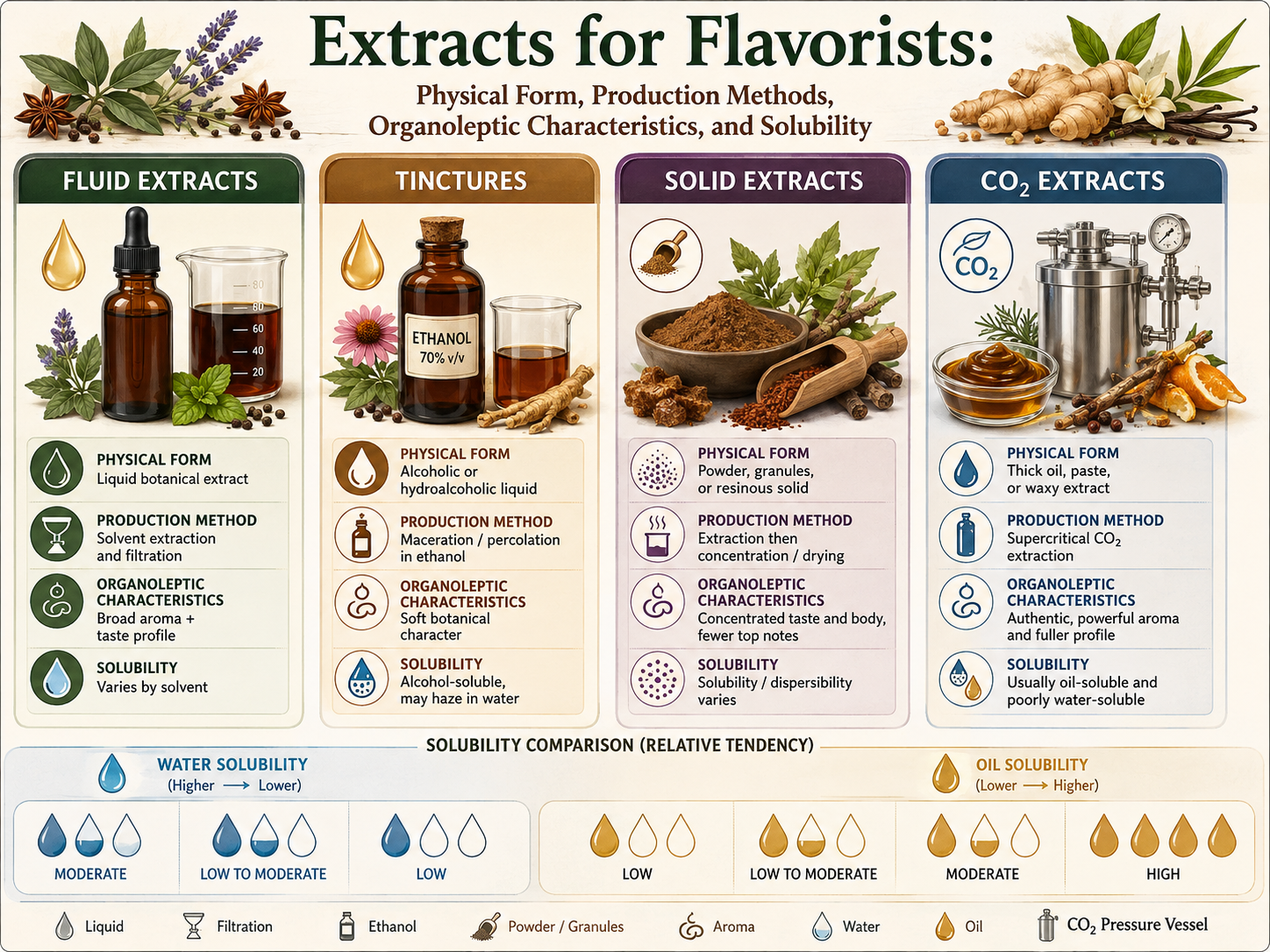
The January 2026 Society of Flavor Chemists syllabus specifically expects candidates to be able to explain the physical form, method of production, organoleptic characteristics, and solubility of “Extracts: Fluid & Solid Extracts, Tinctures, CO₂.” (Flavor Chemists)
A useful flavorist-level treatment is below. One important qualification: “fluid extract,” “solid extract,” and even “CO₂ extract” are not perfectly standardized commercial terms, so the botanical, extraction solvent, concentration, and supplier specification always matter.
1. Fluid Extracts
Physical form
A fluid extract is a liquid botanical extract containing soluble constituents removed from a plant, spice, fruit, herb, etc.
It may be:
- clear to cloudy
- thin and mobile to somewhat viscous
- nearly colorless to dark brown
- aqueous, alcoholic, hydroalcoholic, glycolic, or another food-compatible solvent system
Unlike an essential oil, a fluid extract can contain both volatile aroma chemicals and nonvolatile taste materials.
For example, depending on solvent polarity, a spice extract might contain:
- volatile terpenes
- phenolics
- organic acids
- sugars
- tannins
- pigments
- bitter principles
- pungent principles
So think:
Essential oil → predominantly volatile fraction
Fluid extract → broader soluble fraction of the botanical
Method of production
The raw botanical is normally:
Botanical → size reduction → solvent contact → extraction → filtration → optional concentration/standardization
Common extraction methods include:
- maceration
- percolation
- agitation/extraction tanks
- countercurrent extraction
- occasionally multiple sequential extractions
Typical solvents include:
- water
- ethanol
- water/ethanol mixtures
- propylene glycol
- glycerin or solvent combinations, depending on the desired material and regulatory/application requirements
The solvent determines what gets extracted.
A high-water system preferentially removes more polar compounds such as sugars, acids, salts, some polyphenols and other water-soluble constituents.
A higher-ethanol system extracts a broader range of moderately polar aroma compounds, essential-oil components, phenolics and resins.
Therefore:
Extraction solvent controls both organoleptic profile and eventual solubility.
Organoleptic characteristics
Fluid extracts tend to give a broader representation of the botanical than an essential oil.
They can provide:
- characteristic aroma
- taste
- bitterness
- astringency
- pungency
- sweetness
- color
- mouthfeel
For example, an essential oil of an herb may give a very bright aromatic top note, while a fluid extract can give the herb's aroma + bitter/green/vegetal/tannic character.
Compared with the fresh raw material, some delicate top notes may be lost during extraction or concentration.
The extracting solvent may also be noticeable. An alcohol extract, for example, may initially have an ethanol odor that disappears on dilution or blotter dry-down.
Solubility
There is no single solubility rule for all fluid extracts.
The best answer is:
Solubility largely follows the extraction solvent and composition of the extract.
| Fluid-extract type | Typical behavior |
|---|---|
| Water extract | Usually water soluble |
| Hydroalcoholic extract | Usually compatible with water/alcohol mixtures; may haze when highly diluted with water |
| High-alcohol extract | Alcohol soluble; water solubility may be limited |
| PG extract | Usually compatible with PG; water compatibility varies |
| Extract rich in oils/resins | Limited water solubility; may cloud, precipitate or separate |
A key flavorist concept is dilution shock. An extract can look perfectly clear in 60% ethanol but become cloudy when added to a beverage because lowering the alcohol concentration causes hydrophobic constituents to precipitate.
2. Tinctures
A tincture is essentially a specific type of liquid extract.
The distinction is primarily its extraction solvent and traditional method.
Physical form
Usually:
- clear to slightly cloudy liquid
- low viscosity
- often yellow, amber, brown, greenish or botanical-colored
- strongly alcoholic or hydroalcoholic
Examples might include tinctures of:
- vanilla
- ginger
- gentian
- herbs
- spices
- roots
- citrus peel
Method of production
Traditionally:
Botanical + ethanol or ethanol/water → maceration/percolation → filtration
The botanical is soaked in alcohol or hydroalcoholic solvent long enough for soluble flavor constituents to diffuse into the liquid.
Alcohol is particularly useful because it can dissolve a broader polarity range than water alone.
It can extract some:
- water-soluble constituents
while also extracting many:
- essential-oil components
- phenolics
- moderately lipophilic aroma compounds
- bitter principles
- resins
The alcohol concentration therefore has a substantial effect on the finished profile.
Organoleptic characteristics
Tinctures are commonly:
- relatively true to the botanical
- less concentrated than oleoresins or CO₂ extracts
- broad rather than purely volatile
- capable of contributing both aroma and taste
The initial neat odor often contains obvious ethanol.
After ethanol evaporates, the botanical character becomes easier to evaluate.
For flavorists, tinctures are particularly useful when a soft, natural, integrated botanical character is wanted instead of the sharp concentrated top note produced by an essential oil.
For example:
Ginger essential oil
→ bright, lemony, terpenic, aromatic
Ginger tincture
→ softer ginger aroma with more of the botanical/root character
Ginger oleoresin or broad CO₂ extract
→ much fuller, including pungent/heavier components
Solubility
Typically:
- very soluble in ethanol
- compatible with hydroalcoholic systems
- variable in water
- usually not inherently oil soluble as a whole
A tincture can become cloudy when diluted into water because the ethanol was holding hydrophobic compounds in solution.
So a useful exam answer is:
Tinctures are alcoholic or hydroalcoholic botanical extracts. They are alcohol-soluble, frequently compatible with mixed aqueous/alcohol systems, but may precipitate or haze when the alcohol content is reduced.
3. Solid Extracts / Dry Extracts
Physical form
Solid extracts may appear as:
- powder
- granules
- flakes
- brittle solids
- resinous solids
- sticky or hygroscopic masses
Commercial powdered extracts often contain a carrier, such as maltodextrin, starch, gum or another permitted carrier.
That distinction matters.
A powder might be:
true/native dried extract
or
extract deposited/encapsulated on a carrier.
Those materials can behave quite differently.
Method of production
First, the botanical is extracted much like a fluid extract:
Botanical → solvent extraction → filtration
Then most or all of the solvent is removed:
filtered extract → concentration → drying → solid extract
Possible drying/concentration technologies include:
- vacuum evaporation
- vacuum drying
- spray drying
- freeze drying
- drum drying in certain systems
- adsorption onto a dry carrier
For aroma-sensitive materials, processors try to minimize heat exposure because volatile compounds can be lost during solvent evaporation and drying.
Organoleptic characteristics
Solid extracts are often:
- concentrated
- relatively persistent
- richer in nonvolatile taste constituents
- less top-note dominant than essential oils
- sometimes darker or more cooked than the original botanical
They may contain:
- bitter compounds
- tannins
- acids
- sugars
- pigments
- pungent compounds
- nonvolatile flavor precursors
A major limitation is potential loss of volatile aroma during drying.
Therefore a dry botanical extract might have excellent:
- body
- bitterness
- color
- authentic background character
but relatively weak:
- fresh top notes.
Manufacturers can compensate by encapsulating or adding retained volatile fractions.
Solubility
This is an important SFC-type trap:
Powder does NOT automatically mean water soluble.
Solubility depends on:
- what solvent originally extracted the botanical,
- what compounds remain in the extract,
- whether a carrier is present,
- whether the product is truly soluble or merely dispersible.
Examples:
| Dry extract | Expected behavior |
|---|---|
| Water-extracted botanical powder | Often largely water soluble |
| Maltodextrin-supported aqueous extract | Usually water dispersible/soluble |
| Resin-rich dry extract | Poor water solubility |
| Oil-rich extract plated on carrier | Dispersible but not molecularly soluble |
| Polyphenol-rich extract | May dissolve but precipitate depending on pH |
Flavorists therefore need to distinguish:
soluble ≠ dispersible ≠ suspendable.
A powder may disperse uniformly in water while still containing microscopic insoluble material.
4. CO₂ Extracts
CO₂ extracts deserve special attention because they are chemically quite different from ordinary aqueous/alcohol extracts.
Physical form
Depending on the botanical and extraction conditions, a CO₂ extract may be:
- mobile liquid
- thick oil
- viscous liquid
- paste
- semi-solid
- waxy material
- resinous mass
The physical form gives clues about what was extracted.
A very fluid fraction may contain a high proportion of volatile aromatic material.
A thick paste or waxy extract generally contains more:
- fixed oils
- waxes
- pigments
- resins
- heavier sesquiterpenes
- pungent compounds
Method of production
CO₂ is compressed until it behaves as a powerful extraction fluid.
The best-known process is supercritical CO₂ extraction.
CO₂ reaches its critical region at approximately:
31.1°C and 73.8 bar.
Above its critical point, CO₂ has properties intermediate between a gas and liquid: it penetrates plant material efficiently while possessing useful solvent power. (PubMed Central (PMC))
Simplified process:
Ground botanical
↓
High-pressure extraction vessel
↓
Pressurized CO₂ passes through botanical
↓
Flavor compounds dissolve in CO₂
↓
CO₂/extract mixture enters separator
↓
Pressure is reduced
↓
CO₂ becomes gaseous and separates
↓
Extract remains
↓
CO₂ can be recycled
One major advantage is that the extraction can occur at relatively mild temperatures, reducing thermal degradation of delicate aroma compounds. Pressure and temperature can also be adjusted to change CO₂'s density and therefore its extraction selectivity. (PubMed)
Why pressure matters
Low/moderate extraction strength may favor:
volatile aroma compounds
Increasing extraction strength can pull progressively heavier compounds:
monoterpenes → sesquiterpenes → lipids/resins/waxes/pungent compounds
This means a supplier can produce different fractions from the same raw material.
For example, ginger could yield:
- a lighter aromatic CO₂ fraction
- a broader “total” CO₂ extract containing pungent gingerols and heavier material
So “ginger CO₂” alone does not fully describe the material.
You should ask whether it is:
- selective
- total
- subcritical
- supercritical
- fractionated
- standardized
Organoleptic characteristics
CO₂ extracts are prized because they can be:
- highly authentic
- powerful
- fresh
- close to the starting botanical
- low in thermally generated/cooked notes
- broader than steam-distilled essential oils
Because extraction occurs under relatively mild thermal conditions, delicate compounds can be preserved better than in processes involving prolonged boiling or high-temperature solvent removal. (PubMed)
They can capture compounds that steam distillation leaves behind.
Consider black pepper:
Black pepper essential oil
→ terpenic, woody, fresh pepper aroma
but relatively little pungency.
Broad black pepper CO₂ extract
→ fresh pepper aroma plus pungency and heavier pepper character.
Or ginger:
EO: bright, citrusy, terpenic ginger aroma
CO₂: fuller root character, potentially including pungency and heavier spicy notes.
The SFC itself has highlighted how different CO₂ fractions can show different profiles—for example, a ginger EO-type fraction being brighter while a broader ginger CO₂ oleoresin fraction gives more bakery/root character. (Flavor Chemists)
Solubility
The basic rule:
Most unmodified CO₂ extracts are predominantly lipophilic: oil soluble and poorly soluble or insoluble in water.
Supercritical CO₂ behaves primarily as a relatively nonpolar/lipophilic extraction solvent, although its selectivity can be adjusted and polar co-solvents such as ethanol can sometimes be used. (PubMed Central (PMC))
Typical behavior:
| Medium | CO₂ extract |
|---|---|
| Water | Usually insoluble |
| Vegetable oil/MCT | Usually very soluble |
| Fats | Usually soluble |
| Ethanol | Variable |
| Propylene glycol | Variable |
| Triacetin | Often useful, product-dependent |
A supplier may sell a “water-soluble CO₂ extract,” but this often means the original CO₂ extract has subsequently been:
- emulsified
- solubilized
- encapsulated
- diluted into a water-compatible carrier
rather than the native CO₂ extract itself being water soluble.
The most important distinctions to memorize
| Fluid extract | Tincture | Solid extract | CO₂ extract | |
|---|---|---|---|---|
| Physical form | Liquid | Alcoholic liquid | Powder/solid | Oil, paste or waxy mass |
| Main process | Solvent extraction | Ethanol/hydroalcohol extraction | Extract + remove solvent/dry | Pressurized CO₂ extraction |
| What is extracted | Depends strongly on solvent | Moderately broad botanical fraction | Nonvolatile + retained aroma fraction | Mostly lipophilic aroma/heavier components |
| Aroma | Broad, natural | Soft botanical, alcohol initially | Often less volatile/top-note | Very authentic, concentrated |
| Taste contribution | Often significant | Often significant | Frequently substantial | Can be substantial |
| Water solubility | Variable | Variable; haze possible | Variable | Generally poor |
| Oil solubility | Variable | Usually limited as complete extract | Variable | Generally good |
| Alcohol solubility | Depends on composition | Excellent | Variable | Variable |
| Major concern | Precipitation/clouding | Clouding on dilution | Volatile loss/dispersibility | Very high potency, oil solubility |
A simple flavorist mental model
Remember the extraction solvent:
Water → polar materials
Ethanol/water → polar + moderately lipophilic materials
Oil/nonpolar solvent → lipophilic materials
CO₂ → predominantly lipophilic material, with selectivity controlled by pressure/temperature
Then remember what processing does to aroma:
More heat / more solvent removal → greater risk of losing delicate top notes.
That mental model lets you predict the properties of an unfamiliar extract rather than just memorizing definitions.
For an SFC interview, flavorsit candidates should also be prepared to explain why a tincture can haze in a beverage, why a powdered extract isn't necessarily water soluble, and why a CO₂ extract can smell/taste more like the whole spice than its essential oil. Those answers demonstrate the working knowledge the syllabus is looking for, rather than merely knowing definitions. (Flavor Chemists)
###