Fatty Note Chemistry, Application Formulation, Compound Libraries, Block Architecture, and Compatibility Engineering
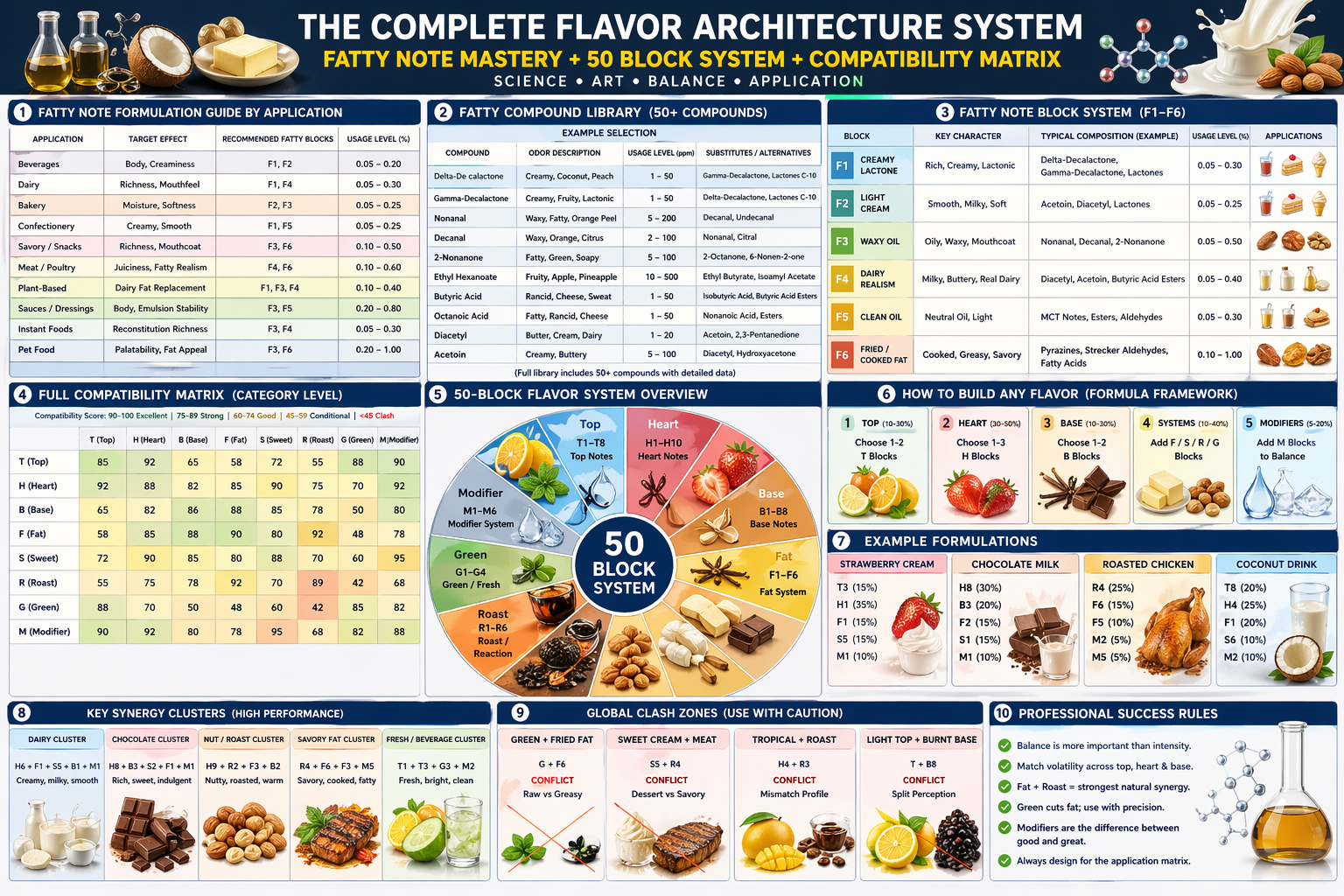
Fatty Note in Flavor: A Beginner-Friendly Guide
A fatty note is the part of a flavor that makes it smell or taste like cream, milk fat, butterfat, animal fat, skin-on meat, oil, wax, tallow, coconut fat, nut oil, or rich dairy fullness. It is not always “greasy” in a bad way. In good flavor work, a fatty note often makes a flavor seem rounder, softer, richer, more natural, and more filling.
Fatty notes are very important in flavors like dairy, cheese, butter, cream sauce, chocolate, coconut, nut, meat, fried foods, and many savory systems. Even fruit flavors sometimes need a tiny fatty effect so they do not smell thin or sharp.
1. What compounds define a fatty note?
A fatty note is usually not made by one single compound. It is usually built from several chemical families working together. The main ones are lactones, fatty acids, aldehydes, ketones, esters, sulfur-containing compounds in savory systems, and some lipid-derived oxidation compounds.
2. Main compound families that create fatty character
A. Lactones
Lactones are among the most important fatty-note materials. Many smell creamy, oily, coconut-like, peach-skin-like, buttery, milky, and rich. They are extremely useful because they can create the impression of fat even when no real fat is present.
Common examples:
Gamma-Nonalactone
Gives a coconut, creamy, oily, sweet-fatty character. Often used in dairy, coconut, nut, and creamy fruit systems.
Gamma-Decalactone
Peachy, creamy, fatty, soft, milky. Useful in stone fruit, cream, and lactonic dairy directions.
Delta-Decalactone
Creamy, buttery, milky, fatty, slightly coconut-like. Very common in cream and dairy building.
Delta-Dodecalactone
Creamy, waxy, fatty, milky, long-lasting. Helps give depth and persistence.
Gamma-Dodecalactone
Rich, creamy, fatty, sweet, coconut/peach nuances. Good for full-bodied dairy and tropical systems.
What beginners should know:
Lactones often do two things at once. They add a fatty/creamy body and also smooth harsh edges. If a formula smells thin, dry, acidic, or too top-heavy, small amounts of lactones can make it feel fuller.
B. Short- and medium-chain fatty acids
Free fatty acids can smell like butter, cheese, cream, sweat, animal fat, goat, rancid fat, and aged dairy, depending on type and level. At very low levels they can make a flavor more realistic. At high levels they can become unpleasant.
Important examples:
Butyric acid
Buttery, cheesy, sour dairy, rancid-butter at high levels. Very powerful. Useful in butter, cheese, dairy, tropical fruit, and some savory flavors.
Hexanoic acid
Goaty, cheesy, fatty, sweaty, animalic. Often used in cheese and dairy realism.
Octanoic acid
Fatty, waxy, goat-like, oily. Stronger and heavier than shorter acids.
Decanoic acid
Waxy, soapy, fatty, oily. Can help body, but can also turn unpleasant if overused.
What beginners should know:
These materials are often useful because real foods containing fat often also contain trace free fatty acids. But they are very easy to overdose. A tiny amount can help realism; slightly too much can make the whole flavor smell spoiled or dirty.
C. Aldehydes associated with fat and lipid breakdown
Some aldehydes smell fatty even though they are also known for citrus, peel, floral, or waxy notes. This is because many aldehydes from lipid oxidation smell like oily skin, wax, tallow, fried fat, cucumber skin, leaf-fat, or chicken fat, depending on structure and amount.
Important examples:
Nonanal
Fatty, waxy, citrus peel, orange peel, oily, clean-fat. Very useful in dairy, citrus, chicken, and fatty profiles.
Decanal
Waxy, fatty, orange peel, aldehydic, soapy if too high. Helps fullness and lift.
2,4-Decadienal
Fried, fatty, chicken skin, deep-fried oil. Extremely impactful in savory and fried notes.
2-Nonenal
Fatty, waxy, cardboard/fat oxidation nuance. Can be useful in trace levels, risky at higher levels.
Trans-2-Decenal
Fatty, waxy, citrus peel, fried nuance depending on context.
What beginners should know:
Aldehydes are often important for making a fatty flavor feel alive, not flat. But too much can cause a formula to smell waxy, soapy, old oil-like, or oxidized.
D. Methyl ketones
These often give blue cheese, dairy fat, creamy, buttery, mushroom-fat, and animalic-fat effects. They are especially important in dairy and cheese.
Examples:
2-Heptanone
Blue cheese, fatty, fruity-ketonic.
2-Nonanone
Fatty, cheesy, blue cheese, waxy.
2-Undecanone
Fatty, green-fatty, rue-like, waxy. Can bridge green and fatty.
Beginners should know:
Methyl ketones can help make dairy flavors less candy-like and more realistic. They often provide the “fermented fat” side of dairy.
E. Butter and cream ketones / diketones
These are not always “fatty” in the pure sense, but they strongly reinforce fat impressions.
Diacetyl
Buttery, creamy, melted butter. Bright and diffusive.
Acetoin
Mild buttery, creamy, yogurt-like, softer than diacetyl.
Acetyl propionyl
Buttery, creamy, richer and heavier.
Beginners should know:
These compounds help the brain interpret a flavor as containing fat, especially in butter, cream, bakery, and heated dairy systems.
F. Esters that support fatty roundness
Some esters do not smell overtly fatty by themselves, but they support an oily, creamy fruit-fat or dairy-fat feeling.
Examples:
Ethyl butyrate in tiny levels can support juicy-fat tropical realism.
Methyl/ethyl decadienoates can add rich fruit skin/body in some systems.
Creamy esters can soften harsh acid or green notes and make the flavor feel fuller.
Beginners should know:
In flavor creation, a “fatty note” often comes from a network effect. One compound may smell coconut-like, another buttery, another waxy, another cheesy. Together they create a convincing fatty body.
G. Sulfur compounds in savory fatty systems
In meat, broth, roast, onion-fat, and chicken-fat profiles, sulfur chemistry becomes important.
Examples include traces of:
- thioesters
- sulfides
- thiols
- reaction flavor sulfur compounds
These may not smell fatty alone, but they can make a fatty note feel like meat fat, pan drippings, roast skin, or cooked butter.
Beginners should know:
Fatty in dairy is different from fatty in beef tallow or chicken skin. The compounds chosen must match the kind of fat you want.
3. Is fatty note part of the top note or heart note?
Usually, fatty note is mainly a heart note to base note, not usually a top note.
Here is the easy way to think about it:
Top note
This is what you smell first. It is usually light, volatile, bright, fresh, sharp, or sparkling.
Heart note
This is the main body of the flavor. It gives character and identity.
Base note
This is the long-lasting foundation. It gives weight, depth, and persistence.
Where does fatty fit?
Most fatty notes sit in the heart because they give the flavor its body and richness. Heavier fatty materials can also act like base notes because they stay longer and support the whole flavor.
Some lighter fatty-associated aldehydes can appear in the upper heart or even influence the opening impression, but the real fatty effect is usually not a true top note.
A simple summary:
- Light aldehydic-fatty materials = upper heart
- Creamy lactones and butter ketones = heart
- Waxy long-lasting lactones and fatty acids = heart to base
So, for a beginner:
Fatty note is mostly a heart note, often with base-note support.
4. How do you increase the fatty note of a flavor?
To increase fatty character, you usually do not just dump in one “fatty” material. You build fatty in layers.
Method 1: Add creamy lactones
This is one of the safest ways to increase fatty body. Lactones can add creaminess, milk-fat character, and richness without immediately making the flavor dirty.
This works well when your flavor feels:
- thin
- dry
- sharp
- too acidic
- too green
- too top-heavy
Method 2: Add butter/cream support
Small amounts of diacetyl, acetoin, or related creamy ketones can make the formula feel more buttery and fat-associated.
Useful in:
- butter
- cream
- dairy beverages
- bakery
- caramel cream
- savory cream sauce
Method 3: Add trace fatty acids for realism
If the formula smells too clean or artificial, a very small amount of butyric, hexanoic, or octanoic acid can create realism.
This is especially useful in:
- cheese
- cultured butter
- yogurt
- cream cheese
- aged dairy
- animal-fat savory flavors
Method 4: Add waxy/fatty aldehydes
Tiny amounts of nonanal, decanal, or savory fatty aldehydes can reinforce oiliness, skin-fat character, or fried-fat realism.
Method 5: Reduce opposing notes
Sometimes the best way to increase fatty note is not to add more fatty materials, but to reduce things that fight it, such as:
- too much citral or citrus top note
- too much green leaf material
- too much acid sourness
- too much dry spice
- too much high-impact sulfur harshness
- too much vanilla sweetness without creamy body
Method 6: Use the right carrier or matrix
Some matrices naturally help a fatty note feel bigger, especially systems that already contain:
- fat
- emulsions
- proteins
- starch
- sugar
- hydrocolloids
These slow release and let the fatty body stay longer in the mouth.
5. How do you reduce the fatty note of a flavor?
A fatty note can become dull, greasy, waxy, or cloying. To reduce it, you can do the opposite.
Method 1: Lower the heavy lactones
Too much lactone can make a flavor feel:
- oily
- peach-coconut creamy when not wanted
- heavy
- waxy
- artificial
Method 2: Cut free fatty acids
If the formula smells cheesy, sweaty, rancid, or animalic, reducing acids is often the first fix.
Method 3: Reduce buttery ketones
Too much diacetyl/acetoin can make a flavor too buttery, dense, or movie-popcorn-like.
Method 4: Add fresh or bright counterweights
To make a flavor feel less fatty, you can add controlled amounts of:
- citrus top notes
- green notes
- minty cooling notes where appropriate
- acidic impressions
- clean fruity notes
- light spice notes
Method 5: Increase volatility balance
Sometimes a flavor seems too fatty because it lacks lift. Adding proper top notes can restore balance so the flavor no longer feels greasy.
Method 6: Change the food matrix
A fatty note will seem stronger in some systems than others. Moving the same flavor from water to an oil-rich emulsion can increase fat perception. Moving it into a brighter, more acidic matrix may make it seem less fatty.
6. What compounds can boost fatty note?
Here are common boosters, explained simply.
Strong direct boosters
These directly add fatty character:
- gamma- and delta-lactones
- butyric acid
- hexanoic acid
- octanoic acid
- nonanal
- decanal
- methyl ketones
- diacetyl
- acetoin
Indirect boosters
These do not always smell fatty alone, but they make fatty notes seem richer:
- vanilla/vanillin type notes in dairy or cream systems
- caramelized notes in butter or cream systems
- mild sulfur roast notes in savory fat systems
- creamy esters
- coconut-like materials in tropical fat profiles
- nutty pyrazines at low levels in roasted fat systems
Why this happens:
The human brain does not smell each ingredient separately. It interprets the whole pattern. So compounds that suggest cream, warmth, roast, milk solids, coconut flesh, cheese fermentation, or oil can all make a fatty note stronger.
7. What compounds can dampen or suppress fatty note?
These are not “anti-fatty” chemicals in a strict sense, but they reduce perceived fatty character by shifting the balance.
Bright top notes
These can make a flavor seem lighter:
- limonene
- citral
- linalool
- orange or lemon aldehydes
- acetate esters in suitable systems
Green notes
These can cut through fat:
- cis-3-hexenol
- cis-3-hexenyl acetate
- hexanal in moderation
- leaf alcohol type materials
Acidic or sour impressions
Citric, malic, lactic, and other acid effects can make a system feel less greasy by increasing brightness.
Dry spice and herbal notes
Depending on use level, herbs and spices can reduce perceived fattiness by adding dryness or aromatic lift.
Cooling notes
In some applications, cooling materials can reduce the sensory heaviness of fatty systems.
Beginners should know:
A note is often dampened by contrast, not by neutralization. The flavor still contains the fatty materials, but your nose and palate pay more attention to brighter notes.
8. What are the challenges in keeping a fatty note in a flavor?
This is very important. Fatty notes are not always easy to preserve.
A. Oxidation
Many fatty-associated compounds, especially aldehydes and lipid-derived materials, are sensitive to oxygen. Over time they may change into notes described as:
- cardboard
- stale oil
- painty
- waxy
- old nuts
- rancid fat
This is one of the biggest problems in fatty profiles.
B. Volatility imbalance
Some fatty systems need both light and heavy materials. The lighter ones disappear first, so the formula can lose realism over time and become flat or greasy.
For example:
- at the beginning: creamy + buttery + fresh-fat
- later: only waxy/heavy remains
C. Overuse of acids or heavy materials
A little free fatty acid helps realism. Too much makes spoilage. This is a narrow balance.
D. Interaction with matrix components
Proteins, starches, emulsifiers, gums, sugars, and fats can all change how a fatty note is released. Sometimes the note is still present chemically, but the consumer no longer perceives it strongly.
E. Heat processing
Baking, retorting, frying, extrusion, spray drying, and UHT processing can damage delicate fatty notes or transform them into cooked, oxidized, or dull notes.
F. Packaging and storage
Oxygen, light, metal contamination, and warm storage accelerate deterioration. Fatty notes often age poorly if storage is not controlled.
G. Masking by strong companion notes
Chocolate, coffee, sulfur, spice, smoke, citrus, acids, or high-intensity sweeteners can mask a fatty nuance. The fatty note may then seem absent even though it is still in the formula.
H. Solubility and emulsion issues
Some fatty materials are more comfortable in oil-compatible systems. In clear beverages or very lean water systems, they may not express naturally or may separate, haze, or seem out of place.
9. What food matrices are favorable for maintaining fatty note?
A food matrix means the full food system the flavor goes into: water, fat, sugar, protein, starch, pH, process, and packaging together.
Fatty notes are generally maintained better in matrices that support slower release and protect richness.
Best matrices for fatty note
Dairy-fat systems
Examples:
- ice cream
- milk drinks
- cream fillings
- cheese sauces
- yogurt
- butter spreads
Why favorable:
These already contain fat or dairy structure, so fatty notes feel natural and are reinforced by the base.
Emulsified systems
Examples:
- mayonnaise
- creamy dressings
- soups
- cream liqueur-style systems
- sauces
Why favorable:
Emulsions can hold hydrophobic materials better and give creamy mouthfeel that matches the aroma.
High-sugar creamy systems
Examples:
- caramel
- fudge
- condensed milk flavors
- cream confectionery
- custard systems
Why favorable:
Sugar can soften harshness and enhance the perception of body and richness.
Protein-containing savory systems
Examples:
- meat analog sauces
- chicken soup
- gravy
- savory seasonings on fat-containing snacks
Why favorable:
Protein and umami context help the brain interpret the flavor as fatty, meaty, and full.
Fat-containing bakery systems
Examples:
- cookies
- cakes
- fillings
- buttercream
- pastries
Why favorable:
The baked matrix and existing fat support buttery and creamy notes.
Less favorable matrices
Clear acidic beverages
These are usually poor places for strong fatty notes unless the target is something like coconut cream, smoothie, dairy-style beverage, or specialty tropical profile.
Why difficult:
- acidity sharpens bright notes
- lack of fat makes creamy-fatty notes feel unnatural
- clear systems may not solubilize some materials well
- the consumer expects freshness, not fat
Highly heated dry systems
Some fatty nuances can degrade during extrusion or aggressive drying.
Strongly oxidizing environments
Systems with poor oxygen control or long warm storage can quickly damage fatty profiles.
10. How do beginners think about fatty note during formulation?
A simple practical model:
If the flavor feels too thin
Add creamy lactones and a little buttery support.
If it feels too clean and unrealistic
Add trace fatty acid or a waxy aldehyde.
If it feels too greasy
Reduce heavy lactones/acids and add brightness.
If it feels buttery but not fatty
Add waxy/fatty aldehydes or creamy body materials.
If it feels fatty but dull
Add a little top-note lift so the richness has contrast.
If it feels spoiled
Check acids, oxidation-sensitive aldehydes, sulfur harshness, and storage history.
11. Common mistakes beginners make
Mistake 1: Using only one fatty material
Realistic fatty notes usually need at least a few supporting materials.
Mistake 2: Overdosing butyric acid
This is probably one of the most common beginner errors. Too much quickly becomes rancid or vomit-like.
Mistake 3: Making fatty without freshness
A good fatty flavor often still needs some opening brightness. Otherwise it smells flat and heavy.
Mistake 4: Ignoring application
A fatty note for cheese, cream, fried chicken, coconut, and beef fat are not the same.
Mistake 5: Forgetting process and matrix
A flavor that works in a bench sample may fail after baking, retorting, spray drying, or acidic dilution.
12. A simple way to classify fatty note types
This helps beginners choose the right materials.
Dairy-fatty
Cream, milk fat, butterfat, cultured dairy
Key tools: lactones, diacetyl, acetoin, butyric acid, methyl ketones
Oily-waxy fatty
Oil, wax, skin, peel oil body
Key tools: nonanal, decanal, long-chain lactones, some fatty acids
Animal-fatty
Tallow, chicken skin, pan drippings, meaty fat
Key tools: fatty aldehydes, reaction flavor materials, sulfur compounds, selected acids
Coconut-fatty
Creamy tropical oil/fat
Key tools: gamma-nonalactone, delta-decalactone, gamma-decalactone, creamy sweet support
Nut-fatty
Nut oil, fatty roasted nut body
Key tools: lactones + nutty pyrazines + aldehydic body + creamy support
13. Final practical summary
A fatty note is the part of a flavor that gives richness, oiliness, creaminess, milk-fat character, waxy body, or animal-fat realism. It is usually created by a combination of:
- lactones for creamy/oily body
- fatty acids for realism
- aldehydes for waxy/oily/fried-fat effects
- ketones and diketones for butter and dairy body
- sulfur/reaction materials for savory fat realism
In the flavor pyramid, fatty note is mainly a heart note, often extending into the base.
To increase it, use layered creamy/fatty materials and reduce overly bright opposing notes.
To reduce it, lower heavy fatty materials and add freshness, acidity, or top-note lift.
The biggest challenges are:
- oxidation
- heat damage
- imbalance between light and heavy materials
- matrix interactions
- masking by other notes
- overuse leading to rancid or greasy character
The best matrices for maintaining fatty notes are usually:
- dairy systems
- emulsions
- creamy confectionery
- savory fat-containing systems
- bakery with fat content
The hardest matrices are usually:
- clear acidic beverages
- harshly processed dry systems
- poorly protected oxygen-exposed products
A beginner-friendly rule to remember is this:
Fatty note should make a flavor feel richer and more natural, not greasy, stale, or spoiled.