FDA Food Facility Registration: A Complete Guide for Global Food, Ingredient, and Flavor Manufacturers Supplying the U.S. Market
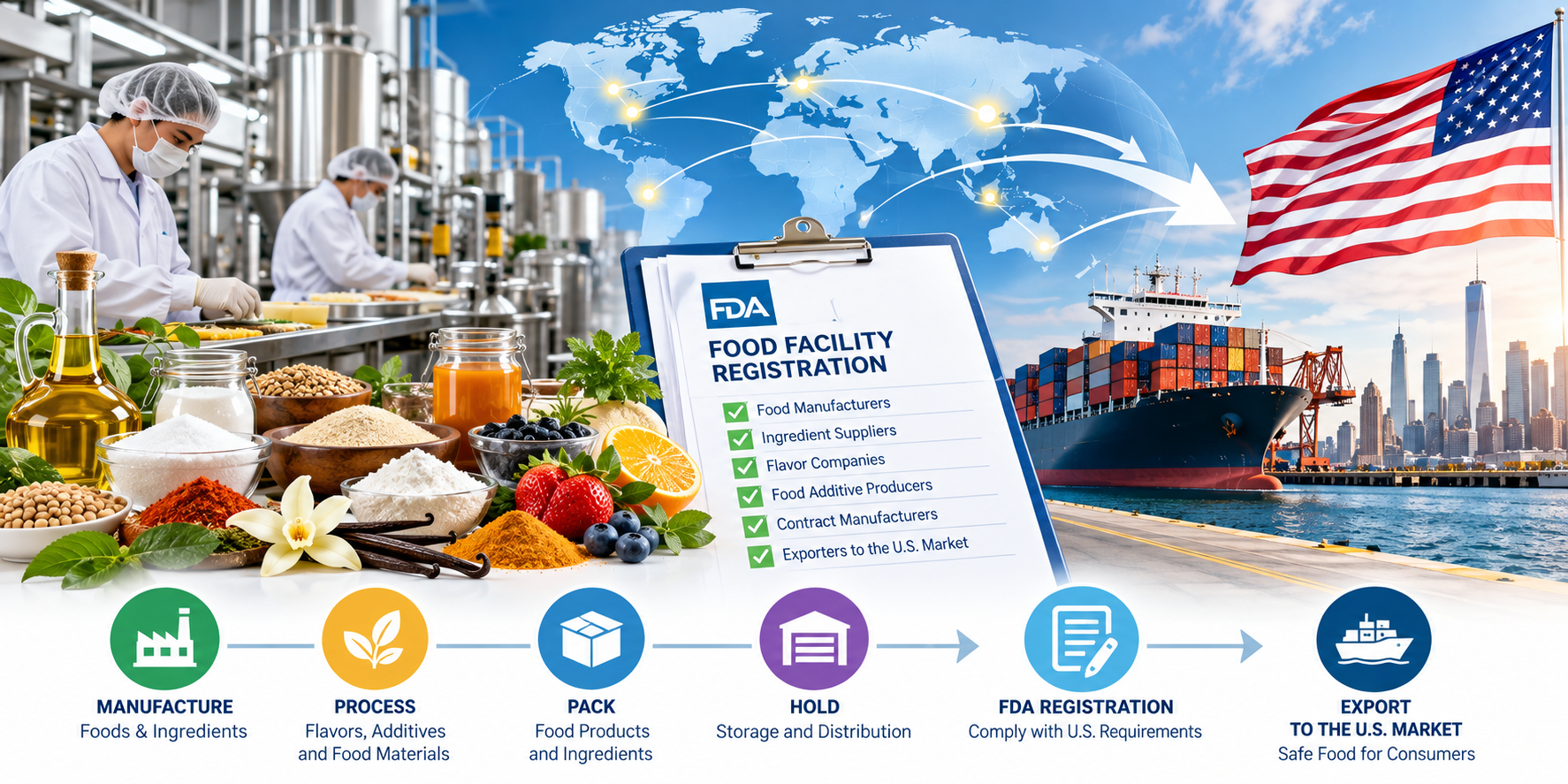
USAgent.com would like to be your U.S. Agent to register your food facility with FDA.
hat international food manufacturers, ingredient suppliers, flavor companies, food additive producers, and exporters need to know about FDA registration requirements, U.S. agents, compliance obligations, and biennial renewal.
Introduction: FDA Food Facility Registration Is Not Just for Finished Food Manufacturers
The United States is one of the world's largest and most attractive markets for food products, food ingredients, flavoring substances, food additives, and specialty ingredients. For businesses around the world, supplying this market requires more than producing safe, high-quality products. It also requires understanding and complying with applicable regulations established by the U.S. Food and Drug Administration (FDA).
One of the most fundamental regulatory requirements is FDA Food Facility Registration (FFR).
Many international businesses assume that FDA registration applies only to companies producing finished foods such as beverages, snacks, confectionery, dairy products, and ready-to-eat meals. However, the registration requirements extend much further into the global food supply chain.
Manufacturers and processors of food ingredients, flavorings, food additives, dietary supplement ingredients, and many other substances intended for use in food may also be required to register their facilities with the FDA, even when they do not manufacture products sold directly to consumers.
For example, a company manufacturing vanilla extracts in Madagascar, a producer of citric acid in China, a flavor house in Germany, or an enzyme manufacturer in India may fall within the FDA food facility registration requirements if its products are intended for the U.S. food market and no applicable exemption applies.
Importantly, FDA registration is generally based on the activities performed at a physical facility and the intended use of the materials handled there, rather than simply whether the company sells a finished consumer food product.
This guide explains who must register, which ingredients and substances are covered, when exemptions apply, how foreign companies complete registration, and what businesses must do to remain compliant.
1. What Is FDA Food Facility Registration?
FDA Food Facility Registration is a regulatory requirement under Section 415 of the Federal Food, Drug, and Cosmetic Act (FD&C Act), as amended by the Public Health Security and Bioterrorism Preparedness and Response Act of 2002 and the Food Safety Modernization Act (FSMA).
The implementing regulations are primarily found in 21 CFR Part 1, Subpart H, including 21 CFR 1.225–1.245.
Under these requirements, domestic and foreign facilities that manufacture, process, pack, or hold food for consumption by humans or animals in the United States generally must register with the FDA unless an exemption applies.
Registration helps FDA identify facilities participating in the food supply chain, communicate with businesses during food safety emergencies, support inspections, and respond to potential food safety threats.
The requirement applies to qualifying facilities located both within and outside the United States.
For foreign businesses, this means that manufacturing in Europe, Asia, Africa, Latin America, the Middle East, or another region does not eliminate the registration obligation if the facility is subject to the U.S. food facility registration requirements.
A key distinction: FDA Food Facility Registration is a facility-level regulatory requirement. It is not a certification that FDA has inspected, approved, or endorsed the facility or the products it manufactures.
2. Which Food Businesses Must Register with the FDA?
A facility generally must register when it performs one or more of the following activities involving food intended for U.S. human or animal consumption:
- Manufacturing: Producing foods, food ingredients, or other materials classified as food.
- Processing: Transforming, extracting, refining, mixing, blending, fermenting, or otherwise processing food.
- Packing: Packing or repacking food products or ingredients.
- Holding: Storing or warehousing food before further distribution or processing.
The requirement is not limited to businesses that sell directly to U.S. consumers.
For example, a manufacturer that supplies an ingredient to an overseas distributor, which then sells it to a U.S. food manufacturer, may still need to assess its FDA registration obligations.
Types of businesses potentially subject to FDA registration
| Business category | Examples | General registration position |
|---|---|---|
| Finished food manufacturers | Snacks, baked goods, confectionery, sauces, canned foods | Generally required |
| Beverage manufacturers | Juices, soft drinks, bottled water, beverage concentrates | Generally required |
| Food ingredient manufacturers | Starches, proteins, sugars, oils, fibers | Generally required |
| Flavor manufacturers | Natural flavors, artificial flavors, flavor blends, extracts | Generally required when products are food ingredients |
| Food additive manufacturers | Acidulants, preservatives, stabilizers, emulsifiers, sweeteners | Generally required when products are intended for food use |
| Spice and botanical processors | Ground spices, botanical extracts, seasoning blends | Generally required, subject to applicable exemptions |
| Food enzyme manufacturers | Enzymes used in baking, dairy processing, brewing, or food production | Depends on intended use; generally required for food-use enzymes |
| Dietary supplement manufacturers | Supplements and dietary ingredients | Generally required |
| Animal food manufacturers | Pet food, treats, feed ingredients | Generally required |
| Food warehouses and repackers | Ingredient storage, food distribution warehouses, bulk repacking | Generally required, unless exempt |
| Food-contact material manufacturers | Packaging, containers, food-contact coatings | Generally not required solely for food-contact substances |
These are general classifications, not automatic determinations. Whether registration is required must be evaluated against the facility's actual operations, the nature of the products, and applicable exemptions.
3. FDA Registration Requirements for Food Ingredient Manufacturers
One of the most common misconceptions among international suppliers is that FDA registration is unnecessary when a company manufactures only ingredients rather than finished food.
This is incorrect.
Under FDA regulations, the definition of food includes articles used as components of food. Accordingly, many ingredient manufacturers form part of the regulated food supply chain.
Products that may trigger facility registration include:
- Citric acid, lactic acid, and other food acidulants
- Starches, modified food starches, and maltodextrins
- Sugar, glucose syrups, and other sweetening ingredients
- Edible oils, fats, and emulsifiers
- Food-grade proteins, peptides, and amino acids
- Gums, stabilizers, and thickening agents
- Vitamins, minerals, and nutritional ingredients
- Food preservatives and antioxidants
- Colors and other food additives
- Botanical extracts and essential oils intended for food use
- Spices, seasonings, and ingredient blends
- Microbial cultures and fermentation-derived food ingredients
Even when a food ingredient has multiple commercial applications, the facility may be subject to FDA registration when the substance is manufactured, processed, packed, or held for an intended food use in the United States.
What about ingredients with both food and industrial applications?
Some substances have multiple applications across food, pharmaceutical, cosmetic, agricultural, and industrial markets.
For instance, citric acid can be used in foods, cleaning formulations, pharmaceuticals, and industrial processes.
In such cases, the product's intended application and the facility's knowledge of its anticipated use are particularly important.
FDA guidance explains that when a manufacturer reasonably believes a substance is expected to be directed to food use, the facility may need to register.
Simply describing a product as a chemical, raw material, intermediate, or industrial ingredient does not automatically exempt the facility when its intended use brings it within FDA's definition of food.
Companies should therefore assess food-use specifications, customer applications, technical documentation, and intended U.S. distribution channels.
4. Do Flavor and Fragrance Companies Need FDA Food Facility Registration?
For global flavor companies, the distinction between flavor ingredients and fragrance ingredients is particularly important.
A flavor house may develop, manufacture, blend, or supply substances used to impart or modify the taste or aroma of food products.
These substances may include natural flavoring preparations, artificial flavor compounds, botanical extracts, distillates, essential oils, reaction flavors, and compounded flavor systems.
Food flavors and flavoring substances
Facilities that manufacture, process, pack, or hold flavoring substances intended for use in food consumed in the United States generally fall within FDA food facility registration requirements, unless an exemption applies.
Examples include:
- Flavor compounds used in soft drinks and beverages
- Vanilla, citrus, mint, and botanical flavor extracts
- Flavor emulsions used in bakery products
- Savory flavors used in soups, sauces, and seasonings
- Flavoring ingredients used in confectionery
- Reaction flavors used in processed foods
- Food-grade essential oils used as flavoring ingredients
- Flavor carriers and blended systems intended for food applications
The fact that a flavor is supplied to another manufacturer rather than directly to consumers does not, by itself, eliminate the registration requirement.
Fragrance products versus food flavors
Fragrance substances manufactured exclusively for perfumes, cosmetics, air-care products, or other nonfood applications are not automatically subject to FDA Food Facility Registration.
However, a company operating a facility that manufactures both fragrances and flavors intended for food use must assess its registration obligation based on its food-related activities.
For example:
Scenario A: A facility manufactures citrus oil exclusively for perfumes. Registration under the food facility rules is generally not required based solely on that activity.
Scenario B: The same facility manufactures food-grade citrus oil for use in beverages sold in the United States. FDA food facility registration may be required.
Scenario C: A flavor company purchases food-grade aroma chemicals, blends them into flavor formulations, and exports those formulations to U.S. food manufacturers. The blending operation generally constitutes food manufacturing or processing and may require registration.
For flavor and fragrance companies, an accurate assessment of intended product use is therefore essential.
5. What About Food Additives, Processing Aids, Enzymes, and Other Food-Related Materials?
Not all materials used within the food industry are treated identically under FDA regulations.
The regulatory classification depends on the substance's intended use, whether it qualifies as food or a component of food, and the nature of the facility's activities.
Food additives
Food additives used to perform a technical function in food generally fall within the scope of food facility registration.
Examples include preservatives, emulsifiers, acidity regulators, stabilizers, and certain coloring substances.
Facilities manufacturing such substances for the U.S. food market generally need to assess registration under the food facility rules.
The requirement to register is separate from the requirement that the additive itself be legally permitted for its intended use.
Processing aids
Processing aids require an assessment based on their intended function and use.
A substance used during food manufacturing may still be considered a food-related substance even if it does not appear as a declared ingredient on the final consumer label.
The absence of a labeling requirement does not automatically mean that the facility manufacturing the material is exempt from registration.
Food enzymes
Enzymes used in food manufacturing, such as those used for baking, dairy processing, starch conversion, and beverage production, may fall within the registration requirements.
FDA guidance distinguishes enzymes added to food for a technical effect from enzymes used only to manufacture food-contact substances.
Thus, intended use is decisive.
Food-contact materials and packaging
An important exception applies to food-contact substances.
Facilities exclusively manufacturing or handling substances that qualify as food-contact substances under FDA's food facility registration rules generally do not need to register solely because their materials contact food.
Examples may include qualifying food packaging films, food-contact coatings, and packaging-related materials.
However, if the same facility also handles edible food ingredients or additives intended to have a technical effect in food, its food-related activities may independently trigger registration.
The practical rule: Materials intended to become part of food or perform a technical function in or on food should be assessed for food facility registration. Materials used exclusively for food contact without qualifying as food require a different regulatory assessment.
6. Foreign Food Facilities: When Is FDA Registration Required?
Foreign food facility registration is a critical requirement for international exporters.
A foreign facility generally must register if it manufactures, processes, packs, or holds food for human or animal consumption in the United States and is not covered by an exemption.
However, FDA regulations contain a special provision for certain foreign facilities involved in multi-stage production.
A foreign facility may be exempt when its food undergoes further manufacturing or processing, including qualifying packaging operations, at another foreign facility before entry into the United States.
This exemption generally does not apply when the subsequent activity consists only of labeling or another de minimis activity.
Example: An international ingredient supply chain
Consider the following production chain:
- A company in Country A produces a food ingredient.
- The ingredient is shipped to a facility in Country B for substantial further processing.
- The processed ingredient is exported to the United States.
Depending on the activities performed, the original facility in Country A may qualify for the foreign-facility exemption, while the subsequent foreign processing facility may be required to register.
By contrast, when the second facility performs only minimal activities such as affixing a label, the original facility may not qualify for that exemption.
Each facility must assess its position individually.
Important: Foreign suppliers should not assume that registration by a downstream distributor, importer, or finished food manufacturer automatically satisfies registration requirements for other facilities in the supply chain.
7. Which Facilities Are Exempt from FDA Food Facility Registration?
FDA regulations provide specific exemptions under 21 CFR 1.226.
Common exempt categories include:
- Farms meeting the regulatory definition of a farm
- Restaurants
- Retail food establishments meeting the applicable definition
- Private residences
- Certain nonprofit food establishments
- Certain fishing vessels
- Facilities regulated exclusively, throughout the entire facility, by specified USDA food inspection laws
- Certain foreign facilities whose products undergo qualifying further processing outside the United States
Additionally, facilities exclusively handling food-contact substances or pesticides are outside the food definition used for these registration rules.
A facility may conduct both exempt and nonexempt activities. For example, a farm that also performs certain manufacturing or processing activities may be classified as a mixed-type facility and may be required to register.
The facility's business name, industry sector, or company size alone does not determine whether an exemption applies.
8. Is FDA Registration Mandatory for Small Manufacturers and Startups?
There is no general exemption from FDA Food Facility Registration simply because a company is small, newly established, or has limited annual sales.
A small ingredient producer, specialty flavor manufacturer, startup beverage company, or family-owned food processing business may still need to register if its activities fall within the applicable rules.
Certain small or very small businesses may qualify for modified obligations or exemptions under specific FSMA food safety regulations, but those provisions should not be confused with food facility registration exemptions.
In other words, being a small business does not automatically eliminate the registration requirement.
9. How to Register a Foreign Food Facility with the FDA
The FDA provides an online registration system through FDA Industry Systems.
The registration process can generally be completed by the facility's owner, operator, agent in charge, or an authorized individual.
Step 1: Determine whether registration is required
Evaluate the facility's activities, products, intended uses, and applicable regulatory exemptions.
Step 2: Obtain a Unique Facility Identifier (UFI)
FDA requires a recognized Unique Facility Identifier. Currently, the agency recognizes the Dun & Bradstreet Data Universal Numbering System (DUNS) number for food facility registration.
The identifier should correspond to the facility's actual physical location.
Step 3: Establish an FDA Industry Systems account
Access the FDA's online systems and navigate to the Food Facility Registration Module.
Step 4: Gather required facility information
Prepare the required details, including the facility's name, physical address, contact information, trade names, and applicable food categories.
Step 5: Appoint a U.S. Agent if the facility is foreign
A foreign facility must designate a qualifying U.S. Agent for FDA food facility registration.
Step 6: Complete the registration
Enter the required information, identify the activities conducted at the facility, and provide the required inspection and certification statements.
Step 7: Complete applicable verification steps
Ensure any required U.S. Agent confirmation and FDA validation steps are completed.
Step 8: Retain the FDA registration details
After registration is successfully completed, maintain the issued facility registration number and associated account information securely.
FDA generally requires electronic submission unless it has granted an applicable waiver.
10. What Information Is Required for FDA Food Facility Registration?
Companies should prepare accurate and consistent information before beginning the process.
The required details generally include:
- Legal name and physical address of the facility
- Facility telephone number and email contact
- Parent company details, where applicable
- Facility trade names
- Emergency contact information
- Relevant human and/or animal food product categories
- Manufacturing, processing, packing, or holding activities performed at the facility
- Owner, operator, or agent-in-charge information
- Required U.S. Agent information for foreign facilities
- FDA-recognized Unique Facility Identifier
- Required assurance permitting FDA inspection
- Certification that the information submitted is accurate and the submission is authorized
Additional information may be requested based on the facility's circumstances.
Accurate facility addresses and consistent identification information are particularly important because FDA uses the submitted UFI to verify facility identity.
11. Why Must Foreign Food Facilities Have a U.S. Agent?
Foreign facilities required to register must designate a U.S. Agent who resides or maintains a place of business in the United States and is physically present there.
The U.S. Agent serves as the communication link between the FDA and the foreign facility.
The agent's functions include facilitating FDA communications, receiving routine and emergency communications, and supporting contact between the agency and the foreign business.
Only one U.S. Agent may be designated for a facility's food facility registration at a time.
The U.S. Agent does not necessarily have to be the foreign facility's U.S. importer, distributor, or commercial representative.
FDA U.S. Agent versus FSVP importer
A common misunderstanding concerns the difference between a food facility registration U.S. Agent and a Foreign Supplier Verification Program (FSVP) importer.
These are distinct regulatory roles.
The registration U.S. Agent primarily serves as a communication point between FDA and the foreign facility.
The FSVP importer is responsible for meeting applicable foreign supplier verification requirements, including risk-based supplier evaluation and verification activities.
A single entity may perform both roles when the applicable requirements are satisfied, but appointment as a food facility registration U.S. Agent does not automatically make that entity the FSVP importer.
Foreign food businesses should clearly establish responsibilities when appointing U.S.-based representatives.
12. Is FDA Food Facility Registration Free?
Yes. FDA does not charge a government fee for initial food facility registration or biennial registration renewal.
Businesses may register directly through FDA's official online system.
However, foreign companies may incur commercial expenses if they engage an external U.S. Agent, consultant, or registration service provider.
These service fees are not FDA registration fees.
Businesses should also be cautious of service providers claiming that FDA registration can only be completed through a paid intermediary or that purchasing an FDA registration certificate is mandatory.
The FDA does not require companies to hire a third-party registrar to register their food facilities.
13. FDA Food Facility Registration Renewal: The 2026 Requirements
Food facility registration is not a one-time obligation.
Under FSMA, facilities subject to FDA registration must renew their registrations every two years during the October 1–December 31 period of each even-numbered year.
Important dates for 2026
- Renewal opens: October 1, 2026
- Renewal deadline: December 31, 2026
- Next regular renewal period: October 1–December 31, 2028
Facilities that fail to complete the 2026 biennial renewal by December 31, 2026, will have their registrations considered expired.
FDA also requires facilities to update required registration information within 60 calendar days of applicable changes.
Changes of facility ownership are handled differently: the former owner generally must cancel the existing registration, and the new owner must submit a new registration.
Businesses should not confuse updating a registration with completing the mandatory biennial renewal.
A company that recently updated its facility details may still be required to renew during the applicable renewal period.
For facilities first registered before October 1, 2026, the 2026 renewal requirement still applies.
14. What Happens If a Foreign Food Facility Is Not Registered?
Failure to register a facility when registration is legally required can create significant regulatory and commercial consequences.
For foreign facilities, food imported or offered for import into the United States from a facility that was required to register but failed to do so may be subject to refusal of admission.
Noncompliance may result in shipment delays, disrupted supply arrangements, increased regulatory scrutiny, and financial losses.
For companies supplying ingredients to U.S. food manufacturers, interruptions may also affect downstream production and customer relationships.
FDA also has legal authority to suspend a facility's registration under specified serious food safety circumstances.
Once suspended, food from that facility may be subject to statutory restrictions on U.S. commerce.
Maintaining an accurate, active registration is therefore an important part of market-access compliance.
15. Does FDA Registration Mean That Products Are FDA Approved?
No.
FDA Food Facility Registration is not equivalent to FDA product approval, food additive authorization, or certification of regulatory compliance.
A registered facility remains responsible for complying with other applicable FDA and U.S. legal requirements.
Depending on the products and activities involved, those obligations may include:
- FDA Current Good Manufacturing Practice (CGMP) requirements
- FSMA preventive controls requirements
- Food ingredient and food additive regulatory status
- Requirements for substances generally recognized as safe (GRAS)
- Food labeling and allergen disclosure requirements
- Food import Prior Notice requirements
- Foreign Supplier Verification Program (FSVP) requirements
- Applicable traceability and recordkeeping requirements
- Specialized requirements for dietary supplements, low-acid canned foods, acidified foods, seafood, juice, and other regulated categories
Not every requirement applies to every business or product. Each company must determine which rules apply to its operations and products.
For flavor and ingredient companies in particular, food facility registration does not establish that an individual flavoring substance, additive, carrier, enzyme, or botanical extract is legally permitted for a particular application in U.S. foods.
Product compliance and facility registration must be evaluated separately.
16. Common FDA Registration Mistakes Made by International Suppliers
Despite the importance of registration, several misunderstandings continue to affect global food businesses.
Mistake 1: Assuming that only finished food manufacturers must register.
Ingredient, flavor, additive, and dietary supplement ingredient facilities may also be subject to registration.
Mistake 2: Assuming that a distributor's registration covers the manufacturer.
Facility registration is tied to qualifying operations at specific facilities. One company's registration does not automatically cover another facility.
Mistake 3: Confusing a U.S. Agent with an FSVP importer.
The roles have different legal purposes and responsibilities.
Mistake 4: Believing that an FDA registration number means FDA has approved the products.
Registration does not establish product approval or general regulatory compliance.
Mistake 5: Overlooking biennial renewal requirements.
Registration generally must be renewed during the prescribed renewal period in every even-numbered year.
Mistake 6: Using inconsistent company addresses or facility identifiers.
Discrepancies between facility registration information and UFI records may create verification problems.
Mistake 7: Registering a facility unnecessarily.
Facilities that are exempt or operate exclusively with materials outside the applicable definition of food should not register merely because a customer or online marketplace requests a registration certificate.
Mistake 8: Sharing confidential FDA registration credentials.
FDA registration information is not generally public. Businesses should carefully protect their registration number, PIN, and online account credentials, and disclose information only when appropriate.
17. FDA Food Facility Registration Checklist for Global Manufacturers
Before supplying the U.S. market, an international food or ingredient business should review the following:
- Confirm whether its products are classified as food, food components, additives, or excluded materials.
- Determine whether its activities involve manufacturing, processing, packing, or holding food.
- Assess whether an exemption applies.
- Identify each physical facility potentially requiring registration.
- Determine how foreign processing arrangements affect registration.
- Obtain and verify the appropriate DUNS number.
- Select a qualified U.S. Agent when required.
- Prepare accurate registration and contact information.
- Complete FDA registration before conducting activities for which registration is required.
- Retain and protect registration information.
- Review other applicable food import and product compliance requirements.
- Establish procedures for updating and renewing registration.
- Verify completion of the October–December 2026 renewal, where applicable.
18. Frequently Asked Questions About FDA Food Facility Registration
Does a foreign food manufacturer need FDA registration to export to the USA?
Generally, yes, if the facility manufactures, processes, packs, or holds food intended for U.S. consumption and no exemption applies. Certain foreign facilities may qualify for an exemption when further manufacturing or processing occurs outside the United States.
Do food ingredient manufacturers need FDA registration?
Generally, yes. Facilities manufacturing food ingredients intended for the U.S. market are commonly subject to FDA food facility registration, even if they do not produce finished consumer foods.
Do flavor companies need FDA registration?
Flavor companies manufacturing, processing, packing, or holding flavoring ingredients intended for U.S. food use generally must register their applicable facilities unless exempt. Facilities handling only nonfood fragrances generally do not register solely on that basis.
Do chemical manufacturers need FDA food facility registration?
It depends on the chemical's intended use. Manufacturers of substances intended to function as food additives or food components may be required to register. Manufacturers exclusively producing excluded food-contact substances or nonfood industrial chemicals generally are not required to register solely for those activities.
Does a food warehouse need FDA registration?
Generally, a facility holding food intended for U.S. consumption must register unless an exemption applies. Special rules can affect certain farms, retail establishments, and other facilities.
Is FDA registration required for every factory owned by a food company?
Each physical facility must be evaluated separately. A single corporate registration does not automatically cover all manufacturing plants, processing sites, or warehouses.
Can a company register without having a U.S. office?
Yes. A foreign business is not necessarily required to establish its own U.S. office to register. However, a foreign facility that is required to register must designate a qualifying U.S. Agent.
How often must FDA food facility registration be renewed?
Every two years, during the October 1–December 31 renewal period in even-numbered years.
How much does FDA food facility registration cost?
FDA charges no government fee for food facility registration or renewal. Independent U.S. Agent and consulting services may have separate charges.
Can a company use its FDA registration as proof of product approval?
No. A food facility registration number does not mean FDA has reviewed or approved the company's products, ingredients, or manufacturing processes.
What is the difference between a DUNS number and an FDA registration number?
A DUNS number is a facility identifier assigned by Dun & Bradstreet and currently accepted by FDA as a UFI. An FDA Food Facility Registration number is issued through the FDA registration system. They serve different purposes.
Is an FDA registration certificate mandatory?
FDA does not issue an official food facility registration certificate as proof of product or facility approval. Any certificate offered by a third-party provider should not be represented as an FDA-issued certificate or endorsement.
19. Conclusion: FDA Registration Is a Fundamental Part of U.S. Food Market Access
For businesses participating in the global food supply chain, FDA Food Facility Registration should be treated as a fundamental regulatory obligation rather than a formality relevant only to finished food manufacturers.
Food ingredients, flavors, food additives, botanical extracts, enzymes, specialty ingredients, and dietary supplement ingredients are all important components of the modern food industry. Facilities engaged in manufacturing, processing, packing, or holding these materials for U.S. food use may be subject to FDA registration requirements.
At the same time, registration is not universal for every material used around food. Businesses must distinguish qualifying food ingredients and additives from excluded food-contact substances, nonfood industrial materials, and activities covered by regulatory exemptions.
A sound compliance strategy begins with accurate classification of the products and facility activities, followed by proper registration where required, appointment of a qualified U.S. Agent for foreign facilities, and timely maintenance and renewal of registration.
With the 2026 FDA Food Facility Registration Renewal Period underway, international food businesses should take the opportunity to review their registration status, facility information, and broader U.S. market-access responsibilities.
For global food, ingredient, and flavor manufacturers, understanding FDA registration obligations early can help prevent avoidable import problems, protect commercial relationships, and support sustainable access to the U.S. food market.
Need Assistance with FDA Food Facility Registration?
Whether your company manufactures finished foods, specialty ingredients, flavoring compounds, food additives, or other food-use materials, determining whether FDA Food Facility Registration applies is an important first step toward U.S. regulatory compliance.
Professional regulatory support can help businesses evaluate registration requirements, determine applicable exemptions, complete registration submissions, arrange appropriate U.S. Agent services, maintain registration information, and prepare for biennial renewal.
Before exporting food products or food-use ingredients to the United States, verify that every relevant facility meets its applicable FDA registration requirements.
###