FMPs & Taste Modulation: A Certified Flavorist’s Guide to Creation, Sensory Science, Application, and Regulatory Strategy
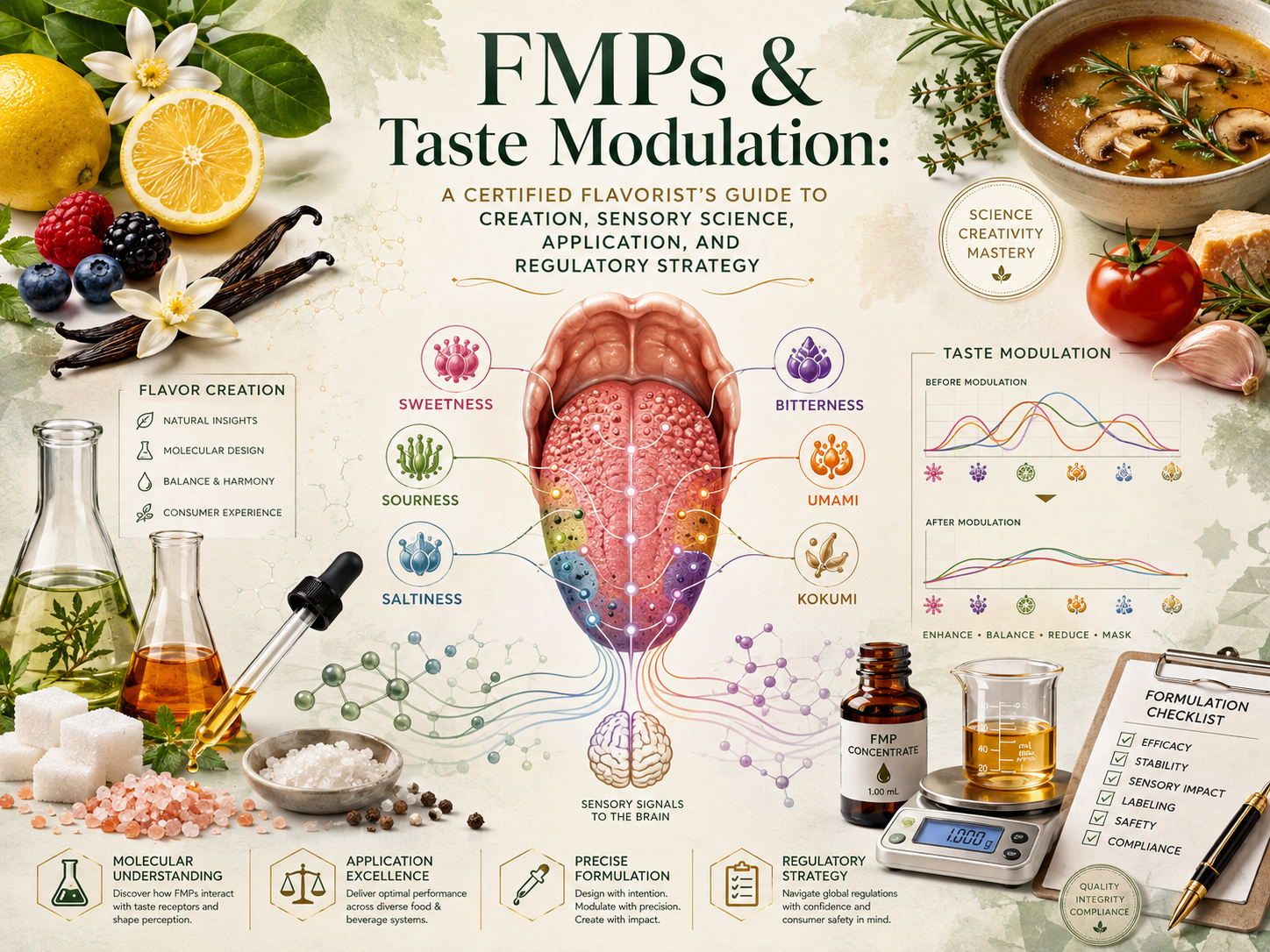
FMPs / Taste Modulation is explicitly listed in the Society of Flavor Chemists syllabus under Flavor Creation, and Certified candidates are expected to demonstrate broad, deep knowledge together with successful independent/original flavor-creation ability—not merely recognize definitions. (Flavor Chemists)
What follows is the knowledge framework I would expect a serious SFC Certified candidate to be able to explain, apply, defend, and troubleshoot verbally. It is not an official SFC answer key, but it is aligned to the published syllabus and current FEMA/IOFI/regulatory and sensory guidance.
1. What an FMP actually is
FMP = Flavoring with Modifying Properties.
IOFI's current definition is especially useful: FMPs are flavorings that modify the flavor/taste of food, may consist of flavoring substances, natural flavoring complexes, thermal-process flavorings, smoke flavorings, or mixtures of these, and do not include substances whose function is exclusively sweet, sour, or salty. (IOFI)
The conceptual distinction is critical.
A conventional flavoring ingredient contributes something recognizable—vanillin contributes vanilla character, ethyl butyrate contributes fruity character, methional contributes cooked-potato character. An FMP may have little characteristic flavor of its own at its intended use level but changes how another sensory characteristic is perceived. FEMA specifically recognizes effects such as increasing fruitiness, reducing bitterness or other characteristics, masking off-notes, or changing the onset and duration of sensory perception.
You should therefore think of an FMP as:
stimulus A + modifier → altered perception of stimulus A
rather than simply:
modifier → its own taste.
For example, a modifier may make an existing sweet system seem fuller or make sweetness arrive faster; decrease bitterness from caffeine; make fruit character seem juicier; round an artificial sweetener's tail; increase perceived mouthfulness; or change the temporal relationship among sweetness, acidity, aroma and bitterness.
An FMP does not necessarily have to be literally tasteless. The important concept is its sensory behavior under the conditions and level of intended use.
2. Know the boundaries between FMPs and related concepts
| Concept | What the flavorist should understand |
|---|---|
| FMP | A flavoring used principally to modify the existing taste/flavor profile under specified conditions of use. |
| Sweetener | Its primary technical effect is to provide sweetness. A material that can behave as an FMP at very low levels may become a sweetener at higher levels. |
| Flavor enhancer | Regulatory category whose interpretation differs by jurisdiction. MSG is a familiar example of a flavor enhancer rather than an FMP in many regulatory systems. |
| Masking flavor | A formulated flavor intended to cover undesirable sensory properties. It may contain FMPs, but the terms are not synonymous. |
| Bitter blocker | A modifier specifically decreasing perceived bitterness; may act by receptor effects or broader perceptual mechanisms. |
| Kokumi modifier | Typically enhances thickness, mouthfulness, continuity and richness rather than supplying a primary basic taste. |
| Sensate | Cooling, warming, tingling, burning or related chemesthetic effects. SFC lists Sensates separately from FMPs, so do not collapse the two subjects. |
| Aroma-induced taste enhancement | Cross-modal perceptual modification—for example, learned sweet-associated aromas increasing perceived sweetness. It is an important taste-modulation strategy even when the aroma material itself would not be legally categorized as an FMP. |
The SFC syllabus itself separating “Sensates” from “FMPs / Taste Modulation” is a clue to how you should discuss them in an interview. (flavorchemists.com)
3. The most important regulatory concept: technical effect + use level
This is probably the most important regulatory sentence to remember:
The same chemical can have different regulatory implications depending on what it is doing and at what level it is being used.
FEMA evaluates ingredients under conditions of intended use as flavor ingredients. FEMA does not use its flavor-GRAS program to authorize a substance for some unrelated technical effect such as use as a primary sweetener. (FEMA)
Some materials are particularly illustrative. Thaumatin, neohesperidin dihydrochalcone and several stevia-derived materials can function as flavor modifiers at relatively low levels but can produce substantial sweetness at higher concentrations. Consequently, the regulatory authority applicable to one technical effect cannot automatically be extrapolated to another. (FEMA)
United States
Under 21 CFR 101.22, natural and artificial flavor designations depend heavily on source and function. “Natural flavor” has a defined source-based meaning and requires flavoring, rather than nutritional, function. (Legal Information Institute)
A Certified flavorist should understand that:
FEMA GRAS is not a license to use an ingredient at any concentration in every food. Intended food category, use level and technical effect matter. Significant changes in use or production can require reevaluation. (FEMA)
You should also know that several common savory tools cannot simply disappear into “natural flavor.” For example, U.S. regulations specifically require monosodium glutamate to be declared by its common or usual name and place restrictions on how protein hydrolysates are declared. (Legal Information Institute)
Codex
Codex defines flavorings as products used to impart, modify or enhance flavor but excludes substances producing an exclusively sweet, sour or salty taste. (FAOHome)
European Union
The EU similarly excludes substances whose effects are exclusively sweet, sour or salty from the flavoring regulation. But the distinction between a flavoring substance with modifying properties and a flavor enhancer can differ from U.S. practice.
European Commission guidance gives an excellent example: neohesperidin DC may be used as a flavoring substance to change characteristics such as fruitiness or jammy character, while the same substance also has separately regulated flavor-enhancer and sweetener functions. (Food Safety)
So in an SFC interview, saying:
“It's FEMA GRAS, so it's legal everywhere as a natural flavor”
would be a serious mistake.
A good flavorist always asks:
What country? What food category? What technical effect? What use level? What source? What label claim?
4. FEMA's FMP sensory framework — know this very well
For a Certified candidate, this is probably the most testable technical material.
FEMA's sensory guidance essentially asks two questions.
| FEMA concept | What must be demonstrated |
|---|---|
| Test 1 — inherent sweetness/saltiness | At the maximum intended flavor-use level, is the FMP itself less sweet or salty than the applicable recognition-threshold control? |
| Test 2 — modifying effect | Does addition of the FMP significantly change the attribute it is intended to modify? |
Test 1
In a water matrix, FEMA's guidance uses recognition-threshold concentrations of approximately 1.5% sucrose and 0.25% NaCl. A 2-AFC directional test is recommended to demonstrate that the FMP sample at its proposed maximum use level has significantly less inherent sweetness or saltiness than the reference. Alternative matrices can require their own threshold determination.
This is important because a candidate flavoring that is simply functioning as a sweetener at the intended level is not doing the technical job being claimed for an FMP.
The guidance recommends at least 30 responses, with at least 10 subjects performing three replicates being one accepted design. For repeated measurements, analysis must account for within-subject replication; FEMA discusses approaches such as beta-binomial analysis. Significance is assessed at α = 0.05.
The sensory specialist also needs to control aroma interference. FEMA specifically notes that nose clips can be appropriate where aroma could confound evaluation of sweetness or saltiness.
Test 2
Here you demonstrate the claimed modification.
If you claim the FMP increases sweetness, your experiment needs to show increased sweetness.
If you claim bitterness masking, demonstrate lower bitterness.
If you claim greater juiciness, demonstrate increased juiciness.
If its purpose is primarily temporal, it may alter onset, time to maximum intensity, persistence or decay without necessarily changing maximum overall intensity. FEMA explicitly recognizes this distinction.
Acceptable sensory approaches include directional 2-AFC tests, descriptive-analysis approaches and time-intensity profiling.
That last part matters enormously in commercial flavoring because many sweetness-modulation problems are actually time-profile problems rather than sweetness-intensity problems.
5. Taste physiology a Certified flavorist should understand
You do not need to become a receptor pharmacologist. You should, however, be able to connect formulation behavior with basic taste biology.
| Sensory system | Core biology | Practical flavorist implication |
|---|---|---|
| Sweet | Principally the heterodimeric GPCR T1R2/T1R3. | Multiple ligand-binding/allosteric sites help explain why different sweeteners and modulators behave differently and can interact synergistically. |
| Umami | Principally T1R1/T1R3, with other pathways contributing. | Glutamate, amino acids, nucleotides and savory materials can create large synergistic effects. |
| Bitter | Humans possess roughly 25 T2R bitter GPCRs. | “Bitterness” is not one receptor problem; one blocker may work brilliantly against one bitterant and poorly against another. |
| Sour | Proton-selective OTOP1 channels are central to sour transduction. | Sour modulation depends on hydrogen-ion activity, but formulation performance also depends on acid identity, buffering and matrix. |
| Salty | Ion-channel pathways are involved; ENaC has a clear role in animal models, while its precise contribution to human salt taste remains less settled. | Do not claim that all saltiness modulation is simply “ENaC activation.” |
| Kokumi | Strong evidence supports involvement of CaSR, particularly for γ-glutamyl peptides. | Kokumi can increase perceived thickness, continuity, richness and persistence without being a conventional basic taste. |
Sweet-receptor biology is well established around T1R2/T1R3, and T1R1/T1R3 is a principal umami receptor. (PubMed Central (PMC)) Bitter perception involves the T2R family. (PubMed) OTOP1 has been established as an important sour proton channel. (PubMed Central (PMC)) Human salt transduction remains more complicated than simply assigning all saltiness to ENaC. (PubMed Central (PMC)) CaSR-mediated perception is central to much current kokumi research. (PubMed Central (PMC))
6. Four fundamentally different ways to modulate taste
A sophisticated flavorist should not assume every modifier is a receptor agonist.
Direct receptor modulation occurs when the material interacts with a gustatory receptor or signaling pathway—agonism, antagonism or positive/negative allosteric modulation.
Taste–taste interactions occur because tastes suppress or reinforce one another perceptually. Sweetness can suppress bitterness and sourness; bitterness, saltiness and sourness can themselves suppress sweetness. Mixture interactions are nonlinear and highly matrix-dependent. (PubMed Central (PMC))
Odor–taste cross-modal modulation occurs centrally in perception. Sweet-associated aromas such as appropriate fruit or vanilla profiles can enhance perceived sweetness in the right context, and learned salty-associated aromas can increase apparent saltiness. The effect depends strongly on congruency, concentration and matrix. (PubMed Central (PMC))
Temporal and mouthfeel modulation changes when or how sensations arrive. A system may build front sweetness, shorten the metallic tail of an HIS, increase savory continuity or make a low-solids product seem fuller.
A good Certified answer discusses all four, rather than saying simply, “I add a bitter blocker.”
7. The creative-development workflow candidates would use in an SFC interview
This is the part where you demonstrate that you are a flavorist, not simply someone who knows receptor names.
- Define the sensory problem precisely. Do not start with “we need a masker.” Determine whether the problem is deficient front sweetness, thin mid-palate, late bitterness, metallic tail, low salt impact, protein astringency, lack of juiciness, excessive acidity, poor persistence or some combination.
- Establish the ideal benchmark. Compare the reformulated product with the full-sugar, full-sodium or otherwise ideal control. Establish what was lost when sugar, salt, fat or another ingredient was removed.
- Build a temporal sensory map. Evaluate attack/onset, development, maximum intensity, mid-palate, swallow, aftertaste and clearing. Taste modulation is often about matching the shape of the benchmark curve.
- Separate taste from aroma and mouthfeel. Identify sweetness, sourness, saltiness, bitterness, umami, astringency, metallic notes, heat/cooling, viscosity, lubricity and retronasal aroma separately. Nose clips can be useful diagnostically.
- Generate hypotheses. Decide whether the deficiency is best addressed by a true FMP, a conventional taste ingredient, aroma modification, mouthfeel adjustment, acid/salt balance, another sweetener, physical delivery modification, or a combination.
- Screen materials individually before blending them. Run dose-response curves around realistic use levels. Determine threshold, useful range, plateau and overdose effects. Many modulators are nonlinear.
- Build complementary modules. A sophisticated sweet-modulation system may contain one component improving onset, another mid-palate/body, another decreasing lingering bitterness and an aroma system reinforcing sweet-associated character.
- Move quickly into the real application. Water screens are useful mechanistically but inadequate for final decisions. Protein, fat, alcohol, carbonation, viscosity, salt, acid and aroma can radically change modifier performance.
- Stress the system. Evaluate process temperature, pH, storage time, oxidation, light, packaging, freeze/thaw, UHT/retort conditions, drying, dissolution and dosage uniformity as appropriate.
- Validate sensory effect, regulatory status, manufacturing practicality and cost-in-use together. A modifier that works sensorially but cannot survive processing, cannot be declared as required, is insoluble at production scale or costs too much is not a successful flavor creation.
That is the kind of creative thought process the SFC syllabus is trying to elicit when it asks candidates to explain how they independently create and develop flavors. (flavorchemists.com)
8. Sugar reduction: what a Certified flavorist should say
Sugar reduction is not simply a “missing sweetness” problem.
Sucrose can supply sweetness, solids, viscosity/body, water activity control, freezing-point effects, browning chemistry and flavor balance. An FMP can potentially repair the sensory side of the problem; it cannot magically replace all of sugar's physical functionality.
So if I reduce sucrose in a strawberry beverage, I would examine at least:
sweetness onset → peak sweetness → strawberry impact → acid balance → juiciness → mouthfeel → bitterness → lingering sweetness → aftertaste clearing.
High-intensity sweeteners may have very different temporal curves from sucrose. If the alternative system comes on slowly and lingers too long, “make it sweeter” is the wrong brief. The real target might be:
increase early sweetness, broaden the middle, decrease late sweet/metallic/bitter character and increase strawberry juiciness.
Then I may use a combination of sweet-modulating FMPs, acid optimization, sweet-congruent aroma, fruit character, body-building ingredients and appropriate high-intensity sweetener ratios.
Cross-modal sweet enhancement can also be useful. Sweet-congruent aromas can increase perceived sweetness, but the effect is highly dependent on aroma identity, intensity and matrix; it is not a guaranteed rule that “vanilla always makes everything sweeter.” (PubMed Central (PMC))
9. High-intensity sweetener modulation
A Certified flavorist should recognize that alternative sweetening systems have different:
onset, maximum intensity, decay, lingering sweetness, bitterness, metallic/licorice character and interaction with acids and flavors.
Taste modulation therefore frequently involves temporal matching.
For instance, a reduced-sugar beverage may require a modifier that increases the perception of early sweetness but another that decreases a lingering late note.
FEMA explicitly recognizes FMPs whose function is to modify temporal sensory behavior.
You should also know the regulatory distinction between using a stevia derivative at a low level as a flavor modifier and using a steviol glycoside as the primary sweetening system. Those are not automatically the same regulatory use. (FEMA)
10. Bitterness masking
A weak candidate says:
“Add sweetness.”
A Certified candidate should give a much broader answer.
First identify the bitterant.
Caffeine bitterness is different from hop bitterness, quinine, botanical alkaloids, catechins, branched-chain amino acids, potassium chloride, certain minerals, hydrolyzed plant proteins and high-intensity sweetener aftertaste.
Because humans possess multiple bitter receptors, blocker efficacy is often bitterant-specific. (PubMed)
Possible approaches include direct bitter receptor antagonism, mixture suppression from sweetness/sodium/umami, FMP bitter blockers, aroma masking, temporal redirection, flavor congruency, sequestration/complexation where appropriate, physical encapsulation, reduction of the bitter ingredient's immediate oral availability, and processing changes that remove the causal bitter compounds.
A useful public example is homoeriodictyol sodium salt, FEMA 4228. FEMA lists it as a flavor ingredient, and sensory research has demonstrated bitterness reduction against several chemically distinct bitterants. Importantly, its performance is not universal—the effect can depend strongly on the bitter compound. (FEMA)
That last point is exactly what you want to say in an oral exam:
“I never assume a bitter blocker is broad-spectrum. I screen against the actual bitter system in the customer's application.”
11. Plant protein taste modulation
Plant-protein systems are excellent oral-exam examples because several sensory problems coexist.
Pea, soy, rice or other plant-protein products may present combinations of:
beany, green, grassy, earthy, cereal, bitter, astringent, chalky, drying, oxidized, sulfurous and lingering notes.
Do not treat these as one “off-note.”
Astringency is especially important because it is not simply bitterness. It is a tactile/oral phenomenon often involving interactions between salivary proteins and polyphenolic or other compounds.
Likewise, chalkiness is a physical mouthfeel problem, so a receptor-level FMP alone is unlikely to solve it.
A strong approach might combine a bitter-modulation system with appropriate creamy/brown/nutty flavor architecture, green-note management, salt/acid balance, sweet modification, mouthfeel ingredients and upstream processing improvements.
The principle is:
remove or minimize the causal problem first where practical; use modulation to complete the sensory solution.
12. Sodium reduction
Again, first distinguish the various jobs of sodium chloride.
NaCl contributes saltiness but also changes overall flavor balance, bitterness perception, water activity, protein behavior, preservation and sometimes texture/process performance.
A flavor modifier only solves the sensory portion.
Strategies for sodium reduction can include partial KCl replacement, savory/umami enhancement, nucleotides, yeast-derived systems, amino acids, kokumi systems, carefully controlled acidity, salty-associated aromas and physical salt distribution.
Potassium chloride can bring bitterness or metallic/mineral character; if used, that creates a second modulation problem.
Congruent savory aromas such as appropriate cheese-, soy-, meat- or fermented-associated notes can enhance perceived saltiness through odor–taste integration, particularly at lower salt concentrations. (PubMed Central (PMC))
But in a certification interview you should also say:
“I would not automatically call MSG, yeast extract, IMP/GMP or KCl an FMP. Their regulatory category and label treatment depend on the material, jurisdiction and technical effect.”
13. Umami and kokumi
Do not use umami and kokumi as synonyms.
Umami is a recognized basic taste associated strongly with glutamate signaling through T1R1/T1R3 and synergistic savory systems.
Kokumi is more often characterized as mouthfulness, thickness, continuity, richness and persistence. CaSR activation by certain γ-glutamyl peptides has substantial experimental support. (PubMed)
A kokumi ingredient can therefore make a reduced-salt broth seem richer and longer-lasting without merely “making it saltier.”
In savory flavor creation, the flavorist should think dimensionally:
saltiness + umami + meatiness + fat impression + roast + mouthfulness + continuity + impact + aftertaste.
A soup can have adequate saltiness and umami and still seem “thin.” Kokumi/mouthfeel modification may solve that.
Conversely, a physical hydrocolloid may increase measurable viscosity but fail to deliver the sensory richness expected from kokumi.
14. Sourness and acid modulation
A flavorist must know that pH is not the same thing as perceived sourness.
Acid identity, dissociation behavior, buffer capacity, titratable acidity, concentration, temperature, sweetness and aroma all influence perception.
OTOP1 is a key proton channel in sour taste transduction, but real beverages are much more complicated than receptor assays. (PubMed Central (PMC))
When troubleshooting an overly sharp reduced-sugar beverage, I would therefore look at:
acid species, acid ratio, pH, titratable acidity, buffering salts, sweetness curve, fruit aroma and mouthfeel, rather than trying to hide the entire problem behind one sourness masker.
15. Public examples you should recognize
You do not need to memorize every proprietary commercial taste-modulation product. You should know representative materials and, more importantly, the principles they demonstrate.
| Example | Why it matters |
|---|---|
| Thaumatin — FEMA 3732 | Demonstrates that a material capable of strong sweetness can nevertheless have different flavor-modification conditions of use. |
| Neohesperidin dihydrochalcone — FEMA 3811 | Classic illustration of technical-effect/use-level distinctions; also useful for understanding different U.S./EU classification frameworks. |
| Stevia-derived materials / glucosylated steviol glycosides | Important example of materials that can have flavor-modification effects at levels different from their use as sweeteners. |
| Homoeriodictyol sodium salt — FEMA 4228 | Well-known public bitter-modulation example; effectiveness varies by bitterant. |
| γ-Glutamyl peptides | Important kokumi class associated with CaSR activation, continuity and mouthfulness. |
| MSG / IMP / GMP | Important taste-enhancement tools and examples of synergism, but do not casually categorize them all as FMPs. |
| Acids, salts, sugars | Powerful taste-modulation tools through mixture interactions but can fall outside the regulatory concept of an FMP when their effect is exclusively sour, salty or sweet. |
FEMA's Flavor Ingredient Library is the appropriate public resource for checking a specific FEMA number and its safety/use references. (FEMA)
16. Concentration-response behavior
A Certified flavorist should expect nonlinear behavior.
With an FMP there may be:
no effect → useful enhancement → optimum → plateau → undesirable side effect/own character.
Homoeriodictyol sodium salt, for example, has shown plateau behavior in bitterness-masking studies. (American Chemical Society Publications)
This is why blindly doubling a modifier is poor practice.
Taste receptor saturation, mixture suppression, adaptation and changes in the relative balance of competing sensory signals all contribute.
You should establish dose-response curves rather than evaluating only “with” and “without.”
17. Temporal sensory science matters enormously
Static “overall sweetness = 7/10” measurements can miss the actual reason products differ.
For FMP work you may want:
time to onset, time to maximum, maximum intensity, duration, area-under-the-curve, decay slope, lingering aftertaste and temporal dominance among attributes.
Time-Intensity, Temporal Dominance of Sensations and related dynamic methods exist because eating and drinking perception changes continuously during oral processing. (ScienceDirect)
This becomes critical when matching sucrose with high-intensity sweeteners.
Two beverages may have identical maximum sweetness yet be obviously different because one reaches its maximum at 3 seconds and clears by 15 seconds while the other peaks at 10 seconds and lingers for a minute.
A flavorist who recognizes this can design the modifier system intelligently.
18. Matrix effects you should be able to discuss
A modifier that works in water may fail in the application because of:
| Matrix variable | What it can change |
|---|---|
| pH / buffer system | Ionization, stability, receptor interaction and overall taste balance |
| Fat | Partitioning and release of aroma molecules; coating and mouthfeel |
| Protein | Binding, bitterness, astringency and flavor release |
| Alcohol | Solubility, aroma volatility, burning sensation and sensory thresholds |
| Carbonation | Acid perception, trigeminal stimulation and aroma release |
| Viscosity | Oral release kinetics and temporal intensity |
| Salt/ionic strength | Taste interactions, solubility and receptor environment |
| Temperature | Volatility and taste intensity |
| Water activity | Release and product stability |
| Processing heat | Chemical degradation/reaction |
| Oxidation/light | Off-note formation and modifier degradation |
This is why the phrase:
“It worked beautifully in water”
means almost nothing without application validation.
19. Flavor form and manufacturing
The SFC syllabus expects Certified members to connect creation to production, so be prepared to explain how an FMP system is delivered.
For liquid systems consider solvent selection, water/oil solubility, pH, precipitation, emulsification, preservative system and order of addition.
For dry systems consider carrier compatibility, spray drying, plating, encapsulation, hygroscopicity, powder flow and reconstitution.
At very low use levels, dosage uniformity becomes important. A potent material may need predilution or plating to permit accurate production-scale addition.
A perfect sensory formula that cannot be weighed reproducibly at a plant is not a commercially finished flavor.
20. Stability
For each modifier ask:
Will it hydrolyze? Oxidize? React with reducing sugars? Interact with proteins? Degrade at acidic pH? Precipitate? Bind to packaging? Lose activity during UHT? Change after six months?
Do not only measure the concentration of the FMP. Evaluate whether sensory performance itself changes.
Chemical concentration and sensory potency are not always perfectly correlated because the surrounding flavor system is also aging.
21. Analytical work supporting taste modulation
GC/MS is extremely useful for aroma, but many taste modulators are low-volatility or nonvolatile. Consequently, FMP work often involves LC/HPLC/LC-MS rather than assuming GC is the universal analytical answer.
Relevant supporting measurements can include pH, titratable acidity, °Brix, salt/sodium, density, viscosity, water activity and color, depending on the system.
But analytical chemistry does not replace human sensory testing.
A receptor assay showing activity does not prove a finished beverage tastes better.
An electronic tongue does not establish consumer liking.
LC-MS confirming 20 ppm modifier does not establish that the modifier is functioning as intended.
The finished-food sensory effect remains fundamental.
22. Sensory study design you should know
For development work, a sophisticated program uses different sensory tools for different questions.
A 2-AFC directional test answers questions such as “Which is sweeter?” or “Which is more bitter?”
A triangle test answers whether samples are detectably different but does not directly tell you what direction changed.
A trained descriptive panel quantifies multiple attributes.
Time-Intensity evaluates one or more attributes over time.
TDS/TCATA-type approaches help reveal which sensations dominate during consumption.
A consumer test measures liking and preference—not the chemistry or mechanism.
And a competent experiment controls serving order, blinding, temperature, concentration, sample coding, palate cleansing, adaptation, replication and fatigue.
23. Sensory adaptation and carryover
This is especially important for FMP work.
Repeated exposure to:
sweeteners, bitterness, acids, menthol, capsicum, alcohol or highly persistent flavors
can alter perception of later samples.
If you're testing six stevia systems in sequence and giving the panel five seconds between them, your data may be garbage.
Randomization, sufficient rest, palate cleansing and sensible panel workload matter.
24. The flavorist's greatest practical skill: diagnosing the actual problem
Consider a zero-sugar peach beverage described by the customer as:
“Too artificial.”
That is not a useful formulation diagnosis.
“Artificial” could mean:
too much candy ester character; insufficient fresh-green notes; sweetness too high; sweetener tail too long; acid too sharp; bitterness; peach aroma lingering after sweetness has disappeared; thin mouthfeel; low pulpy character; lack of natural sulfur/lactonic complexity.
The Certified flavorist converts vague customer language into actionable sensory attributes.
Taste modulation succeeds only after that diagnosis.
25. The relationship between flavor architecture and FMPs
Do not think of the FMP as being added after the “real flavor.”
The best systems are designed together.
For a reduced-sugar strawberry flavor, for example, sweetness enhancement may change the perceived balance of:
ethyl esters, green notes, jammy notes, furaneol-like character, floral notes, acid and ripe notes.
Increasing perceived sweetness can make the fruit seem riper or more candy-like even if you never changed the strawberry flavor formula itself.
Likewise, decreasing bitterness can expose other defects that bitterness had previously hidden.
This means every FMP adjustment should trigger re-evaluation of the entire flavor profile.
26. Aroma can modify taste without altering receptors
This is an important creative distinction.
People learn associations between certain odors and tastes. Fruity and vanilla-associated aromas frequently carry learned sweetness associations, whereas soy sauce, cheese, cured-meat or fermented aromas may carry salt-associated cues.
The brain integrates olfaction and taste to form flavor perception, allowing congruent aromas to change rated taste intensity. (PubMed Central (PMC))
Therefore a good flavorist sometimes solves a sweetness problem by modifying aroma architecture, not merely by adding another sweetener or FMP.
That is part of why the SFC calls this an art as well as a science.
27. Mouthfeel: know what an FMP can and cannot do
Terms you should understand include:
body, fullness, thickness, creaminess, coating, lubricity, juiciness, pulpiness, continuity, drying, chalkiness and astringency.
An FMP may enhance perceived mouthfulness or creaminess.
But if a beverage physically lacks solids or viscosity after sugar removal, a modifier may need to be combined with:
hydrocolloids, fibers, starches, proteins, emulsions, bulking ingredients or other texture systems.
Never promise that taste modulation can replace fundamental product physics.
28. Regulatory documentation a flavorist should appreciate
You do not need to act as the company's regulatory attorney, but a Certified flavorist should know what information needs to exist.
For an FMP-containing flavor you should be able to trace:
material identity, FEMA/other regulatory status, applicable food categories, maximum/typical use levels, natural/artificial determination, source, carrier system, allergens, manufacturing process where relevant, country-specific status and finished-product use level.
You should understand that the regulatory assessment concerns the final level after your flavor is dosed into the food.
A 1% FMP concentration in a flavor dosed at 0.1% gives a very different finished-food level than using that flavor at 1%.
Do your ppm math automatically.
29. FMP calculation competency
You should be comfortable with calculations such as:
If a compounded flavor contains 0.50% FMP and the flavor is used at 0.20% in the finished beverage, then:
0.005 × 0.002 = 0.000010
which is 10 ppm FMP in the finished beverage.
A Certified flavorist should be able to move between:
ppm → % → flavor concentrate level → finished-food use level
without hesitation.
This matters because regulatory limits and sensory thresholds are commonly expressed at the finished-food concentration.
30. Cost-in-use
Commercial flavorists do not optimize formula cost per kilogram of flavor alone.
The relevant metric is often cost-in-use in finished product.
A $500/kg FMP used at 5 ppm can potentially be economically preferable to a $20/kg material required at 1,000 ppm.
You also consider dosage reproducibility, shelf life, processing loss and whether the modifier enables reduction of another expensive ingredient.
SFC explicitly expects Certified candidates to understand economics associated with creation, production and utilization of flavors. (flavorchemists.com)
31. Common oral-exam traps
| Weak / incorrect statement | Better Certified-level answer |
|---|---|
| “FMPs are tasteless.” | They may have little/no character at intended use level; classification depends on sensory function and conditions of use. |
| “FEMA GRAS means FDA approved.” | FEMA GRAS is an independent expert-panel GRAS determination for specified flavor uses; do not equate it simplistically with FDA food-additive approval. |
| “If it is FEMA GRAS, I can use as much as I want.” | Use categories, maximum levels and technical effect matter. |
| “A stevia ingredient is either a sweetener or an FMP.” | The same substance can have different technical effects at different use levels, with corresponding regulatory consequences. |
| “MSG is an FMP.” | MSG is a conventional flavor enhancer/taste ingredient with specific regulatory and labeling treatment. |
| “All bitter blockers work on bitterness.” | Bitter receptor diversity and bitterant-specific effects make efficacy highly compound- and matrix-dependent. |
| “Saltiness is ENaC.” | ENaC is important scientifically, but human salt transduction is more complex and not completely resolved. |
| “Kokumi is the sixth basic taste.” | Kokumi is better described as modulation of mouthfulness, thickness and continuity; CaSR is strongly implicated. |
| “If it activates the receptor assay, it works.” | Receptor assays are screening/mechanistic tools; finished-food human sensory validation is essential. |
| “More FMP means more effect.” | Dose-response can plateau or generate side effects. |
| “It worked in water.” | Application matrices can change release, perception and stability dramatically. |
| “Sugar reduction is a sweetness problem.” | Sugar also contributes solids, texture, processing and preservation effects. |
| “Mask the protein flavor.” | Diagnose bitterness, astringency, green aroma, sulfur, chalkiness and oxidation separately. |
32. A model SFC oral answer
If an examiner asks:
“How would you approach developing a taste-modulation system?”
A strong answer would sound approximately like this:
I would start by identifying the specific sensory deficit rather than immediately choosing a modifier. I would compare the reformulated product with an ideal benchmark and map sweetness, acidity, bitterness, saltiness or umami, mouthfeel, aroma and their temporal profiles. I would determine whether the problem requires receptor-level taste modification, taste–taste interaction, aroma-induced enhancement, mouthfeel rebuilding, or several approaches together. I would then screen potential FMPs and other tools over a dose range, paying particular attention to onset, maximum intensity, duration, aftertaste and side effects. Once I had promising systems I would evaluate them in the actual application because pH, fat, protein, alcohol, carbonation and processing can change performance substantially. I would optimize the FMP together with the characterizing flavor rather than treating it separately. Finally, I would confirm processing and shelf stability, sensory significance, regulatory status and intended use level, labeling, manufacturing feasibility and cost-in-use.
That answer demonstrates creative reasoning, sensory science, application knowledge, regulatory awareness and commercial understanding rather than simply memorizing FMP definitions.
33. A more difficult example: 30% sodium-reduced chicken broth
A Certified-level thought process would be:
The sodium reduction probably decreases salt impact, but it may also reduce overall meaty impact and expose bitterness.
I would first compare it with the full-sodium control.
I would quantify:
initial salt impact, umami, chicken identity, roasted/cooked character, fat impression, mouthfulness, metallic/mineral notes, bitterness and savory persistence.
I might examine partial sodium replacement, but if KCl is introduced I would assess its bitterness/mineral character.
Then I would investigate combinations of umami/savory ingredients, appropriate nucleotides or yeast-derived systems where permitted, kokumi/mouthfulness tools, salt-modulating FMPs and salt-congruent aroma architecture.
I would make sure the system was not merely increasing MSG-style umami while leaving the product perceptually under-salted.
Finally, I would check whether the system gives comparable impact through the entire spoonful and after swallow.
That last temporal point often separates sophisticated savory modulation from simply adding more savory ingredient.
34. Another exam example: protein shake
Suppose the brief is:
“Mask the pea protein.”
A Certified candidate might respond:
Before masking, I would determine whether the defect is volatile or nonvolatile.
With a nose clip, if bitterness/astringency remains, that tells me the problem is not primarily aroma.
I would separately score:
beany/green aroma, earthy notes, bitterness, astringency, chalkiness, drying, mineral character and aftertaste.
Then I would develop the solution in layers.
Aroma masking might handle green/beany character.
A bitter-modifying system might reduce taste bitterness.
Creaminess/body modification could repair thinness.
Sweetness/acid balance may reduce overall harshness.
Astringency might require matrix or protein-processing solutions rather than expecting a bitter blocker to fix it.
That is the type of diagnostic thinking SFC is looking for.
35. What you should know cold before your SFC interview
If you can answer these questions without notes, you are in strong shape for the FMP/taste-modulation portion:
| Question | What you should immediately be able to discuss |
|---|---|
| Define an FMP. | Flavoring that modifies existing flavor/taste under intended conditions rather than merely providing exclusive sweetness/sourness/saltiness. |
| How is an FMP different from a sweetener? | Technical effect and use level. |
| Why are use levels so important? | The same material may change technical function at higher concentration. |
| What are FEMA Test 1 and Test 2? | Inherent sweet/salt assessment and demonstration of intended modifying effect. |
| What are FEMA's water references? | Approximately 1.5% sucrose and 0.25% NaCl. |
| Why temporal profiling? | Modifiers can change onset/duration without changing overall maximum intensity. |
| Sweet receptor? | T1R2/T1R3. |
| Umami receptor? | Primarily T1R1/T1R3. |
| Bitter receptors? | T2R family; numerous subtypes. |
| Sour receptor/channel? | OTOP1 proton channel. |
| Salty mechanism? | Ion channels including ENaC-related pathways; human mechanism remains more complex. |
| Kokumi mechanism? | CaSR strongly implicated, especially for γ-glutamyl peptides. |
| Why might a bitter blocker fail? | Wrong bitter receptor/bitterant, concentration, matrix, temporal behavior or side effects. |
| Why might water results fail in food? | Protein/fat/pH/viscosity/ions/aroma/processing change performance. |
| How can aroma modify taste? | Learned cross-modal odor–taste integration. |
| Can an FMP replace all sugar functionality? | No. |
| Can it replace all NaCl functionality? | No. |
| What analytical techniques might support FMP development? | LC/HPLC/LC-MS for many nonvolatile modulators plus appropriate basic application measurements; GC/MS for aroma system. |
| What does a commercial solution require? | Sensory efficacy + regulatory compliance + stability + manufacturability + economics. |
36. The mindset SFC is really testing
The most important shift is from thinking:
“Which chemical makes sweetness stronger?”
to thinking:
“What does the eating experience need to do differently, why is it currently wrong, and what combination of chemical, sensory, temporal, physical and regulatory tools can create that experience?”
The current SFC syllabus explicitly says Certified candidates should demonstrate broad and deep knowledge indicative of successful independent and original flavor creation, while acknowledging that candidates are not expected to know literally every possible aspect of flavor chemistry. (flavorchemists.com)
For FMP/taste modulation, that means you should be able to move fluently among:
sensory perception → taste biology → raw materials → creative formulation → application matrix → temporal behavior → sensory statistics → manufacturing → stability → regulatory classification → labeling → economics.
That is the Certified-flavorist level of the subject.
The five points I would memorize verbatim
If you retain nothing else, retain these:
FMPs modify perception; they are not simply another word for sweeteners or maskers.
Technical effect and conditions of intended use determine what the ingredient is doing from a regulatory standpoint.
FEMA's two core sensory questions are “Does the candidate itself remain appropriately below inherent sweet/salty recognition?” and “Does it significantly produce the intended sensory modification?”
Taste modulation includes receptor effects, taste–taste interactions, aroma–taste interactions, temporal modification and mouthfeel—not merely receptor agonism.
The final proof is performance in the real finished food, at a legal and practical level, through processing and shelf life.
###