Fresh Notes in Flavor Chemistry: Compounds, Applications, Usage Levels, and Roles in the Flavor Pyramid
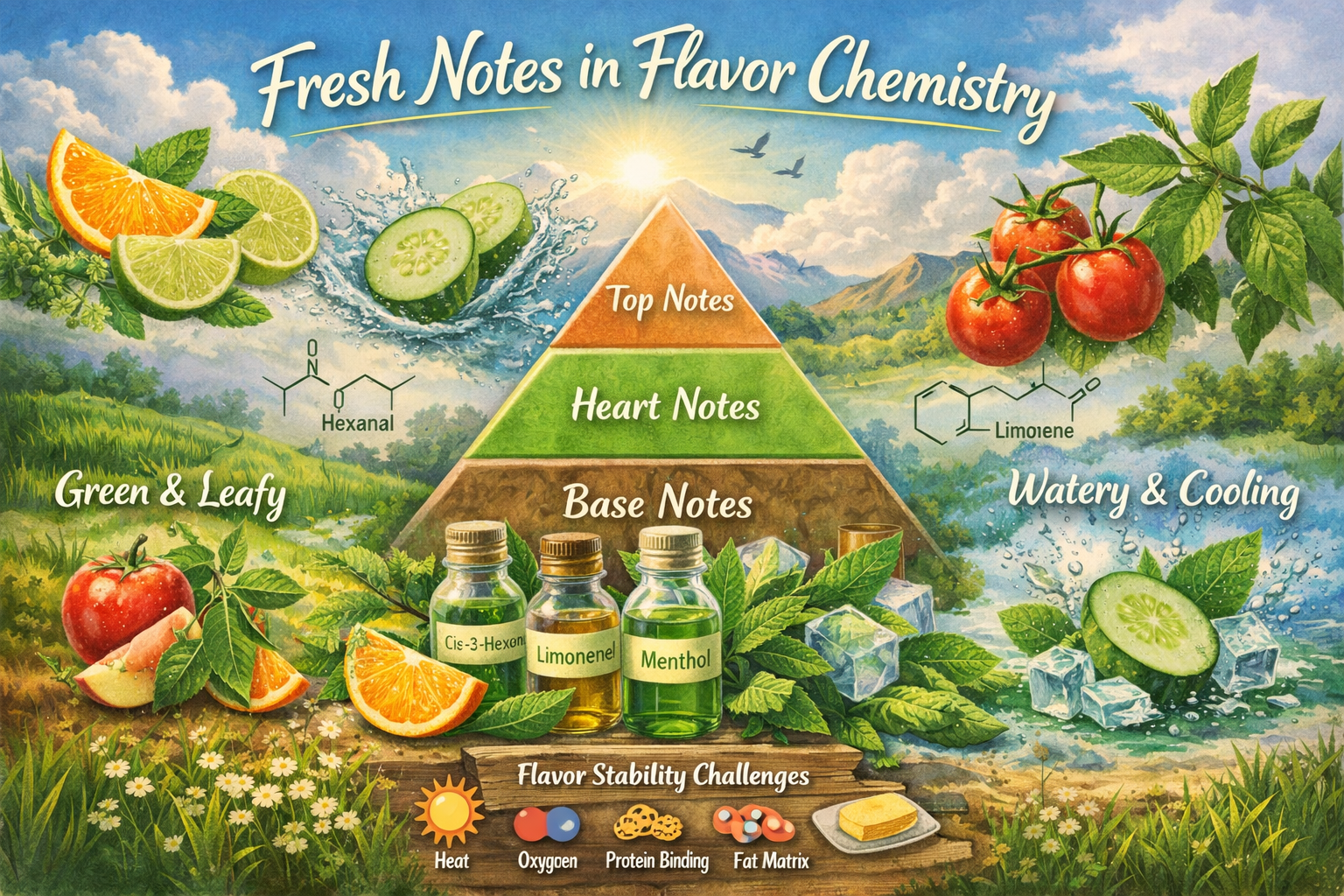
The Society of Flavor Chemists (SFC) requires certified flavorists to understand and be able to manipulate all 20 designated notes—including the fresh note—when formulating or modifying flavors. Provided below is some information about fresh notes that flavorist trainees may find useful when preparing for the Society's qualification exam or interview.
Basics about "fresh" notes
🧪 Key Compounds Defining the "Fresh" Note
The fresh or "green" note is largely defined by volatile compounds produced when plants are damaged. The most critical of these are:
- Cis-3-Hexenal (Leaf Aldehyde): Provides the sharp, "electric," and vibrant green note of freshly cut grass. It is highly unstable and degrades quickly.
- Cis-3-Hexenol (Leaf Alcohol): The industry standard for "green" notes. While more stable than its aldehyde counterpart, it can smell "synthetic" or like "solvent" if used in too high a concentration.
- Trans-2-Hexenal (Leaf Aldehyde): Often the degradation product of cis-3-hexenal. It contributes a green, grassy character but lacks the sharp "flash" of the fresh aldehyde.
These compounds are derived from the oxidative breakdown of unsaturated fatty acids, such as linolenic and linoleic acid, in plant tissues.
⏳ Fresh Notes: Top or Heart?
Fresh notes are classified as top notes. This is because the molecules responsible for them are very small and light, causing them to evaporate rapidly. They create the initial, immediate impression of a flavor before the more stable middle (heart) and base notes emerge. For example, a citrus or ginger scent dissipates quickly, leaving behind the deeper notes of lavender or wood.
📈 Increasing and Reducing Fresh Notes
The search results provide specific strategies for flavor modulation:
- How to Increase the Fresh Note
- Boost with Green Compounds: Add natural sources or synthetic versions of cis-3-Hexenol and cis-3-Hexenal.
- Support with Modifiers: Use trace amounts of cis-3-Hexenyl Acetate to soften the harsh edge of leaf alcohol. Pair with other green or botanical extracts like Galbanum or Violet Leaf to add complexity and mimic the effect of the missing fresh aldehyde.
- Add Fatty Acid Precursors: To produce a "natural" fresh note in situ, ingredients like linolenic acid (often from hydrolyzed linseed oil) can be added to a fruit or leaf slurry to generate fresh aldehydes and alcohols through enzymatic reactions.
- How to Reduce or Dampen the Fresh Note
- Masking: Use other strong flavors to distract the palate. Common masking agents include vanilla, sucrose, licorice extract (glycyrrhizic acid), spices, and citrus compounds.
- Blocking: Use ingredients that bind to taste receptors to prevent the perception of an off-note, such as those derived from fermented mushroom mycelia.
🧱 Challenges for Keeping Fresh Notes
The primary challenge in maintaining fresh notes is their inherent instability.
- High Volatility & Degradation: The sharpest fresh compounds (like cis-3-Hexenal) are so reactive that they can change into other, less desirable molecules (like trans-2-Hexenal) within minutes of being created. They are also easily destroyed by heat and oxidation during food processing.
- The "Synthetic Green" Effect: Overdosing with a more stable compound like cis-3-Hexenol to compensate for the loss of the sharper aldehyde can result in an off-note described as "solvent-like" or "synthetic".
🛡️ Favorable Food Matrices and Solutions
A favorable food matrix is one that protects the volatile compounds from the causes of degradation.
- Encapsulation is Key: The most effective technology for maintaining fresh notes is encapsulation. This process physically encases the delicate flavor molecules in a matrix (e.g., starch, sugar, or gum).
- It protects against heat during processing like baking or extrusion.
- It prevents oxidation by creating a barrier against oxygen.
- It controls volatility by preventing the flavor from evaporating or escaping during storage.
- Low-Moisture & Inert Environments: Encapsulated flavors are particularly useful in dry matrices like powdered beverage mixes, tea bags, and dry soup mixes , where they remain stable until released upon rehydration. They are also designed for applications like hard candy, where the matrix can withstand high heat and release the flavor in a "burst".
Log in to read more