Furans, Pyrroles, and Thiophenes in Food Flavors: Their Odors, Applications, and Reaction Conditions
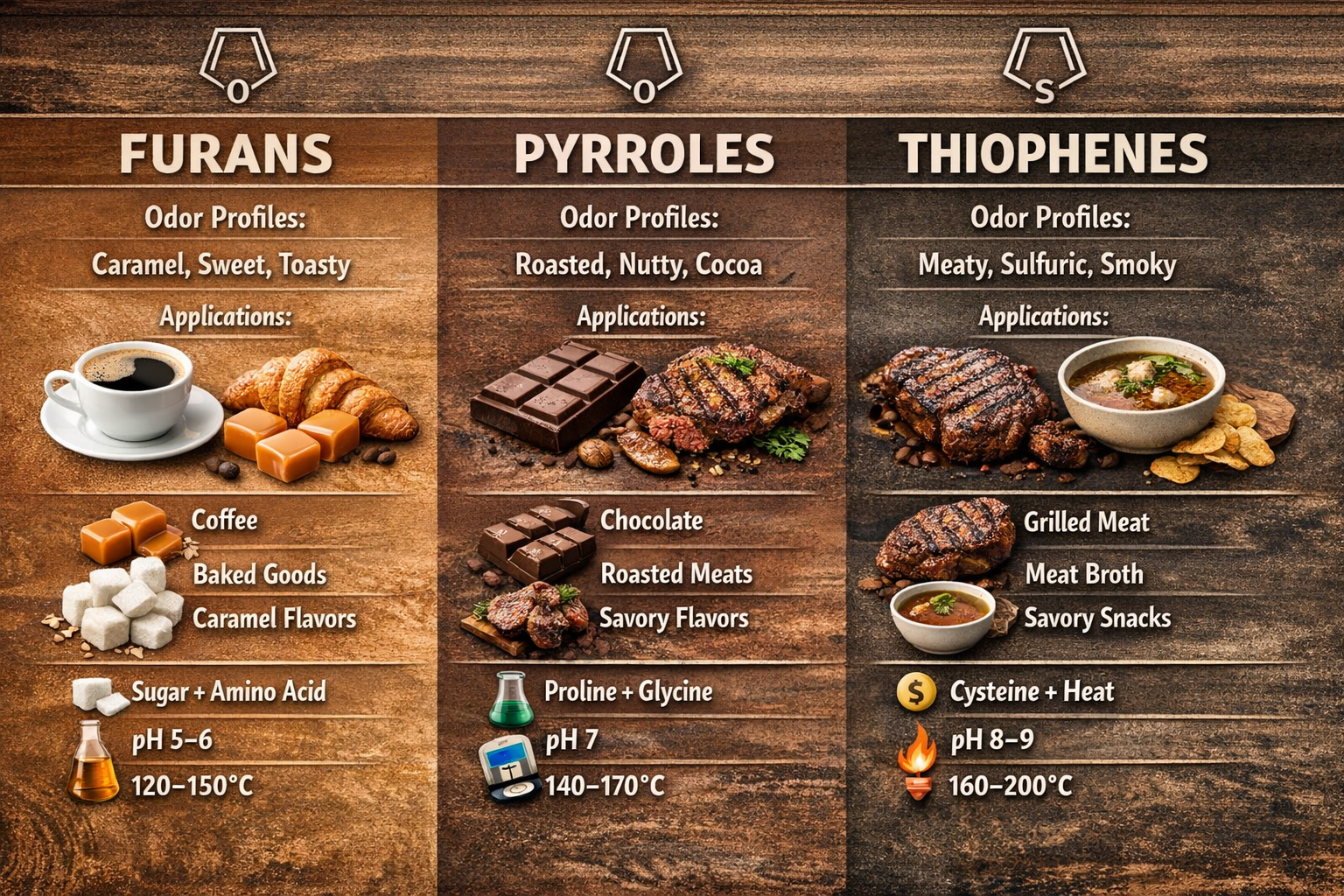
Furans, pyrroles, and thiophenes share similar chemical structures, yet they differ in odor perception and, consequently, in their applications. This page provides an overview of their odor profiles, applications, and the Maillard reaction conditions—including the specific reactants that favor each type of flavor compound. A common feature among them is that all can be generated through thermal processes.
Here’s a comparative breakdown of furans, pyrroles, and thiophenes—focusing on odor, applications, and reaction control (reactants, pH, temperature) in food flavor systems.
1) Core Structural & Sensory Overview
🔥 Furans (O-containing heterocycles)
Odor Profile
- Sweet, caramelized, bready
- Nutty, roasted almond
- Buttery, maple-like
- Slightly green/ethereal (lower MW furans)
Key Compounds
- Furfural – almond, bready
- 5-methylfurfural – caramel, sweet
- 2-acetylfuran – roasted, nutty
- Furaneol – strawberry, cotton candy
Applications
- Coffee, baked goods, cocoa
- Caramel, brown sugar flavors
- Strawberry and fruit flavors (furaneol)
- Dairy (caramelized milk notes)
🌿 Pyrroles (N-containing heterocycles)
Odor Profile
- Toasted, bread crust
- Nutty, cocoa-like
- Slightly meaty, earthy
- Warm, cereal-like
Key Compounds
- 2-acetylpyrrole – popcorn, roasted
- 2-formylpyrrole – sweet, bread-like
- Alkylpyrroles – cocoa, nutty depth
Applications
- Bread crust, baked goods
- Coffee and cocoa bases
- Roasted nuts
- Savory systems (background warmth)
🧄 Thiophenes (S-containing heterocycles)
Odor Profile
- Meaty, roasted, sulfurous
- Onion-like, garlic-like
- Coffee-roasted, savory
- Slightly burnt, rubbery at high levels
Key Compounds
- 2-acetylthiophene – roasted meat, coffee
- Alkylthiophenes – savory depth
- Thiophene-2-carboxaldehyde – roasted, fatty
Applications
- Meat flavors (beef, chicken)
- Coffee roast notes
- Onion/garlic reaction flavors
- Savory bouillon systems
2) Comparative Sensory Matrix
| Property | Furans | Pyrroles | Thiophenes |
|---|---|---|---|
| Heteroatom | Oxygen | Nitrogen | Sulfur |
| Odor Intensity | Medium | Medium | Very high (low threshold) |
| Odor Type | Sweet, caramel, nutty | Toasted, nutty, cocoa | Meaty, sulfurous, roasted |
| Volatility | High | Moderate | Lower, more persistent |
| Flavor Role | Top–mid notes | Mid–base | Base/impact notes |
| Risk | Burnt/bitter if overdone | Earthy/muddy excess | Harsh sulfur/off-notes |
3) Formation Pathways & Reactants
Furans
Primary pathways:
- Sugar degradation (caramelization)
- Maillard (sugar + amino acid)
Key reactants:
- Hexoses (glucose, fructose)
- Pentoses → furfural
- Ascorbic acid (vitamin C pathway)
- Lipid oxidation (minor)
Pyrroles
Primary pathways:
- Maillard reaction (advanced stage)
- Strecker degradation
Key reactants:
- Amino acids (especially proline, ornithine)
- Reducing sugars
- Ammonia/amines
Thiophenes
Primary pathways:
- Sulfur-mediated Maillard
- Decomposition of sulfur amino acids
Key reactants:
- Cysteine, cystine, methionine
- Sugars (ribose, glucose)
- H₂S, mercaptans
4) Reaction Conditions → Output Control
🌡️ Temperature Effects
| Temperature Range | Dominant Products |
|---|---|
| 100–140°C | Furans (sweet, caramel) |
| 140–180°C | Pyrroles increase |
| 160–220°C | Thiophenes dominate |
| >200°C | Burnt, sulfur harshness |
Insight:
- Furans form early → top notes
- Pyrroles mid-stage → body
- Thiophenes late/high heat → impact savory
⚗️ pH Effects
| pH Range | Effect |
|---|---|
| Acidic (pH 3–5) | Enhances furans (caramelization favored) |
| Neutral (pH 6–7) | Balanced Maillard → furans + pyrroles |
| Alkaline (pH 8–10) | Strongly promotes pyrroles & thiophenes |
Mechanism:
- Alkaline pH accelerates:
- Amadori rearrangement
- Strecker degradation
- Sulfur fragmentation
🧪 Reactant Control
Sugar Type
- Pentoses (ribose) → fast Maillard → more thiophenes & pyrroles
- Hexoses → more furans (sweeter profile)
Amino Acids
| Amino Acid | Output Bias |
|---|---|
| Glycine | General Maillard (furans + pyrroles) |
| Proline | Pyrroles ↑ |
| Cysteine | Thiophenes ↑↑ |
| Methionine | Sulfur notes (thiophenes, sulfides) |
💧 Water Activity (aw)
| aw | Effect |
|---|---|
| Low (0.2–0.4) | Maximizes Maillard → thiophenes |
| Medium (0.5–0.7) | Balanced formation |
| High (>0.8) | Suppresses heterocycles |
5) Practical Flavor Design Strategies
To Increase Furans (Sweet/Bakery)
- Use hexoses + mild heat (120–150°C)
- Slightly acidic pH
- Limit sulfur amino acids
- Control water activity (~0.6)
To Increase Pyrroles (Roasted/Nutty)
- Use proline + reducing sugars
- Moderate-high temp (140–180°C)
- Neutral to slightly alkaline pH
- Longer reaction time
To Increase Thiophenes (Meaty/Savory)
- Use cysteine + ribose
- High temp (160–200°C)
- Slightly alkaline pH
- Low water activity
6) Cross-Interaction Insights (Advanced)
- Thiophenes suppress sweetness perception from furans → useful in savory systems
- Furans soften sulfur harshness → balance in meat flavors
- Pyrroles act as bridges between sweet and savory notes
- Excess thiophenes → “burnt rubber” defect
- Excess furans → “over-caramelized / jammy”
7) Example Systems
Coffee Roast
- Furans: caramel sweetness
- Pyrroles: body, roasted grain
- Thiophenes: roast intensity
Beef Flavor
- Low furans
- Moderate pyrroles
- High thiophenes (cysteine-driven)
Bread Crust
- High pyrroles
- Moderate furans
- Minimal thiophenes
8) One-Line Summary (Flavorist Insight)
- Furans = sweetness & caramel (early, oxygen chemistry)
- Pyrroles = roasted backbone (mid-stage nitrogen chemistry)
- Thiophenes = savory impact (late-stage sulfur chemistry)
Below are some major furans, pyrroles, and thiophenes
🔥 FURANS (Sweet / Caramel / Roasted Oxygen Heterocycles)
Key Compounds
1) Furaneol (4-hydroxy-2,5-dimethyl-3(2H)-furanone)
- Odor: Strawberry, caramel, cotton candy, jammy
- Threshold: ~0.01–0.1 ppm (very low; highly potent)
- Applications:
- Strawberry, pineapple, tropical flavors
- Caramel, brown sugar systems
- Dairy (condensed milk, dulce de leche)
👉 Role: Signature sweet-impact molecule in fruit flavors
2) Furfural
- Odor: Almond, bready, baked, slightly woody
- Threshold: ~1–10 ppm
- Applications:
- Bread crust, baked goods
- Coffee, cocoa
- Nut flavors (almond/hazelnut nuance)
👉 Role: Foundation bakery note
3) 5-Methylfurfural
- Odor: Caramel, sweet, maple-like
- Threshold: ~0.5–5 ppm
- Applications:
- Caramel flavors
- Syrup, maple, toffee
- Roasted sugar systems
4) 2-Acetylfuran
- Odor: Roasted, nutty, coffee-like
- Threshold: ~0.1–1 ppm
- Applications:
- Coffee and cocoa
- Nut flavors
- Baked goods
5) 2-Pentylfuran
- Odor: Green, beany, fatty
- Threshold: ~0.01–0.1 ppm
- Applications:
- Vegetable flavors (green bean, soy)
- Lipid oxidation notes (controlled use)
👉 Risk: Easily becomes off-note (rancid/oxidized)
Furan Summary
- Strength: Medium → high (furaneol extremely potent)
- Character: Sweet, caramel, roasted, sometimes green
- Primary Use: Top–mid notes in sweet and roasted systems
🌿 PYRROLES (Toasted / Nutty / Cocoa Nitrogen Heterocycles)
Key Compounds
1) 2-Acetylpyrrole
- Odor: Popcorn, roasted, nutty, bread crust
- Threshold: ~0.01–0.1 ppm
- Applications:
- Popcorn, corn chips
- Bread crust, baked goods
- Coffee and cocoa
👉 Role: Core roasted grain note
2) 2-Formylpyrrole
- Odor: Sweet, bread-like, slightly caramelized
- Threshold: ~1–10 ppm
- Applications:
- Bakery systems
- Cocoa bases
- Malt flavors
3) 1-Methylpyrrole / Alkylpyrroles
- Odor: Nutty, cocoa, slightly earthy
- Threshold: ~0.1–10 ppm (varies widely)
- Applications:
- Cocoa/chocolate
- Roasted nuts
- Coffee body
4) 2-Acetyl-1-pyrroline (technically pyrroline but grouped functionally)
- Odor: Popcorn, pandan, roasted rice
- Threshold: ~0.0001 ppm (extremely potent)
- Applications:
- Rice, bread, popcorn
- Specialty flavors (basmati, pandan)
👉 Role: One of the most potent aroma compounds known
Pyrrole Summary
- Strength: Medium → extremely high (pyrroline derivatives)
- Character: Toasted, nutty, cocoa, cereal
- Primary Use: Mid–base structure in roasted systems
🧄 THIOPHENES (Meaty / Sulfurous / Roasted Impact Compounds)
Key Compounds
1) 2-Acetylthiophene
- Odor: Roasted, coffee, meaty, sulfurous
- Threshold: ~0.01–0.1 ppm
- Applications:
- Meat flavors (beef, chicken)
- Coffee roast
- Savory reaction flavors
👉 Role: Bridge between coffee and meat roast notes
2) Thiophene
- Odor: Sulfurous, gasoline-like, roasted
- Threshold: ~1–10 ppm
- Applications:
- Rarely used directly
- Present in reaction flavors (background)
3) 2-Propionylthiophene / Alkylthiophenes
- Odor: Meaty, fatty, roasted
- Threshold: ~0.001–0.01 ppm (very potent)
- Applications:
- Beef and chicken flavors
- Bouillon, broth systems
4) Thiophene-2-carboxaldehyde
- Odor: Roasted, slightly sweet, fatty
- Threshold: ~0.1–1 ppm
- Applications:
- Coffee
- Roasted savory systems
5) Fused sulfur heterocycles (e.g., thienothiols, thiophenethiols)
- Odor: Extremely meaty, onion, garlic
- Threshold: ppb–ppt range (ultra potent)
- Applications:
- High-impact meat flavors
- Onion/garlic reaction bases
👉 Risk: Overdose → burnt rubber / sulfury harshness
Thiophene Summary
- Strength: Very high (often ppb level)
- Character: Meaty, sulfurous, roasted
- Primary Use: Impact/base notes in savory systems
📊 Cross-Class Comparison (Odor & Use)
| Property | Furans | Pyrroles | Thiophenes |
|---|---|---|---|
| Odor Type | Sweet, caramel | Nutty, toasted | Meaty, sulfurous |
| Threshold | ppm–ppb | ppm–ppb | ppb–ppt |
| Potency | Medium–high | Medium–very high | Extremely high |
| Role | Top–mid | Mid–base | Impact/base |
| Key Use | Sweet & roasted | Roasted backbone | Savory/meat |
🧠 Flavorist Insights (Critical)
1) Odor Threshold Hierarchy
- Thiophenes > Pyrroles > Furans
- Sulfur compounds dominate even at trace levels
2) Matrix Effects
- Fat systems amplify:
- Thiophenes (meaty persistence)
- Sugar systems amplify:
- Furans (sweet perception)
- Dry systems enhance:
- Pyrroles (bread crust effect)
3) Synergy
- Furaneol + maltol → caramel amplification
- Pyrroles + pyrazines → roasted complexity
- Thiophenes + thiazoles → realistic meat flavors
4) Off-Note Risks
| Class | Overuse Effect |
|---|---|
| Furans | Burnt sugar, cloying |
| Pyrroles | Muddy, earthy |
| Thiophenes | Rubber, sulfur harsh |
🧪 Application Examples
Coffee
- Furans: sweetness
- Pyrroles: body
- Thiophenes: roast intensity
Chocolate
- Furans: caramel sweetness
- Pyrroles: cocoa backbone
- Minimal thiophenes
Meat
- Low furans
- Moderate pyrroles
- High thiophenes
🧾 One-Line Takeaway
- Furans → sweetness & caramel identity
- Pyrroles → roasted structure & warmth
- Thiophenes → savory impact & realism
Application of furans, pyrroles, and thiophenes in flavors
Below is a flavorist-oriented mapping of TOP / HEART / BASE roles for furans, pyrroles, and thiophenes across major applications.
Think in terms of volatility + odor impact:
- Top notes → volatile, bright, first impression
- Heart notes → body, character, persistence mid-palate
- Base notes → low volatility, depth, lingering impact
🔥 Bakery (Bread, Cookies, Crackers)
Top Notes
- Furfural → fresh baked, almond, bready lift
- 5-Methylfurfural → sweet caramelized top
- 2-Acetylfuran → light roasted/nutty lift
Heart Notes
- 2-Acetylpyrrole → toasted crust, popcorn-like warmth
- 2-Formylpyrrole → baked sweetness, cereal body
Base Notes
- Alkylpyrroles → deep baked grain structure
- Trace 2-acetylthiophene → subtle roasted depth (very low)
👉 Structure rule:
Furans = opening sweetness → Pyrroles = crust body → Trace thiophenes = depth
☕ Coffee
Top Notes
- Furfural → sweet roasted lift
- 5-Methylfurfural → caramel sweetness
- 2-Acetylfuran → nutty brightness
Heart Notes
- 2-Acetylpyrrole → roasted grain body
- Alkylpyrroles → cocoa-like depth
Base Notes
- 2-Acetylthiophene → dark roast backbone
- Thiophene-2-carboxaldehyde → fatty roast persistence
- Trace alkylthiophenes → smoky depth
👉 Structure rule:
Furans = aroma opening → Pyrroles = cup body → Thiophenes = roast intensity
🍫 Chocolate (Milk & Dark)
Top Notes
- Furfural → soft baked cocoa
- 5-Methylfurfural → caramel sweetness (milk chocolate)
- 2-Acetylfuran → roasted cocoa lift
Heart Notes
- 2-Acetylpyrrole → cocoa warmth
- Alkylpyrroles → chocolate body
Base Notes
- Alkylpyrroles (heavier) → bitter cocoa depth
- Trace 2-acetylthiophene → dark roast accent
👉 Structure rule:
Pyrroles dominate heart/base; furans adjust sweetness; thiophenes minimal
🍯 Caramel / Toffee / Brown Su
Top Notes
- Furaneol → sweet, jammy, cotton candy impact
- 5-Methylfurfural → caramel lift
Heart Notes
- Furfural → baked sugar body
- 2-Acetylfuran → roasted caramel nuance
Base Notes
- 2-Formylpyrrole → cooked sugar depth
- Trace 2-acetylpyrrole → dark caramel warmth
👉 Structure rule:
Furans dominate top + heart; pyrroles provide “cooked depth”
🥛 Dairy (Cooked Milk, Dulce de Leche)
Top Notes
- Furaneol → sweet creamy top
- 5-Methylfurfural → caramel milk lift
Heart Notes
- Furfural → cooked milk/baked lactose
- 2-Acetylfuran → light roasted dairy
Base Notes
- 2-Acetylpyrrole (trace) → warm cooked depth
👉 Structure rule:
Mostly furans; pyrroles very light; thiophenes avoided
🌰 Nut Flavors (Hazelnut, Peanut, Almond)
Top Notes
- Furfural → almond-like lift
- 5-Methylfurfural → sweet roasted top
- 2-Acetylfuran → nutty brightness
Heart Notes
- 2-Acetylpyrrole → roasted nut body
- Alkylpyrroles → skin/roast depth
Base Notes
- Trace 2-acetylthiophene → peanut dark roast
- Heavier pyrroles → persistent nuttiness
👉 Structure rule:
Furans (top sweetness) + pyrroles (core nut body) + minimal sulfur
🥩 Meat (Beef, Chicken, Pork)
Top Notes
- Furfural (low) → browned sweetness
- 2-Acetylfuran (low) → roasted lift
Heart Notes
- 2-Acetylpyrrole → roasted/meaty body
- Alkylpyrroles → grilled/browned character
Base Notes (critical)
- 2-Acetylthiophene → core roasted meat
- Alkylthiophenes → fatty grilled depth
- Thiophenethiols / fused sulfur heterocycles → impact meat realism
👉 Structure rule:
Thiophenes define the base; pyrroles fill body; furans soften edges
🧅 Onion / Garlic / Bouillon
Top Notes
- Furfural (trace) → sweet cooked onion lift
- 2-Acetylfuran → light roasted vegetable
Heart Notes
- 2-Acetylpyrrole → cooked savory body
Base Notes (dominant)
- 2-Acetylthiophene → roasted sulfur backbone
- Alkylthiophenes → onion/garlic depth
- Thiophenethiols → high-impact allium realism
👉 Structure rule:
Sulfur dominates base; pyrroles support; furans soften
🌾 Rice / Popcorn / Cereals
Top Notes
- Furfural → warm grain lift
- 5-Methylfurfural → cooked grain sweetness
Heart Notes
- 2-Acetylpyrrole → toasted cereal
- 2-Acetyl-1-pyrroline → popcorn/rice signature
Base Notes
- Alkylpyrroles → persistent toasted grain
👉 Structure rule:
Pyrroline/pyrroles dominate; furans are supportive
🍓 Fruit (Cooked/Jammy Profiles Only)
Top Notes
- Furaneol → fruity caramel impact
Heart Notes
- Furfural → cooked fruit body
- 5-Methylfurfural → caramelized fruit sweetness
Base Notes
- (Rare) very light pyrroles in cooked fruit
👉 Structure rule:
Furans dominate; pyrroles/thiophenes minimal or absent
📊 Cross-Class Role Summary
| Role | Furans | Pyrroles | Thiophenes |
|---|---|---|---|
| Top | ✔ dominant | rare | almost never |
| Heart | ✔ strong | ✔ dominant | limited |
| Base | limited | ✔ strong | ✔ dominant |
| Impact | medium | medium-high | extremely high |
🧠 Key Flavorist Insights
1) Volatility hierarchy
- Furans → most volatile → top notes
- Pyrroles → medium → heart
- Thiophenes → least volatile → base
2) Functional layering rule
- Top = sweetness + aroma lift → furans
- Heart = roasted identity → pyrroles
- Base = realism + depth → thiophenes
3) Balancing strategy
- Too sweet → add pyrrole or thiophene
- Too dry → add furans
- Too harsh → reduce thiophenes, increase furans
One-line takeaway
👉 Furans open the flavor, pyrroles define it, thiophenes anchor it😄.
###