Galbanum as a Natural Flavoring: A Comprehensive Technical Guide
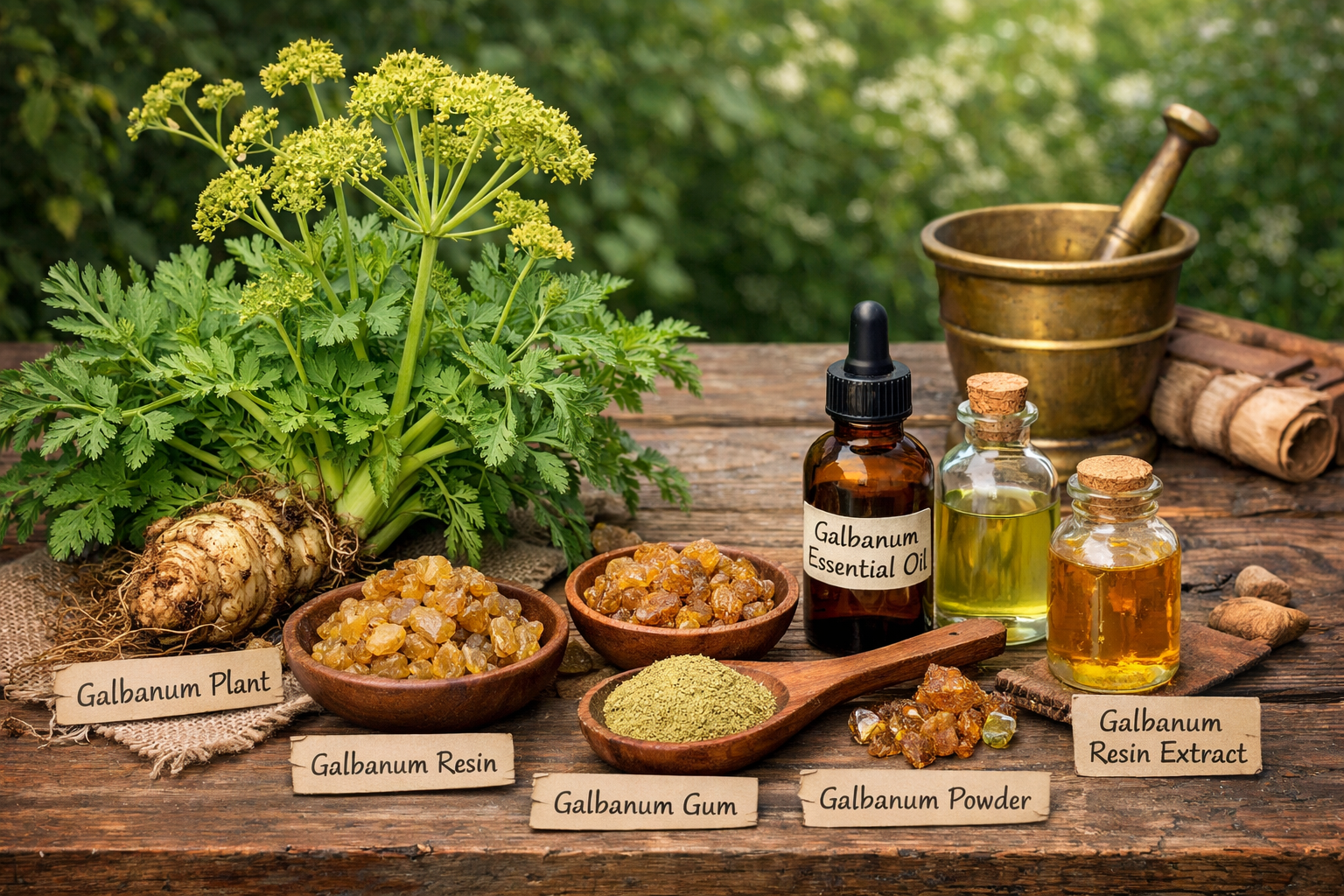
Here is a comprehensive technical guide for Galbanum, structured in the same format as the previous guides. All key information for flavorists has been incorporated.
Galbanum as a Natural Flavoring: A Comprehensive Technical Guide
The Society of Flavor Chemists requires certified flavorists to be able to identify the plant part used, derivatives, organoleptic characteristics, and major chemical component(s) characterizing the aroma and flavor of the 80 natural flavorings listed on its syllabus for the qualification test and interview. Galbanum is included among these essential items.
Introduction
Galbanum is a fragrant oleo-gum-resin obtained from the roots of several species of Ferula, a genus of perennial herbs in the Apiaceae (umbellifer) family, which also includes asafoetida, carrot, and fennel. Native to the Middle East and Central Asia (primarily Iran, Afghanistan, and Turkey), galbanum has been used since ancient times. It was one of the sacred incenses mentioned in the Bible and was highly prized by the Egyptians, Greeks, and Romans for its medicinal and aromatic properties.
For flavorists, galbanum offers a uniquely complex and powerful profile—green, fresh, piney, balsamic, and resinous with distinct galbanum-specific notes that are often described as leafy, earthy, and slightly peppery. Its aroma is reminiscent of green peppers, fresh-cut grass, and pine needles with a warm, balsamic undertone. It is a powerful modifier used to add a natural "green" character to citrus, herbal, and woody flavors, as well as to create authentic "forest floor" or "vegetal" notes in savory applications.
Galbanum is one of the few natural sources of pinene and other monoterpenes, but its unique character comes from a combination of sesquiterpenes and sulfur-containing compounds that give it its distinctive "green" and slightly "galbanum" note. It is used sparingly due to its high potency.
Plant Parts Used
The oleo-gum-resin is the plant exudate used for flavoring and fragrance purposes. The following characteristics are notable:
- Source Plants: Primarily Ferula galbaniflua Boiss. & Buhse (syn. Ferula gummosa Boiss.), and Ferula rubricaulis Boiss. Other Ferula species may also be sources.
- Family: Apiaceae (umbellifer family).
- Plant Characteristics: Large perennial herbs with thick, fleshy taproots, native to Iran, Afghanistan, Turkey, and surrounding regions.
- Resin Description: The plant exudes a milky latex when the root is incised. This latex hardens upon exposure to air, forming a yellowish-brown to greenish-brown, semi-solid to solid oleo-gum-resin with a characteristic intense, green, balsamic, and slightly peppery aroma.
- Harvesting: The roots are incised, and the exuding latex is collected. The resin may be collected in the form of "tears" (higher quality) or as a mass (lower quality). The resin is then dried and processed.
- Composition: Galbanum is an oleo-gum-resin consisting of:
- Resin (40–60%): Alcohol-soluble terpenes and sesquiterpenes
- Gum (20–40%): Water-soluble polysaccharides
- Essential Oil (5–15%): Volatile monoterpenes and sesquiterpenes
The essential oil is obtained by steam distillation of the crude oleo-gum-resin. The resinoid is obtained by solvent extraction.
Derivatives
Galbanum is commercially available in several forms, with the essential oil and resinoid being the most important for flavorists.
Galbanum Essential Oil
Production Method: Steam distillation of the crude galbanum oleo-gum-resin.
Description: Colorless to pale yellow to pale green mobile liquid with a characteristic intensely fresh, green, piney, balsamic, and slightly peppery, leafy aroma. The oil is lighter and more volatile than the resinoid.
Technical Notes: Yield is typically 5–15% from the crude resin. The oil is dominated by α-pinene and β-pinene (60–90%), with significant amounts of limonene, myrcene, and other monoterpenes. The characteristic "galbanum" note comes from trace amounts of sesquiterpenes and sulfur-containing compounds.
Galbanum Resinoid
Production Method: Solvent extraction of the crude galbanum oleo-gum-resin, followed by concentration.
Description: Green to brown viscous liquid or semi-solid with a richer, more balsamic, more tenacious aroma than the essential oil. Contains both volatile and non-volatile components.
Technical Notes: The resinoid has a darker color and a more complex, resinous character. It is used in fragrance and some flavor applications for its tenacity.
Galbanum Absolute
Production Method: Further processing of the resinoid to remove waxes and other insoluble materials, typically by alcohol extraction.
Description: Green to amber viscous liquid with a very intense, complex, green, balsamic aroma.
Galbanum Oleoresin
Production Method: Solvent extraction of the crude resin.
Description: Similar to resinoid; a concentrated, resinous material.
Organoleptic Characteristics
Aroma Profile
When evaluated, galbanum oil reveals a powerful, fresh, and intensely green aromatic profile:
- Primary Note: Intensely fresh, green, balsamic, piney
- Green: Leafy, grassy, reminiscent of fresh-cut grass, green pepper, and crushed leaves
- Piney: Fresh, resinous, forest-like (from α-pinene and β-pinene)
- Balsamic: Warm, resinous, amber-like
- Galbanum-Specific: Distinctive, unique "galbanum" note that is difficult to describe—earthy, slightly spicy, and peppery
- Woody: Cedar-like, dry undertones
- Herbaceous: Slightly, with hints of chamomile or sage
- Spicy: Subtle, peppery, and warm
The overall aroma is often described as "intensely fresh, green, and piney with a unique balsamic, leafy, and slightly peppery character that is unmistakably galbanum."
Taste Characteristics
At typical flavor usage levels (parts per million), galbanum provides:
- Green: Fresh, leafy, vegetal character
- Piney: Resinous, forest-like notes
- Bitter: Pleasant, complex bitterness that adds depth
- Herbaceous: Savory, herb-like
- Balsamic: Warm, slightly sweet undertone
- Spicy: Subtle, peppery warmth
The Key to Galbanum's Unique Flavor
Galbanum's characteristic intensely green, piney, and balsamic flavor comes from a combination of monoterpenes (providing the fresh, piney top notes) and trace amounts of sesquiterpenes and sulfur compounds (providing the distinctive "galbanum" character):
Primary Components (by volume):
- α-Pinene (30–60%): A monoterpene hydrocarbon that provides fresh, pine, and woody notes
- β-Pinene (15–40%): A monoterpene hydrocarbon that provides fresh, woody, and pine-like notes
- Limonene (1–5%): Contributes fresh, citrus notes
- Myrcene (1–5%): Contributes fruity, balsamic notes
Character-Impact Components (trace amounts):
- Sesquiterpenes: Various sesquiterpenes (e.g., cadinene, muurolene) contribute to the balsamic, woody, and galbanum-specific character
- Sulfur-Containing Compounds: Trace amounts of sulfur compounds (similar to those in asafoetida) contribute to the distinctive "galbanum" note—the slightly pungent, "green" character
- Cadinene: Contributes woody, spicy notes
- β-Caryophyllene: Contributes woody, spicy notes
The combination of high pinene content (fresh, piney) with trace sulfur compounds and sesquiterpenes creates the unique galbanum profile that is both fresh and balsamic, green and resinous.
Major Chemical Components
Key Aroma Compounds (Galbanum Essential Oil)
| Component | Typical Percentage | Organoleptic Contribution | CAS No. |
|---|---|---|---|
| α-Pinene | 30–60% | Fresh, pine, woody | 80-56-8 |
| β-Pinene | 15–40% | Fresh, woody, pine-like | 127-91-3 |
| Limonene | 1–5% | Fresh, citrus | 138-86-3 |
| Myrcene | 1–5% | Fruity, balsamic | 123-35-3 |
| Cadinene | 1–5% | Woody, spicy, balsamic | 483-76-1 |
| β-Caryophyllene | 1–5% | Woody, spicy | 87-44-5 |
| Camphene | trace–2% | Camphoraceous, woody | 79-92-5 |
| Sabinene | trace–1% | Fresh, woody, spicy | 3387-41-5 |
| Terpinen-4-ol | trace–1% | Spicy, earthy | 562-74-3 |
| Sulfur Compounds | trace | Distinctive galbanum "green" note | Various |
Comparison: Galbanum vs. Pine vs. Asafoetida
| Characteristic | Galbanum | Pine (e.g., Pinus sylvestris) | Asafoetida |
|---|---|---|---|
| Family | Apiaceae | Pinaceae | Apiaceae |
| Primary Components | α-Pinene, β-pinene (60–90%) | α-Pinene, β-pinene (60–90%) | Disulfides, pinene |
| Aroma Profile | Green, piney, balsamic, leafy, peppery | Fresh, pine, turpentine-like | Sulfurous, garlicky, pungent |
| Distinctive Note | Galbanum-specific "green" note | Pure pine | Sulfurous, alliaceous |
| Typical Use | Green modifier, citrus, herbal, woody | Pine flavor, cleaning products | Savory, garlic-onion substitute |
Applications in Flavoring
Regulatory Status
Galbanum and its derivatives are approved as natural flavoring substances:
- United States: Galbanum oil is listed under 21 CFR §172.510 as a natural flavoring substance (FEMA No. 2501 for oil, 2502 for resinoid).
- European Union: Permitted for use in food flavorings under Regulation (EC) No 1334/2008.
- China: Approved food flavor under GB 2760.
Typical Usage Levels (mg/kg)
Galbanum is used at very low levels due to its high potency. The following usage levels are based on FEMA GRAS determinations and industry standards:
| Application | Galbanum Oil (mg/kg) |
|---|---|
| Non-alcoholic beverages | 0.1–2 |
| Alcoholic beverages | 0.2–5 |
| Baked goods | 0.2–3 |
| Hard candy | 0.5–5 |
| Frozen dairy | 0.1–2 |
| Gelatins and puddings | 0.1–2 |
| Soft candy | 0.2–3 |
| Chewing gum | 0.5–5 |
| Savory systems (as modifier) | 0.1–2 |
| Citrus flavors (as modifier) | 0.1–1 |
Note: These ranges represent typical industry usage. Galbanum is extremely potent; begin at the lowest levels.
Usage & Dosage Best Practices
Flavorists should observe the following guidelines when working with galbanum:
Start Extremely Low: Galbanum is highly potent and can easily dominate a formulation. Begin at the lower end of typical usage ranges (e.g., 0.1–0.5 mg/kg in beverages) and titrate upward. Overuse can result in an overpowering, bitter, and "piney" character.
Use as a Modifier: Galbanum is rarely used as a primary flavor. It is most effective as a modifier to add a natural, fresh "green" character to citrus, herbal, woody, and some savory flavors.
Pre-Dilution Essential: Pre-dilute galbanum oil at a ratio of 1:10 or even 1:100 in ethanol or propylene glycol for easier handling and more even dispersion.
Flavor Synergies: Galbanum pairs exceptionally well with:
- Citrus: Bergamot, lemon, lime, grapefruit, orange (adds a fresh, green, natural complexity)
- Herbs: Rosemary, thyme, sage, lavender, basil (adds a balsamic, green depth)
- Woody notes: Cedarwood, pine, cypress (enhances the natural forest character)
- Green notes: Violet leaf, cucumber, green pepper, fresh grass (adds authenticity)
- Spices: Black pepper, cardamom, juniper (adds a green, spicy lift)
- Fruity notes: Berry, blackcurrant (adds a "leafy" or "bushy" character)
- Beverages: Gin, herbal liqueurs, vermouth (adds a complex, botanical character)
Flavor Applications: Galbanum serves as a flavor modifier in:
- Citrus flavors: Adds a natural "green" leaf and peel character to citrus profiles
- Gin and spirits: Contributes to complex botanical profiles
- Herbal teas: Adds a fresh, balsamic note
- Savory: Adds a green, vegetal depth to soups, sauces, and marinades
- Woody flavors: Enhances pine, cedar, and forest notes
- Confectionery: Used in some high-end, complex confections
Fragrance Applications
Galbanum is highly valued in perfumery for:
- Green fragrances: Provides an intensely fresh, green, leafy top note
- Chypre and fougère compositions: Adds complexity and naturalness
- Citrus colognes: Adds a green, balsamic lift
- Woody and forest fragrances: Enhances pine and balsamic notes
- Modern and natural perfumery: Used to create realistic "green" and "vegetal" accords
Blends well with: Bergamot, lemon, lavender, rosemary, pine, cedarwood, oakmoss, vetiver, patchouli.
Example Formula: Green Citrus Beverage Modifier
The following formula demonstrates the use of galbanum oil to add a fresh, natural "green" character to a citrus flavor system.
Green Citrus Beverage Flavor Concentrate
| Component | Percentage (%) | Function | Technical Note |
|---|---|---|---|
| Galbanum oil (1% pre-dilution) | 10.0 | Flavor modifier | Adds fresh, green, leafy complexity |
| Bergamot oil | 40.0 | Primary citrus | Floral-citrus top note |
| Lemon oil (cold-pressed) | 30.0 | Citrus brightness | Adds freshness |
| Lime oil (distilled) | 10.0 | Citrus note | Adds complexity |
| Rosemary oil | 5.0 | Herbal note | Adds green depth |
| Ethanol | 5.0 | Solvent | Food grade |
| Total | 100.0 |
Usage Instructions: Use at 0.05–0.2% in finished beverages. The galbanum adds a sophisticated, natural green character.
Alternative: Gin Botanical Flavor Modifier
| Component | Percentage (%) | Function |
|---|---|---|
| Galbanum oil (1% pre-dilution) | 15.0 | Green, balsamic complexity |
| Juniper berry oil | 40.0 | Primary gin note |
| Coriander oil | 15.0 | Citrusy, aromatic |
| Angelica root oil | 10.0 | Earthy, woody |
| Cardamom oil | 10.0 | Floral, spicy |
| Lemon oil | 10.0 | Citrus brightness |
| Total | 100.0 |
Usage Instructions: Use at 0.05–0.15% in finished gin or gin-flavored beverages.
Alternative: Galbanum Oil Pre-Dilution for Lab Use
| Component | Percentage (%) | Function |
|---|---|---|
| Ethanol (190 proof) | 90.0 | Solvent |
| Galbanum oil | 10.0 | Active ingredient |
Method: Mix thoroughly. For a more dilute working solution, further dilute 1:10. Store in amber glass bottles. Use 0.1–1.0% in flavor formulations for easy handling and precise dosing.
Shelf Stability & Storage
Understanding the stability of galbanum oil is critical for maintaining flavor quality.
Essential Oil
Storage Recommendation: Store in a full, airtight container in a cool, dry place away from light. Refrigeration is strongly recommended for long-term storage.
Stability Notes: Galbanum oil contains high levels of monoterpenes (α-pinene, β-pinene, limonene), which are highly susceptible to oxidation. Oxidation produces off-notes (turpentine-like, piney) and can polymerize the oil. The trace sulfur compounds are also reactive. Shelf life is typically 12–24 months when properly stored.
Resinoid
Storage Recommendation: Store in airtight containers in a cool, dry place away from light.
Stability Notes: The resinoid is more stable than the essential oil due to the presence of natural antioxidants and the absence of the most volatile monoterpenes. Shelf life is typically 24–36 months.
Stability in Finished Products
- Heat stability: Monoterpenes are heat-sensitive and may volatilize or degrade during high-temperature processing.
- pH stability: Monoterpenes are susceptible to acid-catalyzed rearrangements; best in neutral to slightly acidic conditions.
- Oxidation: Highly susceptible to oxidation; use antioxidants for long-shelf-life products.
- Light sensitivity: Protect from light.
Safety Considerations
General Safety
Galbanum oil is generally recognized as safe (GRAS) for use as a flavoring at approved levels (FEMA 2501, 2502). However, it has significant safety considerations due to its potency.
Important Considerations
- Skin Sensitization: Galbanum oil contains high levels of pinene and other monoterpenes, which can cause skin sensitization and irritation, particularly when oxidized. It is subject to IFRA restrictions for fragrance use.
- Mucous Membrane Irritation: Can cause mild to moderate irritation to mucous membranes.
- Allergies: As a member of the Apiaceae family, cross-reactivity with other members (carrot, celery, asafoetida) is possible.
- Pregnancy: Safe in food amounts; concentrated essential oil should be used with caution during pregnancy.
- Potency: Extremely potent; use only at very low levels.
Maximum Usage Levels (IFRA)
For fragrance applications, galbanum oil is subject to IFRA restrictions. Flavorists developing products for topical applications should consult current IFRA standards.
Skin Safety
- Essential oil: May cause sensitization; dilute properly for topical applications.
- Protective measures: Wear suitable gloves when handling concentrated essential oil.
Quality Control & Sourcing
Flavorists should implement the following quality checks when sourcing galbanum ingredients.
Essential Requirements for Certificates of Analysis (COA)
For Galbanum Essential Oil:
- Botanical identity: Ferula galbaniflua Boiss. & Buhse (or Ferula gummosa)
- Origin: Iran, Afghanistan, Turkey
- α-Pinene content: 30–60% (GC analysis)
- β-Pinene content: 15–40%
- Physical properties: Specific gravity (0.860–0.900), refractive index (1.470–1.485)
For Galbanum Resinoid:
- Botanical identity: Ferula galbaniflua
- Physical appearance: Green to brown viscous liquid
- Aroma: Characteristic fresh, green, balsamic
Common Adulteration Risks
- Essential oil: Dilution with synthetic pinene; extension with less expensive pine oils; mislabeling of origin
- Resinoid: Dilution with other resins or carriers
Sourcing Considerations
| Origin | Characteristics |
|---|---|
| Iran | Traditional origin; highest quality; complex, well-balanced profile |
| Afghanistan | Good quality; similar profile |
| Turkey | Good quality; European origin |
Traditional and Historical Applications
Historical Uses
- Ancient Egypt: Used in embalming rituals and as an incense.
- Biblical: Mentioned in the Bible as one of the sacred incenses.
- Ancient Greece and Rome: Used in perfumery and medicine.
- Traditional Medicine: Used as an expectorant, antispasmodic, and for treating respiratory ailments.
Modern Applications
- Perfumery: A classic green note in chypre and fougère fragrances.
- Flavoring: Used as a green modifier in citrus, herbal, and some savory flavors.
- Aromatherapy: Used for its grounding and balancing properties.
Summary
Galbanum is a unique and powerful natural flavoring material prized for its intensely fresh, green, piney, and balsamic character. Its essential oil is dominated by α-pinene (30–60%) and β-pinene (15–40%) , but its distinctive "galbanum" note comes from trace amounts of sesquiterpenes and sulfur-containing compounds.
Key characteristics:
- Primary components: α-Pinene (30–60%), β-pinene (15–40%)
- Aroma profile: Fresh, green, piney, balsamic, leafy, slightly peppery
- Typical usage: 0.1–5 mg/kg (used at very low levels as a modifier)
- Primary applications: Green modifier for citrus, gin, herbal flavors, and savory systems
Critical considerations for flavorists:
- Extreme potency: Use at very low levels (0.1–2 mg/kg); start low and titrate.
- Use as a modifier: Best used to add a natural, fresh, green character to citrus, herbal, and woody flavors.
- Pre-dilution essential: Pre-dilute 1:10 or 1:100 before use.
- Flavor synergies: Pairs with bergamot, lemon, rosemary, gin botanicals.
- Stability: Monoterpenes are highly susceptible to oxidation; store properly.
- Sourcing: Iranian galbanum is traditionally considered the highest quality.
References and Further Reading
The information presented in this guide is synthesized from:
- Regulatory documents from FDA, FEMA (Nos. 2501, 2502), and international food safety authorities.
- Published scientific literature on Ferula galbaniflua.
- Standard textbooks on natural flavoring materials.
- Industry technical data from major suppliers.
- Historical texts documenting galbanum's use in perfumery and incense.
Key References:
- FEMA Flavor Ingredient Library: Galbanum Oil (FEMA 2501), Galbanum Resinoid (FEMA 2502)
- Journal of Essential Oil Research: Galbanum oil composition studies
- TGSC Information System: Galbanum Oil
Disclaimer: This article is for educational/training purposes only. When using galbanum in commercial products, always verify current regulatory status in your jurisdiction, conduct appropriate safety assessments, and source ingredients from reputable suppliers who can provide documentation of botanical identity, origin, and quality. Galbanum is extremely potent; use at very low levels and pre-dilute before incorporating into formulations. The formulas and usage levels provided are illustrative examples and may require adjustment based on specific product requirements and regulatory compliance.
###