Important Synthetic Flavor Chemists - Part 11 (γ-decalactone,γ-dodecalactone, exaltolide, ambrettolide, 5-methylfurfural, 2-acetylfurfural, theaspirane, 2-methyl tetrahydro furan-3-one, furfuryl mercaptan, 2-methyl 3-tetrahydrofuran thiol)
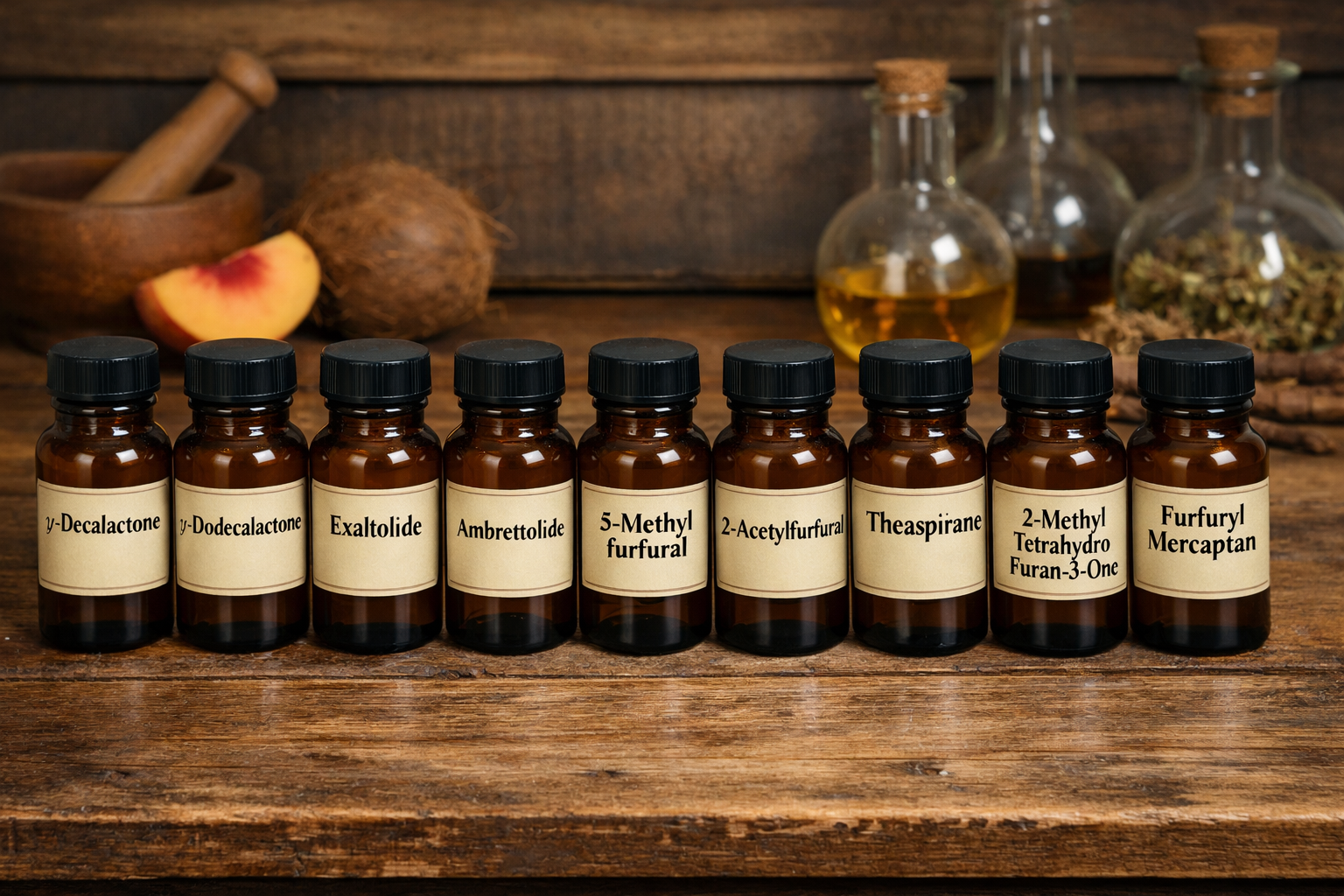
Part 11 (γ-decalactone, γ-dodecalactone, 1,15-pentadecalactone or exaltolide, ambrettolide, 5-methylfurfural, 2-acetylfurfural, theaspirane, 2-methyl tetrahydro furan-3-one, 2-furan methane thiol or furfuryl mercaptan, 2-methyl 3-tetrahydrofuran thiol)
These are among the 128 synthetic flavor compounds that John Wright, in his book Flavor Creation, suggests every flavorist should know and work with.
γ-Decalactone
- FEMA Number: 2360
- Flavor Note(s): Intensely fruity, soft, and velvety, evoking peach aromas with a creamy, indulgent touch .
- Compounds That Render Similar Flavor Note: gamma-Undecalactone (peach, more intense), gamma-Dodecalactone (heavier, more fatty-taste), and delta-Decalactone (creamy, peach, but different balance).
- Compounds Often Used Together With: Essential in peach flavors. Often used with gamma-dodecalactone and delta-decalactone to add extra taste dimension and authenticity .
- All Potential Applications: Fruity, dairy, and pastry profiles. Particularly used in peach, apricot, strawberry, raspberry, blackberry, and blueberry flavors .
- General Usage Levels: In flavor concentrates intended for use at 0.05% in a finished product, levels can be high (e.g., 2500 ppm for peach). In finished products, levels are typically in the low ppm range.
- Important Considerations for Flavorists: Ennolys produces a 100% natural version through fermentation, compliant with EU and FDA regulations. Kosher, Halal, and Non-GMO certified. Minimum purity of 99% with a shelf life of 3 years. Store in a cool, dry place . FEMA GRAS.
γ-Dodecalactone
- FEMA Number: 2400
- Flavor Note(s): Fatty, waxy, sweet, peachy, creamy, with a green-rind undertone. It has a fatty peach, sweet, and slightly metallic fruity odor .
- Compounds That Render Similar Flavor Note: gamma-Decalactone (more aromatic peach), gamma-Undecalactone (peach, but more aromatic), and delta-Dodecalactone (butter, more creamy).
- Compounds Often Used Together With: Used with gamma-decalactone in peach and other fruit flavors to gain an extra taste dimension and realism .
- All Potential Applications: Peach, apricot, and other stone fruit flavors, as well as in some dairy and creamy flavor applications where a fatty, lingering note is desired .
- General Usage Levels: Used at low levels, often in conjunction with gamma-decalactone. In flavor concentrates, levels are typically a fraction of the gamma-decalactone level.
- Important Considerations for Flavorists: Appears as a colorless to pale yellow clear oily liquid with a melting point of 17-18°C. Assay 97-100%. Flash point >230°F TCC. Store in a cool, dry place in tightly sealed containers, protected from heat and light. Shelf life of 12 months or longer if stored properly . FEMA GRAS.
1,15-Pentadecalactone (Exaltolide)
- FEMA Number: 2840
- Flavor Note(s): Musk, animal, powdery, natural, fruity. Also has notes of tobacco, coumarin, heliotropine, licorice, and brown . The flavor is described as vanilla, powdery, heliotrope, creamy, and licorice .
- Compounds That Render Similar Flavor Note: Ambrettolide (musk, fruity), ethylene brassylate (musk), and other macrocyclic musk lactones.
- Compounds Often Used Together With: Used with other musk compounds, vanillin, heliotropine, and coumarin-like materials in creamy, powdery, and musky flavor and fragrance complexes.
- All Potential Applications: Vanilla, creamy, powdery, and licorice flavors. Also used extensively in fragrances for its musk character .
- General Usage Levels: High odor strength, recommend smelling in a 10.00% solution or less . Substantivity is 400 hours at 10.00% in dipropylene glycol.
- Important Considerations for Flavorists: Appears as a colorless solid with a melting point of 34-38°C. Flash point >220°F TCC. Soluble in alcohol and dipropylene glycol. logP (o/w) is 6.1. Occurs naturally in angelica root and seed oil . FEMA GRAS.
Ambrettolide
- FEMA Number: 2555
- Flavor Note(s): Musk, fruity, sweet. It is a macrocyclic musk lactone with a soft, tenacious, and elegant musk aroma with fruity undertones.
- Compounds That Render Similar Flavor Note: 1,15-Pentadecalactone (musk, animalic), ethylene brassylate (musk), and other macrocyclic musk lactones.
- Compounds Often Used Together With: Used with other musk compounds and fruity notes in complex flavor and fragrance compositions.
- All Potential Applications: Synthetic food flavor, limited to this functional purpose . Used in specific food categories as permitted by regulations.
- General Usage Levels: Subject to specific maximum content limits in food (g/kg) depending on the food category, as per NHC regulations in China .
- Important Considerations for Flavorists: In China, it is regulated as a synthetic food flavor and can only be used for that functional purpose, with specific applicable food categories and maximum content limits as per NHC regulations . It may have food label warning requirements for specific uses . FEMA GRAS.
5-Methylfurfural
- FEMA Number: 2702
- Flavor Note(s): Soft caramel, sweet, brown, with much less of the harsh benzaldehyde secondary character than furfural .
- Compounds That Render Similar Flavor Note: Furfural (more harsh, bitter almond-like), 5-(hydroxymethyl)furfural (softer, honey-like, but less stable).
- Compounds Often Used Together With: Used in a wide range of brown flavors including caramel, coffee, chocolate, brown sugar, malt, bread, black tea, maple syrup, vanilla bean, and honey .
- All Potential Applications: Caramel (2000 ppm), coffee (2000 ppm), chocolate and cocoa (1500 ppm), brown sugar (1500 ppm), malt and malted milk (1500 ppm), bread (1000 ppm), black tea (500 ppm), maple syrup (300 ppm), vanilla bean (200 ppm), and honey flavors .
- General Usage Levels: Dose rates are suggested for flavors intended to be dosed at 0.05% in ready-to-drink beverages or simple bouillons. Levels vary by application from 200 ppm in vanilla bean to 2000 ppm in caramel and coffee flavor concentrates .
- Important Considerations for Flavorists: Makes the best contribution to the caramel underpinnings of flavors derived from heated sugars . Preferable to furfural in most applications due to its softer character. FEMA GRAS.
2-Acetylfurfural
- Note: Search results provided information for 2-Acetylfuran (FEMA 3163), not 2-Acetylfurfural. Flavorists should verify the correct compound and its FEMA number. The information below is for 2-Acetylfuran as a reference.
- FEMA Number: 3163 (for 2-Acetylfuran)
- Flavor Note(s): Sweet, almond, nutty, roasted, smoky .
- Compounds That Render Similar Flavor Note: Furfural (caramel, almond), 5-methylfurfural (soft caramel), and other furan derivatives with roasted notes.
- Compounds Often Used Together With: Used with other nutty, roasted, and caramelic compounds in nut, coffee, and baked good flavors.
- All Potential Applications: Nut, coffee, and baked good flavors where roasted and smoky notes are desired.
- General Usage Levels: In the final flavored food, the suggested concentration is about 20 mg/kg .
- Important Considerations for Flavorists: Appears as a light yellow liquid or crystal with a melting point of 29-30°C. Insoluble in water, soluble in organic solvents such as ethanol . In China, GB 2760-1996 approves it as a permitted food spice . FEMA GRAS.
Theaspirane
- FEMA Number: 3774
- Flavor Note(s): Tea, herbal, green, wet, tobacco, leafy, metallic, woody, spicy. Also has cooling, minty, and camphoreous notes . Flavor is cooling, minty, camphoreous, herbal, and pine .
- Compounds That Render Similar Flavor Note: Other tea constituents like linalool oxides, ionones, and damascenone.
- Compounds Often Used Together With: Used with other tea flavor constituents (ionones, damascenone, linalool oxides) in tea, berry, and fruit flavor complexes.
- All Potential Applications: Tea flavors (especially black tea), berry flavors (raspberry, blackberry), grape, guava, and passion fruit .
- General Usage Levels: High odor strength, recommend smelling in a 1.00% solution or less . Substantivity is 47 hours at 100.00%.
- Important Considerations for Flavorists: Appears as a colorless clear liquid with a flash point of 149°F TCC. Soluble in alcohol. logP (o/w) is 4.057. Occurs naturally in blackberry, grape, guava, passion fruit, raspberry, and tea leaf . FEMA GRAS.
2-Methyl Tetrahydrofuran-3-One
- FEMA Number: 3373
- Flavor Note(s): Pleasant, agreeable, caramel, roast burnt odor .
- Compounds That Render Similar Flavor Note: Furaneol (caramel, strawberry), 2-ethyl-4-hydroxy-5-methyl-3(2H)-furanone (caramel, burnt sugar), and other furanones.
- Compounds Often Used Together With: Used with other caramelic and roast compounds in coffee, nut, and brown flavor complexes.
- All Potential Applications: Caramel, coffee, nut, and other brown flavors where a roasted, burnt sugar note is desired.
- General Usage Levels: Used at low to moderate levels, typically requiring careful balancing due to its potent roast character.
- Important Considerations for Flavorists: Appears as a colorless to pale yellow liquid with a flash point of 38°C (cc). Slightly soluble in water, soluble in most organic solvents. Boiling point is 138-139°C at 1013 mbar . FEMA GRAS.
2-Furan Methane Thiol (Furfuryl Mercaptan)
- FEMA Number: 2493
- Flavor Note(s): Sulfurous, roasted coffee, meaty, burnt. It is a key character impact compound for roasted coffee aroma.
- Compounds That Render Similar Flavor Note: 2-Methyl-3-tetrahydrofuran thiol (meaty, roast beef), methyl furfuryl disulfide (coffee, meaty), and other sulfur-containing furans.
- Compounds Often Used Together With: Used with other sulfur compounds, pyrazines, and thiazoles in coffee, meat, and savory flavor complexes.
- All Potential Applications: Coffee, meat (beef, chicken), savory flavors, and roasted notes for various food applications .
- General Usage Levels: Extremely potent. Used at very low levels, typically in the parts per billion (ppb) range in finished products.
- Important Considerations for Flavorists: Extremely potent sulfur compound with an intense odor that can cause olfactory fatigue. Must be handled with extreme care, almost always as a diluted solution. Flash point information not available in search results. FEMA GRAS Publication No(s): 3, 25. JECFA Flavor Number: 1072 .
2-Methyl-3-Tetrahydrofuran Thiol
- FEMA Number: 3787
- Flavor Note(s): Roasted, crusted beef and chicken, meaty, pot roast, sulfurous and mildly alliaceous (onion and garlic) . Taste is roast beef, meaty, brothy savory chicken and turkey, fatty alliaceous onion and garlic .
- Compounds That Render Similar Flavor Note: Furfuryl mercaptan (coffee, meaty), 2-methyl-3-furanthiol (meaty, more intense), and other tetrahydrofuran thiols.
- Compounds Often Used Together With: Used with other meaty sulfur compounds, pyrazines, and thiazoles in beef, chicken, turkey, and savory flavor complexes.
- All Potential Applications: Beef, chicken, turkey, pot roast, and other meaty and savory flavors where a roasted, crusted meat character is desired .
- General Usage Levels: Extremely potent. Used at very low levels, typically in the parts per billion (ppb) range in finished products.
- Important Considerations for Flavorists: Appears as a colorless to pale yellow clear liquid with a flash point of 124°F TCC. Assay 97-100% sum of isomers. Insoluble in water, soluble in most organic solvents. logP (o/w) is 0.62 . FEMA GRAS. d
###