Gas Chromatography, GC-Olfactometry, and FID: An SFC Exam Study Guide for Flavorists
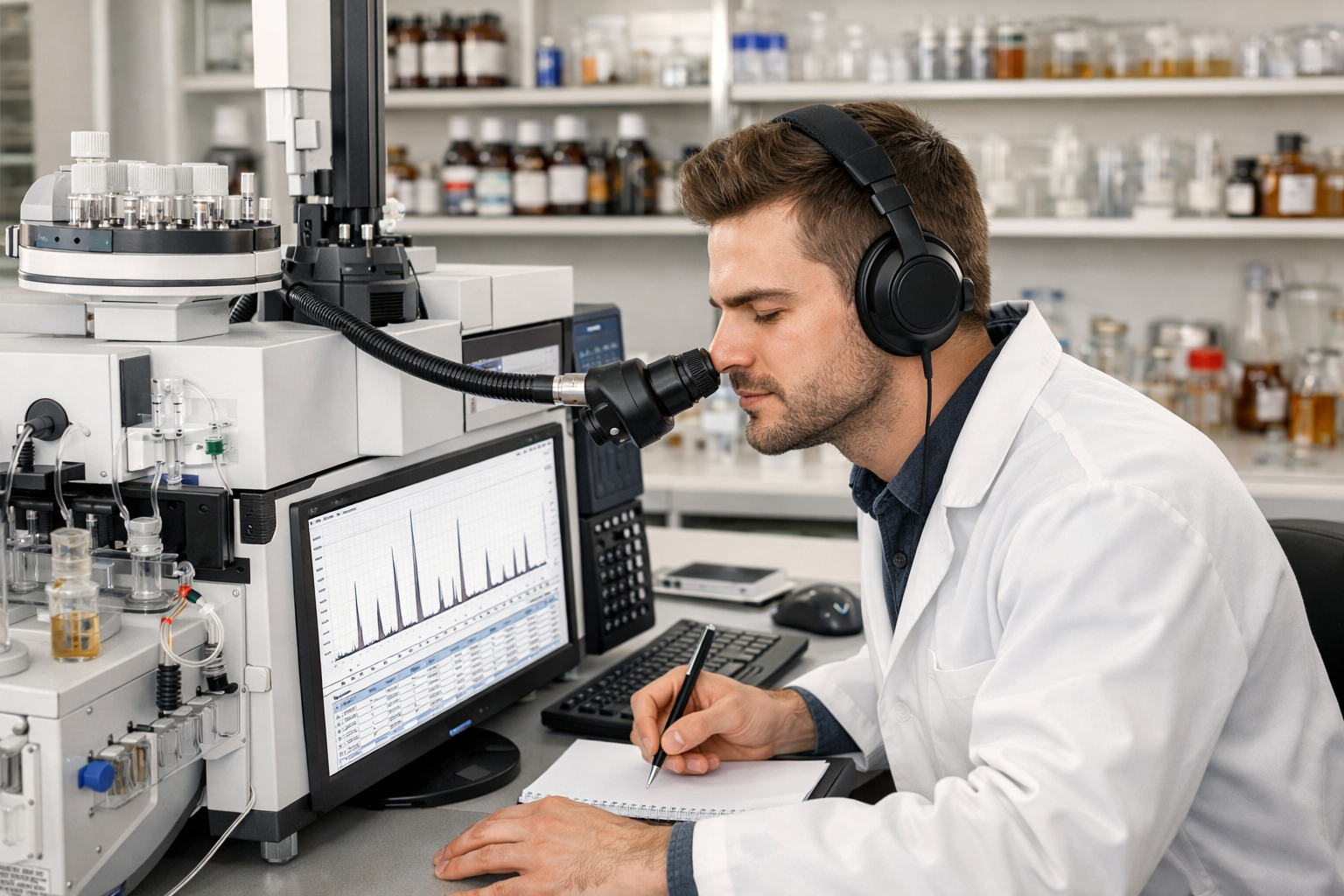
The Society of Flavor Chemists expects certified flavorists to understand the theory, function, reporting, relevance to the flavor industry, and advantages and limitations of more than a dozen instruments used to analyze food and flavor products. These instruments are listed on the syllabus for the Society’s qualification exam. Among them are Gas Chromatography (GC), GC-Olfactometry (GC-O), and the Flame Ionization Detector (FID).
Below is a beginner-friendly but fairly complete guide to Gas Chromatography (GC), GC-Olfactometry (GC-O), and the Flame Ionization Detector (FID), with emphasis on how flavorists actually use them.
1. Why flavorists care about these tools
A flavor is almost never one chemical. It is usually a mixture of many volatile compounds, often at very different concentrations. Some compounds may be present at high levels but contribute little to aroma, while others may be present at trace levels and dominate the smell.
That creates three big questions:
- What compounds are present?
- How much of each is there?
- Which ones actually matter to the aroma?
GC, GC-O, and FID help answer those questions, but each does a different job.
- GC separates volatile compounds.
- GC-O combines GC with the human nose to identify which separated compounds are actually odor-active.
- FID is one common detector attached to GC; it measures organic compounds very well and is widely used for quantitation.
A simple way to think about them:
- GC = the separation engine
- GC-O = the aroma relevance tool
- FID = the quantitative hydrocarbon-sensitive detector
2. Gas Chromatography (GC)
What GC is
Gas chromatography is an analytical technique used to separate volatile and semi-volatile compounds in a mixture. In flavor work, it is one of the most important tools for analyzing aroma chemicals, essential oils, extracts, reaction flavors, fermented notes, and finished flavor systems.
The sample is vaporized and carried by an inert gas through a long column coated with a stationary phase. Different compounds travel through the column at different speeds, so they come out at different times. That is how they become separated.
Theory of GC
GC works because compounds distribute themselves differently between two phases:
- the mobile phase, which is the carrier gas
- the stationary phase, which is the coating inside the column
As a compound moves through the column, it repeatedly partitions between:
- being in the gas phase and moving forward
- interacting with the stationary phase and being temporarily retained
A compound that interacts only weakly with the stationary phase moves faster and elutes earlier.
A compound that interacts more strongly stays longer and elutes later.
Main scientific basis
Separation depends mainly on:
- Volatility
- More volatile compounds tend to move faster.
- Polarity
- Polar compounds interact more strongly with polar stationary phases.
- Nonpolar compounds interact more strongly with nonpolar stationary phases.
- Molecular structure
- Size, shape, branching, unsaturation, and functional groups affect retention.
- Column temperature
- Higher temperature reduces retention and speeds elution.
Retention time
Each compound comes off the column at a characteristic time under fixed conditions. This is called the retention time.
Important: retention time alone does not prove identity. It is useful, but not absolute. Two different compounds can sometimes elute at similar times.
Peak formation
When a compound exits the column, it produces a signal called a peak in the chromatogram. The chromatogram is the detector signal plotted versus time.
Each peak has:
- a retention time, which helps indicate what it may be
- an area, which is often related to amount
- a shape, which gives clues about column performance or sample issues
Function of GC
The main function of GC is separation.
In flavor work, that means GC helps you:
- separate dozens or hundreds of volatile compounds from one sample
- simplify a complex aroma mixture into individual peaks
- prepare the compounds for detection by FID, MS, or human sniffing in GC-O
GC by itself is not really a complete “identifier.” It is the separation platform to which detectors are attached.
Major parts of a GC system
A beginner should know these components:
1. Carrier gas
Usually helium, hydrogen, or nitrogen.
Its job is to carry the sample through the column.
2. Injector
This is where the sample enters the instrument.
Common injection modes:
- split injection: only part of the sample enters the column; useful for concentrated samples
- splitless injection: more sample enters the column; useful for trace analysis
- on-column injection: gentler, useful for thermally sensitive compounds
- headspace or SPME introduction: common in flavor work for volatile analysis
3. Column
The heart of the GC.
Capillary columns are most common in flavor work.
Columns vary by:
- length
- internal diameter
- film thickness
- stationary phase polarity
Common idea:
- nonpolar columns separate largely by boiling point and hydrophobic interactions
- polar columns help separate alcohols, aldehydes, esters, acids, and oxygenated flavor compounds better
4. Oven
Controls column temperature.
Often uses a temperature program, meaning it starts low and gradually increases. This helps separate both low-boiling and high-boiling compounds in one run.
5. Detector
The detector measures compounds as they leave the column.
Examples:
- FID
- MS
- thermal conductivity detector
- electron capture detector
In this prompt, the detector of interest is FID.
Reporting of GC results
When GC results are reported, they are usually presented as a chromatogram plus supporting data.
Typical items in a GC report:
1. Chromatogram
A plot of signal versus time showing the peaks.
2. Retention times
Reported for each peak.
3. Peak areas or area percentages
Used to estimate relative or absolute amounts.
4. Tentative or confirmed identities
These may be based on:
- retention times versus standards
- retention indices
- co-injection with authentic standards
- detector-specific data
- GC-MS confirmation
5. Method conditions
Very important for reproducibility:
- column type
- oven program
- injector temperature
- detector type
- carrier gas flow
- split ratio
- sample preparation
6. Quantitation details
If quantitative analysis was done, reporting may include:
- calibration curve
- internal standard
- external standard
- response factor
- concentration units such as ppm, mg/kg, or mg/L
7. Replicates and variability
Good reports may include:
- replicate injections
- standard deviations
- detection limits
- method precision
Relevance of GC to the flavor industry
GC is foundational in flavor science because most aroma-active compounds are volatile enough to be analyzed by it.
Major uses in the flavor industry
1. Raw material characterization
GC helps profile:
- essential oils
- extracts
- distillates
- oleoresins
- fermentation products
- reaction flavors
Example: comparing two orange oils to see whether their terpene and oxygenated fractions differ.
2. Quality control
GC can check whether a flavor or raw material matches a reference standard.
Example:
- Is this vanilla flavor batch consistent with the previous lot?
- Is the lemon oil oxidized?
- Did the supplier substitute or adulterate a raw material?
3. Troubleshooting off-notes
GC helps detect:
- oxidation products
- solvent residues
- contamination
- degradation compounds
- packaging-derived volatiles
4. Product development
GC supports formulation by showing which volatiles are present before and after:
- heating
- pasteurization
- drying
- fermentation
- storage
- encapsulation
5. Stability studies
Flavorists use GC to track changes over time:
- loss of top notes
- growth of aldehydes from oxidation
- hydrolysis-related changes
- interactions with product matrix
6. Authenticity and adulteration screening
Some profiles are characteristic of natural materials. GC can help detect unusual composition patterns suggesting dilution, substitution, or synthetic addition.
7. Competitive benchmarking
Companies analyze competitor products to understand their volatile composition.
Advantages of GC
- Excellent separation for volatile compounds
- High sensitivity when paired with good detectors
- Good reproducibility
- Works well for complex mixtures
- Large established knowledge base in flavor chemistry
- Can be linked to many detectors, including FID and MS
- Very useful for QC and development
Limitations of GC
- Only works well for compounds that are volatile enough and thermally stable enough
- Nonvolatile compounds are generally not suitable without derivatization or other methods
- Thermal degradation can occur in injector or column
- Co-elution can happen in complex samples
- Retention time alone is not definitive identification
- Instrument conditions strongly affect results
- A large peak does not necessarily mean strong sensory importance
That last point matters a lot in flavor work: GC tells you what separates and how much detector signal you get, but not automatically what the nose cares about most.
3. GC-Olfactometry (GC-O)
What GC-O is
GC-O, or gas chromatography-olfactometry, is GC with a human assessor smelling the compounds as they elute from the column.
After separation by GC, the column effluent is split:
- one part goes to an instrumental detector
- the other part goes to a sniffing port
At the sniffing port, a trained human evaluator smells each eluting compound and records:
- when it appears
- how strong it smells
- what it smells like
This is one of the most important tools in flavor science because aroma is not only chemistry. It is also sensory perception.
Theory of GC-O
The theory behind GC-O is simple but powerful:
A normal GC detector measures chemical signal.
A human nose measures odor perception.
Not every chromatographic peak matters to aroma.
Some large peaks may have weak or no smell.
Some tiny peaks may have enormous aroma impact because they have very low odor thresholds.
GC-O bridges chemistry and perception by asking:
Which separated compounds are actually odor-active?
Why GC-O is necessary
In aroma systems:
- concentration is not the same as sensory importance
- detector response is not the same as odor strength
- odor threshold varies enormously between compounds
For example, one sulfur compound at trace level may smell far stronger than a much larger ester peak.
GC-O therefore helps identify character impact compounds, key odorants, and off-note drivers.
Function of GC-O
The main function of GC-O is to connect separated GC peaks with human odor observations.
It helps answer:
- Which compounds are responsible for the smell?
- Which peaks are aroma-active?
- Which compounds create freshness, roast, sulfur, citrus, floral, green, or stale notes?
- Which trace compounds cause an off-note?
- Which peaks matter in a finished application, not just in the neat flavor?
How GC-O works in practice
A sample is introduced into the GC.
The GC separates the volatiles.
At the end of the column, the effluent is split:
- part to a detector such as FID or MS
- part to an olfactory port with humidified air and comfortable temperature
The assessor smells the eluting compounds and records:
- odor event time
- descriptor
- intensity
- duration
The sniffing port needs to be designed so the assessor can smell comfortably without excessive dryness or fatigue.
Reporting of GC-O results
GC-O reports are usually more descriptive than standard detector-based GC reports because they include human sensory data.
Typical items include:
1. Odor event retention time
When the assessor noticed an odor.
2. Odor descriptor
Examples:
- green
- caramel
- burnt sugar
- nutty
- onion
- sweaty
- citrus peel
- floral
- earthy
3. Perceived intensity
Could be reported as:
- weak / medium / strong
- numerical intensity scale
- time-intensity scoring
4. Duration
How long the odor event lasted.
5. Frequency of detection across panelists
If multiple assessors are used, a report may show how many people detected that odor event.
6. Aroma extract dilution analysis or similar ranking systems
Some GC-O methods rank odorants by apparent potency through dilution approaches.
Examples include:
- detection frequency methods
- charm analysis
- AEDA-type approaches
A beginner does not need to master all of those at once. The key idea is that GC-O can estimate relative sensory importance of separated odorants.
7. Correlation with chromatographic peaks
The odor event is linked back to peaks in the detector trace and then, ideally, to identified compounds.
Relevance of GC-O to the flavor industry
GC-O is extremely important because flavor creation is sensory by nature.
Major uses in flavor work
1. Identifying key aroma contributors
GC-O can reveal the few odorants truly responsible for a flavor profile.
Example:
A strawberry aroma may contain many esters, but only certain compounds may drive the authentic fresh note.
2. Finding off-notes
GC-O is very effective for identifying trace odorants responsible for:
- cardboard
- metallic
- rubbery
- burnt
- sulfurous
- oxidized
- musty
- medicinal notes
3. Understanding processing effects
Heating, fermentation, drying, roasting, and storage can create or destroy important odorants. GC-O helps determine which sensory changes correspond to which compounds.
4. Reverse engineering and benchmarking
A flavorist can analyze a competitor product and identify not just its composition, but which peaks actually matter to the aroma.
5. Improving formulation efficiency
Instead of chasing every detected compound, the flavorist can focus on the odor-active compounds.
6. Matrix effect studies
GC-O can help compare headspace extracts from different applications to understand how beverage, dairy, confection, or savory matrices change aroma release.
Advantages of GC-O
- Directly links chemistry with smell
- Helps identify character impact compounds
- Detects aroma-relevant trace compounds that detectors may underemphasize
- Excellent for off-note diagnosis
- Helps prioritize important compounds in complex mixtures
- Very valuable in flavor creation, matching, and troubleshooting
Limitations of GC-O
- Human assessors fatigue quickly
- Results can vary from person to person
- Training is needed to get reliable odor descriptions
- Sniffing is subjective
- Not ideal for long continuous runs without breaks
- Weak odors may be missed if the assessor is tired or adapted
- Quantitation is less objective than detector-based analysis
- Co-elution can complicate odor interpretation
- Some compounds may be smelled as mixed events if separation is incomplete
A major beginner lesson:
GC-O is powerful, but it is not fully objective. It is best used together with instrumental data and authentic standards.
4. Flame Ionization Detector (FID)
What FID is
The Flame Ionization Detector is one of the most common detectors used in GC. It is especially useful for organic compounds containing carbon-hydrogen bonds.
As compounds leave the GC column, they enter a hydrogen-air flame. In that flame, they are ionized, producing charged particles. The detector measures the resulting electrical current. That current is proportional, roughly, to the amount of carbon being burned.
Theory of FID
The FID works by burning the eluting organic compounds in a small flame fueled by hydrogen and air.
During combustion, many organic molecules form ions and electrons. These charged species create an electrical current between electrodes. The detector measures this current.
Core principle
More combustible organic material entering the flame generally produces a larger signal.
This makes FID highly useful for many flavor compounds such as:
- hydrocarbons
- alcohols
- aldehydes
- ketones
- esters
- many sulfur-free and nitrogen-free organics
Response behavior
FID is often described as giving a response approximately related to the number of reduced carbon atoms. In simple terms:
- compounds with more combustible carbon usually produce larger signals
- but response is not exactly identical for every compound
So for accurate quantitation, calibration with standards is often needed.
What FID does not detect well
FID has weak or essentially no response to:
- water
- carbon dioxide
- carbon monoxide
- ammonia
- many fully oxidized inorganic gases
This is often useful in flavor work because water is common and it is helpful that it does not overwhelm the detector.
Function of FID
The main functions of FID are:
- detect organic compounds coming off the GC
- generate a chromatogram with high sensitivity
- provide peak areas for quantitation
FID is especially valued for:
- routine QC
- batch comparison
- quantitation of flavor volatiles
- monitoring consistency
Reporting of FID results
When FID is the detector, reports usually include:
1. FID chromatogram
Signal versus retention time.
2. Peak area or peak height
Peak area is more commonly used for quantitation.
3. Area percentage
A relative composition estimate, though not always a true weight percent.
Important beginner note:
Area percent is not the same as exact concentration percent unless response factors are accounted for.
4. Calibrated concentration
If authentic standards are used, concentrations may be reported in:
- ppm
- mg/kg
- mg/L
- percent
5. Internal standard data
Often used for better quantitation.
6. Method details
Such as gas flows, detector temperature, and calibration model.
Relevance of FID to the flavor industry
FID is one of the workhorse detectors in flavor labs.
Why flavor labs use FID so much
1. It is robust and reliable
Excellent for routine work.
2. It is sensitive to most volatile organics
That covers many flavor compounds.
3. It has a wide linear range
This is very useful because flavor samples often contain compounds spanning large concentration differences.
4. It is good for quantitative comparison
Batch-to-batch consistency testing often relies on FID.
5. It is less affected by water
Helpful for many flavor and food extracts.
Typical flavor applications of FID
- essential oil profiling
- solvent residue checks
- flavor batch QC
- raw material acceptance testing
- stability monitoring
- relative comparison of volatile profiles
- quantifying known key compounds when standards are available
Advantages of FID
- High sensitivity for organic compounds
- Excellent reproducibility
- Very wide linear dynamic range
- Stable baseline in many applications
- Strong for routine quantitation
- Relatively simple and durable detector
- Responds to many flavor-relevant compounds
Limitations of FID
- Provides little structural information
- Cannot identify compounds by itself
- Response factors vary somewhat between compounds
- Not suitable for compounds that do not ionize well in the flame
- Destructive detector, since compounds are burned
- Usually needs standards for accurate quantitation
- Cannot directly tell which peaks are odor-active
This is a critical beginner point:
FID is very good at measuring peaks, but poor at telling you what those peaks are.
5. How GC, GC-O, and FID relate to each other
These three are best understood as parts of one analytical workflow.
GC + FID
This is a common routine setup.
What it gives:
- good separation
- strong quantitative signal
- good batch comparison
What it does not fully give:
- confident structural identity
- sensory importance
GC + olfactory port
This is GC-O.
What it gives:
- odor event timing
- odor quality
- sensory relevance
What it does not fully give:
- objective quantitation
- full structural identity
Best practical mindset
For a flavorist:
- GC separates
- FID measures
- GC-O prioritizes what matters to the nose
In real lab practice, these are often used with other tools too, especially GC-MS, because MS helps identify compounds. But even without discussing MS in depth, you can see the logic:
- Separate the sample with GC.
- Measure the peaks with FID.
- Smell the peaks with GC-O.
- Confirm the key compounds with standards or identification methods.
6. Beginner-friendly examples
Example 1: Lemon flavor
A lemon flavor may contain many peaks on GC-FID:
- limonene
- citral isomers
- terpinenes
- linalool
- aldehydes and trace sulfur compounds
GC-FID may show limonene as a very large peak.
But GC-O may reveal that:
- certain aldehydes are more important to the “fresh peel” character
- trace sulfur compounds may contribute realism
- a tiny oxidized peak may cause a stale off-note
So:
- FID says what is abundant
- GC-O says what is sensory important
Example 2: Roasted coffee flavor
GC-FID chromatogram may have many peaks from:
- pyrazines
- furans
- pyrroles
- phenols
- sulfur compounds
Some medium-size peaks may contribute nuttiness and roast.
Some tiny sulfur peaks may define fresh brewed realism.
Some late peaks may contribute burnt bitterness.
GC-O helps identify which peaks give:
- roast
- caramel
- smoky
- sulfury
- ashy
- stale notes
Example 3: Off-note in beverage
Suppose a fruit beverage develops a strange cardboard note after storage.
GC-FID may show new peaks appearing over time.
GC-O may identify one trace oxidation product as the main odor-active culprit.
Then the flavorist can investigate:
- oxygen exposure
- light exposure
- aldehyde formation
- packaging interaction
- antioxidant strategy
7. Important reporting concepts beginners should understand
A. Peak area is not the same as aroma impact
A giant peak may smell weak.
A tiny peak may smell powerful.
B. Identification is stronger when confirmed with standards
Tentative identification is not the same as confirmation.
C. Method conditions matter
Change the column or oven program, and retention times can change.
D. Sample preparation matters enormously
Headspace, solvent extraction, distillation, SPME, and direct injection can all give different pictures of the same sample.
E. Matrix matters
A compound’s importance in a neat flavor may differ from its importance in:
- beverage
- dairy
- bakery
- candy
- savory systems
Because release and perception change with matrix.
8. Common beginner misunderstandings
“GC tells me exactly what the flavor smells like.”
Not by itself. It tells you about separated compounds and detector response.
“The biggest peak is the most important aroma compound.”
Not necessarily. Odor thresholds differ drastically.
“FID identifies compounds.”
No. FID measures them, but does not provide structural identity.
“GC-O is objective.”
Not fully. It relies on trained human smell perception, so it has subjective elements.
“If a compound is present, it must matter.”
Not true. Some compounds are below odor threshold or masked by the matrix.
9. Practical strengths and weaknesses summarized
Gas Chromatography (GC)
Main role
Separation of volatile compounds.
Biggest strengths
- Handles complex mixtures
- Essential foundation of volatile analysis
- Reproducible and versatile
Biggest weaknesses
- Not enough by itself for full identification or sensory ranking
- Limited to volatile, thermally stable compounds
GC-O
Main role
Determining which separated compounds are odor-active.
Biggest strengths
- Links instrument output to human aroma perception
- Excellent for key odorants and off-notes
Biggest weaknesses
- Subjective
- labor-intensive
- assessor fatigue and variability
FID
Main role
Sensitive measurement of organic compounds after GC separation.
Biggest strengths
- Robust
- quantitative
- wide linear range
- ideal for routine flavor work
Biggest weaknesses
- no structural information
- destructive
- does not indicate sensory importance
10. How a beginner flavorist should think about using them
A good practical mindset is:
Use GC when you want to know:
- what is in a volatile mixture as separate peaks
- whether two samples differ
- whether a batch is stable or drifting
Use GC-FID when you want to know:
- relative or calibrated amounts of volatile organics
- whether batches match
- whether process changes altered composition
Use GC-O when you want to know:
- which peaks actually smell
- what causes a key note
- what causes an off-note
- which trace compounds deserve your attention
11. A simple analogy
Imagine a flavor is a full orchestra.
- GC separates the instruments so you can hear them one by one.
- FID tells you roughly how loudly each instrument is playing in chemical terms.
- GC-O tells you which instruments your ear actually notices and how they sound.
In flavor creation, that third question is often the most important.
12. Final takeaway
For the flavor industry, these tools are not interchangeable.
- Gas Chromatography is the core method for separating volatile flavor compounds.
- GC-Olfactometry reveals which separated compounds actually contribute to aroma.
- Flame Ionization Detection provides sensitive, reliable measurement of many organic volatiles and is especially useful for routine quantitative work.
A beginner flavorist should remember this central lesson:
Chemical abundance, detector response, and odor importance are three different things.
GC helps separate them, FID helps measure them, and GC-O helps smell them.
A study guide for the Society of Flavor Chemists exam focused on Gas Chromatography, GC-O, and Flame Ionization Detector
Here is a study guide for the Society of Flavor Chemists exam focused on Gas Chromatography, GC-O, and Flame Ionization Detector, organized the way the current SFC syllabus frames instrument questions: theory, function, reporting, relevance to flavor work, and advantages/limitations. The 2026 SFC syllabus explicitly lists Gas Chromatography, GC-O, and Flame Ionization Detector among the primary/secondary instruments candidates are expected to know, and it says expected knowledge includes theory, function, reporting, relevance to the flavor industry, and advantages and limitations of each method. It also states that certified candidates are expected to demonstrate broad working knowledge, with no formal course prescribed. (Flavor Chemists)
SFC exam mindset for this topic
For the exam, do not study these as isolated definitions. Study them as a connected analytical workflow:
- GC separates volatile compounds.
- FID measures many of those separated organic compounds well.
- GC-O tells you which separated compounds are actually odor-active to the human nose.
That is the core logic the examiners usually want to see: you understand not just what each instrument is, but why a flavorist uses it and what question it answers. The syllabus language emphasizes practical, industry-oriented working knowledge rather than purely academic memorization. (Flavor Chemists)
1) Gas Chromatography (GC)
A. Theory
Gas chromatography is a method for separating volatile and semi-volatile compounds in a mixture. A sample is introduced into a heated inlet, vaporized, and swept by an inert carrier gas through a column coated with a stationary phase. Different compounds move through the column at different speeds because they differ in volatility and in how strongly they interact with the stationary phase. As a result, they leave the column at different times. That is the basis of separation.
A beginner-friendly way to think about it is this: every compound is repeatedly making a “choice” between staying in the gas stream and moving forward, or interacting with the stationary phase and being held back. The more time it spends interacting with the stationary phase, the later it comes out.
The main factors that govern GC separation are:
- Volatility / boiling behavior
- Polarity
- Molecular size and shape
- Column chemistry
- Temperature program
A compound that is more volatile or less strongly retained tends to elute earlier. A compound that is less volatile or more strongly retained tends to elute later.
Terms you should know for the exam
- Retention time: time from injection to detector response for a compound
- Peak: signal generated when a compound reaches the detector
- Chromatogram: plot of detector response versus time
- Stationary phase: column coating that interacts with compounds
- Mobile phase: carrier gas
- Resolution: how well two peaks are separated
- Co-elution: two compounds overlap and are not fully separated
B. Function
The function of GC is separation. It does not primarily “smell,” “identify,” or “quantify” by itself. Its job is to take a complex volatile mixture and separate it into individual peaks that can then be:
- detected by FID or another detector
- identified by GC-MS or standards
- smelled by the analyst in GC-O
In flavor work, GC is used to separate compounds from:
- essential oils
- extracts
- oleoresins
- reaction flavors
- fermented materials
- finished flavor formulas
- headspace from foods and beverages
C. Major GC components you should know
1. Carrier gas
Usually helium, hydrogen, or nitrogen. Its role is to move the vaporized sample through the column.
2. Injector
Where the sample enters the instrument. Common modes include:
- split for concentrated samples
- splitless for trace analysis
- on-column for thermally sensitive materials
- introduction from headspace, SPME, or other sample prep methods
3. Column
Usually a capillary column in flavor analysis. The column’s stationary phase strongly influences separation. Nonpolar and polar columns give different selectivity.
4. Oven
Controls temperature. Many GC methods use a temperature ramp so that low-boiling and higher-boiling compounds can both be analyzed in one run.
5. Detector
The detector responds when compounds elute from the column. In this study guide, the detector of focus is FID.
D. Reporting of GC data
On the exam, “reporting” usually means: what information comes out of GC and how it is communicated.
Typical GC reporting includes:
- chromatogram
- retention times
- peak areas or heights
- area %
- method conditions
- sometimes tentative or confirmed identities
- sometimes calibration results if quantitative work was performed
A strong exam answer should mention that retention time alone is not definitive proof of identity. Stronger identification may require:
- authentic standards
- retention index comparison
- co-injection
- complementary detection such as MS
You should also mention that good reporting includes method conditions because GC data are only meaningful when tied to the exact analytical conditions:
- column type
- oven program
- inlet temperature
- flow rate
- split ratio
- detector type
- sample preparation method
E. Relevance to the flavor industry
GC is one of the core tools of flavor chemistry because most aroma-active molecules are volatile enough to be analyzed by it.
Key flavor-industry uses:
- raw material characterization
- batch-to-batch QC
- adulteration and authenticity checks
- stability studies
- troubleshooting off-notes
- benchmarking competitors
- tracking process effects such as heating, storage, oxidation, fermentation, or drying
A very exam-worthy point is this: GC helps the flavorist see how a flavor changes over time, but it does not by itself tell which compounds matter most to aroma perception.
F. Advantages
- Excellent for volatile mixtures
- High resolving power
- Reproducible
- Suitable for complex flavor systems
- Compatible with multiple detectors
- Valuable for QC and development
- Can analyze many flavor compounds in one run
G. Limitations
- Only suitable for compounds that are volatile enough and sufficiently thermally stable
- Nonvolatile materials generally are not amenable without extra chemistry or other methods
- Co-elution can occur
- Injector or column heat can degrade sensitive compounds
- Retention time alone is not conclusive identification
- Large peaks are not necessarily the most important sensory contributors
H. SFC-style short answer you could memorize
GC is a separation technique for volatile compounds. A vaporized sample is carried by an inert gas through a coated column, and compounds separate based on volatility and interaction with the stationary phase. In flavor work, GC is used for raw material profiling, QC, stability studies, and off-note troubleshooting. Results are reported as chromatograms with retention times, peak areas, and method conditions. Its strengths are separation efficiency and reproducibility; its limitations are dependence on volatility, risk of co-elution, and the fact that GC alone does not establish sensory importance or definitive identity.
2) GC-Olfactometry (GC-O)
A. Theory
GC-O is gas chromatography coupled with human olfactory detection. After the GC separates the compounds, the effluent is split so that one part goes to an instrumental detector and another part goes to a sniff port. A trained assessor smells compounds as they elute and records odor events.
The theory behind GC-O is central to flavor science: not every chromatographic peak matters equally to aroma. Some large peaks may have little sensory impact, while some trace peaks may dominate aroma because they have very low odor thresholds.
So GC-O is built on the idea that the human nose is also a detector, and in flavor work it is often the most relevant detector.
B. Function
The function of GC-O is to determine:
- which separated compounds are actually odor-active
- what they smell like
- how intense they seem
- which compounds create a key note or an off-note
GC-O helps answer questions such as:
- What causes the fresh top note in this citrus flavor?
- Which trace compound creates the sulfur realism in a savory flavor?
- Which oxidation product is causing the cardboard off-note?
C. What the analyst actually does
The analyst smells the GC effluent at the sniff port and records:
- retention time or odor event time
- descriptor
- perceived intensity
- sometimes duration
- sometimes detection frequency across panelists
Common descriptors in flavor work might include:
- green
- citrus peel
- roasted
- caramellic
- sulfurous
- oniony
- floral
- earthy
- fatty
- medicinal
- cardboard
D. Reporting of GC-O data
GC-O reports are usually more sensory-descriptive than standard detector reports.
Typical reporting elements:
- odor event time
- odor descriptor
- odor intensity score
- duration of event
- correlation with instrumental peak
- detection frequency if multiple sniffers are used
Some methods also rank odorants using dilution-based or frequency-based approaches, but the key exam point is that GC-O reporting reflects human odor perception tied to chromatographic separation.
A strong exam answer should say that GC-O results are often combined with chromatographic and identification data so the analyst can connect:
- the odor event,
- the peak,
- and the likely chemical identity.
E. Relevance to the flavor industry
GC-O is highly relevant because flavor is ultimately judged by sensory effect, not by detector response alone.
Its major uses in the flavor industry include:
- identifying character impact compounds
- finding off-note drivers
- prioritizing which compounds matter during formulation
- understanding how processing changes aroma
- reverse engineering and benchmarking
- confirming which trace compounds create realism
This is an exam favorite: GC-O is especially valuable where trace compounds with extremely low odor thresholds are important. That is common in savory, roasted, sulfur-containing, dairy, coffee, cocoa, tropical fruit, and citrus systems.
F. Advantages
- Directly links separated compounds to odor perception
- Helps find key odorants and off-notes
- Detects aroma significance that a normal chromatogram may hide
- Useful in formulation, matching, and troubleshooting
- Helps distinguish chemical abundance from sensory importance
G. Limitations
- Subjective: depends on the human assessor
- Assessor fatigue and adaptation occur
- Results vary by training, health, and sensitivity
- Long runs are tiring
- Not a purely quantitative technique
- Co-elution can confuse interpretation
- Descriptors can vary from person to person
H. Important beginner lesson
A very common mistake is to think the biggest peak must be the most important aroma compound. GC-O teaches the opposite lesson: odor activity depends on both concentration and threshold.
I. SFC-style short answer you could memorize
GC-O is gas chromatography coupled to human olfactory detection. After compounds are separated by GC, the effluent is split and a trained analyst smells the eluting compounds at a sniff port. GC-O is used to determine which compounds are odor-active, how they smell, and which ones are responsible for key character or off-notes. Results are reported as odor events with times, descriptors, and intensity. Its strength is that it connects chemistry to actual aroma perception; its limitations are subjectivity, assessor fatigue, and lower precision than instrumental quantitation.
3) Flame Ionization Detector (FID)
A. Theory
FID is a detector used after GC separation. As compounds elute from the GC column, they enter a small hydrogen-air flame. In that flame, many organic compounds produce ions and electrons. The detector measures the electrical current produced by those charged species.
In practical terms, the more combustible organic carbon entering the flame, the bigger the signal tends to be.
FID responds well to many organic flavor compounds, especially those containing carbon and hydrogen. It responds poorly or negligibly to water and some small inorganic gases, which is often helpful in flavor analysis.
B. Function
The main functions of FID are:
- detect organic compounds leaving the GC column
- generate a chromatogram
- provide peak area data for comparison or quantitation
In flavor labs, FID is widely used because it is robust, sensitive, and practical for routine work.
C. Response characteristics
FID is often described as having a response roughly related to the amount of reduced carbon being burned. That is why it is very useful for many flavor volatiles. But a good exam answer should mention that response is not perfectly identical for every compound, so accurate quantitation may require calibration and response factors.
D. Reporting of FID data
Typical FID reporting includes:
- FID chromatogram
- retention times
- peak areas
- area %
- concentrations if calibrated
- internal or external standard information
- method conditions
Important exam point: area % is not automatically true composition %. Different compounds can give somewhat different detector responses, so exact quantitation should be calibrated.
E. Relevance to the flavor industry
FID is one of the most useful routine detectors in flavor chemistry because flavor compounds are largely organic volatiles.
Common industry uses:
- batch comparison
- routine QC
- measuring known compounds with standards
- stability trending
- essential oil profiling
- checking lot consistency
- screening raw materials and finished flavors
FID is especially valued in production and QC environments because of its reproducibility and wide linear range.
F. Advantages
- Sensitive to many organic compounds
- Wide linear dynamic range
- Reproducible
- Robust and reliable
- Good for routine quantitation
- Stable detector for many flavor analyses
- Water usually does not dominate the signal
G. Limitations
- Gives little structural information
- Cannot identify compounds by itself
- Destructive detector: analytes are burned
- Response factors differ somewhat among compounds
- Does not show odor importance
- Poor for compounds that do not generate strong ionization response in the flame
H. Important beginner lesson
FID is excellent for measuring peaks, but weak for telling you what the peak is or whether it matters sensorially.
I. SFC-style short answer you could memorize
FID is a GC detector in which eluting organic compounds are burned in a hydrogen-air flame, producing ions that create an electrical signal. It is widely used in flavor analysis because it is sensitive, robust, reproducible, and suitable for routine quantitation of many organic volatiles. Reports include chromatograms, retention times, and peak areas or calibrated concentrations. Its main strengths are sensitivity and wide linear range; its limitations are that it provides little structural information, destroys the sample, and does not indicate sensory relevance.
4) How the three fit together
This relationship is worth memorizing because it shows true working knowledge.
GC
Separates the mixture.
FID
Measures many separated organic compounds well.
GC-O
Tells you which separated compounds are actually odor-active.
A strong SFC answer often sounds like this:
In flavor work, GC is used to separate volatile compounds, FID is used to detect and quantify many of those organic volatiles, and GC-O is used to determine which of the separated peaks are sensorially important. Together they allow the flavorist to move from composition, to amount, to aroma relevance.
5) What examiners may want you to explain beyond definitions
Why GC-FID alone is not enough
Because a large FID peak may not be a key odorant, and a tiny peak may be critical to aroma.
Why GC-O alone is not enough
Because it is subjective and not strong for true quantitation or structural identification.
Why method conditions matter
Because retention times and resolution change with column type, oven program, split ratio, and sample preparation.
Why sample preparation matters in flavor work
Because the way you prepare a sample can change which compounds you observe. Headspace, solvent extraction, SPME, distillation, and direct injection can give different pictures of the same flavor system.
6) Real flavor-industry examples to know
Citrus flavor
GC-FID may show limonene as a huge peak, but GC-O may show that low-level aldehydes and sulfur compounds are disproportionately important to freshness and realism.
Coffee or roasted flavor
GC-FID may show many pyrazines, furans, pyrroles, phenols, and sulfur compounds. GC-O helps identify which ones create roasted, nutty, burnt, sulfury, or stale notes.
Oxidized beverage
GC-FID may show new peaks after storage, but GC-O may reveal which trace oxidation compound is actually causing the cardboard off-note.
These kinds of examples demonstrate exam-ready understanding.
7) Comparison section you can memorize
Gas Chromatography
Main job: separation
Best for: complex volatile mixtures
Main weakness: does not by itself determine odor importance or definitive identity
GC-O
Main job: odor relevance
Best for: key odorants and off-notes
Main weakness: subjective and labor-intensive
FID
Main job: organic-compound detection and quantitation
Best for: routine QC and batch comparison
Main weakness: no structural identification and no sensory information
8) Common mistakes candidates make
Do not say:
- “GC identifies compounds.”
Better: GC separates compounds; identification may require standards or another detector.
Do not say:
- “FID tells you what the compound is.”
Better: FID gives a signal proportional to ionized combustion products of many organic compounds, but not structural identity.
Do not say:
- “The largest GC peak is the strongest odorant.”
Better: sensory importance depends on concentration, threshold, matrix effects, and interactions.
Do not say:
- “GC-O is objective.”
Better: GC-O is valuable but subjective, depending on trained assessors.
9) Likely oral-exam style questions
Here are some practice prompts in the style the SFC syllabus supports.
Question 1
What is the difference between GC and GC-O?
Good answer:
GC separates volatile compounds and produces peaks through a detector. GC-O adds a sniff port so a trained assessor can smell compounds as they elute and determine which peaks are odor-active and what they smell like.
Question 2
Why is FID useful in a flavor lab?
Good answer:
FID is useful because it is sensitive, reproducible, robust, and has a wide linear range for many organic volatiles common in flavors. It is excellent for routine QC and quantitative comparison, though it does not identify compounds by itself.
Question 3
Why can a tiny peak matter more than a large peak?
Good answer:
Because odor thresholds differ greatly among compounds. A trace compound with a very low threshold may dominate aroma even if its chromatographic peak is small.
Question 4
What would you report from a GC analysis?
Good answer:
Chromatogram, retention times, peak areas or area percentages, method conditions, and if quantitative work was done, calibration details and concentrations. If identities are assigned, I would explain whether they are tentative or confirmed.
Question 5
What are the limitations of GC-O?
Good answer:
GC-O depends on human assessors, so fatigue, adaptation, training level, and individual variability affect results. It is highly useful but not purely objective or strongly quantitative.
10) Rapid-review memory sheet
GC
- separation technique
- volatile compounds
- carrier gas + stationary phase
- chromatogram, retention time, peak area
- key uses: QC, profiling, stability, troubleshooting
- limits: only volatile/thermally stable, co-elution, no direct sensory ranking
GC-O
- GC + human nose
- identifies odor-active peaks
- records time, odor description, intensity
- key uses: key odorants, off-notes, character impact compounds
- limits: subjective, fatigue, variability
FID
- compounds burned in hydrogen-air flame
- ions produce electrical signal
- sensitive for many organic volatiles
- useful for routine quantitation and QC
- limits: no structure, destructive, no sensory meaning
11) Best one-paragraph exam answer
Gas chromatography is a core separation method for volatile flavor compounds. It works by vaporizing a sample and carrying it through a coated column, where compounds separate based on volatility and interaction with the stationary phase. A flame ionization detector is commonly paired with GC to detect many organic compounds by burning them in a hydrogen-air flame and measuring the ions produced; this makes it very useful for routine quantitative flavor analysis, QC, and batch comparison. GC-Olfactometry adds a sniff port so a trained analyst can smell compounds as they elute, allowing the flavorist to determine which peaks are actually odor-active and responsible for key character or off-notes. In reporting, GC and FID data are presented as chromatograms with retention times, peak areas, and method conditions, while GC-O also includes odor descriptors and perceived intensity. Their major strength in the flavor industry is that together they connect composition, quantity, and sensory relevance; their limitations are that GC requires volatility and good separation, FID does not identify compounds or measure odor significance, and GC-O is subjective and dependent on human assessors.
12) Final exam tip
For SFC preparation, aim to answer every instrument question in this order:
- What it is
- How it works
- What information it gives
- How flavorists use it
- What it does well
- What it cannot do
That structure matches the current SFC syllabus language very closely. (Flavor Chemists)