Grilling vs Broiling · flavor deep‑dive
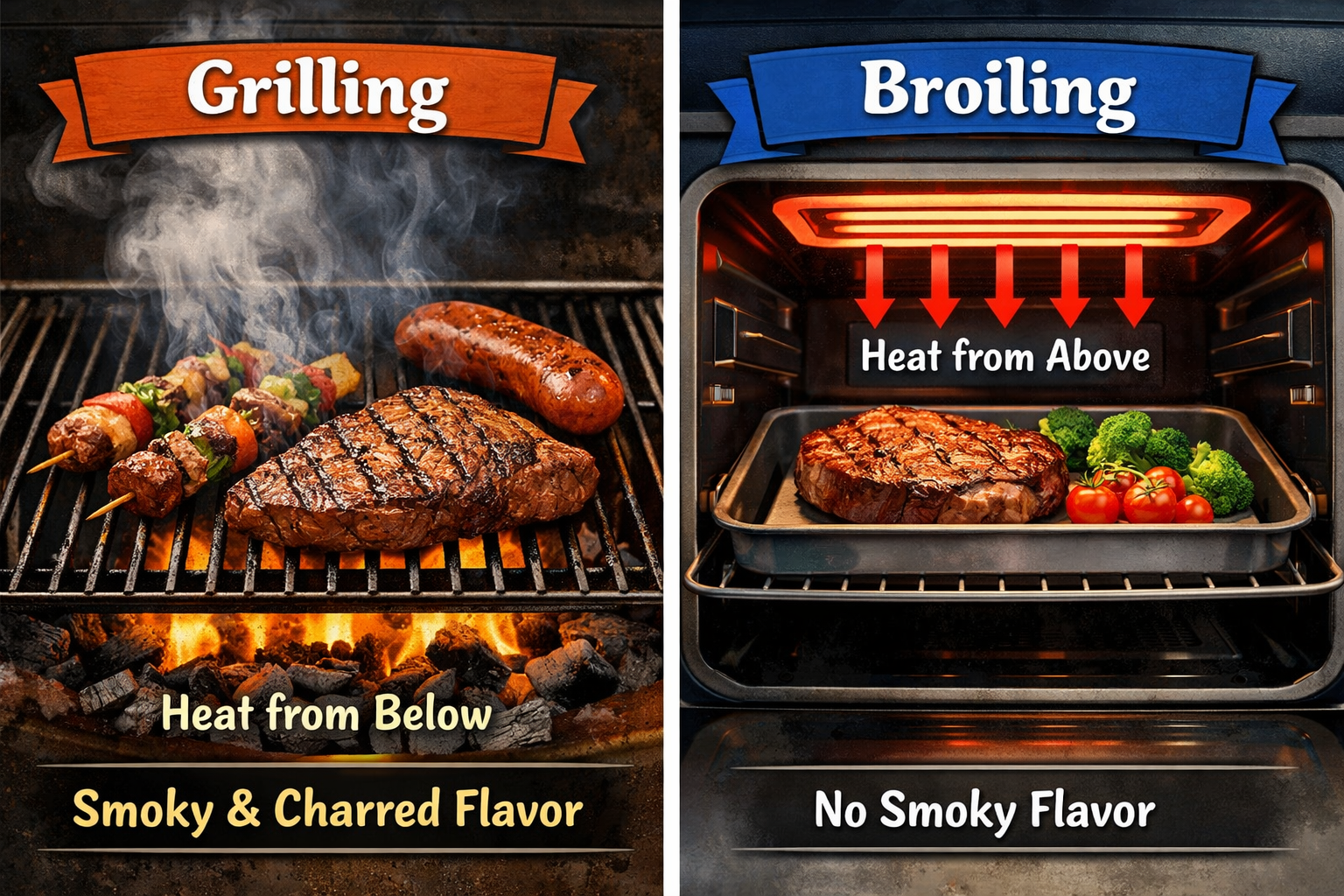
grilling ⟷ broiling
a flavour chemistry perspective
Grilling and broiling are culinary twins separated by the presence of smoke. Both rely on radiant heat above 500 °F (260 °C) to drive the Maillard reaction and caramelisation, but the direction of heat and the chance for smoke to interact with food create two distinct flavour identities. Below we dissect the common foundations and the crucial divergences, retaining all references and compound-level detail from the original analysis.
⚡ 1. common ground — the flavour base
As dry‑heat methods, both grilling and broiling trigger three fundamental reactions on the food’s surface. The table below outlines the shared chemistry.
| mechanism | description | flavour contribution |
|---|---|---|
| Maillard reaction | amino acids + reducing sugars under high heat | savory, umami, nutty, roasted, “meaty” notes; browning |
| caramelisation | pyrolysis of sugars at elevated temperature | sweetness, complexity, buttery/nuanced caramel; browning |
| fat pyrolysis | thermal breakdown of triglycerides & fats | general cooked‑meat character, species‑specific tones (beef, chicken, etc.) |
These shared reactions mean that, chemically, a broiled steak and a grilled steak both contain pyrazines (nutty/roasty), aldehydes, and a host of Maillard‑derived volatiles. The divergence begins with smoke.
🔥 2. method differences — where heat comes from
| feature | grilling | broiling |
|---|---|---|
| heat source location | below the food | above the food |
| typical equipment | charcoal grill, gas grill, electric grill | oven top element, salamander, broiler drawer |
| flavour infusion | dripping juices vaporise on hot coals → smoke rises and coats food | juices drip away; no smoke creation |
| resulting flavour profile | robust, smoky, heavily charred, complex | cleaner, lightly charred, milder, can be plainer |
🧪 3. flavour volatiles — the smoke divide
grilling + smoke infusion
- phenols – guaiacol (2‑methoxyphenol), cresol (3‑methylphenol) → smoky, spicy, charcoal‑like
- furans/furanones – sweet, caramel, bready notes
- pyrazines – nutty, roasted, toasted
- ketones · lactones · benzene derivatives – complex layering
- sulfur‑containing volatiles – meaty depth
📄 Charcoal‑grilled beef study (2024): phenols like guaiacol directly linked to smoke from charcoal.
broiling no smoke
- pyrazines – still present (from Maillard)
- aldehydes – from fat breakdown & Maillard
- other Maillard products – roasted, nutty, but no phenolic smoke compounds
- ⬤ broiled flavour is a subset: seared, caramelised, yet “fairly bland” compared to grilled, often needing rubs/marinades.
📊 4. flavour nuances — side by side
| aspect | grilling | broiling |
|---|---|---|
| primary flavour source | Maillard + caramelisation + smoke infusion | Maillard + caramelisation only |
| key flavour notes | smoky, charred, robust, complex | clean, lightly charred, plainer |
| dominant compound families | pyrazines, phenols, furans, aldehydes, ketones, lactones, benzene derivatives, sulfur compounds | pyrazines, aldehydes, other Maillard‑reaction products (phenols absent) |
✴️ essence — broiled flavour is a subset of grilled flavour. Both deliver seared, caramelised crust via Maillard; grilling adds an extra layer of smoky complexity from vaporised drippings and the resulting phenolic volatiles.
📌 references & original notes
Every reference from the initial analysis is retained below. The numbers correspond to the detailed statements throughout the article.
- Dry heat / temperature range: Both methods typically exceed 500 °F (260 °C), using radiant heat to cook food quickly.
- Maillard & caramelisation: Core shared chemical reactions; responsible for savoury depth and browning.
- Heat source location: Grilling = heat below; broiling = heat above (oven top element / salamander).
- Smoke generation (grilling): Dripping juices vaporise on hot coals/briquettes → smoke rises and coats food → distinctive smoky flavour.
- 2024 volatile study (charcoal‑grilled beef): Identified 196 volatile compounds including phenols (guaiacol, cresol), furans/furanones, ketones, lactones, benzene derivatives, pyrazines and sulfur‑containing volatiles. Phenols like 2‑methoxyphenol (guaiacol) and 3‑methylphenol (cresol) are directly associated with charcoal smoke aroma.
- Broiling “bland” note: Without smoke infusion, broiled food can be “fairly bland in taste” compared to grilled, often requiring marinades, rubs or basting for depth.
- Pyrazines and aldehydes: Present in both methods as Maillard products; pyrazines contribute nutty/roasty notes.
- Broiled flavour as subset: Broiling achieves everything from Maillard and caramelisation, but lacks the phenolic/smoke compounds introduced by charcoal or wood.
🔗 All compound names, reaction descriptions and comparative statements are preserved verbatim from the detailed analysis.
Understanding the Flavor Divide
The page is built around a central comparison: both methods create a savory base, but grilling adds a unique smoky layer. You can explore this through several dedicated sections.
- Shared Foundation: The first table explains the Maillard reaction and caramelization, which are the core flavor generators in both grilling and broiling.
- Key Differences: A method comparison table highlights how the heat source location (below vs. above) leads to smoke infusion in grilling, while a flavor card section breaks down the specific volatile compounds produced by each technique.
- At-a-Glance Summary: A final comparison table and a highlighted "essence" block let you quickly grasp that broiled flavor is a subset of grilled flavor, lacking the smoky phenolic compounds.
Grilling and broiling are indeed very similar cooking methods that use high, direct heat to cook food quickly and generate complex flavors. Their main difference lies in the heat source's location—below the food for grilling and above for broiling—which significantly impacts the final flavor profile, primarily due to the addition of smoke in grilling. Here is a detailed comparison based on your questions.
Similarities: The Foundation of Flavor
As cooking methods, grilling and broiling share several core principles that lead to the creation of rich, savory flavors.
- Dry Heat Cooking: Both are dry-heat cooking methods that use radiant heat, typically at temperatures exceeding 500°F (260°C), to cook food . This high heat quickly sears the exterior, creating a flavorful crust while the interior cooks more slowly.
- The Maillard Reaction: The intense heat triggers the Maillard reaction, a chemical reaction between amino acids and reducing sugars that is fundamental to generating the savory, "meaty," and complex flavors and the characteristic browning we associate with cooked food .
- Caramelization: The high heat also caramelizes natural sugars present in the food, contributing sweetness, depth, and additional browning .
The table below summarizes these common flavor-generation mechanisms:
| Flavor Mechanism | Description | Common Contribution |
|---|---|---|
| Maillard Reaction | Reaction between amino acids and sugars at high heat | Savory, umami, "meaty," roasted, and nutty flavors; browning |
| Caramelization | Pyrolysis of sugars at high heat | Sweetness, complexity, nutty and buttery notes; browning |
| Fat Pyrolysis | Thermal breakdown of fats and oils | General "cooked meat" flavors, species-specific notes (e.g., beef vs. chicken) |
Differences: The Role of Smoke and Heat Source
While the chemical reactions are similar, the physical setup of grilling and broiling creates key differences in the final flavor.
As Cooking Methods
| Feature | Grilling | Broiling |
|---|---|---|
| Heat Source Location | Below the food | Above the food |
| Typical Equipment | Outdoor grill (charcoal, gas), electric grill | Oven's top heating element, salamander |
| Flavor Infusion | Dripping juices vaporize on the heat source, creating smoke that infuses the food | Dripping juices fall away from the heat source; no smoke is created to flavor the food |
| Resulting Flavor Profile | Robust, smoky, heavily charred, complex | Cleaner, lightly charred, milder, can be plainer |
In Terms of Flavors Generated
The most significant difference in flavor comes from the presence or absence of smoke.
- Grilling's Unique Smoky Flavor: When fat and juices from the food drip onto the hot coals, ceramic briquettes, or lava rocks below, they vaporize and create smoke. This smoke rises and coats the food, imparting a distinctive smoky flavor that is the hallmark of grilling . This process is so influential that the specific volatile compounds in charcoal-grilled meat have been extensively studied.
- A 2024 study on charcoal-grilled marinated beef identified a vast array of 196 volatile compounds, including phenols, furans/furanones, ketones, lactones, and benzene derivatives . Many of these, particularly phenols like 2-methoxyphenol (guaiacol) and 3-methylphenol (cresol), are directly associated with smoke from the charcoal and contribute to the characteristic "charcoal-grilled" aroma . Sulfur-containing compounds and pyrazines (which contribute nutty, roasted notes) are also key to the complex grilled flavor profile .
- Broiling's Cleaner Flavor: Without the smoke-generating step, broiling produces a flavor that is more straightforward. It relies purely on the Maillard reaction and caramelization from the top-down radiant heat. As one source notes, this can result in food that is "fairly bland in taste" compared to its grilled counterpart, making it more dependent on marinades, rubs, or basting sauces for flavor depth . The flavor compounds generated are primarily those from the Maillard reaction, such as pyrazines and certain aldehydes, but they lack the smoky phenolic compounds introduced by charcoal or wood .
In essence, one can think of broiled flavor as a subset of grilled flavor. Broiling achieves the seared, caramelized surface and the meaty flavors from the Maillard reaction. Grilling achieves all of that, plus an additional, complex layer of flavor derived from smoke.
Summary: Flavor Nuances Compared
| Aspect | Grilling | Broiling |
|---|---|---|
| Primary Flavor Source | Maillard reaction, caramelization, and smoke infusion | Maillard reaction and caramelization only |
| Key Flavor Notes | Smoky, charred, robust, complex | Clean, lightly charred, "plain," often requires added seasoning |
| Dominant Compounds | Pyrazines (nutty/roasty), phenols (smoky/spicy), furans (sweet/caramel), aldehydes | Pyrazines, aldehydes, and other Maillard reaction products |