Ground Cinnamon Lead Contamination Recall 2026: FDA Warning, Health Risks, and What the Flavor Industry Must Know
Updated November 8, 2026
Ground cinnamon, one of the world's most popular baking spices, is facing renewed food safety scrutiny following another U.S. recall involving elevated lead levels. As consumers prepare seasonal recipes and food manufacturers increase production of cinnamon-flavored products, the latest warning raises important questions about ingredient safety, sourcing, and quality assurance.
On November 4, 2026, the U.S. Food and Drug Administration (FDA) updated its public health alert to include Wise Wife Brand Ground Cinnamon. The addition followed an October 29 voluntary recall by SLR Food Distribution Inc., affecting products distributed across 14 states.
According to Food Safety News, the expanded FDA warning now identifies 21 ground cinnamon products with elevated lead levels.
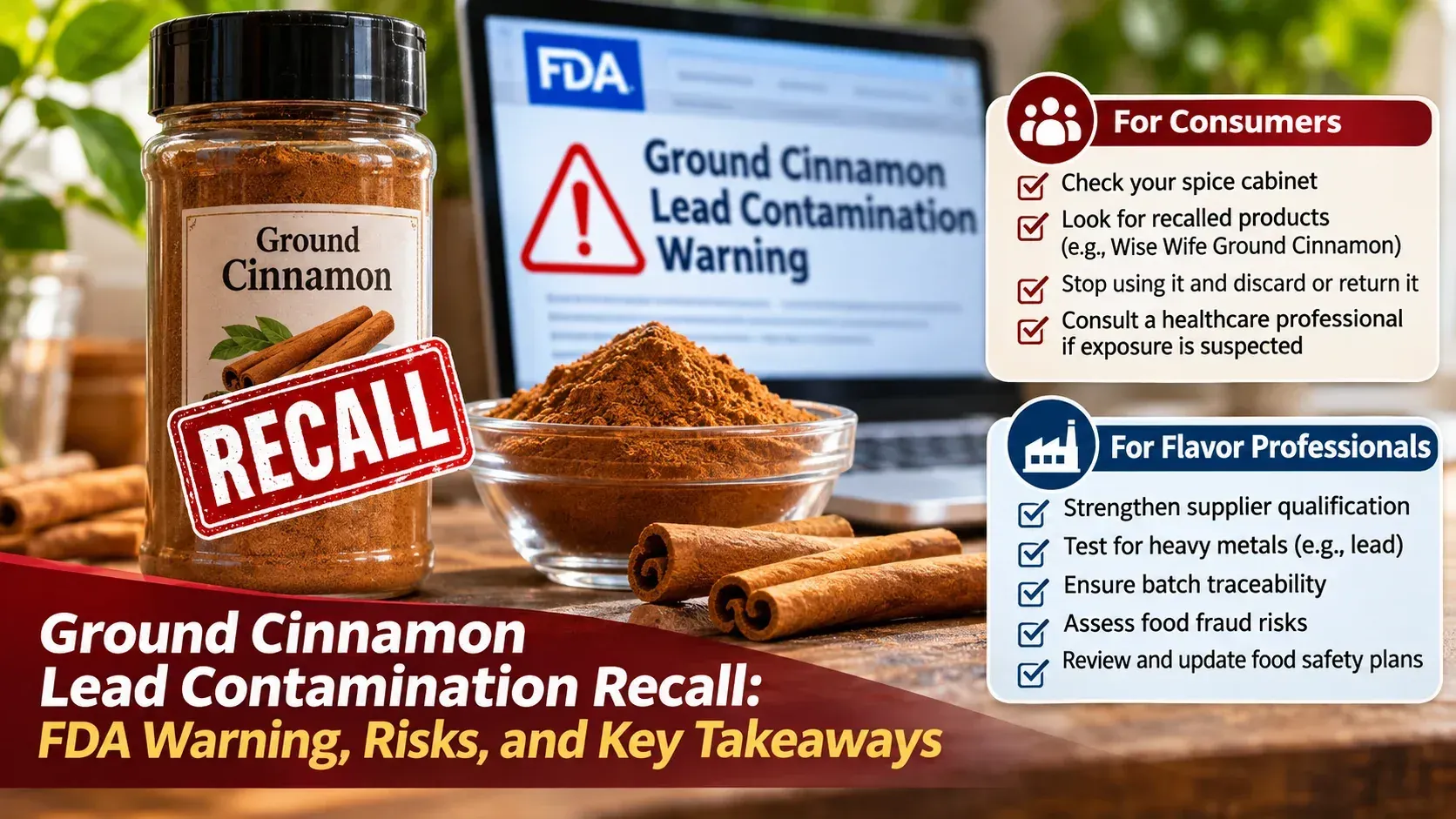
For consumers, the immediate priority is checking spice cabinets. For flavor professionals, the incident reinforces the importance of rigorous ingredient testing and supply chain transparency.
Latest Ground Cinnamon Recall: Which Product Is Affected?
According to the official FDA recall announcement, SLR Food Distribution Inc., based in Hicksville, New York, voluntarily recalled Wise Wife Brand Ground Cinnamon after laboratory testing detected elevated lead levels.
The affected product is identifiable by these details:
- Brand: Wise Wife Ground Cinnamon
- Package size: 110 grams (3.88 ounces)
- UPC: 0688474302754
- Best-before date: April 25, 2027
- Packaging: Clear plastic container with a black screw-top cap
The product was distributed between September 8, 2025, and June 28, 2026, to stores in Connecticut, Indiana, Kansas, Massachusetts, Michigan, Minnesota, Nebraska, New York, North Carolina, Ohio, Pennsylvania, Texas, Virginia, and Wisconsin.
Testing by the Connecticut Agricultural Experiment Station identified the contamination. The FDA's updated cinnamon alert lists the affected product's lead concentration at 2.118 parts per million (ppm).
No illnesses had been reported when the recall was announced.
Importantly, Wise Wife was also involved in a separate 2025 recall concerning a different 50-gram product with another UPC. Consumers should verify the specific package information rather than relying on the brand name alone.
Why Is Lead Contamination in Cinnamon a Serious Concern?
Lead is a toxic heavy metal that can affect multiple organ systems. Unlike microbial contamination, lead cannot be detected through ordinary tasting, smelling, or visual inspection.
The concern is especially significant for children, pregnant individuals, and people experiencing repeated exposure.
According to the FDA's information on lead in food, prolonged exposure can contribute to developmental and neurological problems in children, including learning difficulties, behavioral changes, and reduced IQ. In adults, chronic exposure is associated with kidney dysfunction, hypertension, and cognitive effects.
Lead contamination can originate from environmental exposure, contaminated agricultural materials, or processing practices.
The FDA previously investigated a major cinnamon-related incident involving WanaBana apple cinnamon fruit puree products in 2023. Investigators identified lead chromate in cinnamon used in the affected products, with economically motivated adulteration considered the leading explanation.
However, the FDA has not established that the latest Wise Wife recall resulted from intentional adulteration.
This distinction matters: the presence of lead requires investigation, but it does not automatically establish how contamination occurred.
Is All Ground Cinnamon Unsafe?
No. The FDA's warnings concern identified products, not every cinnamon product sold in the United States.
Cinnamon remains a valuable culinary ingredient, providing warm, sweet, woody, and slightly spicy notes in baked goods, beverages, confectionery, cereals, and savory dishes.
However, the recurring recalls highlight vulnerabilities in the global spice supply chain.
In September 2026, Galil Importing Corp. also recalled Lior Cinnamon Ground Seasoning, specifically lot GAP11304, after Maryland health authorities detected elevated lead levels.
The FDA reported a concentration of 2.18 ppm for that product.
Consumers should review the FDA's complete warning list rather than assuming that an unlisted brand is automatically laboratory-certified as lead-free.
Similarly, choosing organic cinnamon or switching between Ceylon and cassia cinnamon does not, by itself, guarantee protection from contamination.
What Should Consumers Do About the Cinnamon Recall?
Consumers should immediately check their spice cabinets, particularly if they purchased ground cinnamon from retailers in affected states.
If the packaging matches the recall information, stop using the product. The FDA advises consumers to discard the recalled cinnamon or return it to the place of purchase for a full refund.
Do not attempt to make contaminated cinnamon safe through cooking or baking. Heat does not eliminate lead from food.
Families who may have consumed recalled cinnamon should consult a healthcare professional, especially when young children are involved.
According to the CDC's guidance on lead testing in children, lead exposure frequently causes no noticeable immediate symptoms. A blood lead test is the best way to determine whether a child has an elevated blood lead level.
Consumers can also reduce unnecessary exposure by purchasing spices from suppliers with transparent quality controls and regularly reviewing official food recall notices.
What Does the Recall Mean for Flavor Manufacturers and Ingredient Suppliers?
For flavor houses, spice processors, food manufacturers, and ingredient distributors, the latest cinnamon recall highlights a critical principle: flavor quality and food safety must be evaluated together.
Cinnamon's distinctive sensory profile makes it an essential component in numerous flavor formulations. However, excellent aroma, color, and taste cannot confirm that an ingredient is free from hazardous concentrations of heavy metals.
The recall reinforces several important industry priorities.
Supplier qualification: Manufacturers should evaluate cinnamon suppliers based on documented quality systems, raw material traceability, contaminant controls, and sourcing transparency.
Heavy-metal testing: Risk-based testing programs should address lead and other relevant contaminants using validated laboratory methods. Supplier certificates of analysis should be supported by appropriate verification.
Batch traceability: Ingredient buyers need reliable systems connecting raw material lots with finished products, enabling rapid identification of potentially affected inventory.
Food fraud prevention: Businesses should assess risks associated with economically motivated adulteration, particularly when purchasing powdered spices through complex international supply chains.
Regulatory compliance: Food manufacturers should review chemical hazards within their food safety plans and implement appropriate preventive controls.
These recommendations align with the FDA's March 2024 industry communication, which reminded cinnamon manufacturers, processors, and distributors of their responsibilities to prevent chemical contamination.
How Could Cinnamon Recalls Influence Future Flavor Innovation?
The implications extend beyond immediate product recalls.
Food and beverage manufacturers increasingly need to balance authentic flavor characteristics with ingredient safety, supplier reliability, and consumer confidence.
For cinnamon-based applications, this may encourage closer collaboration between flavor development teams, analytical laboratories, procurement specialists, and regulatory departments.
Flavor professionals may also reassess supplier diversification, ingredient specifications, and testing requirements for high-risk botanical materials.
However, replacing cinnamon with another spice or flavoring should not be presented as an automatic safety solution. Alternative ingredients require their own hazard assessments and quality verification.
The opportunity for the flavor industry is to strengthen safety systems while preserving the sensory characteristics consumers expect.
Final Takeaway: Cinnamon Safety Requires Continued Vigilance
The November 2026 ground cinnamon lead contamination warning is another reminder that familiar ingredients can carry hidden food safety risks.
Consumers should identify recalled products, follow FDA instructions, and seek medical advice when exposure is suspected.
For flavor manufacturers and spice suppliers, the lesson is equally clear: dependable sourcing, science-based testing, traceability, and preventive controls are essential to protecting both consumers and brand reputation.
Cinnamon remains an important global flavor ingredient. The priority is ensuring that the warmth and comfort it brings to food are supported by equally strong safety standards.
For the latest product information, consult the FDA's updated ground cinnamon public health alert.