Hops as a Natural Flavoring: A Comprehensive Technical Guide
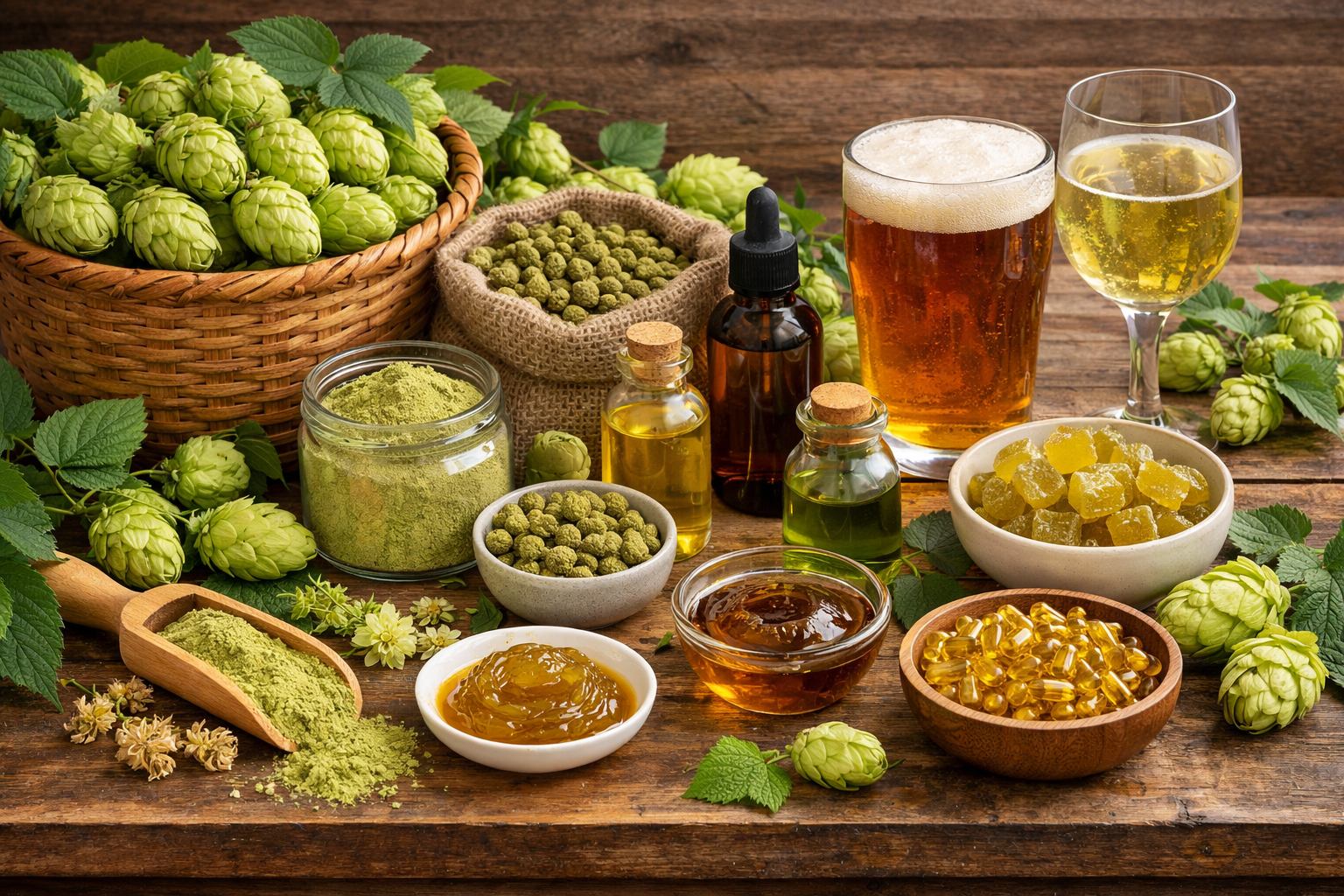
Here is a comprehensive technical guide for Hops, structured in the same format as the previous guides. All key information for flavorists has been incorporated.
Hops as a Natural Flavoring: A Comprehensive Technical Guide
The Society of Flavor Chemists requires certified flavorists to be able to identify the plant part used, derivatives, organoleptic characteristics, and major chemical component(s) characterizing the aroma and flavor of the 80 natural flavorings listed on its syllabus for the qualification test and interview. Hops is included among these essential items.
Introduction
Hops (Humulus lupulus L.) are the cone-like flowers (strobiles) of a climbing perennial plant in the Cannabaceae family (which also includes hemp). Hops are best known as an essential ingredient in beer, where they provide bitterness, flavor, aroma, and preservative properties. However, for flavorists, hops offer a much broader palette of complex, nuanced profiles ranging from floral, citrus, and fruity to earthy, herbal, spicy, and resinous.
The flavor of hops is remarkably diverse, driven by hundreds of volatile compounds and the unique chemistry of hop resins. The two primary classes of flavor-active compounds are: α-acids (humulones) and β-acids (lupulones), which contribute bitterness; and essential oils (terpenes, terpenoids, and sulfur compounds), which contribute the complex aroma. Different hop varieties have distinct flavor profiles, making hops a versatile and sophisticated tool for flavorists creating not only beer flavors but also beverages, savory systems, and even confectionery.
Plant Parts Used
The cones (strobiles) are the plant part used for flavoring purposes. The following characteristics are notable:
- Source Plant: Humulus lupulus L., a member of the Cannabaceae family.
- Plant Description: A dioecious, perennial, climbing vine (bine) that can grow up to 6–10 meters. The female plants produce the hop cones used in brewing and flavoring.
- Hop Cone Description: The cone is a papery, green to yellow-green, cone-shaped structure (strobile) composed of bracts and bracteoles. At the base of each bract are lupulin glands—yellow, powdery glands that contain the bitter acids (α-acids and β-acids) and essential oils.
- Varieties: There are hundreds of hop varieties, broadly categorized into:
- Aroma Hops: Lower α-acid content; prized for their complex essential oil profiles (e.g., Noble hops: Hallertau, Tettnang, Spalt, Saaz; newer aroma varieties: Citra, Mosaic, Cascade)
- Bitter Hops: Higher α-acid content; used primarily for bitterness (e.g., Nugget, Columbus, Magnum)
- Dual-Purpose Hops: Moderate α-acid content; used for both bitterness and aroma (e.g., Centennial, Chinook)
- Harvesting: Hop cones are harvested in late summer to early autumn when the lupulin glands are fully developed. They are then dried to reduce moisture content and processed into pellets, extracts, or oils.
The essential oil is obtained by steam distillation of fresh or dried hop cones. Hop extracts (CO₂ and solvent) are also widely used, capturing both the volatile oils and the bitter acids.
Derivatives
Hops are commercially available in several forms, each with different applications and technical specifications.
Hop Essential Oil
Production Method: Steam distillation of fresh or dried hop cones.
Description: Pale yellow to amber-yellow mobile liquid with a characteristic fresh, hoppy aroma. The composition varies dramatically by hop variety, ranging from floral, citrus, and fruity to earthy, herbal, and spicy.
Technical Notes: Yield is typically 0.5–2.0% from dried hops. The oil is composed primarily of monoterpenes (myrcene, humulene, caryophyllene) and oxygenated compounds. Storage in a cool, dry place away from light is recommended to prevent oxidation.
Hop CO₂ Extract
Production Method: Supercritical carbon dioxide extraction of dried hop cones.
Description: Dark amber to green-brown viscous liquid or semi-solid. Contains both the essential oils (aroma) and the bitter acids (α-acids, β-acids). Provides a complete hop profile.
Technical Notes: The CO₂ extract is preferred for many applications because it captures the full hop character without the use of organic solvents. It can be standardized to a specific α-acid content.
Hop Solvent Extract (Oleoresin)
Production Method: Solvent extraction (typically hexane or ethanol) of dried hop cones, followed by solvent removal.
Description: Dark amber to green-brown viscous liquid or semi-solid. Similar to CO₂ extract but may have a different flavor profile due to solvent residues or extraction selectivity.
Hop Pellets (Type 90, Type 45)
Production Method: Dried hop cones are ground and compressed into pellets. Type 90 contains the whole cone; Type 45 is concentrated (45% of the original weight, with plant material removed).
Description: Green to yellow-green pellets with characteristic hop aroma.
Technical Notes: Used primarily in brewing but can be used for extraction or tinctures.
Isomerized Hop Extract (Iso-α-acids)
Production Method: α-acids extracted from hops are isomerized (through heating or chemical means) to form iso-α-acids, which are more soluble and contribute the characteristic bitter taste of beer.
Description: Pale yellow to amber liquid or powder with intense, clean bitterness.
Technical Notes: Used in beer and beverage applications where clean bitterness is desired without the hop aroma.
The Chemistry of Hop Flavor
Hop flavor is derived from two primary classes of compounds: essential oils (aroma) and bitter acids (bitterness).
Essential Oil Components (Aroma)
Hop essential oils are complex mixtures of hundreds of compounds. Key classes include:
Monoterpenes (Primary Volatiles):
- Myrcene (20–60%): Contributes fresh, resinous, balsamic, and slightly spicy notes; abundant in many aroma varieties
- Humulene (α-caryophyllene) (10–30%): Contributes woody, earthy, spicy, and noble hop character
- β-Caryophyllene (5–15%): Contributes woody, spicy, clove-like notes
- Linalool (0.1–2%): Contributes fresh, floral, citrusy notes; a key contributor to "hoppy" aroma
- Geraniol (trace–1%): Contributes sweet, rose-like, floral notes
Oxygenated Compounds:
- Esters (e.g., ethyl esters): Contribute fruity, tropical notes
- Aldehydes: Contribute fresh, green, citrusy notes
- Sulfur Compounds (trace): Contribute tropical, passionfruit, catty notes (characteristic of some modern "American" hops like Citra)
Bitter Acid Components (Bitterness)
α-acids (Humulones):
- Humulone, Cohumulone, Adhumulone: Contribute the characteristic bitter taste of hops. In beer, these are isomerized to iso-α-acids, which are more soluble and more bitter. Iso-α-acids have a clean, sharp bitterness.
- α-acid content varies by variety: Aroma hops (2–5%), dual-purpose (5–10%), bitter hops (10–18%).
β-acids (Lupulones):
- Lupulone, Colupulone, Adlupulone: Contribute a more harsh, lingering bitterness. β-acids are less soluble and less bitter than α-acids but are more antimicrobial.
Organoleptic Characteristics
Aroma Profile (Hop Essential Oil – by Variety)
Hop aroma is highly variable and depends on the variety. Key aroma profiles include:
| Aroma Category | Character | Example Hop Varieties | Key Compounds |
|---|---|---|---|
| Floral / Noble | Delicate, floral, spicy, herbal | Hallertau, Tettnang, Spalt, Saaz | Humulene, linalool, nerol |
| Citrus | Lemon, grapefruit, orange, zest | Cascade, Centennial, Citra | Myrcene, linalool, citral |
| Tropical Fruit | Pineapple, passionfruit, mango, guava | Citra, Mosaic, Galaxy | Myrcene, sulfur compounds, esters |
| Stone Fruit | Peach, apricot, nectarine | Mosaic, El Dorado | Sulfur compounds, esters |
| Berry | Blackcurrant, raspberry, berry | Cascade, Centennial | Myrcene, esters |
| Herbal / Earthy | Tea, grass, earth, forest floor | Fuggle, Willamette, East Kent Golding | Humulene, caryophyllene |
| Spicy / Woody | Black pepper, cedar, pine | Chinook, Columbus | Myrcene, caryophyllene |
| Resinous | Pine, cannabis-like | Chinook, Columbus, Nugget | Myrcene, humulene |
Taste Characteristics
At typical usage levels, hops provide:
- Bitter: Clean, sharp bitterness (from α-acids/iso-α-acids)
- Floral: Delicate, sweet floral notes
- Citrus: Fresh, lemon, grapefruit notes
- Fruity: Tropical, berry, stone fruit notes
- Herbal: Tea-like, grassy, earthy notes
- Spicy: Peppery, woody notes
- Resinous: Balsamic, pine-like notes
The Key to Hop's Unique Flavor
Hop flavor is defined by the interplay of essential oils (aroma) and bitter acids (taste):
Aroma Components:
- Myrcene: Provides fresh, resinous, balsamic notes; abundant in many American and modern aroma varieties
- Humulene: Provides woody, earthy, spicy notes; characteristic of European "Noble" hops
- Linalool: Provides fresh, floral, citrusy notes; key contributor to "hoppy" aroma
- Sulfur Compounds (trace): Provide tropical, passionfruit, catty notes (characteristic of Citra, Mosaic)
Bitterness Components:
- Iso-α-acids: Provide clean, sharp, persistent bitterness—the characteristic bitter taste of beer
Major Chemical Components
Key Aroma Compounds (Hop Essential Oil – by Type)
| Component | Typical Percentage (varies by variety) | Organoleptic Contribution | CAS No. |
|---|---|---|---|
| Myrcene | 20–60% | Fresh, resinous, balsamic, spicy | 123-35-3 |
| Humulene | 10–30% | Woody, earthy, spicy, noble hop character | 6753-98-6 |
| β-Caryophyllene | 5–15% | Woody, spicy, clove-like | 87-44-5 |
| Linalool | 0.1–2% | Fresh, floral, citrusy | 78-70-6 |
| Geraniol | trace–1% | Sweet, rose-like, floral | 106-24-1 |
| α-Terpineol | trace–1% | Floral, lilac | 98-55-5 |
| Nerol | trace | Sweet, rose-like | 106-25-2 |
| Citral | trace | Lemon, citrus | 5392-40-5 |
| Sulfur Compounds | trace | Tropical, passionfruit, catty | Various |
Key Bitter Acid Components
| Component | Typical Percentage (in cones) | Organoleptic Contribution | CAS No. |
|---|---|---|---|
| α-Acids (Humulones) | 2–18% | Bitter precursor; isomerized to iso-α-acids | Various |
| β-Acids (Lupulones) | 2–10% | More harsh, lingering bitterness | Various |
| Iso-α-acids | N/A (formed by isomerization) | Clean, sharp, persistent bitterness | Various |
Comparison: Noble vs. American Aroma Hops
| Characteristic | Noble Hops (Hallertau, Tettnang, Spalt, Saaz) | American Aroma Hops (Cascade, Centennial, Citra) |
|---|---|---|
| α-Acid Content | 2–5% | 5–12% |
| Myrcene | Lower (20–30%) | Higher (40–60%) |
| Humulene | Higher (20–30%) | Lower (10–20%) |
| Linalool | Moderate | Higher |
| Sulfur Compounds | Low | Significant (in modern varieties) |
| Aroma Profile | Floral, spicy, herbal, earthy | Citrus, tropical, fruity, pine |
| Typical Use | Traditional lagers, European styles | American IPAs, modern craft beer |
Applications in Flavoring
Regulatory Status
Hops and their derivatives are approved as natural flavoring substances:
- United States: Hops are generally recognized as safe (GRAS). Hop oil is listed under 21 CFR §182.20 as a natural flavoring substance (FEMA No. 2578 for hop oil, 2579 for extract).
- European Union: Permitted for use in food flavorings under Regulation (EC) No 1334/2008.
- China: Approved food flavor under GB 2760.
Typical Usage Levels (mg/kg)
The following usage levels are based on FEMA GRAS determinations and industry standards:
| Application | Hop Oil (mg/kg) | Hop Extract (mg/kg) | Isomerized Extract (mg/kg) |
|---|---|---|---|
| Non-alcoholic beverages | 2–20 | 5–50 | 5–50 |
| Alcoholic beverages (beer) | 10–200 | 20–500 | 20–200 |
| Baked goods | 2–15 | 5–30 | 5–30 |
| Hard candy | 5–30 | 10–50 | 10–50 |
| Frozen dairy | 2–15 | 5–30 | 5–30 |
| Gelatins and puddings | 2–15 | 5–30 | 5–30 |
| Soft candy | 2–15 | 5–30 | 5–30 |
| Chewing gum | 5–40 | 10–80 | 10–80 |
| Savory systems | 1–10 | 2–20 | N/A |
Note: These ranges represent typical industry usage. Hop oil is potent; start low and titrate.
Usage & Dosage Best Practices
Flavorists should observe the following guidelines when working with hops:
Select the Correct Form:
- Hop Essential Oil: Use for hop aroma without bitterness. Suitable for applications where only the floral, citrus, fruity, or herbal notes are desired.
- Hop CO₂ Extract: Use for complete hop flavor (aroma + bitterness). Preferred for authentic beer flavors.
- Isomerized Hop Extract: Use for clean, sharp bitterness without hop aroma. Suitable for beverages and confectionery where bitterness is the primary goal.
- Hop Pellets: Use for tinctures or for applications requiring the whole hop character.
Select the Correct Variety: Different hop varieties have dramatically different flavor profiles. For authentic beer flavors, select varieties appropriate to the beer style (e.g., Noble hops for European lagers, Cascade/Centennial for American IPAs).
Start Low, Titrate: Hop oil is potent and can become overpowering if overused. Begin at the lower end of typical usage ranges and adjust upward.
Pre-Dilution: Pre-dilute hop oil in ethanol or propylene glycol for easier handling and more even dispersion.
Flavor Synergies: Hops pair exceptionally well with:
- Malt: The classic beer pairing (balance of sweetness and bitterness)
- Citrus: Lemon, orange, grapefruit (enhances citrus hop notes)
- Tropical fruits: Pineapple, passionfruit, mango (complements tropical hop notes)
- Spices: Coriander, ginger, black pepper, cardamom
- Herbs: Rosemary, thyme, sage, chamomile
- Florals: Rose, lavender, orange blossom
- Honey: Adds sweetness and complexity
- Smoked flavors: For rauchbier styles
Flavor Applications: Hops serve as a primary flavor or modifier in:
- Beer flavors: Lager, ale, IPA, stout, porter, pilsner
- Non-alcoholic beverages: Hop water, hop tea, hop sodas, sparkling waters
- Baked goods: Hop-infused breads, crackers, cookies
- Confectionery: Hop-flavored chocolates, caramels, gummies
- Dairy: Hop ice cream, hop yogurt
- Savory: Hop-infused sauces, marinades, glazes
- Culinary: Hop salt, hop-infused oils, hop vinegar
Example Formula: American IPA Flavor Concentrate
The following formula demonstrates the use of American aroma hops to create an IPA-style beer flavor.
American IPA Flavor Concentrate (Alcohol-Based)
| Component | Percentage (%) | Function | Technical Note |
|---|---|---|---|
| Hop CO₂ extract (Citra/Cascade blend) | 30.0 | Hop aroma and bitterness | Provides tropical, citrus character |
| Hop oil (Cascade) | 10.0 | Hop aroma enhancement | Adds citrus, floral notes |
| Malt extract (liquid) | 20.0 | Malt sweetness | Provides beer backbone |
| Orange oil | 5.0 | Citrus brightness | Enhances citrus notes |
| Isomerized hop extract | 10.0 | Clean bitterness | Adds bitterness |
| Ethanol | 25.0 | Solvent | Food grade |
| Total | 100.0 |
Usage Instructions: Use at 0.1–0.3% in finished beverages. For a complete beer flavor, combine with malt flavor, water, and carbonation.
Alternative: Noble Lager Flavor Concentrate
| Component | Percentage (%) | Function |
|---|---|---|
| Hop oil (Hallertau or Saaz) | 40.0 | Floral, spicy noble hop aroma |
| Malt extract (light) | 30.0 | Clean malt sweetness |
| Isomerized hop extract | 10.0 | Clean bitterness |
| Ethanol | 20.0 | Solvent |
| Total | 100.0 |
Usage Instructions: Use at 0.1–0.2% in finished lager-style beverages.
Alternative: Hop Oil Pre-Dilution for Lab Use
| Component | Percentage (%) | Function |
|---|---|---|
| Ethanol (190 proof) | 90.0 | Solvent |
| Hop oil | 10.0 | Active ingredient |
Method: Mix thoroughly. Store in amber glass bottles in a cool place. Use 0.1–1.0% in flavor formulations.
Shelf Stability & Storage
Understanding the stability of hop ingredients is critical for maintaining flavor quality.
Hop Essential Oil
Storage Recommendation: Store in a full, airtight container in a cool, dry place away from light. Refrigeration is strongly recommended for long-term storage.
Stability Notes: Hop oil contains monoterpenes (myrcene) that are highly susceptible to oxidation. Oxidation produces off-notes (oxidized, aged hop character). Myrcene can polymerize, thickening the oil. Shelf life is typically 12–18 months when properly stored.
Hop CO₂ Extract
Storage Recommendation: Store in airtight containers in a cool, dry place away from light. Refrigeration is recommended.
Stability Notes: CO₂ extracts are more stable than essential oil due to the presence of natural antioxidants (α-acids, β-acids). However, α-acids will slowly degrade over time, losing bitterness. Shelf life is typically 18–24 months.
Hop Pellets
Storage Recommendation: Store in airtight, oxygen-barrier packaging in a freezer (−20°C to 0°C) for long-term storage.
Stability Notes: Hops are highly perishable. Stored at room temperature, they oxidize rapidly, losing essential oils and α-acids. Vacuum-sealed, frozen pellets can maintain quality for 12–24 months.
Stability in Finished Products
- Heat stability: Myrcene and other terpenes are heat-sensitive; may degrade during high-temperature processing.
- pH stability: α-acids are stable in neutral to slightly acidic conditions; isomerized α-acids are more stable.
- Oxidation: Highly susceptible to oxidation; use antioxidants for long-shelf-life products.
- Light sensitivity: Light causes "skunking" (formation of 3-methylbut-2-ene-1-thiol) in hops; protect from light.
Safety Considerations
General Safety
Hop oil and extracts are generally recognized as safe (GRAS) for use as flavorings at approved levels (FEMA 2578, 2579).
Important Considerations
- Allergies: Hops may cause allergic reactions in sensitive individuals. Hops are in the Cannabaceae family (which includes hemp). Cross-reactivity is possible.
- Pregnancy: Safe in food amounts; concentrated hop extracts should be used with caution during pregnancy.
- Skin Irritation: Hop oil may cause skin irritation in sensitive individuals.
- Sedative Effects: Hops have mild sedative properties; this is not significant at flavoring levels.
Quality Control & Sourcing
Flavorists should implement the following quality checks when sourcing hop ingredients.
Essential Requirements for Certificates of Analysis (COA)
For Hop Oil:
- Botanical identity: Humulus lupulus L.
- Variety: Specify variety (e.g., Cascade, Citra, Hallertau)
- Origin: Specify country of origin (USA, Germany, Czech Republic, etc.)
- Myrcene content: Varies by variety (GC analysis)
- Humulene content: Varies by variety
- Physical properties: Specific gravity (0.870–0.910), refractive index (1.480–1.500)
For Hop CO₂ Extract:
- Variety: Specify
- α-Acid content: 20–60% (varies by product)
- Essential oil content: 5–20%
Common Adulteration Risks
- Hop oil: Dilution with synthetic myrcene or other terpenes; substitution with less expensive oils; mislabeling of variety
- Hop extract: Dilution with carriers; addition of synthetic bitter acids; mislabeling of variety
Sourcing Considerations
| Type | Origin | Characteristics |
|---|---|---|
| Noble Hops | Germany, Czech Republic | Floral, spicy, herbal; traditional lager character |
| American Aroma Hops | USA (Pacific Northwest) | Citrus, tropical, fruity; IPA character |
| Bitter Hops | USA, Germany, UK | High α-acid; clean bitterness |
| New Zealand Hops | New Zealand | Unique fruit, tropical profiles |
Traditional and Culinary Applications
Traditional Uses
- Beer: The primary use; provides bitterness, flavor, aroma, and preservative properties
- Herbal Medicine: Traditionally used as a sedative, digestive aid, and for nervous conditions
- Culinary: Limited traditional culinary use; modern culinary use is expanding
Modern Culinary Applications
- Beverages: Hop water, hop tea, hop sodas, kombucha, spirits
- Baked goods: Hop-infused breads, crackers, cookies
- Confectionery: Hop chocolates, caramels, gummies
- Dairy: Hop ice cream, hop yogurt
- Savory: Hop salts, hop-infused oils, sauces, marinades, glazes
- Cheese: Hop-infused cheese
Summary
Hops (Humulus lupulus) are a complex and versatile natural flavoring material, prized for their diverse aroma profiles (floral, citrus, tropical, fruity, herbal, earthy, spicy) and their clean, sharp bitterness. The key to hop flavor lies in its essential oils (myrcene, humulene, linalool) for aroma and its α-acids (humulones) for bitterness. Different hop varieties offer dramatically different flavor profiles, from the delicate, floral, spicy character of European Noble hops to the bold, citrus, tropical, fruity character of modern American aroma hops.
Key characteristics:
- Primary aroma components: Myrcene (20–60%), humulene (10–30%), linalool (0.1–2%)
- Primary bitter components: α-acids (humulones, 2–18%)
- Aroma profile: Highly variable (floral, citrus, tropical, fruity, herbal, earthy, spicy, resinous)
- Typical usage: Oil 2–200 mg/kg; extract 5–500 mg/kg
- Primary applications: Beer flavors, beverages, confectionery, savory
Critical considerations for flavorists:
- Select the correct variety: Different varieties have different flavor profiles; essential for authentic beer flavors.
- Distinguish forms: Oil provides aroma only; CO₂ extract provides both aroma and bitterness; isomerized extract provides clean bitterness.
- Stability: Hop oil is highly susceptible to oxidation; store properly.
- Flavor synergies: Pairs with malt, citrus, tropical fruits, and spices.
- Sourcing: Noble hops from Europe; American aroma hops from USA; varieties are critical to flavor.
References and Further Reading
The information presented in this guide is synthesized from:
- Regulatory documents from FDA, FEMA (Nos. 2578, 2579), and international food safety authorities.
- Published scientific literature on Humulus lupulus.
- Standard textbooks on natural flavoring materials and brewing science.
- Industry technical data from major hop suppliers.
- Traditional knowledge documented in public domain sources.
Key References:
- FEMA Flavor Ingredient Library: Hop Oil (FEMA 2578), Hop Extract (FEMA 2579)
- Journal of Agricultural and Food Chemistry: Hop essential oil composition studies
- Brewing Science: Hop chemistry and varieties
- TGSC Information System: Hop Oil
Disclaimer: This article is for informational purposes only. When using hops in commercial products, always verify current regulatory status in your jurisdiction, conduct appropriate safety assessments, and source ingredients from reputable suppliers who can provide documentation of botanical identity, variety, origin, and quality. Different hop varieties have different flavor profiles; select the appropriate variety for your application. The formulas and usage levels provided are illustrative examples and may require adjustment based on specific product requirements and regulatory compliance.
###