ISO Certification for Flavor Chemists: Essential Knowledge, Applications, and SFC Exam Preparation Guide
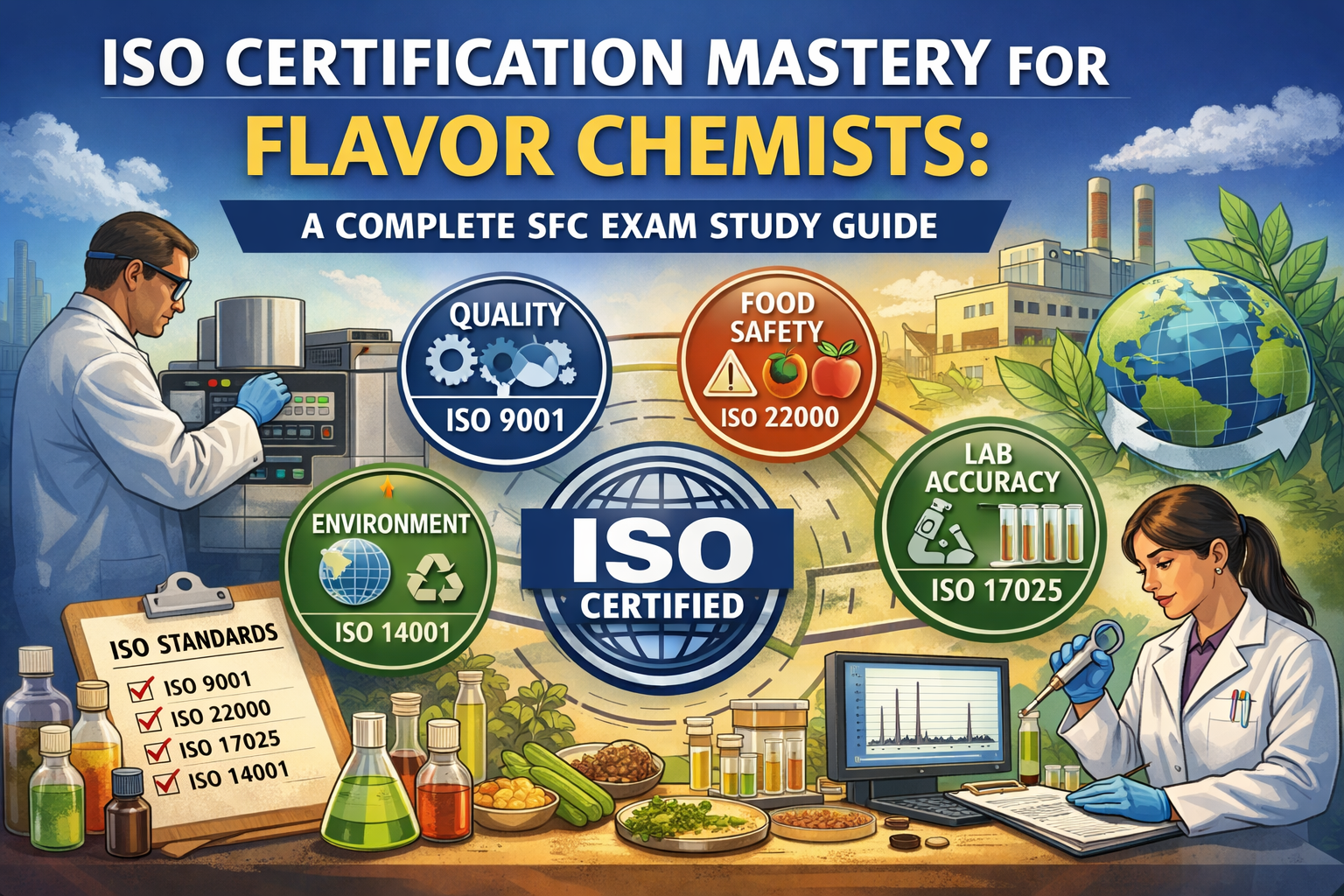
Here is a detailed, trainee-friendly explanation of ISO certification and its specific role in the flavor industry.
Part 1: What Does "ISO" Stand For?
ISO stands for the International Organization for Standardization.
- Important note: It is not an acronym for "International Standards Organization" (though many think so). The name comes from the Greek word isos, meaning "equal." This reflects the goal of making things equal or consistent worldwide.
What does ISO do?
ISO is an independent, non-governmental organization that develops and publishes voluntary international standards. These standards are agreed-upon best practices that help ensure products, services, and systems are safe, reliable, and of good quality.
What is an ISO certification?
When a company is "ISO certified," it means an independent auditing body has verified that the company follows the specific requirements of a particular ISO standard (e.g., ISO 9001 for quality management). It is not a certification of the product itself, but of the processes used to make the product.
Part 2: The Most Important ISO Standard for the Flavor Industry
There are thousands of ISO standards, but the flavor industry primarily focuses on three key ones:
1. ISO 9001: Quality Management Systems (The Foundation)
- What it means: A company has documented, consistent processes for everything from raw material purchasing to production, testing, packaging, and shipping. They also have a system for fixing problems (corrective actions) and continuously improving.
- For a flavor trainee: Think of ISO 9001 as a recipe for running the business smoothly. It ensures that a lemon flavor made today is identical to one made last month, and that if a mistake happens, the company will find the root cause and prevent it from happening again.
2. ISO 22000: Food Safety Management Systems (Critical for Flavors)
- What it means: A company has controls in place to prevent, eliminate, or reduce food safety hazards (biological, chemical, physical) to acceptable levels. It includes HACCP (Hazard Analysis Critical Control Points).
- For a flavor trainee: Flavors are food additives, so they must be safe to eat. ISO 22000 ensures that allergens (e.g., milk, soy), contaminants (e.g., solvents, pesticides), and pathogens are controlled.
3. ISO 17025: Testing and Calibration Laboratories (Technical Accuracy)
- What it means: A flavor company’s lab (or an external lab they use) is competent to perform specific tests (e.g., gas chromatography, density, refractive index). It ensures results are accurate and traceable to international standards.
- For a flavor trainee: When a flavorist creates a new flavor, the lab must verify it meets specifications. ISO 17025 means you can trust those test results.
Part 3: Where and How ISO Certification Is Used in the Flavor Industry
A. Raw Material Sourcing
Flavor companies buy hundreds of raw materials (natural extracts, essential oils, synthetic aroma chemicals). An ISO-certified supplier gives confidence that:
- The material is consistently the same purity and strength.
- Documentation (Certificate of Analysis, Safety Data Sheet) is accurate.
- There is no adulteration (e.g., adding cheaper solvents).
Example: A trainee checks in a batch of vanillin. The supplier is ISO 9001 certified, so the trainee can trust the labeling and lot numbers without testing every single drum.
B. Flavor Manufacturing (Production Floor)
Inside the flavor plant, ISO processes control:
- Weighing and mixing: Prevents cross-contamination between flavors (e.g., a strawberry flavor residue getting into a mint flavor).
- Allergen management: Ensures equipment is cleaned properly between runs.
- Traceability: Every batch of flavor has a unique code linking it back to the exact raw materials used, so a recall can be done within hours if needed.
For a trainee: If you work on the production line, ISO means you follow a Standard Operating Procedure (SOP) for every step. You cannot "guess" or take shortcuts. You must document what you did.
C. Quality Control (QC) Laboratory
QC analysts test each batch of flavor against a specification sheet (specific gravity, refractive index, gas chromatography profile, odor/taste). Under ISO 17025:
- Instruments are calibrated regularly.
- Test methods are validated.
- Results are recorded and reviewed.
- Out-of-spec batches are automatically rejected and investigated.
For a trainee: If you run a GC (gas chromatograph) to check a citrus flavor’s profile, ISO ensures your machine is accurate. You don’t have to wonder if the result is a real problem or just a machine error.
D. Customer (Flavor User) Requirements
Flavor houses sell to food, beverage, and nutraceutical companies (e.g., soda manufacturers, candy makers, dairy producers). Those customers often require their flavor suppliers to be ISO certified (especially ISO 22000). Without certification, a flavor company cannot become a approved supplier to major brands.
For a trainee: When a customer asks, "Are you ISO certified?" they are really asking: "Can you prove you make flavors safely and consistently?" Saying "yes" opens doors; saying "no" loses business.
E. Regulatory Compliance and Exporting
Many countries (EU, US, Japan, etc.) do not mandate ISO certification by law, but ISO standards align closely with legal requirements (e.g., Food Safety Modernization Act in the US, General Food Law in the EU). Being ISO certified makes it easier to:
- Pass government inspections.
- Export flavors internationally (customs authorities recognize ISO systems).
- Defend the company in case of a lawsuit (ISO documentation shows due diligence).
Part 4: What a Flavor Trainee Must Understand Day-to-Day
| ISO Principle | What It Means for You |
|---|---|
| Say what you do | Write down every procedure (SOPs). |
| Do what you say | Follow those procedures exactly. |
| Prove it | Fill out logs, checklists, and batch records. |
| Improve it | Report mistakes so the system gets better. |
Common trainee questions answered:
Q: Does ISO mean the flavor tastes better?
No. ISO does not judge taste preference. It ensures the flavor tastes the same every time and is safe.
Q: Can a small flavor company be ISO certified?
Yes. ISO is about having a working system, not about company size. Many small, boutique flavor houses are certified.
Q: What happens if we ignore ISO rules?
- Internal: You may cause a recall, waste materials, or create safety hazards.
- External: You could lose certification, lose customers, or face fines from food regulators.
Summary for a Flavor Trainee (Remember This)
- ISO = International Organization for Standardization (not an acronym).
- ISO certification = Proof that a company follows documented, audited processes.
- In the flavor industry, the key ISO standards are:
- ISO 9001 (quality management – consistency)
- ISO 22000 (food safety – no contamination)
- ISO 17025 (lab accuracy – reliable testing)
- Where it’s used: Raw material receiving, production, lab testing, customer contracts, and export.
- Your role: Follow SOPs, document your work, and report problems – that’s how the ISO system works in practice.
By understanding and respecting ISO systems, you protect the company, the customer, and ultimately the consumer who eats the flavored food.
📘 ISO Certification Mastery for Flavor Chemists
A Complete, Beginner-Friendly SFC Exam Study Guide
🧭 Introduction — Why Flavorists Must Understand ISO
If you are training to become a flavorist, you might think your job is mainly about creativity and sensory skills. While that’s true, professional flavor work is equally about:
- Precision
- Safety
- Reproducibility
- Regulatory compliance
This is where ISO comes in.
The International Organization for Standardization (ISO) creates global rules and systems that ensure flavor products are:
- Safe to consume
- Consistent from batch to batch
- Scientifically validated
- Accepted worldwide
👉 Simple way to think about it:
ISO is the “invisible backbone” that makes sure your flavor works the same way in every product, every country, every time.
🧠 1. What ISO Means (Deep Understanding for Beginners)
🔑 ISO = Standardization System
ISO does NOT manufacture flavors. Instead, it defines:
- How you should work
- How you should document
- How you prove your work is correct
🔍 Why Standardization is Critical in Flavor Work
Flavor systems are extremely sensitive:
- Many compounds are used at ppm or ppb levels
- Small deviations can cause:
- Off-notes
- Loss of key character
- Instability over time
👉 Example:
If vanillin is overdosed by even 10%, a chocolate flavor can shift from balanced → artificial
ISO ensures:
- You measure correctly
- You record correctly
- You repeat correctly
📚 2. Core ISO Standards — Expanded for Flavor Trainees
🧪 ISO 9001 — Quality Management System (QMS)
🔑 What It Really Means
ISO 9001 is about building a system so mistakes are minimized and consistency is maximized.
🔬 In Flavor Labs (Detailed)
1. Standard Operating Procedures (SOPs)
- Step-by-step instructions for:
- Weighing ingredients
- Mixing sequences
- Dilutions
👉 Why important:
- Prevents human variability
- Ensures every technician follows the same method
2. Batch Records
- Every flavor batch must include:
- Ingredient lot numbers
- Exact weights
- Date and operator
👉 Why important:
- If something goes wrong, you can trace the root cause
3. Deviation & CAPA (Corrective Action)
- If an error occurs:
- Record it
- Investigate cause
- Fix system
👉 Example:
- Wrong ingredient added → retrain staff + improve labeling
🧠 Exam Insight
👉 ISO 9001 = “Make it the same every time”
🦠 ISO 22000 — Food Safety Management System
🔑 What It Really Means
ISO 22000 focuses on preventing hazards before they reach the consumer
🔬 Flavor-Specific Hazards (Expanded)
1. Chemical Hazards
- Residual solvents (ethanol, hexane)
- Pesticide residues in natural extracts
👉 Control:
- Supplier qualification
- Analytical testing
2. Biological Hazards
- Possible in:
- Citrus oils
- Botanical extracts
👉 Control:
- Proper storage
- Microbial testing
3. Allergen Risks
- Cross-contact from:
- Nut extracts
- Dairy-derived ingredients
👉 Control:
- Segregated storage
- Cleaning validation
🧪 HACCP in Flavor Work (Simplified)
Steps:
- Identify hazard
- Determine control point
- Monitor
- Take action if needed
👉 Example:
- CCP = filtration step removing particles
🧠 Exam Insight
👉 ISO 22000 = “Make it safe before it becomes a problem”
🔬 ISO 17025 — Laboratory Competence
🔑 What It Really Means
This standard ensures your data is scientifically valid
🔬 Key Concepts Explained Simply
1. Calibration
- Instruments must be checked against known standards
👉 Example:
- Balance must read 1.000 g accurately
2. Method Validation
You must prove your method is:
- Accurate (correct value)
- Precise (repeatable)
👉 Example:
- GC method consistently measures vanillin
3. Measurement Uncertainty
- Every measurement has some error
- ISO requires you to understand and control it
🧠 Why It Matters for Flavorists
- Incorrect data = incorrect flavor decisions
- Could lead to:
- Regulatory failure
- Poor sensory performance
🧠 Exam Insight
👉 ISO 17025 = “Trust your data”
🌱 ISO 14001 — Environmental Management
🔑 What It Really Means
Focuses on reducing environmental impact of operations
🔬 In Flavor Industry (Expanded)
1. Solvent Management
- Common solvents:
- Ethanol
- Propylene glycol
👉 Control:
- Minimize emissions
- Recycle when possible
2. Waste Handling
- Chemical waste must be:
- Identified
- Stored safely
- Disposed legally
3. Sustainable Sourcing
- Natural ingredients:
- Citrus oils
- Vanilla
👉 Concern:
- Overharvesting
- Environmental damage
🧠 Exam Insight
👉 ISO 14001 = “Reduce your footprint”
🔄 3. How ISO Connects to Daily Flavor Work (Expanded Workflow)
🧪 Step 1: Raw Materials
- Approved suppliers only
- Verified identity (GC, sensory)
👉 ISO ensures:
- You start with reliable inputs
🧪 Step 2: Formulation
- Controlled formulas
- Version tracking
👉 Prevents:
- Accidental formula drift
🧪 Step 3: Production
- Calibrated equipment
- Controlled environment
👉 Prevents:
- Variability and contamination
🧪 Step 4: Testing
- Analytical (GC, GC-O)
- Sensory panel
👉 Ensures:
- Flavor matches target profile
🧪 Step 5: Release
- QC approval
- Documentation complete
👉 Only compliant products leave the facility
⚠️ 4. Common Beginner Mistakes (Highly Testable)
❌ Thinking ISO = paperwork only
✔️ Reality: It is a control system
❌ Ignoring documentation
✔️ If not recorded → it did not happen
❌ Assuming natural = safe
✔️ Natural extracts can still contain:
- Pesticides
- Microbes
❌ Trusting instruments blindly
✔️ Must validate and calibrate
🧠 5. Memory Anchors (Quick Recall for Exam)
- ISO 9001 → Consistency
- ISO 22000 → Safety
- ISO 17025 → Accuracy
- ISO 14001 → Environment
🏁 Final Summary — What You Should Walk Away With
ISO certification is not just a requirement—it is a professional mindset.
For a flavorist, it means:
- You design flavors creatively, but produce them scientifically
- You measure precisely, not approximately
- You document everything, not selectively
- You anticipate risks, not react to failures
👉 In simple terms:
ISO turns a flavorist from a “mixer of ingredients” into a reliable, globally trusted scientist
📘 ISO Certification — 50+ SFC Exam Questions with Detailed Explanations
(Beginner-friendly but exam-level depth for flavor chemists)
🧠 How to Use This Section
- Questions are written in SFC exam style
- Focus on:
- Concepts
- Application in flavor systems
- Decision-making
👉 Each question includes:
- ✅ Correct answer
- 🧪 Explanation (flavor-specific)
🧪 SECTION 1 — Fundamentals of ISO (Q1–Q10)
❓ Q1: What does ISO stand for?
A. International Safety Organization
B. International Organization for Standardization
C. Industrial Standards Office
D. International Systems Operation
✅ Answer: B
🧪 Explanation:
The International Organization for Standardization develops global standards.
👉 Key idea: ISO creates frameworks, not products.
❓ Q2: What is the main goal of ISO systems?
A. Increase production speed
B. Reduce labor cost
C. Ensure consistency and safety
D. Improve marketing
✅ Answer: C
🧪 Explanation:
ISO ensures:
- Same flavor performance
- Safe ingredients
- Reliable results
❓ Q3: ISO standards are primarily:
A. Optional guidelines only
B. Government laws
C. Voluntary but widely required
D. Only for laboratories
✅ Answer: C
🧪 Explanation:
Not laws—but required by customers (e.g., food companies).
❓ Q4: What is “standardization”?
A. Making products cheaper
B. Making processes consistent
C. Increasing complexity
D. Reducing documentation
✅ Answer: B
🧪 Explanation:
Critical in flavoring because small variations → large sensory impact.
❓ Q5: Why is ISO critical in flavor systems?
A. Flavors are expensive
B. Flavors are volatile and complex
C. Flavors are simple
D. Flavors are stable
✅ Answer: B
🧪 Explanation:
Flavor systems:
- Highly sensitive
- Multi-component
❓ Q6: What is traceability?
A. Measuring flavor intensity
B. Tracking materials through production
C. Recording temperature
D. Monitoring employees
✅ Answer: B
🧪 Explanation:
Essential for recalls and troubleshooting.
❓ Q7: Which is NOT part of ISO systems?
A. Documentation
B. Random processes
C. Controlled procedures
D. Audits
✅ Answer: B
❓ Q8: What does “audit” mean?
A. Mixing flavors
B. Independent system review
C. Selling products
D. Packaging
✅ Answer: B
❓ Q9: ISO helps companies:
A. Avoid all risks
B. Control and reduce risks
C. Ignore risks
D. Increase variability
✅ Answer: B
❓ Q10: ISO applies to:
A. Only large companies
B. Only labs
C. All sizes and industries
D. Only food
✅ Answer: C
🧪 SECTION 2 — ISO 9001 (Quality) (Q11–Q20)
❓ Q11: ISO 9001 focuses on:
A. Safety
B. Quality consistency
C. Environment
D. Marketing
✅ Answer: B
❓ Q12: What is an SOP?
A. Sales Order Process
B. Standard Operating Procedure
C. Safety Output Plan
D. System Operation Protocol
✅ Answer: B
🧪 Explanation:
Step-by-step instructions for tasks like:
- Flavor compounding
- Dilution
❓ Q13: Why are batch records critical?
A. For marketing
B. For traceability
C. For decoration
D. For speed
✅ Answer: B
❓ Q14: A deviation means:
A. Correct process
B. Planned action
C. Departure from procedure
D. Finished product
✅ Answer: C
❓ Q15: CAPA stands for:
A. Chemical Analysis Procedure
B. Corrective and Preventive Action
C. Control and Production Audit
D. Calibration and Process Adjustment
✅ Answer: B
❓ Q16: Which improves consistency?
A. Guesswork
B. SOPs
C. Random mixing
D. No documentation
✅ Answer: B
❓ Q17: ISO 9001 emphasizes:
A. Creativity only
B. System thinking
C. No structure
D. Speed
✅ Answer: B
❓ Q18: If wrong ingredient added:
A. Ignore
B. Record and correct
C. Hide
D. Ship product
✅ Answer: B
❓ Q19: Documentation ensures:
A. Faster mixing
B. Repeatability
C. Lower cost
D. Less work
✅ Answer: B
❓ Q20: ISO 9001 key idea:
👉 “__________”
✅ Answer: Consistency
🦠 SECTION 3 — ISO 22000 (Food Safety) (Q21–Q30)
❓ Q21: ISO 22000 focuses on:
A. Quality
B. Safety
C. Cost
D. Marketing
✅ Answer: B
❓ Q22: HACCP stands for:
A. Hazard Analysis Critical Control Points
B. High Accuracy Chemical Control Process
C. Hazard Control Chemical Plan
D. Heat and Control Processing
✅ Answer: A
❓ Q23: A hazard is:
A. Flavor note
B. Risk to safety
C. Ingredient
D. Equipment
✅ Answer: B
❓ Q24: CCP means:
A. Chemical Control Point
B. Critical Control Point
C. Calibration Control Point
D. Central Control Process
✅ Answer: B
❓ Q25: Example of chemical hazard:
A. Sugar
B. Ethanol
C. Residual solvent
D. Water
✅ Answer: C
❓ Q26: Allergen control prevents:
A. Flavor loss
B. Cross-contact
C. Evaporation
D. Oxidation
✅ Answer: B
❓ Q27: HACCP is:
A. Reactive
B. Preventive
C. Optional
D. Random
✅ Answer: B
❓ Q28: Biological hazard example:
A. Metal
B. Microbes
C. Solvent
D. Aroma
✅ Answer: B
❓ Q29: Best control for hazards:
A. Detect after production
B. Prevent during process
C. Ignore
D. Reduce cost
✅ Answer: B
❓ Q30: ISO 22000 key idea:
👉 “__________”
✅ Answer: Safety
🔬 SECTION 4 — ISO 17025 (Lab Accuracy) (Q31–Q40)
❓ Q31: ISO 17025 ensures:
A. Faster production
B. Accurate lab data
C. Lower cost
D. Packaging
✅ Answer: B
❓ Q32: Calibration means:
A. Cleaning
B. Adjusting equipment accuracy
C. Mixing
D. Recording
✅ Answer: B
❓ Q33: If balance is inaccurate:
A. Ignore
B. Recalibrate
C. Continue
D. Estimate
✅ Answer: B
❓ Q34: Precision means:
A. Correct result
B. Repeatable result
C. Fast result
D. Cheap result
✅ Answer: B
❓ Q35: Accuracy means:
A. Repeatability
B. Closeness to true value
C. Speed
D. Size
✅ Answer: B
❓ Q36: Method validation ensures:
A. Cost reduction
B. Data reliability
C. Faster mixing
D. Marketing
✅ Answer: B
❓ Q37: GC is used for:
A. Mixing
B. Separation and analysis
C. Packaging
D. Cleaning
✅ Answer: B
❓ Q38: Poor calibration leads to:
A. Better flavor
B. Wrong data
C. Faster results
D. Lower cost
✅ Answer: B
❓ Q39: Measurement uncertainty means:
A. No error
B. Known possible error range
C. Exact value
D. No variation
✅ Answer: B
❓ Q40: ISO 17025 key idea:
👉 “__________”
✅ Answer: Accuracy
🌱 SECTION 5 — ISO 14001 (Environment) (Q41–Q50)
❓ Q41: ISO 14001 focuses on:
A. Quality
B. Safety
C. Environment
D. Sales
✅ Answer: C
❓ Q42: Environmental impact includes:
A. Flavor notes
B. Waste and emissions
C. Packaging design
D. Marketing
✅ Answer: B
❓ Q43: Solvent emissions are:
A. Flavor benefit
B. Environmental concern
C. Required
D. Harmless
✅ Answer: B
❓ Q44: Waste must be:
A. Ignored
B. Controlled and disposed properly
C. Mixed
D. Burned freely
✅ Answer: B
❓ Q45: Sustainable sourcing means:
A. Cheap sourcing
B. Responsible sourcing
C. Fast sourcing
D. Local sourcing only
✅ Answer: B
❓ Q46: Example environmental risk:
A. Vanilla flavor
B. Overharvesting vanilla
C. Sugar
D. Water
✅ Answer: B
❓ Q47: ISO 14001 helps:
A. Increase waste
B. Reduce impact
C. Ignore environment
D. Increase emissions
✅ Answer: B
❓ Q48: Recycling solvents:
A. Increases waste
B. Reduces environmental impact
C. No effect
D. Not allowed
✅ Answer: B
❓ Q49: Environmental compliance means:
A. Ignore laws
B. Follow regulations
C. Reduce cost
D. Increase speed
✅ Answer: B
❓ Q50: ISO 14001 key idea:
👉 “__________”
✅ Answer: Sustainability
🧠 BONUS — Integrated Thinking (Q51–Q55)
❓ Q51: Which ISO ensures consistent flavor batches?
✅ ISO 9001
❓ Q52: Which ISO ensures flavor safety?
✅ ISO 22000
❓ Q53: Which ISO ensures GC data reliability?
✅ ISO 17025
❓ Q54: Which ISO ensures reduced solvent emissions?
✅ ISO 14001
❓ Q55: Which concept ties all ISO systems together?
A. Cost
B. Risk control
C. Speed
D. Marketing
✅ Answer: B
🏁 Final Summary — Exam Strategy
To pass the SFC exam:
Always think in this order:
- What can go wrong? (Risk)
- How do we prevent it? (Control)
- How do we prove it? (Verification)
🧠 Final Memory Map
- ISO 9001 → Consistency
- ISO 22000 → Safety
- ISO 17025 → Accuracy
- ISO 14001 → Sustainability