Liquid Chromatography in Flavor Science: Theory, Applications, and Practical Insights for Flavorists
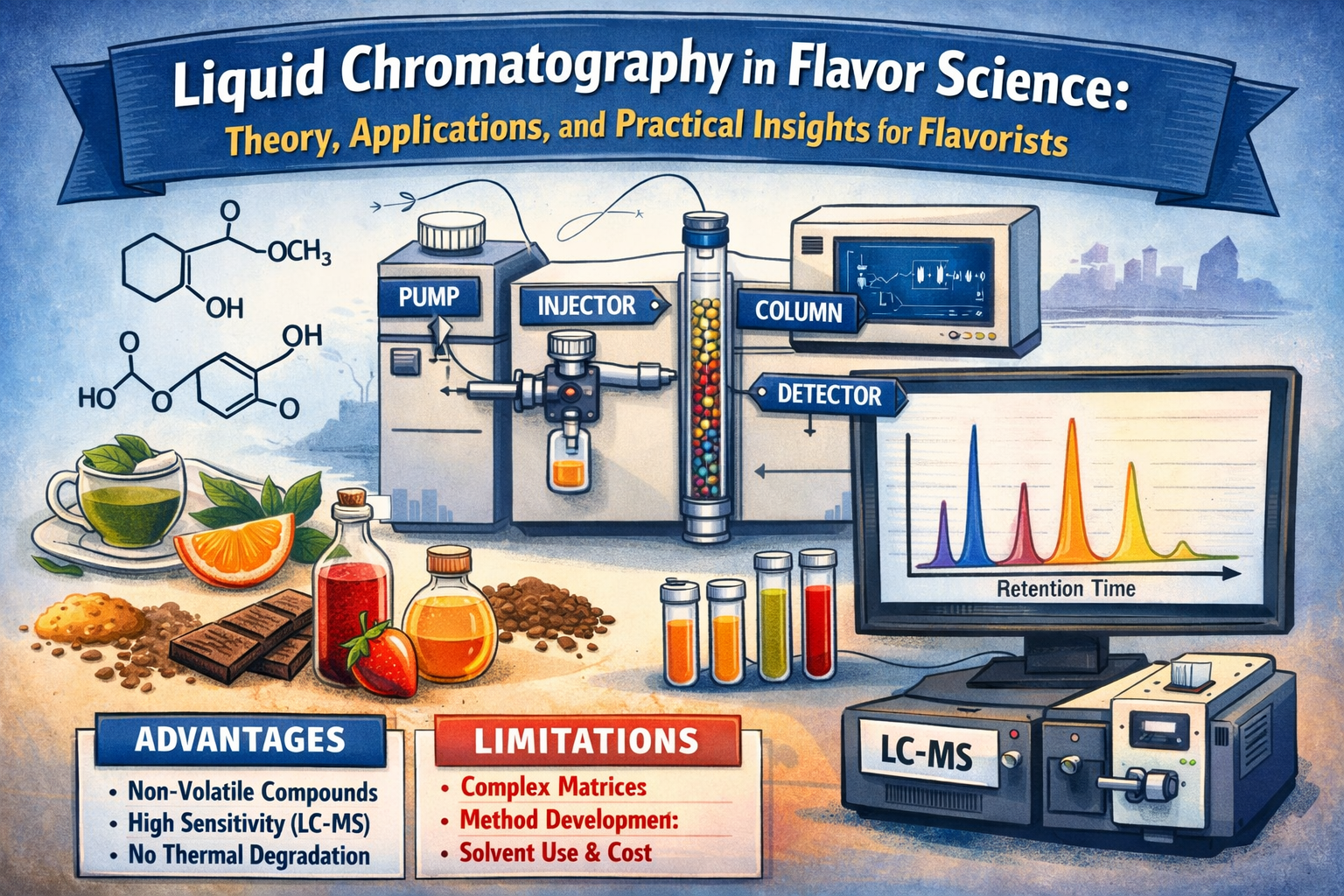
The Society of Flavor Chemists expects certified flavorists to understand the theory, function, reporting, relevance to the flavor industry, and advantages and limitations of more than a dozen instruments used to analyze food and flavor products. These instruments are listed on the syllabus for the Society’s qualification exam. Among them is liquid chromatography.
1) Theory, Function, and Reporting
Theory
Liquid Chromatography (LC) separates components of a mixture based on their differential partitioning between a mobile phase (liquid solvent) and a stationary phase (solid or liquid-coated solid inside a column). The core theoretical principle is described by the van Deemter equation for LC, which relates plate height (HETP – theoretical plate height) to mobile phase linear velocity (u):HETP = A + B/u + C·u
- A (Eddy diffusion): Caused by multiple flow paths around packing particles. Minimized with small, uniform particles.
- B (Longitudinal diffusion): Negligible in LC compared to GC due to much lower solute diffusivity in liquids.
- C (Mass transfer resistance): The dominant term in LC. Time required for solutes to equilibrate between stationary and mobile phases. Reduced by using smaller particles and higher temperatures.
Separation is quantified by retention factor (k') : k' = (t_R - t_0)/t_0
where t_R = retention time of analyte, t_0 = dead time (unretained compound). Selectivity (α) and resolution (R_s) derive from these values.
Function
LC’s primary function is to separate, identify, and quantify non-volatile, thermally labile, or polar compounds that cannot be analyzed by gas chromatography (GC). The instrument (HPLC or UHPLC) pumps mobile phase through a column at high pressure (up to 1000+ bar in UHPLC). A sample injector introduces the mixture; as compounds elute, a detector (e.g., UV-Vis, diode array, evaporative light scattering, or mass spectrometer) generates a signal. The system functions to:
- Isolate individual analytes from complex matrices (e.g., food extracts, flavors).
- Provide qualitative identity via retention time matching and spectral data.
- Provide quantitative concentration via peak area or height.
Reporting
An LC report typically includes:
- Chromatogram: Plot of detector response (y-axis) vs. time (x-axis). Peaks represent separated compounds.
- Peak Table: Lists each peak with:
- Retention time (t_R)
- Peak area and height
- Area % (normalized)
- Resolution (R_s) between adjacent peaks
- Theoretical plates (N) and tailing factor
- Quantitation results: Concentration (ppm, mg/L, etc.) calculated via external standard calibration curve, internal standard method, or standard addition.
- System suitability parameters: e.g., %RSD of retention time/area for replicate injections, column pressure trace.
- Method conditions: Column type, mobile phase composition & gradient, flow rate, temperature, detector wavelength/parameters.
2) Relevance to the Flavor Industry
LC is indispensable in the flavor industry because many flavor-relevant compounds are non-volatile, heat-sensitive, or highly polar. Key applications include:
- Analysis of Non-Volatile Taste Compounds:
- Sweeteners: Aspartame, sucralose, steviol glycosides (requires LC for detection, often with ELSD or MS).
- Bitter compounds: Naringin (citrus), caffeine, theobromine.
- Sour/umami: Organic acids (citric, malic, lactic) – detected via LC-UV.
- Salty enhancers and nucleotides (IMP, GMP) – LC-MS/MS.
- Characterization of Natural Extracts:
- Vanilla: Vanillin and related glucosides (non-volatile precursors) analyzed by LC-UV.
- Chili: Capsaicinoids (non-volatile pungent principles) by LC-fluorescence.
- Licorice: Glycyrrhizin by LC-UV.
- Fruits: Anthocyanins (color and flavor-associated) and phenolic glycosides.
- Quality Control and Authenticity:
- Detecting adulteration: e.g., adding synthetic capsaicin to natural chili extract; synthetic steviol glycosides not matching natural profiles.
- Monitoring degradation: Oxidation of flavor precursors or breakdown of artificial sweeteners in beverage systems.
- Reaction Flavor Development:
- Monitoring Maillard reaction intermediates (non-volatile Amadori compounds) to control cooked/meaty flavor generation.
- Flavor Stability Studies:
- Tracking loss of preservatives (sodium benzoate, potassium sorbate) or colorants linked to flavor perception over shelf life.
3) Advantages and Limitations of Each Method
Note: “Each method” refers to common LC modes/methods relevant to flavor analysis: Reversed-Phase LC (RPLC), Hydrophilic Interaction LC (HILIC), Ion-Exchange LC (IEX), and LC-MS (when applicable).
| Method | Advantages | Limitations |
|---|---|---|
| Reversed-Phase (RPLC) – Most common (C18, C8 columns) | - Separates wide range of non-polar to moderately polar flavor compounds. - Excellent reproducibility and robustness. - Compatible with most detectors (UV, MS). - Gradient elution highly flexible. |
- Poor retention for very polar compounds (sugars, organic acids, small amines). - Cannot separate isomers of some glycosides easily without special stationary phases. - Requires organic solvent waste disposal. |
| Hydrophilic Interaction (HILIC) | - Excellent for polar flavor actives: sugars, sugar alcohols, small organic acids, amino acids, Maillard intermediates. - Uses high organic mobile phase → enhances MS sensitivity. - Complements RPLC for 2D-LC. |
- Long equilibration time (20+ column volumes). - Retention very sensitive to mobile phase pH and buffer concentration. - Some compounds show poor peak shape. |
| Ion-Exchange (IEX) | - Ideal for charged flavor molecules: organic acids (anion exchange), biogenic amines (cation exchange), nucleotides. - Can separate structural isomers of sulfonated or phosphorylated flavor precursors. |
- Requires salt gradients → incompatible with MS without desalting. - Limited to ionizable compounds. - Column re-equilibration slow. |
| LC-MS (Single Quad or Triple Quad) | - Highest specificity and sensitivity (ppb to ppt levels). - Allows identification via molecular weight and fragmentation (MS/MS). - Crucial for trace off-flavors (e.g., geosmin, 2-methylisoborneol) or allergen-derived peptides. |
- High instrument cost and maintenance. - Requires volatile mobile phases (no non-volatile buffers like phosphate). - Matrix effects (ion suppression/enhancement) from complex flavor extracts. - Not all flavor compounds ionize well (e.g., saturated hydrocarbons). |
General practical trade-off for flavor labs:
- RPLC-UV is the workhorse for routine QC of sweeteners, preservatives, and colorants (low cost, robust).
- HILIC-MS is required for sugar and amino acid profiling in natural flavor extracts.
- LC-MS/MS is the gold standard for authenticity and safety (e.g., pyrrolizidine alkaloids in herbal flavors), but too expensive for small flavor houses.
###