Mace as a Natural Flavoring: A Comprehensive Technical Guide
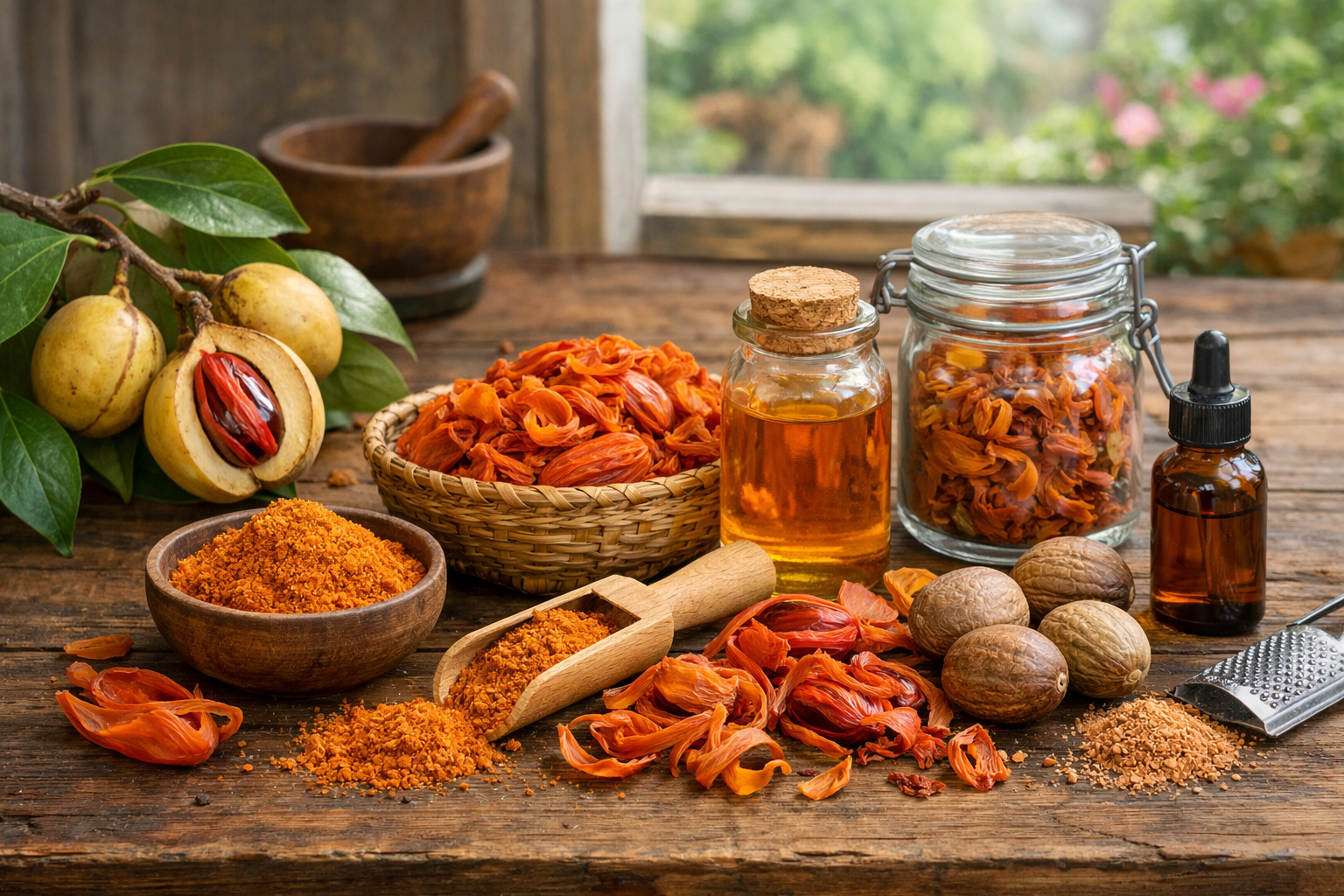
The Society of Flavor Chemists requires certified flavorists to be able to identify the plant part used, derivatives, organoleptic characteristics, and major chemical component(s) characterizing the aroma and flavor of the 80 natural flavorings listed on its syllabus for the qualification test and interview. Mace is included among these essential items.
Introduction
Mace is the dried, lacy covering (aril) that surrounds the nutmeg seed (Myristica fragrans Houtt.). Nutmeg and mace come from the same fruit—a member of the Myristicaceae family—but they are distinct spices with different flavor profiles. While nutmeg is derived from the seed kernel, mace is the bright red, web-like aril that envelops the seed. When dried, the aril becomes brittle and develops a characteristic orange-yellow to reddish-brown color.
For flavorists, mace offers a delicate, warm, sweet, and subtly spicy flavor that is more refined and less intense than nutmeg. Its aroma is often described as a blend of nutmeg, cinnamon, and pepper with a distinct floral, pine-like, and slightly fruity character. Mace is prized for its ability to add a subtle, warm complexity to light-colored sauces, baked goods, and savory dishes without darkening the color—an advantage over nutmeg in certain applications .
The key aroma components of mace are dominated by monoterpenes (primarily α-pinene, β-pinene, and sabinene) and the phenylpropanoid myristicin. Unlike nutmeg, which has a higher content of myristicin and other compounds that contribute to its more robust, sometimes "musty" character, mace has a more delicate, floral, and fresh profile.
Plant Parts Used
The aril (mace) is the plant part used for flavoring purposes. The following characteristics are notable:
- Source Plant: Myristica fragrans Houtt., a member of the Myristicaceae (nutmeg) family, native to the Banda Islands in Indonesia (the "Spice Islands").
- Fruit Description: The nutmeg fruit resembles an apricot. When ripe, the fruit splits open to reveal a bright red, lacy, fleshy aril (mace) surrounding a hard, dark brown seed (nutmeg).
- Mace Description: The aril is initially bright red, fleshy, and web-like. Upon drying, it becomes brittle, translucent, and develops an orange-yellow to reddish-brown color. The flavor is more delicate and refined than nutmeg .
- Harvesting: The fruit is harvested when ripe. The mace is carefully removed from the nutmeg seed, flattened, and dried (sun-dried or artificially dried). Drying takes 10–15 days.
- Essential Oil Content: Dried mace yields 5–15% essential oil (higher than nutmeg, which yields 5–10%) .
The essential oil is obtained by steam distillation of the dried mace. Mace oleoresin is also available.
Mace vs. Nutmeg: Critical Distinction
Flavorists must distinguish between mace and nutmeg, as they come from the same fruit but have different flavor profiles and applications.
| Characteristic | Mace | Nutmeg |
|---|---|---|
| Plant Part | Aril (lacy covering) | Seed kernel |
| Color (dried) | Orange-yellow to reddish-brown | Dark brown |
| Essential Oil Content | 5–15% | 5–10% |
| Primary Components | α-Pinene (20–40%), β-pinene (10–25%), sabinene (10–25%), myristicin (1–5%) | α-Pinene (10–20%), β-pinene (5–15%), sabinene (5–15%), myristicin (5–15%), elemicin |
| Aroma Profile | Delicate, warm, sweet, floral, pine-like, refined | Robust, warm, nutty, slightly "musty," more intense |
| Flavor Character | Subtle, elegant, less pungent | Bold, warm, pungent, slightly bitter |
| Color Impact | Does not darken light-colored sauces | Can darken light-colored sauces |
| Typical Use | Light sauces, white sauces, delicate baked goods, sausages | Dark sauces, eggnog, baked goods, spice blends |
Derivatives
Mace is commercially available in several forms. The following details include technical specifications important for procurement and formulation.
Mace Essential Oil
Production Method: Steam distillation of dried, crushed mace.
Description: Pale yellow to amber-yellow mobile liquid with a characteristic delicate, warm, sweet, and slightly spicy, floral, pine-like aroma. The oil has a fresh top note and a warm, persistent drydown .
Technical Notes: Yield is typically 5–15% from dried mace. The oil is dominated by α-pinene, β-pinene, and sabinene, with significant amounts of myristicin, terpinen-4-ol, and γ-terpinene . Storage in a cool, dry place away from light is recommended.
Mace Oleoresin
Production Method: Solvent extraction of ground mace, followed by solvent removal.
Description: Dark amber to reddish-brown viscous liquid or semi-solid containing both volatile and non-volatile components. Provides a more complete, full-bodied profile than the essential oil.
Technical Notes: Often standardized to a specific myristicin content or flavor intensity.
Dried Mace (Whole and Ground)
Production Method: Harvesting, flattening, and drying of fresh mace. Ground mace is produced by milling the dried mace.
Description: Whole mace consists of flat, brittle, orange-yellow to reddish-brown, lacy pieces. Ground mace is an orange-yellow to light brown powder with a characteristic delicate, warm, sweet aroma.
Technical Notes: Whole mace maintains potency longer than ground. Ground mace loses volatile oils rapidly. Store in airtight containers away from light and heat.
Mace CO₂ Extract
Production Method: Supercritical carbon dioxide extraction of dried mace.
Description: Yields a clean, solvent-free extract containing a wider range of components than the essential oil, including heavier, less volatile compounds.
Organoleptic Characteristics
Aroma Profile (Mace Essential Oil)
When evaluated, mace oil reveals a delicate, warm, and complex aromatic profile:
- Primary Note: Delicate, warm, sweet, spicy
- Terpenic: Fresh, pine-like, woody (from α-pinene, β-pinene)
- Floral: Sweet, slightly rose-like, lavender-like (from linalool, terpineol)
- Spicy: Warm, cinnamon-like, clove-like (from myristicin)
- Fruity: Subtle, berry-like, citrusy notes (from sabinene, terpinenes)
- Herbaceous: Slightly green, tea-like
- Nutmeg-Like: Subtle, refined nutmeg character (less intense than nutmeg oil)
The overall aroma is often described as "delicate, warm, and sweet with fresh, pine-like top notes and a refined, nutmeg-like, slightly floral drydown."
Taste Characteristics
At typical usage levels, mace provides:
- Warm: Gentle, lingering warmth
- Sweet: Pleasant, subtle sweetness
- Spicy: Delicate, cinnamon-like, clove-like notes
- Floral: Slight, sweet floral notes
- Piney: Fresh, clean top notes
- Bitter: Very subtle, pleasant bitterness in higher concentrations
- Smooth: More refined and less pungent than nutmeg
The Key to Mace's Unique Flavor
Mace's characteristic delicate, warm, sweet flavor comes from a combination of monoterpenes (fresh, piney top notes) and phenylpropanoids (warm, spicy notes):
Primary Components:
- α-Pinene (20–40%): A monoterpene hydrocarbon that provides fresh, pine, woody notes
- β-Pinene (10–25%): A monoterpene hydrocarbon that provides fresh, woody, pine-like notes
- Sabinene (10–25%): A monoterpene hydrocarbon that provides fresh, woody, slightly spicy notes
- Myristicin (1–5%): A phenylpropanoid that provides warm, spicy, nutmeg-like, slightly clove-like notes—contributes to the characteristic mace warmth
Supporting Components:
- γ-Terpinene (5–10%): A monoterpene hydrocarbon that contributes fresh, herbal, citrusy notes
- Terpinen-4-ol (1–5%): A monoterpene alcohol that contributes spicy, earthy notes
- Linalool (1–5%): A monoterpene alcohol that contributes fresh, floral notes
- α-Terpineol (1–5%): A monoterpene alcohol that contributes floral, lilac notes
- β-Caryophyllene (1–5%): A sesquiterpene hydrocarbon that contributes woody, spicy notes
The combination of high monoterpene content (fresh, piney) with myristicin (warm, spicy) creates the characteristic delicate, refined mace profile. Compared to nutmeg, mace has a higher proportion of monoterpenes (giving it a fresher, more pine-like character) and a lower proportion of myristicin and other heavier compounds (making it less pungent and more delicate).
Major Chemical Components
Key Aroma Compounds (Mace Essential Oil)
| Component | Typical Percentage | Organoleptic Contribution | CAS No. |
|---|---|---|---|
| α-Pinene | 20–40% | Fresh, pine, woody | 80-56-8 |
| β-Pinene | 10–25% | Fresh, woody, pine-like | 127-91-3 |
| Sabinene | 10–25% | Fresh, woody, slightly spicy | 3387-41-5 |
| γ-Terpinene | 5–10% | Fresh, herbal, citrusy | 99-85-4 |
| Myristicin | 1–5% | Warm, spicy, nutmeg-like, clove-like | 607-91-0 |
| Terpinen-4-ol | 1–5% | Spicy, earthy | 562-74-3 |
| Linalool | 1–5% | Fresh, floral, lavender-like | 78-70-6 |
| α-Terpineol | 1–5% | Floral, lilac | 98-55-5 |
| β-Caryophyllene | 1–5% | Woody, spicy | 87-44-5 |
| Limonene | 1–5% | Fresh, citrus | 138-86-3 |
Comparison: Mace vs. Nutmeg Oil Composition
| Component | Mace Oil (%) | Nutmeg Oil (%) |
|---|---|---|
| α-Pinene | 20–40 | 10–20 |
| β-Pinene | 10–25 | 5–15 |
| Sabinene | 10–25 | 5–15 |
| γ-Terpinene | 5–10 | 5–10 |
| Myristicin | 1–5 | 5–15 |
| Elemicin | trace | 1–5 |
| Terpinen-4-ol | 1–5 | 1–5 |
| Linalool | 1–5 | 1–5 |
| Aroma Profile | Delicate, fresh, piney, floral | Robust, warm, nutty, pungent |
Applications in Flavoring
Regulatory Status
Mace and its derivatives are approved as natural flavoring substances:
- United States: Mace is generally recognized as safe (GRAS). Mace oil is listed under 21 CFR §182.20 as a natural flavoring substance (FEMA No. 2650 for mace oil; FEMA No. 2648 for mace).
- European Union: Permitted for use in food flavorings under Regulation (EC) No 1334/2008.
- China: Approved food flavor under GB 2760.
Typical Usage Levels (mg/kg)
The following usage levels are based on FEMA GRAS determinations and industry standards:
| Application | Mace Oil (mg/kg) | Ground Mace (mg/kg) |
|---|---|---|
| Non-alcoholic beverages | 1–20 | N/A |
| Alcoholic beverages | 2–30 | 50–200 (infusion) |
| Baked goods | 5–50 | 200–1,000 |
| Hard candy | 5–60 | N/A |
| Frozen dairy | 2–25 | 100–500 |
| Gelatins and puddings | 2–25 | 100–500 |
| Soft candy | 5–40 | N/A |
| Chewing gum | 5–50 | N/A |
| Meat products (sausages) | 5–60 | 200–1,500 |
| Sauces and marinades | 5–40 | 200–800 |
| Cream sauces | 5–50 | 200–1,000 |
Note: These ranges represent typical industry usage. Mace oil is delicate but potent; start low and titrate.
Usage & Dosage Best Practices
Flavorists should observe the following guidelines when working with mace:
Start Low, Titrate: Mace oil is delicate but can become overpowering if overused. Begin at the lower end of typical usage ranges (e.g., 5–10 mg/kg in baked goods) and adjust upward.
Advantage Over Nutmeg: Mace does not darken light-colored sauces, making it the preferred choice for white sauces, cream soups, béchamel, and light-colored baked goods . Nutmeg, with its darker color, can darken these preparations.
Pre-Dilution: Pre-dilute mace oil in ethanol or propylene glycol for easier handling and more even dispersion.
Flavor Synergies: Mace pairs exceptionally well with:
- Cream sauces: Béchamel, Alfredo, cream soups (the classic pairing)
- Light-colored dishes: Creamed spinach, mashed potatoes, cauliflower, potatoes
- Sausages: Pork sausages, pâtés, terrines (especially European-style)
- Baked goods: Pound cake, doughnuts, sweet breads, cookies, pastries
- Seafood: Fish sauces, shellfish, crab, lobster (adds warmth without overpowering)
- Cheese: Cream cheese, brie, camembert, cheese sauces
- Poultry: Chicken, turkey (in stuffings and sauces)
- Vegetables: Spinach, potatoes, cauliflower, mushrooms
- Spices: Nutmeg, cinnamon, clove, cardamom, black pepper
- Fruits: Apples, pears (in desserts)
Flavor Applications: Mace serves as a primary flavor or modifier in:
- Light sauces: Béchamel, Alfredo, cream sauces, velouté
- Sausages: Pork sausages, breakfast sausages, pâtés, terrines
- Baked goods: Pound cake, doughnuts, sweet breads, cookies, spice cakes
- Seafood dishes: Fish sauces, shellfish, crab cakes, lobster bisque
- Vegetable dishes: Creamed spinach, mashed potatoes, cauliflower gratin
- Poultry: Chicken and turkey dishes, stuffings, pot pies
- Cheese dishes: Macaroni and cheese, cheese sauces, quiches
- Beverages: Some cocktails (mace-infused syrups), eggnog, spiced cider
- Spice blends: Poultry seasoning, sausage seasoning, spice cakes
Fragrance Applications
Mace oil is used in perfumery for:
- Spicy and oriental fragrances: Adds warmth and complexity
- Masculine fragrances: Adds a warm, spicy, aromatic character
- Aromatherapy: Used for its warming, comforting properties
Blends well with: Nutmeg, cinnamon, clove, cardamom, black pepper, bergamot, lavender, sandalwood.
Example Formula: Béchamel Sauce Flavor Base
The following formula demonstrates the use of mace oil as the signature flavor in a classic béchamel (white sauce) flavor system.
Béchamel Sauce Flavor Concentrate
| Component | Percentage (%) | Function | Technical Note |
|---|---|---|---|
| Mace oil | 40.0 | Primary spice | Delicate, warm, sweet, refined character |
| Butter flavor | 30.0 | Rich, creamy base | Essential for béchamel |
| Cream flavor | 15.0 | Dairy richness | Adds creaminess |
| White pepper oil | 5.0 | Subtle heat | Adds warmth without darkening |
| Onion oil | 5.0 | Savory base | Adds depth |
| Bay leaf oil | 5.0 | Herbal note | Adds complexity |
| Total | 100.0 |
Usage Instructions: Use at 0.05–0.2% in finished cream sauces, soups, or casseroles.
Alternative: Sausage Seasoning Flavor
| Component | Percentage (%) | Function |
|---|---|---|
| Mace oil | 35.0 | Delicate, warm spice base |
| Black pepper oil | 20.0 | Spicy warmth |
| Sage oil | 15.0 | Herbal note |
| Thyme oil | 10.0 | Herbal note |
| Nutmeg oil | 5.0 | Complementary warmth |
| Coriander oil | 5.0 | Citrusy, aromatic |
| Ginger oil | 5.0 | Warm, pungent note |
| Red pepper oil | 5.0 | Optional heat |
| Total | 100.0 |
Usage Instructions: Use at 0.1–0.3% in sausage meat or other meat products.
Alternative: Mace Tincture
| Component | Percentage (%) | Function |
|---|---|---|
| Dried mace (crushed) | 20.0 | Active ingredient |
| Ethanol (190 proof) | 80.0 | Solvent |
Method: Crush dried mace into small pieces. Combine with ethanol in a sealed container. Allow to macerate for 7–14 days, shaking daily. Filter. Store in amber glass bottles.
Usage Instructions: Use 0.1–0.5% in finished products.
Shelf Stability & Storage
Understanding the stability of mace ingredients is critical for maintaining flavor quality.
Mace Essential Oil
Storage Recommendation: Store in a full, airtight container in a cool, dry place away from light. Refrigeration is recommended for long-term storage.
Stability Notes: Mace oil contains high levels of monoterpenes (α-pinene, β-pinene, sabinene, γ-terpinene) that are susceptible to oxidation. Oxidation produces off-notes (turpentine-like, piney). Myristicin is more stable. Shelf life is typically 18–30 months when properly stored.
Dried Mace
Storage Recommendation: Store in airtight containers in a cool, dry, dark place.
Stability Notes: Whole mace maintains potency for 2–3 years. Ground mace loses volatile oils rapidly; use within 6–12 months.
Mace Oleoresin
Storage Recommendation: Store in airtight containers in a cool, dry place away from light.
Stability Notes: Oleoresins are generally stable for 12–24 months due to the presence of natural antioxidants.
Stability in Finished Products
- Heat stability: Monoterpenes are heat-sensitive; may degrade during high-temperature baking. For baked goods, slightly higher usage levels may be required.
- pH stability: Stable across typical food pH range (3–8).
- Oxidation: Monoterpenes are susceptible to oxidation; use antioxidants for long-shelf-life products.
- Light sensitivity: Protect from light.
Safety Considerations
General Safety
Mace and its derivatives are generally recognized as safe (GRAS) for use as flavorings at approved levels (FEMA 2648, 2650). However, they have safety considerations due to their chemical composition.
Important Considerations
- Myristicin Content: Mace contains myristicin (1–5%), a phenylpropanoid that can have psychoactive effects in large quantities . At typical flavoring levels, this is not a concern. However, ingestion of large amounts (tablespoons of ground mace) can cause symptoms such as nausea, dizziness, and hallucinations.
- Pregnancy: Should be used in normal culinary amounts; concentrated essential oil and medicinal doses should be avoided during pregnancy .
- Skin Sensitization: May cause skin irritation in sensitive individuals.
- Methyl Eugenol: Mace oil may contain trace amounts of methyl eugenol, which is subject to regulatory limits in some jurisdictions.
Maximum Usage Levels
| Form | Typical Maximum in Food |
|---|---|
| Essential oil | 0.01–0.05% (100–500 mg/kg) |
| Ground mace | 0.1–0.5% (1,000–5,000 mg/kg) |
Skin Safety
- Essential oil: May cause sensitization; dilute properly for topical applications.
- Protective measures: Wear suitable gloves when handling concentrated essential oil.
Quality Control & Sourcing
Flavorists should implement the following quality checks when sourcing mace ingredients.
Essential Requirements for Certificates of Analysis (COA)
For Mace Essential Oil:
- Botanical identity: Myristica fragrans Houtt. (aril)
- Origin: Indonesia (Banda Islands, Moluccas), Grenada, Sri Lanka, etc.
- α-Pinene content: 20–40% (GC analysis)
- β-Pinene content: 10–25%
- Sabinene content: 10–25%
- Myristicin content: 1–5%
- Physical properties: Specific gravity (0.880–0.930), refractive index (1.470–1.490), optical rotation (+10° to +25°)
For Dried Mace:
- Botanical identity: Myristica fragrans
- Physical appearance: Orange-yellow to reddish-brown, flat, lacy pieces
Common Adulteration Risks
- Mace oil: Dilution with nutmeg oil (different profile, higher myristicin); extension with terpenes (pinene, sabinene); mislabeling of origin
- Ground mace: Adulteration with ground nutmeg; addition of fillers; use of lower-grade mace
Sourcing Considerations
| Origin | Characteristics |
|---|---|
| Indonesia (Banda Islands) | Traditional origin; highest quality; complex, refined profile |
| Grenada | Good quality; well-established production |
| Sri Lanka | Good quality; similar to Indonesian |
Traditional and Culinary Applications
Traditional Uses
- European: Essential in béchamel sauce, cream soups, sausages, and pâtés
- British: Used in spice cakes, puddings, and Christmas fare
- Dutch: Used in speculaas spice blends
- Caribbean: Used in some spice blends and savory dishes (Grenada is a major producer)
Culinary Pairings
Mace pairs well with:
- Dairy: Cream, butter, milk, cheese (brie, camembert, cream cheese)
- Vegetables: Potatoes, spinach, cauliflower, mushrooms, carrots
- Proteins: Pork, sausage, poultry, fish, shellfish
- Spices: Nutmeg, cinnamon, clove, cardamom, black pepper, allspice
- Herbs: Sage, thyme, bay, parsley
- Fruits: Apples, pears, stone fruits (in desserts)
- Baked goods: Cakes, cookies, pastries
Traditional Recipe: Béchamel Sauce
Béchamel, one of the French mother sauces, traditionally includes mace as a key flavoring. The sauce is made by whisking milk into a roux (butter and flour) and simmering with onion, bay leaf, and mace .
Summary
Mace is the delicate, warm, and refined spice derived from the lacy aril covering the nutmeg seed. Its essential oil is dominated by monoterpenes (α-pinene, β-pinene, sabinene) that provide fresh, pine-like top notes, with myristicin (1–5%) contributing warm, spicy depth. Mace has a more delicate, less pungent, and more floral character than nutmeg, and it does not darken light-colored sauces—a key advantage in culinary applications.
Key characteristics:
- Primary components: α-Pinene (20–40%), β-pinene (10–25%), sabinene (10–25%), myristicin (1–5%)
- Aroma profile: Delicate, warm, sweet, pine-like, floral, refined
- Typical usage: Oil 1–60 mg/kg; ground 100–1,500 mg/kg
- Primary applications: Light sauces (béchamel), cream soups, sausages, light-colored baked goods, seafood dishes
Critical considerations for flavorists:
- Distinguish from nutmeg: Mace is more delicate, less pungent, and does not darken light-colored sauces.
- Advantage over nutmeg: Preferred for white sauces, cream soups, and light-colored dishes.
- Flavor synergies: Pairs with cream, butter, poultry, sausage, and seafood.
- Potency: Use at moderate levels (5–50 mg/kg); start low and titrate.
- Stability: Monoterpenes are susceptible to oxidation; store properly.
- Sourcing: Indonesian (Banda Islands) mace is traditionally considered the highest quality.
References and Further Reading
The information presented in this guide is synthesized from:
- Regulatory documents from FDA, FEMA (Nos. 2648, 2650), and international food safety authorities.
- Published scientific literature on Myristica fragrans.
- Standard textbooks on natural flavoring materials.
- Industry technical data from major suppliers.
- Traditional culinary knowledge documented in public domain sources.
Key References:
- FEMA Flavor Ingredient Library: Mace Oil (FEMA 2650), Mace (FEMA 2648)
- Journal of Essential Oil Research: Mace and nutmeg oil composition studies
- TGSC Information System: Mace Oil
Disclaimer: This article is for educational and training purposes only. When using mace in commercial products, always verify current regulatory status in your jurisdiction, conduct appropriate safety assessments, and source ingredients from reputable suppliers who can provide documentation of botanical identity, origin, and quality. Mace contains myristicin; use at approved flavoring levels. The formulas and usage levels provided are illustrative examples and may require adjustment based on specific product requirements and regulatory compliance.
###