National Sanitation Foundation - What a Flavorist Needs to Know
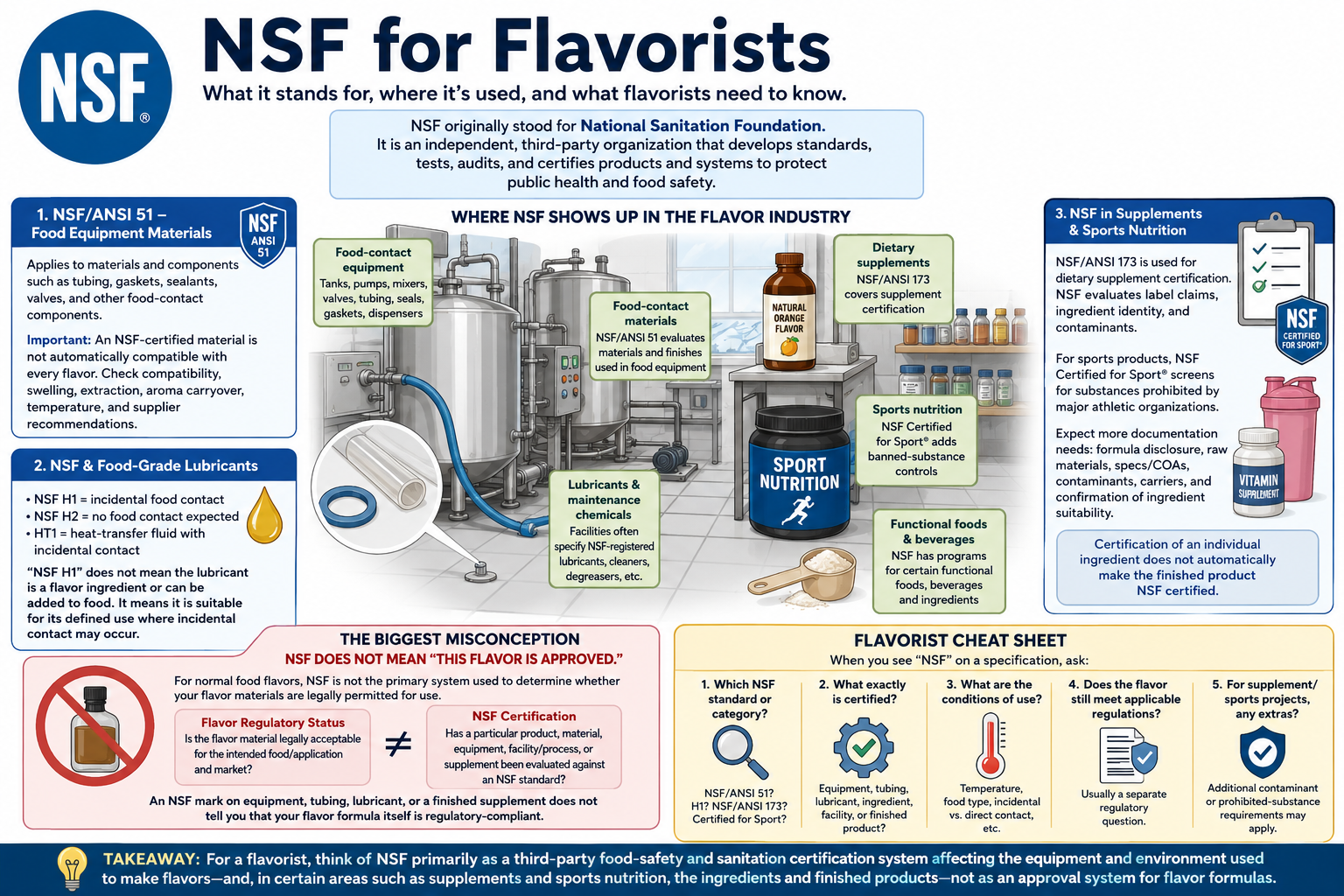
NSF — What a Flavorist Needs to Know
NSF originally stood for National Sanitation Foundation. It was founded in 1944 to develop sanitation and food-safety standards. Today, the organization officially uses the name NSF because its activities extend well beyond sanitation. It is an independent third-party standards, testing, auditing, and certification organization—not the U.S. National Science Foundation.
Where NSF shows up in the flavor industry
For most flavorists, NSF is more relevant to the equipment, processing environment, and certain customers than to the actual flavor formula.
| Area | Why a flavorist may encounter NSF |
|---|---|
| Food-contact equipment | Tanks, pumps, mixers, tubing, valves, hoses, seals, gaskets, dispensers, and other surfaces that may contact a flavor or food product |
| Food-contact materials | NSF/ANSI 51 evaluates materials and finishes used in food equipment for factors such as material safety and suitability |
| Lubricants / maintenance chemicals | Food-processing facilities frequently specify NSF-registered lubricants, cleaners, degreasers, etc. |
| Dietary supplements | Flavors going into NSF-certified supplements may face additional ingredient documentation and contaminant requirements |
| Sports nutrition | Products pursuing NSF Certified for Sport® have additional banned-substance controls |
| Functional foods/beverages | NSF also has certification programs covering certain functional foods, beverages, and ingredients |
1. NSF/ANSI 51 — probably the most relevant equipment standard
NSF/ANSI 51: Food Equipment Materials applies to materials and components such as tubing, gaskets, sealants, valves, and other food-contact components.
For a flavorist, this matters when working with pilot plants, application labs, compounding equipment, or production equipment.
For example, if a citrus flavor concentrate is being pumped through flexible tubing, you may see specifications such as “NSF/ANSI 51 certified.” NSF listings can specify the permitted food-contact types and maximum use temperature for a material. (NSF International)
Important: an NSF-certified tube or gasket does not automatically mean it is chemically compatible with every flavor. Flavor systems can contain aggressive materials such as citrus oils, terpenes, ethanol, acids, or other solvents. You still need to check compatibility, swelling, extraction, aroma carryover, temperature, and supplier recommendations.
2. NSF and food-grade lubricants
Flavor-production equipment has pumps, bearings, filling equipment, mixers, compressors, and other moving parts. This is where you may hear terms such as:
- NSF H1 = lubricant permitted where incidental food contact may occur.
- NSF H2 = lubricant intended for areas where food contact is not expected.
- HT1 = heat-transfer fluid where incidental contact may occur.
NSF maintains its White Book™ directory of registered nonfood compounds used in food-processing environments. (NSF International)
For flavorists, the key point is:
“NSF H1” does not mean the lubricant is a flavor ingredient or can intentionally be added to food. It means it is suitable for its defined use where incidental contact may occur.
This distinction can matter during plant trials or investigations of an unusual off-note or contamination issue.
3. NSF becomes especially important in supplements and sports nutrition
If you are designing flavors for protein powders, hydration products, pre-workouts, nutrition products, or dietary supplements, NSF requirements may become much more visible.
NSF/ANSI 173 is used for dietary supplement certification. NSF evaluates areas including label claims, ingredient identity, and contaminants.
For sports products, NSF Certified for Sport® adds screening for substances prohibited by major athletic organizations.
So a customer developing an NSF-certified sports drink powder, for example, may ask the flavor supplier for much more documentation than a conventional beverage customer.
A flavorist may need to work with Regulatory/QA to provide things such as:
formula disclosure → raw-material information → specifications/COAs → contaminant information → processing aids/carrier information → confirmation of ingredient suitability
Also remember that certification of an individual ingredient does not automatically make the finished product NSF certified. NSF specifically notes that its dietary-supplement ingredient certification is not transferable to the finished product.
The biggest misconception for flavorists
NSF does not mean “this flavor is approved.”
For normal food flavors, NSF is not the primary system used to determine whether your aroma chemicals, extracts, essential oils, carriers, or other flavoring materials are legally permitted for use.
A flavorist should mentally separate:
Flavor regulatory status
→ Is the flavor material legally acceptable for the intended food/application and market?
from
NSF certification
→ Has a particular product, material, piece of equipment, facility/process, or supplement been independently evaluated against a particular NSF standard?
An NSF mark on a mixer, hose, gasket, lubricant, or finished supplement therefore does not tell you that your flavor formula itself is regulatory-compliant.
NSF food-equipment certification principally evaluates areas such as material safety, hygienic design/cleanability, construction, and performance.
Flavorist cheat sheet
If you see “NSF” on a specification, don't simply interpret it as food grade. Ask:
- Which NSF standard or category? NSF/ANSI 51? H1? NSF/ANSI 173? Certified for Sport?
- What exactly is certified? The equipment, tubing, lubricant, ingredient, facility, or finished product?
- What are the conditions of use? Temperature, food type, incidental versus direct contact, etc.
- Does the flavor itself still meet applicable flavor/food regulations? Usually this is a separate regulatory question.
- For supplement/sports-nutrition projects, are there additional contaminant or prohibited-substance requirements?
One-sentence takeaway
For a flavorist, think of NSF primarily as a third-party food-safety and sanitation certification system affecting the equipment and environment used to make flavors—and, in certain areas such as supplements and sports nutrition, the ingredients and finished products—not as an approval system for flavor formulas themselves.
###