Nestle Pushes for Simpler U.S. Food Labels to Ditch 'Frankenstein' Image
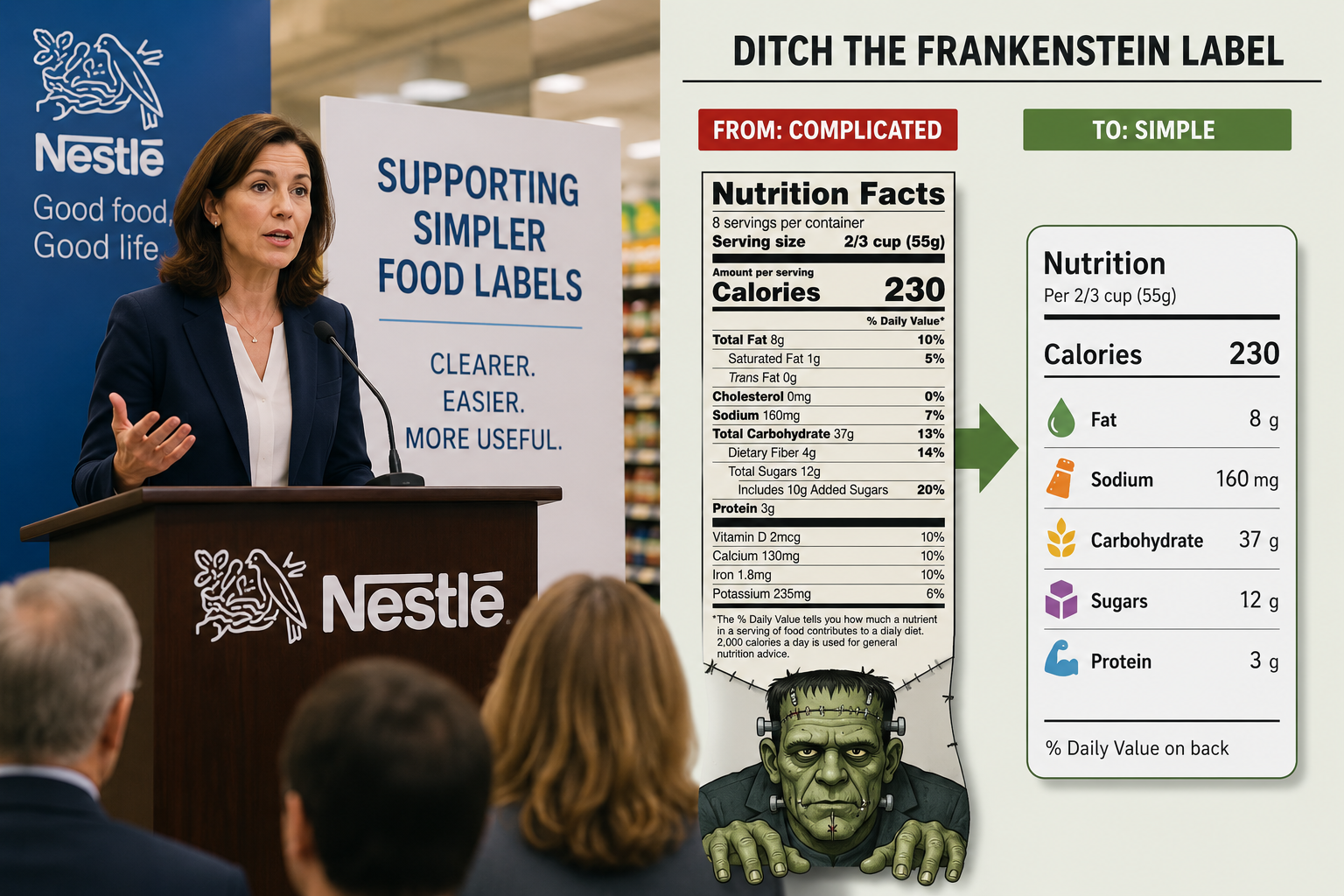
The food giant argues that technical terms on packaging scare consumers away from safe, natural ingredients.
In a move that could reshape the aisles of American grocery stores, food and beverage giant Nestle is quietly lobbying U.S. authorities to allow simpler, more consumer-friendly language on food labels . The Swiss company, known for brands like Nescafe and KitKat, wants to replace scientific terms like "ascorbic acid" with the more familiar "vitamin C" and "beta-carotene" with "vitamin A" .
At the heart of the issue is a growing consumer trend: shoppers are increasingly scrutinizing ingredient lists and turning away from products with long, unrecognizable names they associate with "Frankenstein food" .
"Sometimes the way we have to describe ingredients in the U.S. makes it sound like Frankenstein food," a former senior Nestle executive told Reuters. "In reality, it's actually a natural ingredient that consumers have a natural word for" .
The Regulatory Divide: U.S. vs. Europe
The push highlights a key difference in labeling rules. Current U.S. Food and Drug Administration (FDA) regulations often require ingredients to be listed by their specific "common or usual name," which can be highly technical . This can unintentionally stigmatize safe, naturally derived ingredients like vitamins.
In contrast, European regulations allow for more flexibility based on the ingredient's intended use. For example, ascorbic acid can be listed as an "antioxidant (ascorbic acid)," "ascorbic acid (vitamin C)," or simply "vitamin C" . This dual approach can make European labels more approachable to consumers.
A Battle for Consumer Trust
Nestle's lobbying is part of a broader industry effort to address the "clean label" movement . Consumers are demanding products with shorter, more recognizable ingredient lists, forcing companies to spend billions reformulating products to remove artificial colors, preservatives, and additives .
The company's chief technology officer, Stefan Palzer, confirmed that Nestle is engaging with trade associations to simplify labels, but acknowledged the challenge . He noted, “We try to reduce ingredients that are not understood by consumers whenever possible, without compromising on the safety, quality or functionality of the product” .
This effort aligns with the political climate, as the issue has been raised with Health Secretary Robert F. Kennedy Jr.'s team under the administration's "Make America Healthy Again" initiative .
Consumer Confusion and Industry Pushback
However, the proposal is not without its critics. Some public health advocates argue that using less scientific terms could be misleading and allow companies to be less transparent about additives . They worry that dumbing down labels could obscure the presence of ingredients some consumers actively wish to avoid.
Research shows a complex picture. While a significant number of consumers express concern about processed foods, their purchasing habits are often driven by factors like taste and affordability . A 2025 report by Innova Market Insights found that about three-quarters of North American consumers reconsider what they buy because of ingredient lists, yet many remain disengaged from the details .
Nestle is not alone in this lobbying effort. It is part of coalitions like the Americans for Ingredient Transparency, which includes other major players like Coca-Cola, PepsiCo, and Cargill, all arguing that technical names unfairly stigmatize safe, commonly used ingredients .
As the FDA continues its review of food-labeling policies, the debate over what constitutes a "simple" versus a "misleading" label is only set to intensify . For now, American shoppers may continue to see scientific names on their food labels, but the push to replace them with plain English is a clear signal of the changing tides in the food industry.
###