Non-GMO Project’s Non-UPF Verified Label Expands to More Than 300 Products as Demand for Food Processing Transparency Grows
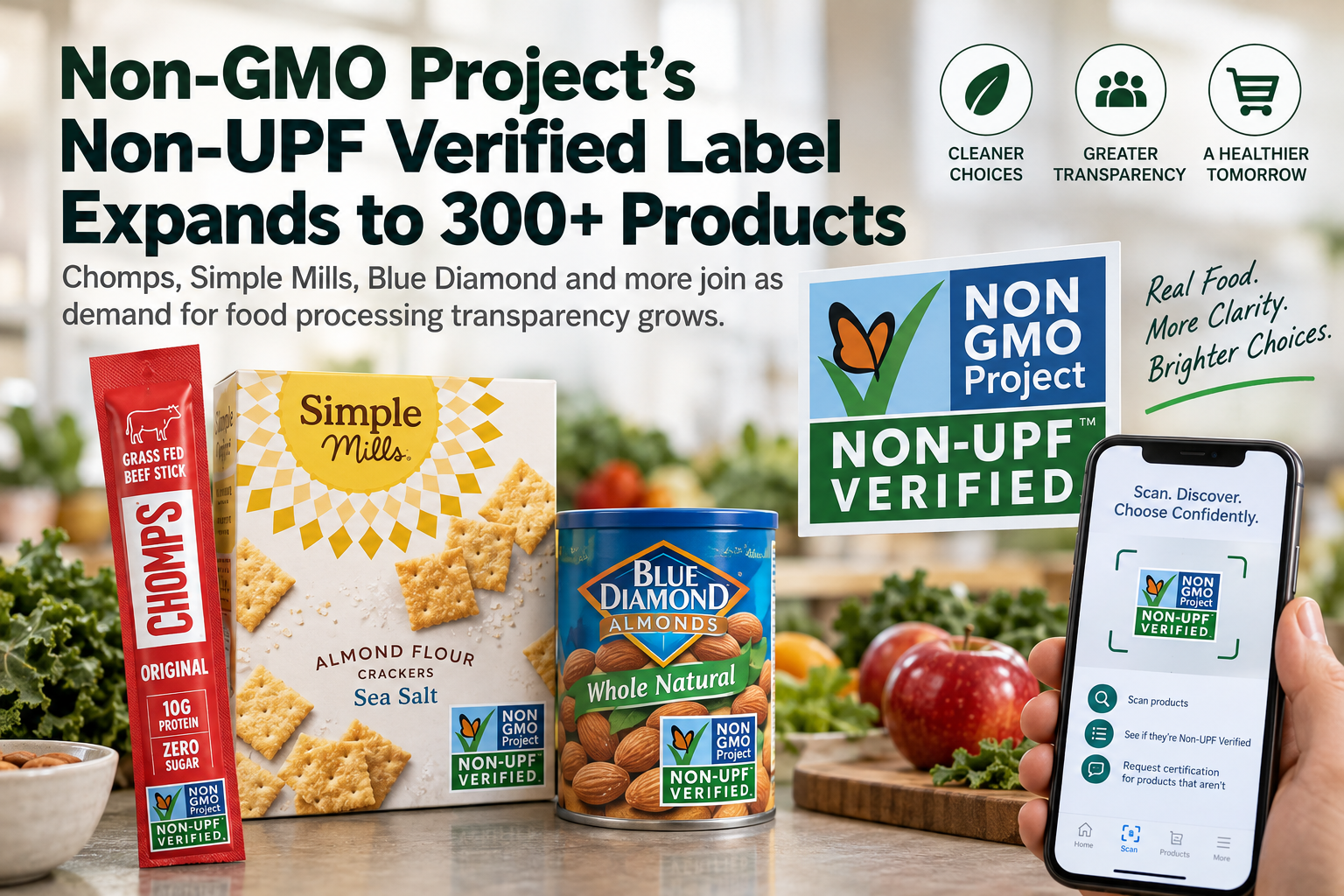
Tuesday September 22, 2026 – Major brands including Simple Mills, Chomps and Blue Diamond are adopting the Non-UPF Verified certification as consumers increasingly scrutinize ultraprocessed foods and how packaged products are made.
The Non-GMO Project’s Non-UPF Verified certification has expanded rapidly, with more than 300 food and beverage products across 23 brands now carrying verification that they meet the program’s standards for products that are not ultraprocessed.
The milestone represents significant growth for the certification program, which launched earlier in 2026 amid heightened consumer attention to ultraprocessed foods, commonly abbreviated as UPFs.
Participating brands now include well-known names such as Simple Mills, Chomps, Blue Diamond, Amy’s Kitchen and Spindrift, with verified products spanning 15 food and beverage categories. According to the program, another 41 brands are pursuing verification, suggesting that the number of certified products could continue to rise.
“When we launched Non-UPF Verified earlier this year, we knew people were asking deeper questions about how their food is made,” Megan Westgate, CEO of the Non-GMO Project, said in a statement cited by Food Dive. “Seeing more than 300 products achieve verification in a matter of months shows that brands are ready to meet that demand with greater transparency.”
What Is the Non-UPF Verified Label?
The Non-UPF Verified label is designed to help shoppers identify packaged foods that meet the program's criteria regarding the extent of processing.
Rather than focusing solely on calories, fat, sodium or other conventional nutrition measures, the verification considers how a product is made, along with the presence of certain additives and limits on refined added sugar.
That distinction is important because the debate surrounding ultraprocessed foods increasingly extends beyond traditional nutrition labels.
There is no single universally accepted definition of an ultraprocessed food. Much of the scientific literature relies on classification systems that distinguish foods according to the nature and extent of industrial processing. The widely used NOVA framework, for example, separates foods into categories ranging from unprocessed or minimally processed foods to processed culinary ingredients, processed foods and ultraprocessed foods.
UPFs commonly include industrial formulations made with ingredients or additives that are uncommon in home cooking, although determining whether an individual product should be considered ultraprocessed can sometimes be less straightforward.
The Non-UPF Verified program is attempting to translate that complicated discussion into a consumer-facing certification that can be recognized quickly on a package.
Consumer Concern About Ultraprocessed Foods Is Growing
The expansion comes as ultraprocessed foods receive increasing attention from consumers, researchers, policymakers and the food industry.
Research from Cornell University published in 2026 found that more than 60% of surveyed consumers believed ultraprocessed foods are addictive and are a major contributor to chronic diseases such as obesity, Type 2 diabetes and heart disease.
However, consumer understanding remains uneven.
While 58% of Americans surveyed had heard of ultraprocessed foods, only about one-third felt confident that they could explain what the term means.
That gap between awareness and understanding creates an opportunity for certification programs such as Non-UPF Verified. Instead of requiring shoppers to interpret complicated ingredient lists or processing methods themselves, the seal is intended to provide a simple indicator that a product has undergone third-party verification against a defined standard.
It is important, however, to distinguish consumer perceptions from scientific conclusions. A substantial body of research has found associations between diets high in ultraprocessed foods and adverse health outcomes, but researchers continue to investigate why those associations occur and how much is attributable to processing itself versus factors such as nutrient composition, energy density, eating patterns and other characteristics of foods categorized as UPFs.
Non-UPF Verified Launches Barcode-Scanning App
The Non-GMO Project is also expanding the certification beyond product packaging with a new consumer app.
Shoppers will be able to scan barcodes on packaged foods to determine whether products are Non-UPF Verified.
For products that have not received certification, consumers can use the app to request that the manufacturer pursue verification. According to the organization, these requests can provide food companies with a direct indication of consumer interest.
The strategy could turn shoppers into active participants in the certification program rather than simply users of the label.
For food manufacturers, those signals could provide additional insight into whether consumers are actively seeking products positioned as alternatives to ultraprocessed foods.
California Adds Momentum to the Non-UPF Labeling Debate
The certification's expansion also comes as governments begin examining how ultraprocessed foods should be defined and communicated to consumers.
California is moving toward what could become the first statewide non-ultraprocessed food labeling program in the United States, further elevating the debate around UPF definitions and disclosure.
The Non-UPF Verified program says its approach differs from California's proposed framework.
According to the organization, its certification places greater emphasis on the degree and nature of food processing, rather than relying primarily on a product's ingredient composition and nutritional profile.
“We welcome the growing conversation about food processing and the opportunity to bring more transparency to how food is made,” Westgate said.
“There is real value in policymakers, researchers, food makers and certifiers bringing their different perspectives to this work. For us, processing itself needs to be part of the conversation.”
The distinction highlights one of the central challenges surrounding ultraprocessed food policy: how exactly should an ultraprocessed food be defined?
Why Defining Ultraprocessed Foods Is Complicated
Unlike familiar nutrition metrics such as grams of sugar, sodium or saturated fat, the degree of food processing cannot always be captured with a single number.
Two packaged foods can have similar nutrition profiles while being produced through very different manufacturing processes. Conversely, products classified within the same processing category can have significantly different nutritional characteristics.
That has made UPF classification an increasingly important area of research and policy discussion.
The debate is particularly relevant to food manufacturers because any widely adopted definition could influence product formulation, marketing, packaging and consumer purchasing behavior.
Companies may face pressure to simplify ingredient lists, reconsider certain additives or processing methods, reduce refined added sugars, or provide consumers with more information about manufacturing processes.
Independent certification programs could therefore become another competitive factor in packaged food, much as Non-GMO, organic, gluten-free and other third-party certifications have become recognizable signals for consumers.
23 Brands Have Joined the Non-UPF Verified Program
According to Non-UPF Verified, brands with products that have received certification include:
- Amy’s Kitchen
- Big Tree Farms
- BjornQorn
- Blue Diamond
- Brothers-All-Natural
- Chomps
- Frontier Soups
- Go Raw
- Heray Spice
- Lovevery
- Maskal Teff
- next level
- NoWhere Foods
- Odds & Ends
- Olyra Foods
- Roots Farm Fresh
- Simple Mills
- Simply Sunflower
- SOFRESCO
- Spindrift
- Sunday Night
- The Yes Bar
One additional participating company has chosen not to be publicly identified, according to information provided by Non-UPF Verified to Food Dive.
What the Growth of Non-UPF Certification Means for Food Brands
Reaching more than 300 verified products within months of launch suggests that food processing transparency is becoming a more visible part of packaged-food marketing and product development.
For manufacturers, the trend creates both opportunities and challenges.
Brands that already use relatively simple formulations may see Non-UPF certification as another way to differentiate their products. Others may need to reformulate products or reconsider ingredients and manufacturing practices if they want to meet emerging certification requirements.
Retailers could eventually play a role as well. If consumer interest continues to increase, UPF-related certifications could become another attribute used for online product filters, in-store merchandising or wellness-focused product assortments.
At the same time, certification does not automatically establish that one individual product is healthier than another. Nutritional quality, dietary patterns, portion sizes and individual health needs remain relevant considerations alongside processing.
Food Processing Transparency Could Become a Major Industry Trend
The rapid expansion of Non-UPF Verified reflects a broader change in the conversation surrounding packaged food.
Consumers have long examined what is in their food. Increasingly, they are also asking how that food was made.
That shift could have significant implications for manufacturers.
If consumer awareness of ultraprocessed foods continues to increase — and governments, researchers and certification organizations develop clearer standards — processing methods may become a more prominent part of food labeling and marketing.
With more than 300 products already verified, 23 participating brands and another 41 brands seeking certification, the Non-GMO Project's initiative provides an early indication of how quickly that market could develop.
The larger question is whether “non-ultraprocessed” will evolve into a mainstream packaged-food claim, similar to the way non-GMO, organic and other labeling categories became established parts of grocery shopping.
For now, the growth of Non-UPF Verified suggests that food processing itself is becoming an increasingly important part of the transparency conversation between consumers and food companies.