North America Food & Flavor Business Roundup: November 1–15, 2026
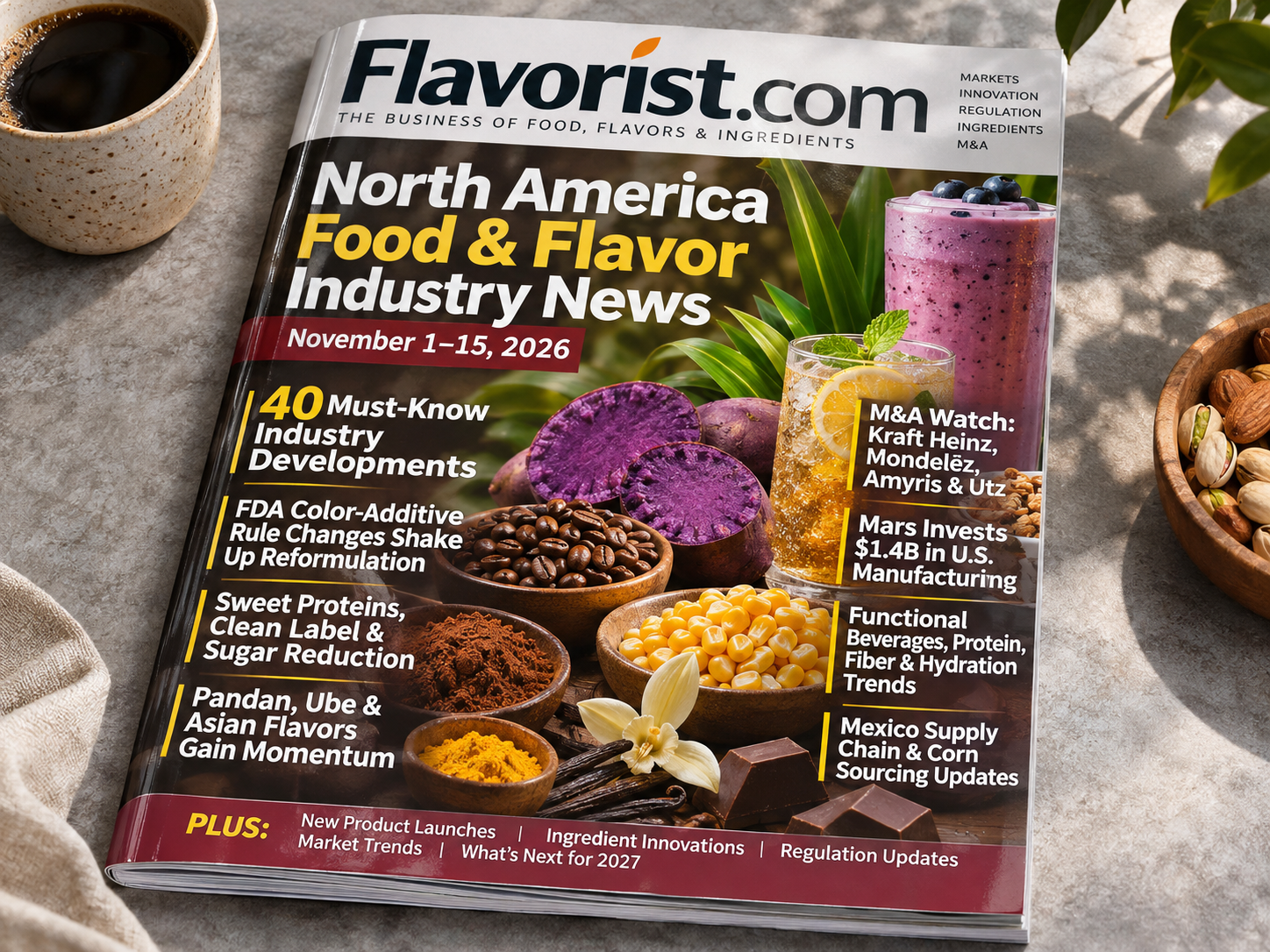
North America Food & Flavor Business Roundup: November 1–15, 2026
Flavorist.com Business Intelligence · United States, Canada and Mexico · Updated November 22, 2026
Deals and reformulation pressure defined the first half of November. Kraft Heinz agreed to sell its North American coffee business for $650 million, Mondelēz moved to buy Undercover Snacks, and Amyris agreed to acquire sweet-protein developer Oobli. The FDA revoked authorizations for three solvents used to make natural colors, Oterra launched a radish-based alternative to Red 40, and Mars announced a record $1.4 billion US manufacturing budget for 2027.
This roundup covers 40 developments published between November 1 and November 15, 2026, across the United States, Canada and Mexico. It includes acquisitions, investments, partnerships, leadership changes, earnings, regulation and food safety, ingredient and product launches, and consumer and market trends.
Pending deals, proposals and forecasts are labeled as such throughout.
Contents
- Mergers, acquisitions and ownership changes
- 1. Kraft Heinz agrees to sell its North American coffee business for $650 million
- 2. Mondelēz agrees to buy a majority stake in Undercover Snacks
- 3. Amyris agrees to acquire sweet-protein developer Oobli
- 4. Sazerac buys Full Sail Brewing for its production capacity
- 5. Core Home acquires Asian-flavored snack brand Tochi
- Investments and capacity expansion
- 6. Mars plans a record $1.4 billion US manufacturing investment for 2027
- 7. Good Protein raises C$128 million for plant-based shakes
- 8. Wixon completes a $25.6 million flavor and blending expansion
- 9. Buitoni consolidates refrigerated pasta and sauce production in Massachusetts
- 10. Coca-Cola FEMSA weighs a new bottling plant in southeastern Mexico
- Partnerships and supply agreements
- Leadership and restructuring
- Financial results
- Regulation and food safety
- 19. FDA revokes authorizations for solvents used to make natural colors
- 20. FDA's salt-substitute rule draws renewed attention ahead of its start date
- 21. Experts propose changes to food traceability before the 2028 deadline
- 22. FDA opens two Salmonella outbreak investigations
- 23. Mexico urges food manufacturers to buy more domestic white corn
- Ingredient innovation and product launches
- 24. Oterra launches a radish-based alternative to Red 40
- 25. Cargill launches Craftiva reduced-sugar syrups and sweeteners
- 26. ADM sees precision fermentation as a major growth area
- 27. AB Enzymes' Veron MaxiFresh draws North American bakery interest
- 28. Poppi's founders launch hydration brand Jetty
- 29. Just Ice Tea launches Awaken caffeinated cold-brew tea
- 30. Stellar Snacks launches olive-oil pretzel braids in six flavors
- 31. General Mills and Dunkin' launch co-branded cereals
- Consumer and market trends
- 32. Pandan emerges as a standout flavor
- 33. PepsiCo steps up protein, fiber and functional innovation
- 34. Clean-label expectations complicate reformulation
- 35. Experts question "GLP-1 friendly" labeling
- 36. Gut health moves into everyday foods
- 37. Online grocery sales rise 15.5% as store sales fall
- 38. Support for MAHA food policies extends well beyond its supporters
- 39. Tyson seeks partnerships to stabilize beef supply
- 40. Ardagh's metal-can sale adds uncertainty to beverage packaging
- What to watch
Mergers, acquisitions and ownership changes
1. Kraft Heinz agrees to sell its North American coffee business for $650 million
November 4 · United States, Canada · Divestiture · Coffee
Kraft Heinz has agreed to sell its North American coffee business to private equity firm One Rock Capital Partners for about $650 million. The brands include Maxwell House, Gevalia, Nabob, Yuban, Tassimo, Ethical Bean and Sanka. Kraft Heinz says it will focus on businesses more central to its long-term strategy.
Why it matters: New owners often review suppliers and repositioning plans. Coffee flavor suppliers, roasters and packaging companies could see new premiumization and innovation projects, along with procurement reviews.
Sources: Food Business News; Food Dive
2. Mondelēz agrees to buy a majority stake in Undercover Snacks
November 2 · United States · Pending acquisition · Better-for-you snacks
Mondelēz International plans to take a majority stake in Undercover Snacks, maker of chocolate-covered quinoa crisps. Terms were not disclosed, and the deal is expected to close in the first quarter of 2027. Undercover will run independently within Mondelēz North America Ventures, alongside Tate's Bake Shop, Perfect Snacks and Hu Chocolate, with founder Diana Levy staying on.
Why it matters: Large snack makers are paying for permissible indulgence. The deal supports demand for chocolate coatings, crunchy inclusions, alternative grain bases and new flavor pairings.
Sources: Food Dive; Food Business News
3. Amyris agrees to acquire sweet-protein developer Oobli
November 13 · United States · Pending acquisition · Sweeteners
Biomanufacturer Amyris plans to acquire Oobli, which uses fermentation to make sweet proteins including brazzein, monellin and thaumatin. These deliver sweetness at far lower concentrations than sugar. Amyris will combine Oobli's technology with its own strain engineering, fermentation capacity and sales network for food, beverage, flavor and fragrance markets. Terms were not disclosed.
Why it matters: Sweet proteins add a new route to sugar reduction alongside high-intensity sweeteners and polyols. Flavor houses should watch their scale-up, regulatory status, cost and performance, since sweetness is closely tied to bitterness masking, mouthfeel and aroma release.
Source: Food Business News
4. Sazerac buys Full Sail Brewing for its production capacity
November 5 · United States · Acquisition · Ready-to-drink beverages
Sazerac, owner of Fireball and BuzzBallz, has acquired substantially all the assets of Oregon craft brewer Full Sail Brewing, including equipment, brand and intellectual property. Sazerac says its long-term plans do not center on Full Sail's beer. The aim is to add production capacity for its wider portfolio, which increasingly includes ready-to-drink alcoholic beverages.
Why it matters: Growth in ready-to-drink cocktails supports demand for citrus, fruit and botanical flavors, sweetness balancing and shelf-stable flavor systems.
Source: Food Dive
5. Core Home acquires Asian-flavored snack brand Tochi
November 11 · United States · Acquisition · Snacks
Consumer products company Core Home has bought Tochi Snacks, its first move into food and beverage. Tochi makes salmon chips with 8 grams of protein and 5 grams of collagen per serving, and popcorn cooked in coconut oil, in flavors such as Korean barbecue, sriracha, salted egg, black sesame, milk tea and ube. Tochi will remain a separate brand. Terms were not disclosed.
Why it matters: Asian flavors keep moving into mainstream US snacking. Seasoning houses can develop authentic regional profiles that work across chips, popcorn and protein snacks.
Source: Food Business News
Investments and capacity expansion
6. Mars plans a record $1.4 billion US manufacturing investment for 2027
November 12 · United States · Planned investment · Confectionery and snacks
Mars plans to invest about $1.4 billion in US manufacturing and operations in 2027, its largest single-year US investment. It follows a $2 billion commitment covering 2025 and 2026, and Mars says it has invested more than $9 billion in US operations since 2017.
Why it matters: Heavy capital spending by a major customer usually precedes new procurement. Suppliers of flavor systems, compound coatings and inclusions should watch for plant-level announcements.
Source: Food Business News
7. Good Protein raises C$128 million for plant-based shakes
November 11 · Canada · Investment · Plant-based nutrition
Montreal's Good Protein, maker of dairy-free protein shakes, has closed a C$128 million investment and strategic partnership led by SEMCAP Food & Nutrition, with Canadian investors and Del Monte Corporation taking part. The funds will support Canadian growth, new products and possible expansion into other countries.
Why it matters: Plant-protein shakes depend on vanilla, chocolate, fruit and dessert flavors, plus masking and mouthfeel technology. Suppliers should follow the brand's new products and market entries.
Sources: Vegconomist; Lavery
8. Wixon completes a $25.6 million flavor and blending expansion
November 3 · United States · Completed expansion · Flavors and seasonings
Wixon has finished a $25.6 million expansion of its Wixon West facility near Milwaukee, more than tripling its footprint to over 350,000 square feet and adding about 110 jobs. The site now has five packaging lines, including a high-speed line, segregated blending suites, expanded quality and analytical labs, and more warehouse space, with room to grow.
Why it matters: Extra blending and quality capacity lets Wixon compete for larger and more technically demanding flavor and seasoning programs, sharpening competition among suppliers.
Source: Food Business News
9. Buitoni consolidates refrigerated pasta and sauce production in Massachusetts
November 12 · United States · Manufacturing consolidation · Refrigerated foods
Buitoni Food Co., part of Artisan Chef Manufacturing, will consolidate refrigerated pasta and sauce production at its plant in Lawrence, Massachusetts.
Why it matters: Consolidation often brings supplier requalification. Suppliers of cheese flavors, herb blends, tomato systems and pasta fillings should watch for sourcing changes.
Source: Food Business News
10. Coca-Cola FEMSA weighs a new bottling plant in southeastern Mexico
November 2 · Mexico · Proposed investment · Beverages
Coca-Cola FEMSA is evaluating a new plant in southeastern Mexico to cut transport costs, since some drinks sold there are made in Toluca. Location, capacity and timing have not been confirmed. In the third quarter, consolidated volume rose 5.3% and revenue 10.9%, with Mexican volume up 4.2%.
Why it matters: A new plant would bring opportunities for flavor concentrate, sweetener, acidulant and packaging suppliers in the region.
Source: enAlimentos
Partnerships and supply agreements
11. LBB Specialties to distribute Palsgaard emulsifiers across North America
November 10 · United States, Canada, Mexico · Exclusive distribution agreement · Emulsifiers
LBB Specialties has signed an exclusive deal to distribute Palsgaard's plant-based emulsifiers and stabilizers in North America, with LBB providing sales, logistics and technical support. Palsgaard's range serves bakery, confectionery, ice cream, dressings, and fats and oils.
Why it matters: Emulsifiers shape texture, fat dispersion and flavor release. The deal widens access and technical help for manufacturers working on clean-label and plant-based recipes.
Source: enAlimentos
Leadership and restructuring
12. General Mills reorganizes into three operating segments
November 11 · United States · Restructuring · Packaged foods
General Mills will replace its four units (North America Retail, North America Pet, North America Foodservice and International) with three: Cereal, Snacks & International; Meals & Baking Solutions; and Pet. It will also create a single commercial function combining marketing, sales, consumer insights and analytics. The changes coincide with a CEO transition at the start of 2027.
Why it matters: General Mills is a major buyer of flavors, colors, sweeteners and baking ingredients. Suppliers should expect new decision-makers, purchasing structures and innovation priorities.
Source: Food Business News
13. Utz names a new CEO ahead of its $2.9 billion sale to Intersnack
November 9 · United States · Leadership · Snacks
John Lindeman will replace Howard Friedman as Utz Brands chief executive on December 1, ahead of German snack maker Intersnack Group's acquisition of Utz, announced in July at an enterprise value of about $2.9 billion. Utz's quarterly net sales fell 2.3% to $369.2 million amid inflation and softer spending.
Why it matters: The combination could bring European and US snack flavors together, though integration plans have not been announced. Seasoning and coating suppliers should watch for product localization projects.
Source: Food Dive
14. Celsius splits into three business units as Alani Nu drives growth
November 5 · United States · Restructuring · Energy drinks
Celsius Holdings is creating separate units for Celsius, Alani Nu, and Rockstar Energy & Emerging Growth, each with its own leadership. Third-quarter revenue rose 16.7% to about $847.2 million, with Alani Nu a key contributor.
Why it matters: Three distinct brand teams are likely to pursue different flavor directions, from mainstream fruit to wellness profiles and limited editions.
Financial results
Energy drinks and specialty sodas grew strongly, while confectionery and dressings felt the effects of cautious shoppers and a food safety event.
| Company | Period | Headline figure | What stood out |
|---|---|---|---|
| Monster Beverage | Q3 2026 | Net sales above $2.5 billion | About 47% of business outside the US |
| Celsius (story 14) | Q3 2026 | Revenue up 16.7% | Alani Nu growth |
| Hershey | Q3 2026 | Net sales up 3% | Weak convenience-store candy |
| Marzetti | Fiscal Q1 | Net sales down 2.4% | Cyclospora outbreak hit sales |
| Jones Soda | Latest quarter | Revenue up about 204% | Record quarter |
15. Monster grows sales despite aluminum and tariff costs
November 6–10 · United States · Quarterly results · Energy drinks
Monster Beverage reported third-quarter net sales above $2.5 billion despite higher aluminum costs and tariffs. Markets outside the US now make up about 47% of its business. Monster plans new and limited-time flavors and the return of some earlier successes.
Why it matters: Fruit, sour and tropical flavors remain central to energy drinks. As brands expand abroad, developers must adapt profiles to regional tastes and ingredient rules.
Sources: Food Business News; BevNET
16. Hershey flags weak convenience-store candy sales
November 6 · United States · Quarterly results · Confectionery
Hershey's third-quarter net sales rose 3%, but CEO Kirk Tanner said candy, gum and mint sales in convenience stores were especially weak, with the US category down nearly 5% in September. Shoppers are shifting some spending to mass retailers and online.
Why it matters: With consumers buying selectively, confectionery customers will look for value: cost-effective flavor systems, proven favorites and seasonal items with strong indulgence appeal.
Source: Food Dive
17. Marzetti's sales hit by the lettuce Cyclospora outbreak
November 4 · United States · Quarterly results · Dressings and sauces
Marzetti's fiscal first-quarter net sales fell 2.4% to about $481.5 million. A Cyclospora outbreak linked to recalled Taylor Farms lettuce dragged down sales of dressings, dips and croutons, cutting retail sales by an estimated 4% and foodservice by 2%. Freight and new-capacity startup costs also rose. Its acquisition of Japanese barbecue sauce brand Bachan's added about $17.8 million in sales.
Why it matters: A recall in one ingredient can hurt demand for related products. Sauce and seasoning suppliers should factor this into planning and keep traceability strong.
Source: Food Business News
18. Jones Soda triples its revenue
November 10 · United States · Quarterly results · Specialty soda
Jones Soda reported a record quarter, with revenue up about 204% year on year, helped by innovation such as Fallout-themed colas and new functional drinks. The growth comes from a small base and does not necessarily mean equivalent profit growth.
Why it matters: Specialty brands create openings for experimental, nostalgic and licensed flavor concepts.
Source: BevNET
Regulation and food safety
19. FDA revokes authorizations for solvents used to make natural colors
November 9 · United States · Final regulatory action · Colors
The FDA has revoked authorizations for methylene chloride, ethylene dichloride and trichloroethylene in the production of annatto extract, paprika oleoresin and turmeric oleoresin, and for methylene chloride in inks used to mark fruits and vegetables. Some uses had been abandoned by industry; the fruit-marking decision followed a petition citing cancer concerns. The changes take effect January 11, 2027. Annatto, paprika and turmeric colors themselves are not banned.
Why it matters: Users of natural colors and botanical extracts should confirm with suppliers how their materials are made and update specifications before the deadline.
Source: FDA
20. FDA's salt-substitute rule draws renewed attention ahead of its start date
November 10–13 · United States · Final rule · Sodium reduction
The FDA rule allowing salt substitutes in about 80 standards of identity, published October 13, received fresh coverage this period, including a Government Accountability Office review on November 13. It takes effect December 14, 2026, though some dairy provisions may be stayed. Substitutes must still be otherwise permitted and correctly labeled.
Why it matters: The rule makes sodium reduction easier in standardized foods, increasing demand for potassium-compatible masking, savory enhancers and reformulated seasonings.
Sources: US GAO; Federal Register
21. Experts propose changes to food traceability before the 2028 deadline
November 4 · United States · Industry analysis · Traceability
In an Institute of Food Technologists article, Bruce Welt argues that the FDA's Food Traceability Rule under FSMA Section 204, now enforced from July 20, 2028, focuses too much on collecting detailed Key Data Elements. He proposes automated tracking of Critical Tracking Events to find contamination sources faster. This is an expert proposal, not an FDA change.
Why it matters: Ingredient makers with complex supply chains should keep preparing for the current rule while watching for any shift in approach.
Source: Institute of Food Technologists
22. FDA opens two Salmonella outbreak investigations
November 12 · United States · Outbreak investigation · Food safety
The FDA posted two new Salmonella Enteritidis outbreak investigations on November 12. No food source had been identified when they were posted, so no product or company should be linked to them yet.
Why it matters: Suppliers of herbs, spices, seasonings and other ingredients should keep lot identification and microbiological controls ready in case tracebacks reach them.
Source: FDA
23. Mexico urges food manufacturers to buy more domestic white corn
November 9 · Mexico · Government policy · Corn
At the Second National Industrialized Corn Forum, Agriculture Secretary Columba Jazmín López called on food manufacturers to buy more Mexican white corn and honor commitments to farmers, promoting advance purchases and financing. The government highlighted price-risk coverage for about 1.775 million metric tons of corn and credit programs for growers.
Why it matters: Corn underpins tortillas, snacks, cereals and starches. Manufacturers in Mexico should watch how the push affects contracts, availability and prices.
Source: enAlimentos
Ingredient innovation and product launches
24. Oterra launches a radish-based alternative to Red 40
November 12 · North America · Ingredient launch · Natural colors
Oterra has launched ColorFruit Red Radish Powder as a natural-origin replacement for FD&C Red No. 40. It is designed for stability at neutral pH, through baking and extrusion, and over shelf life, for cereals, snacks, baked goods and icings. Oterra cites Innova Market Insights data showing that about 70% of US launches using synthetic colors in the year to October 2026 contained Red 40.
Why it matters: Color and flavor perception are linked, so suppliers can help manufacturers replace synthetic reds as regulatory and retailer pressure grows.
Source: enAlimentos
25. Cargill launches Craftiva reduced-sugar syrups and sweeteners
November 4 · United States · Product launch · Sweeteners
Cargill has launched Craftiva, a consumer brand of reduced-sugar syrups in Vanilla, Brown Sugar, Caramel, Cinnamon and Toasted Marshmallow, made with cane sugar, stevia and sea salt at 7 grams of sugar per serving. Its sweetener packets combine cane sugar and stevia at 5 calories each. Sales start on Amazon, with retail, social commerce and foodservice to follow.
Why it matters: An ingredient giant going direct to consumers shows demand for sugar reduction in coffee, tea and desserts, where sweetness, aftertaste and mouthfeel must be balanced.
Source: Food Business News
26. ADM sees precision fermentation as a major growth area
November 5 · United States · Corporate strategy · Ingredient technology
On its third-quarter earnings call, ADM named precision fermentation as a promising long-term growth area, especially for proteins, building on its existing fermentation assets and research. It also reiterated natural colors as an opportunity worth $80 million to $100 million in annual operating profit.
Why it matters: Fermentation-derived proteins and functional ingredients could offer more consistent, resilient supply. Flavor and ingredient makers should assess where the technology fits their portfolios.
Source: Food Business News
27. AB Enzymes' Veron MaxiFresh draws North American bakery interest
November 5 · North America · Ingredient coverage · Bakery enzymes
Food Business News reported on AB Enzymes' Veron MaxiFresh, an enzyme solution that keeps baked goods soft and fresh for longer by controlling starch changes as bread ages. The product was launched internationally in October; this is North American coverage, not a new launch.
Why it matters: Longer freshness cuts waste and supports wider distribution. Bakers should validate performance in their own recipes and storage conditions.
Sources: Food Business News; AB Enzymes
28. Poppi's founders launch hydration brand Jetty
November 9 · United States · Product launch · Hydration drinks
Allison and Stephen Ellsworth, who sold Poppi to PepsiCo in 2025, have launched Jetty, an everyday hydration brand of electrolyte powders and ready-to-drink beverages. Each drink has 100 milligrams of sodium, 310 milligrams of potassium, 100 milligrams of magnesium, B vitamins and prebiotics, with 6 grams of sugar and 45 calories. Flavors are Watermelon, Orange Mango, Fruit Punch, Black Raspberry and White Cherry, sold at Whole Foods Market and online.
Why it matters: Everyday hydration drinks pair fruit flavors with minerals, so masking electrolyte off-notes and balancing sweetness are key.
Source: Food Dive
29. Just Ice Tea launches Awaken caffeinated cold-brew tea
November 13 · United States · Product launch · Functional beverages
In a review of new functional drinks, Food Business News highlighted Just Ice Tea's Awaken, a cold-brew tea made with yerba mate, green tea and white tea with 120 milligrams of caffeine per serving, in Strawberry, Tropical and Honeydew Lime.
Why it matters: Tea-based energy drinks need fruit flavors that suit tea and solutions for astringency, bitterness and sweetness balance.
Source: Food Business News
30. Stellar Snacks launches olive-oil pretzel braids in six flavors
November 10 · United States · Product launch · Snacks
Stellar Snacks has launched olive-oil-baked pretzel braids at Sprouts Farmers Market in Maui Monk, Bold and Herby, Cinnamon Dolce, French Dijon, Elote and Spicy Flame.
Why it matters: The range shows how a familiar snack format can carry adventurous seasonings, from sweet-savory to herb blends and layered heat.
Source: Food Business News
31. General Mills and Dunkin' launch co-branded cereals
November 5 · United States · Product launch · Cereal
General Mills and Dunkin' have introduced cereals that bring the coffee chain's flavors into the cereal aisle.
Why it matters: Translating branded coffee and bakery flavors into dry cereal requires coatings that keep aroma and taste through storage and in milk, creating work for flavor suppliers.
Source: Food Business News
Consumer and market trends
32. Pandan emerges as a standout flavor
November 11 · United States · Flavor trend · Global flavors
Euromonitor International data presented at SupplySide Global show US new-product claims mentioning pandan rose 53% between the first quarter of 2025 and the second quarter of 2026. In hot drinks, pandan claims rose from five to 13. Pandan's grassy profile with vanilla and almond notes may help US acceptance. Pistachio and saffron were also flagged.
Why it matters: Pandan is worth adding to development pipelines for tea, coffee, bakery, confectionery, frozen desserts and nutrition drinks, paired with familiar notes.
Source: Food Business News
33. PepsiCo steps up protein, fiber and functional innovation
November 3 · United States · Product strategy · Snacks and beverages
PepsiCo is adding products with more protein and fiber, hydration drinks and snacks without artificial colors alongside its core range, tailored to needs such as fitness and daily wellness.
Why it matters: Adding protein and fiber brings bitterness, dryness and texture problems, and removing colors complicates reformulation. Taste modulation and mouthfeel expertise will be in demand.
Source: Food Dive
34. Clean-label expectations complicate reformulation
November 5 · United States · Consumer research · Clean label
Experts from Innova Market Insights and Ingredion say concern about ultra-processed foods is driving interest in clean label, though neither term has an agreed consumer meaning. Shoppers tend to associate clean label with natural ingredients, short ingredient lists and no artificial flavors, colors or preservatives, but expectations vary by category and demographic.
Why it matters: Demand for natural flavors and plant-based colors that match the performance of what they replace will keep growing.
Source: Food Dive
35. Experts question "GLP-1 friendly" labeling
November 5 · United States · Consumer trends · Nutrition
Industry experts warned at a Food Dive discussion that people taking GLP-1 weight-loss drugs are not one uniform market: some want protein-rich meals, others hydration, fiber or smaller portions. Brands built entirely around one medication trend may be vulnerable.
Why it matters: Smaller, nutrient-dense portions call for concentrated flavor delivery and better masking of protein and fiber off-notes, rather than medication-based marketing.
Source: Food Dive
36. Gut health moves into everyday foods
November 4 · United States · Market trend · Functional ingredients
Food Business News reports growing use of fiber, prebiotics and probiotics in foods, drinks and snacks, citing Market Research Future estimates of a global gut-health market worth about $55.1 billion in 2025 and a projected $115.2 billion by 2035. Examples include Darigold's Nutrition+ Whole Milk with prebiotic fiber.
Why it matters: Fiber and fermented ingredients affect flavor, viscosity, acidity and stability, creating demand for technical help keeping functional products enjoyable.
Source: Food Business News
37. Online grocery sales rise 15.5% as store sales fall
November 5 · United States · Retail data · Channels
Circana data show US online food and beverage sales rose 15.5% in the four weeks to October 4, 2026, while physical-store sales fell 2.8%. Total food and beverage sales fell by less than 1%.
Why it matters: Online channels offer a lower-risk way to test niche and unusual flavors before wider retail rollout.
Source: Food Dive
38. Support for MAHA food policies extends well beyond its supporters
November 10 · United States · Public opinion · Ingredient policy
Research from the University of Pennsylvania's Annenberg Public Policy Center found that about 26% of adults identify as Make America Healthy Again supporters, but nearly three-quarters back food-related policies associated with the movement.
Why it matters: Pressure on artificial colors, additives and processing is likely to last across political groups, so suppliers need reformulation expertise and strong documentation.
Source: Food Business News
39. Tyson seeks partnerships to stabilize beef supply
November 10 · United States · Supply chain · Beef
Tyson Foods says the future of its beef business depends on closer coordination with supply-chain partners, reflecting continuing pressure on large meat processors.
Why it matters: Tight beef supply affects frozen meals, soups, sauces and foodservice. It may increase demand for cost-efficient savory systems, beef flavors and blended-protein formats.
Source: Food Business News
40. Ardagh's metal-can sale adds uncertainty to beverage packaging
November 6 · North America · Supply chain · Packaging
Ardagh Group is moving to divest its metal-can business, raising questions for beverage makers about future capacity, terms and service from a major North American supplier. Smaller brands with less buying power are most exposed.
Why it matters: Can availability can delay drink launches. Flavor suppliers working with ready-to-drink customers should factor packaging constraints and minimum runs into launch plans.
Source: BevNET
What to watch
| Date | What to expect | Story |
|---|---|---|
| December 1, 2026 | John Lindeman becomes Utz CEO | 13 |
| December 14, 2026 | FDA salt-substitute rule takes effect | 20 |
| Early 2027 | General Mills CEO transition and new structure | 12 |
| January 11, 2027 | FDA color-solvent revocations take effect | 19 |
| Q1 2027 | Mondelēz–Undercover deal expected to close | 2 |
| 2027 | Mars' $1.4 billion US investment program | 6 |
| July 20, 2028 | FDA traceability rule enforcement begins | 21 |
- Sweetness is being reinvented. Amyris–Oobli, Cargill's Craftiva and PepsiCo's functional push all point to sugar reduction that must still taste right.
- Colors are under pressure. The FDA solvent revocations, Oterra's Red 40 alternative, ADM's natural-color ambitions and broad public support for ingredient reform signal more reformulation ahead.
- Portfolios are being reshaped. Kraft Heinz's coffee sale, Mondelēz's Undercover deal, the Utz–Intersnack combination and restructurings at General Mills and Celsius will change who buys and decides.
- Functional beverages keep multiplying. Hydration, caffeinated tea, gut health and energy drinks all depend on masking and balancing functional ingredients.
- Shoppers are selective. Weak convenience-store candy, falling store sales and rising online sales reward value and targeted innovation.