Oceania Food & Flavor Regulatory News: Key Updates from October 16–31, 2026
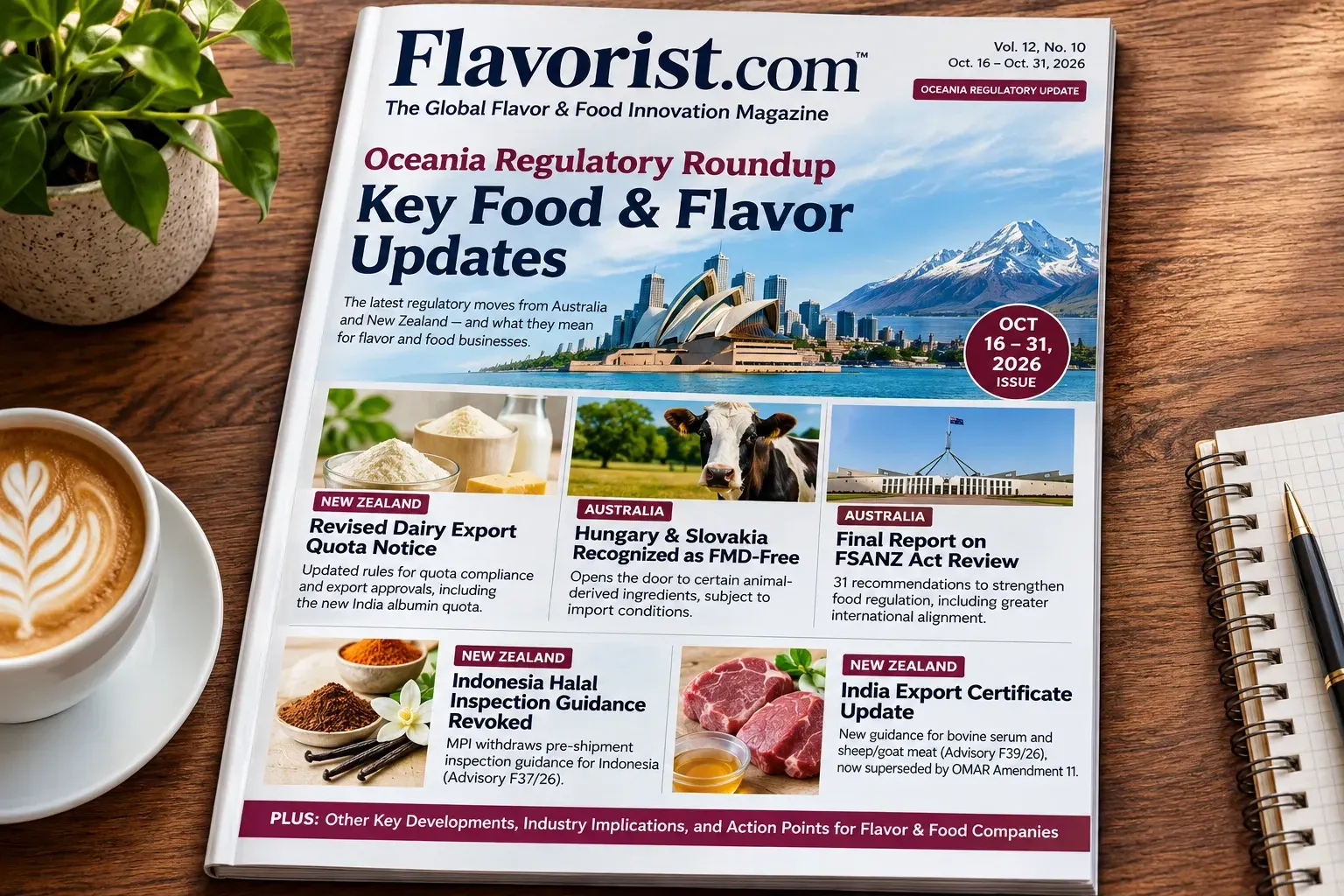
Oceania Food & Flavor Regulatory Roundup: October 16–31, 2026
Flavorist.com Regulatory Intelligence · Australia, New Zealand and the Pacific · Updated November 18, 2026
Food Standards Australia New Zealand (FSANZ) proposed making Health Star Ratings mandatory on most packaged foods, and the Australian Government published its final review of the FSANZ Act with 31 recommendations for reforming food regulation. New Zealand issued a binding dairy export quota notice to support its new free trade agreement with India, and Indonesia pushed back its halal certification deadline for imported food by two years.
This roundup covers 25 regulatory developments published between October 16 and October 31, 2026, in Australia and New Zealand. It covers food standards, pesticide residues, export and import rules, biosecurity, competition enforcement and product recalls. No significant food-specific regulatory changes from the Pacific Islands were identified for the period.
Proposals and consultations are not law. Each story states whether it is binding, proposed or guidance.
Contents
- Food standards and labeling
- Pesticides and agricultural chemicals
- 5. APVMA amends residue limits and proposes Food Standards Code changes
- 6. New Zealand proposes changes to agricultural residue limits
- 7. APVMA keeps phosphine fumigant labels unchanged ahead of a lower exposure limit
- 8. APVMA narrows its pre-application assistance
- 9. New Zealand consults on veterinary medicine labeling guidance
- Trade, exports and market access
- 10. Indonesia delays mandatory halal certification for imported food by two years
- 11. New Zealand issues a binding dairy export quota notice
- 12. New Zealand opens its first mānuka honey export quota for India
- 13. New Zealand revokes its Indonesia halal pre-shipment inspection advice
- 14. New Zealand updates India certificates for bovine serum and sheep and goat meat
- 15. Australia introduces a US health certificate for edible fats and tallow
- 16. Australia changes pre-clearance for lemons shipped to South Korea
- Imports and biosecurity
- Competition and food safety guidance
- Product recalls
- 21. Arla protein puddings recalled in Australia and New Zealand over possible glass
- 22. Farmdale long-life milk recalled over microbial spoilage
- 23. Maruto Castella cake recalled for undeclared egg and soy
- 24. Bomberry chocolate-covered fruit recalled over metal contamination
- 25. Maria's Pasta recalls six products over metal fragments
- What to watch
Food standards and labeling
1. FSANZ proposes mandatory Health Star Ratings on most packaged foods
October 28 · Australia, New Zealand · Public consultation · Front-of-pack labeling
FSANZ has opened a second consultation on Proposal P1067, revised after earlier feedback. Most retail packaged foods that carry a nutrition information panel would need a Health Star Rating, with some exemptions and prohibitions. The symbol's design and placement would be standardized, and ratings would be calculated with a prescribed algorithm.
FSANZ proposes a three-year transition plus a separate two-year stock-in-trade period. The system stays voluntary while the proposal is considered. Submissions close December 23, 2026.
Why it matters: A mandatory rating would push sugar and sodium reduction across much of the packaged-food range and require new nutrition calculations and packaging artwork. Companies can still shape the final rules through the consultation.
Source: FSANZ
2. Australia publishes its final review of the FSANZ Act
October 23 · Australia · Review report · Food regulatory system
The Australian Government has published the final report of its review of the Food Standards Australia New Zealand Act 1991 and FSANZ's operations. It makes 31 recommendations across 21 reform concepts, including stronger risk-based regulation, more use of international safety assessments and standards, better review of existing standards, changes to cost recovery and clearer guidance for industry. The recommendations are not law; Australia and New Zealand must agree on any legislative changes.
Why it matters: If adopted, the reforms could change how flavoring substances, processing aids and novel foods are assessed and approved, and closer alignment with international assessments could shorten approval routes.
Sources: Australian Government Department of Health; Full report (PDF)
3. FSANZ approves three new processing aids
October 29 · Australia, New Zealand · Gazetted amendment · Processing aids
Amendment No. 253 to the Australia New Zealand Food Standards Code amends Standard 4.5.1 and Schedule 18 to permit three processing aids: chitosan from mushrooms (Application A1306), triacylglycerol lipase produced by Komagataella phaffii carrying genetic material from Yarrowia lipolytica (A1338), and dextransucrase produced by Bacillus subtilis with a gene from Streptococcus salivarius (A1345). The amendment is binding.
Why it matters: Enzyme suppliers and processors gain new options, but must check each permission's technological function, production organism, specifications and conditions of use before commercial use.
Source: FSANZ
4. FSANZ consults on food from genetically modified wheat
October 20 · Australia, New Zealand · Public consultation · Genetically modified food
FSANZ is consulting on Application A1356 to permit food from genetically modified wheat carrying event UM-12115T-1. A rice-derived gene raises levels of nicotianamine, a compound involved in moving iron and zinc in plants. The wheat is mainly intended for feed but could enter food supply chains. FSANZ's preliminary assessment found no safety concerns compared with conventional wheat, and GM labeling rules would apply where novel DNA or protein is present. Food approval would not authorize cultivation, which is regulated separately. Comments close December 1, 2026.
Why it matters: Millers, bakers, cereal makers and users of wheat-derived ingredients should follow the application for its effect on sourcing and labeling.
Source: FSANZ
Pesticides and agricultural chemicals
5. APVMA amends residue limits and proposes Food Standards Code changes
October 20 · Australia · Gazette · Pesticide residues
The Australian Pesticides and Veterinary Medicines Authority (APVMA) has published Gazette No. 21, amending its Maximum Residue Limit (MRL) Standard and proposing changes to Schedule 20 of the Food Standards Code. The gazette also lists new registrations, approved labels and active constituents, and two insecticide safety recalls.
Why it matters: Users of botanical extracts, essential oils, fruit concentrates, herbs and spices should check the specific chemical–commodity changes, separate final amendments from proposals, and update residue specifications, especially for products moving between markets with different limits.
Source: APVMA
6. New Zealand proposes changes to agricultural residue limits
October 20 · New Zealand · Public consultation · Pesticide residues
New Zealand Food Safety is consulting on amendments to the Food Notice: Maximum Residue Levels for Agricultural Compounds. The proposal changes existing entries, adds new ones, removes an entry for a compound no longer authorized in New Zealand and restructures the notice. Chlorine dioxide is among the substances highlighted. Comments close December 19, 2026, and current limits apply until changes are final.
Why it matters: Suppliers of botanicals, fruit-derived flavor components, herbs and spices should check whether the proposed limits affect their specifications and testing.
Source: MPI
7. APVMA keeps phosphine fumigant labels unchanged ahead of a lower exposure limit
October 22 · Australia · Regulatory decision · Grain fumigation
APVMA and Safe Work Australia reviewed labels for the 33 approved products containing phosphine or aluminium or magnesium phosphide, ahead of a lower workplace exposure limit due December 1, 2026 (timing may vary by jurisdiction). Labels cite 0.3 parts per million for clearing fumigated grain and enclosures, which APVMA said serves a different purpose from the workplace limit. It concluded that label changes are not needed now but may revisit the issue if new evidence emerges.
Why it matters: Grain processors, warehouses and importers should check fumigation contractors' practices, ventilation and worker-exposure controls against the new limit as well as the labels.
Source: APVMA
8. APVMA narrows its pre-application assistance
October 20 · Australia · Procedural change · Chemical registration
For requests made from October 16, 2026, APVMA will generally give pre-application assistance only in four cases: government requests on biosecurity risks, planning for designated novel-technology applications, study-protocol reviews, and global joint reviews or other international collaborations. Applicants must first contact APVMA's enquiries team. Other requests may be considered for compelling reasons, and earlier requests follow transitional arrangements.
Why it matters: Developers of crop-protection products may face longer registration timelines, which could slow approval of new treatments for crops used in food ingredients.
Source: APVMA
9. New Zealand consults on veterinary medicine labeling guidance
October 20 · New Zealand · Public consultation · Veterinary medicines
MPI is consulting on the fourth draft update of its guidance on labeling veterinary medicines registered under the Agricultural Compounds and Veterinary Medicines (ACVM) Act 1997. It is guidance, not a food-labeling standard. Comments close December 1, 2026.
Why it matters: Clear treatment directions and withholding periods support residue control in meat, milk and eggs. Buyers of animal-derived ingredients should check suppliers' medicine-use and residue procedures.
Source: MPI
Trade, exports and market access
10. Indonesia delays mandatory halal certification for imported food by two years
October 19 · Australia, Indonesia · Market access advice · Halal
Australia's Department of Agriculture, Fisheries and Forestry (DAFF) has advised exporters that Indonesia announced on October 16 a revision to its halal regulation, PP42/2024, pushing the start of mandatory halal certification for relevant imported food and drinks back two years, to October 18, 2028. DAFF issued notices for edible non-prescribed goods, dairy, and fish and seafood, and is still seeking clarity on halal slaughter staff and pre-shipment conformity assessment. Existing halal requirements still apply.
Why it matters: Exporters of flavors, beverages, dairy ingredients and food to Indonesia gain time, but should keep checking current import rules and the halal status of flavor carriers, processing aids and animal-derived inputs.
Sources: DAFF edible products notice; DAFF dairy notice; DAFF seafood notice
11. New Zealand issues a binding dairy export quota notice
October 20 · New Zealand · Binding notice · Dairy exports
MPI has issued the Animal Products Notice: Regulated Control Scheme – Dairy Export Quota Products and Related Export Approvals 2026, which took effect October 23 and replaces the April 2024 version. It sets requirements for approved Quota Compliance Programmes, verification, export approvals, records and compliance for dairy exported under tariff quotas to markets including the EU, UK, US, Japan, India and the Dominican Republic. It also covers the new albumin quota under the New Zealand–India Free Trade Agreement.
Why it matters: Exporters of milk powders, cheese and albumins, including milk and whey protein concentrates, should review their programmes, approvals and records now. Non-compliance carries regulatory consequences.
Source: MPI
12. New Zealand opens its first mānuka honey export quota for India
October 23 · New Zealand · Export quota · Honey
MPI opened applications on October 23 for the 2027 mānuka honey quota under the New Zealand–India Free Trade Agreement, which took effect October 20. The India Export Quotas (Mānuka Honey Quota Management System) Regulations 2026, in force from October 22, set the allocation rules. Applications closed November 16, 2026.
Why it matters: Quota access will shape export pricing and commitments for honey suppliers. It does not replace authenticity, labeling and Indian import requirements.
Source: MPI
13. New Zealand revokes its Indonesia halal pre-shipment inspection advice
October 19 · New Zealand · Export advisory · Halal
MPI has issued advisory F37/26, Indonesia: Halal Pre-Shipment Inspections revoked, replacing earlier advice on Indonesia's pre-shipment inspection arrangements. This is separate from Indonesia's certification deadline extension (story 10). The full text was not available, so exporters should confirm the practical effect with MPI.
Why it matters: New Zealand exporters of food, dairy, meat and animal-derived ingredients should stop relying on the superseded instructions and use the current Indonesia market access requirements.
Source: MPI
14. New Zealand updates India certificates for bovine serum and sheep and goat meat
October 28 · New Zealand · Export advisory · Animal products
MPI advisory F39/26 updated export certificates for bovine serum and sheep and goat meat bound for India, following earlier advisories F34/26 and F38/26. MPI now lists F39/26 as superseded by India market access requirements Amendment 11. The detailed certificate changes were not independently confirmed.
Why it matters: Exporters handling these materials should check the latest consolidated India requirements and certificate templates before shipping.
Source: MPI
15. Australia introduces a US health certificate for edible fats and tallow
October 16 · Australia, United States · Export certification · Animal fats
DAFF Market Access Advice 2026-09 introduces a new health certificate, USEXT, for exports of rendered edible fats and oils, including tallow, to the United States. It became available in the Next Export Documentation System (NEXDOC) on October 16, following agreement with the US Food Safety and Inspection Service.
Why it matters: Exporters of edible animal fats should set up the new NEXDOC workflow and make sure shipment descriptions match the certificate's requirements.
Source: DAFF
16. Australia changes pre-clearance for lemons shipped to South Korea
October 16 · Australia, South Korea · Export procedure · Citrus
DAFF Industry Advice Notice 2026-53 changes pre-clearance for Australian lemons sent to South Korea under in-transit cold treatment, effective immediately for already-registered farms and packhouses. Existing pre-clearance still applies to oranges and to lemons treated onshore. Queensland growers seeking Korean accreditation for 2026 will receive further information.
Why it matters: Citrus exporters should update procedures and paperwork. Changes in export logistics can also affect the availability and cost of citrus for juice and flavor use.
Source: DAFF
Imports and biosecurity
17. Australia recognizes Hungary and Slovakia as free of foot-and-mouth disease
October 29 · Australia · Biosecurity status change · Animal-derived imports
DAFF has added Hungary and Slovakia to its foot-and-mouth disease (FMD)-free country list and related commodity lists. Recognition applies from September 10, 2025, for Hungary and October 31, 2025, for Slovakia, allowing some products from FMD-susceptible animals to be imported if all other conditions are met. Restrictions remain for products linked to earlier periods.
Why it matters: Importers of animal-derived ingredients, including meat- and dairy-based materials and animal-origin flavor components, gain new sourcing options but must check product eligibility, manufacturing dates and permit conditions.
Source: DAFF
18. Australia expands a digital biosecurity inspection trial for air cargo
October 29 · Australia · Trial program · Import administration
DAFF Import Industry Advice Notice 184-2026 announces an expanded trial of its Biosecurity Activity Reporting Tool from November 2026 for air-cargo operators under Class 14.3 Approved Arrangements. Participants can receive inspection directions, submit results and evidence, report incidents and receive release instructions digitally. Wider rollout depends on the results, and existing import controls are unchanged.
Why it matters: Importers of flavor ingredients by air may see faster, less paper-based inspection and release, affecting how they work with customs brokers.
Source: DAFF
Competition and food safety guidance
19. Perfection Fresh admits price fixing on vegetables supplied to ALDI
October 26 · Australia · Competition enforcement · Fresh produce
The Australian Competition and Consumer Commission (ACCC) says Perfection Fresh has admitted cartel conduct over prices for broccoli, cauliflower and iceberg lettuce supplied to ALDI in New South Wales in 2019 and 2020. The company and the ACCC will jointly propose a A$12 million penalty for nine contraventions and one attempted contravention, plus a compliance program, subject to Federal Court approval. Proceedings against other suppliers and individuals continue.
Why it matters: Food companies and buyers should review compliance rules on pricing talks and information sharing with competitors, including informal exchanges.
Source: ACCC
20. New Zealand's food regulator newsletter flags food control plan updates
October 30 · New Zealand · Regulatory guidance · Food Act 2014
MPI's October Food News, written for councils, food safety officers and verifiers, covers proposed updates to the Simply Safe and Suitable Food Control Plan template, the new New Zealand infant formula standard (already in effect before October), upgrades to the Food Act Verifiers Academy, training deadlines and exporter support. The food control plan changes are proposals.
Why it matters: Food service operators and small manufacturers should check that their food safety plans match current guidance and watch for the template changes.
Source: MPI
Product recalls
Recalls are not changes to the law, but they show where food safety controls are failing.
21. Arla protein puddings recalled in Australia and New Zealand over possible glass
October 24–28 · Australia, New Zealand · Product recall · Dairy desserts
In Australia, Arla Foods Mayer Australia recalled Arla Protein Salted Caramel Flavour Pudding (200 g, best before April 28, 2027), sold through Costco in New South Wales, and Arla Protein Chocolate Flavour Pudding (200 g, best before May 9, 2027), sold through Coles and independent retailers in New South Wales, Queensland and the ACT.
In New Zealand, Hutchinsons Ltd recalled Arla Protein Pudding Vanilla Cookie (200 g, best before April 26, 2027), imported from Denmark and sold through Woolworths, Fresh Choice and Foodstuffs stores. On October 28, MPI reported that recalled stock had been put back on sale at Pak'n Save Hornby in Christchurch on October 27–28. No injuries were reported.
Why it matters: Beyond glass and brittle-plastic controls, the New Zealand error shows that recalls also depend on quarantining stock so it cannot return to shelves.
Sources: FSANZ; MPI recall announcement; MPI recall update
22. Farmdale long-life milk recalled over microbial spoilage
October 23, updated October 26 · Australia · Product recall · Dairy
ALDI has recalled Farmdale Full Cream Long Life Milk (1 L, best before June 5, 2027) after microbial contamination causing spoilage was found. It was sold in ALDI stores and online in Victoria and South Australia, and at Albury and Lavington in New South Wales.
Why it matters: Makers of UHT and flavored milks should review thermal validation, aseptic filling, seal integrity and how they investigate complaints about odd odors or tastes.
Source: FSANZ
23. Maruto Castella cake recalled for undeclared egg and soy
October 26 · Australia · Allergen recall · Bakery
ALOG Australia Wholesale has recalled Maruto Nagasaki Castella Cake (238 g, best before January 25 and February 14, 2027) because the label did not declare egg and soy. It was sold through Asian grocery stores in New South Wales.
Why it matters: Importers must make sure translated and Australian labels reflect true composition. Flavor and bakery ingredient suppliers should check allergen statements for compound ingredients, emulsifiers and carriers.
Source: FSANZ
24. Bomberry chocolate-covered fruit recalled over metal contamination
October 28 · Australia · Product recall · Confectionery
Atomic Changes, trading as Bomberry, has recalled four 150-gram chocolate-covered blueberry and raspberry products with best-before dates up to January 20, 2028, over possible metal contamination. They were sold nationally through supermarkets, independents and online.
Why it matters: Coated-fruit makers need metal detection, equipment maintenance and supplier controls across both fruit processing and coating. The long date range shows why lot-level traceability matters.
Source: FSANZ
25. Maria's Pasta recalls six products over metal fragments
October 30 · Australia · Product recall · Prepared meals
Maria's Pasta has recalled Traditional Bolognese Pasta Sauce, Lasagna Bolognese, Spaghetti Bolognese, Penne Bolognese, and Prime Beef Ravioli and Tortellini in Bolognese Sauce over possible metal fragments. The products, with dates from October 30 to November 4, 2026, were sold through IGA and other Victorian independents and online.
Why it matters: One faulty shared input or line can affect many products. Sauce and seasoning suppliers should consider whether incoming materials could carry physical contaminants.
Source: FSANZ
What to watch
| Date | Deadline or event | Story |
|---|---|---|
| November 2026 | Digital biosecurity inspection trial for air cargo begins | 18 |
| December 1, 2026 | Comments close on GM wheat and NZ veterinary medicine labeling | 4, 9 |
| December 1, 2026 | Lower workplace exposure limit for phosphine due | 7 |
| December 19, 2026 | Comments close on New Zealand's proposed residue limits | 6 |
| December 23, 2026 | Submissions close on mandatory Health Star Ratings | 1 |
| Pending | Federal Court decision on Perfection Fresh's A$12 million penalty | 19 |
| October 18, 2028 | Indonesia's revised start date for mandatory halal certification | 10 |
- Labeling and approvals could change. Mandatory Health Star Ratings and the FSANZ Act review together could reshape both product labels and how new ingredients are approved.
- The India trade deal is now operational. A binding dairy quota notice, a mānuka honey quota and new certificate rules turn the agreement into day-to-day export compliance.
- Halal rules are moving. Indonesia's two-year delay and New Zealand's revoked inspection advice both require exporters to recheck current requirements.
- Residue limits are in flux on both sides of the Tasman. Australian amendments and New Zealand proposals mean ingredient specifications for botanicals, fruit and spices need checking.
- Physical contamination dominates recalls. Three of the five recalls involved glass or metal, and one exposed weaknesses in recall execution.