Oil-Soluble Flavors: Comprehensive Study Guide for Certified Flavorists
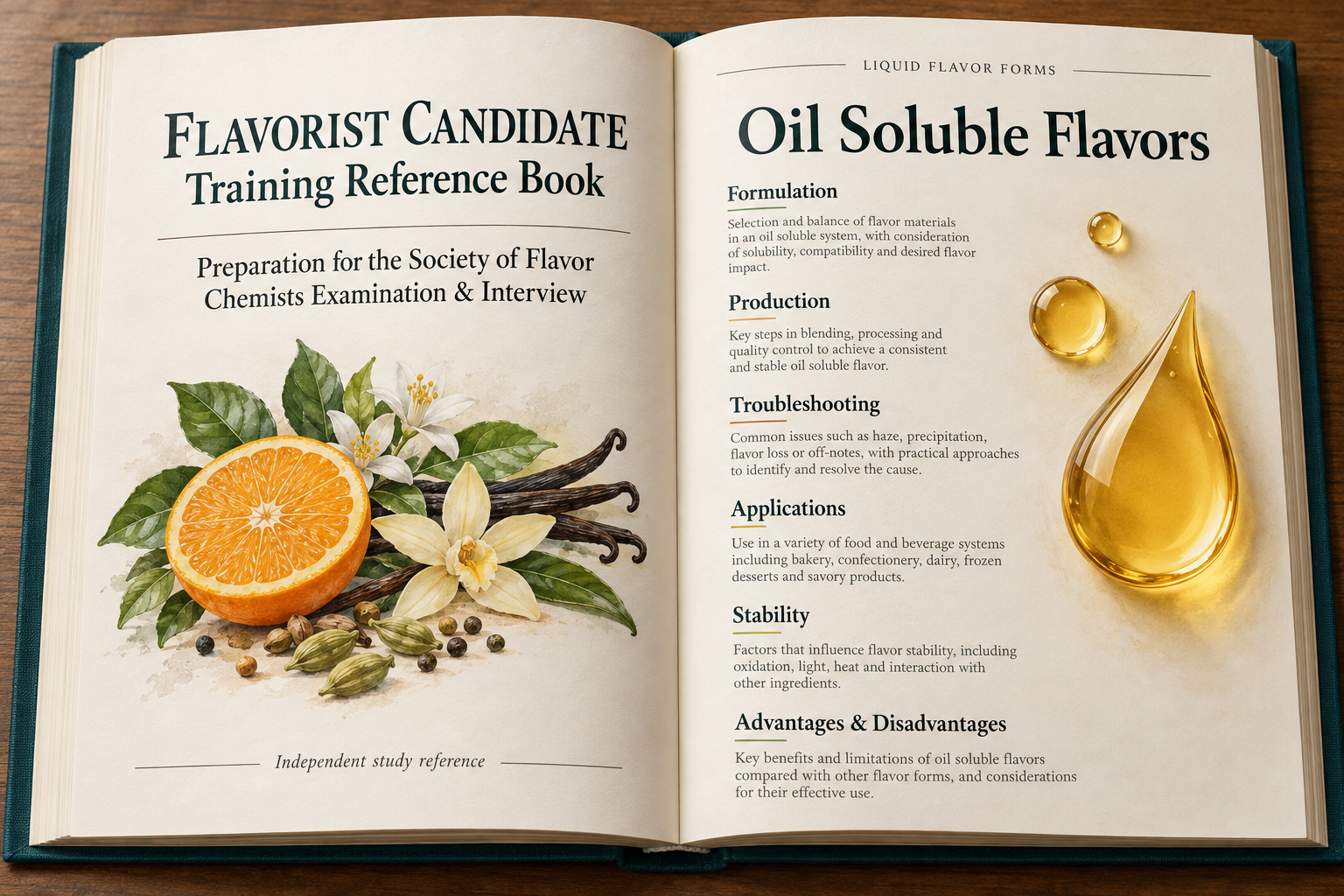
Society of Flavor Chemists (SFC) Syllabus • Section V: Flavor Forms • Certified Membership Examination Level
1. Introduction and SFC syllabus requirements
The January 2026 Society of Flavor Chemists (SFC) syllabus, Section V, explicitly identifies oil-soluble flavors as one of the liquid flavor forms that candidates must understand.
The syllabus requires candidates to be able to:
- Describe formulation.
- Explain production processes.
- Diagnose and troubleshoot problems.
- Identify appropriate applications.
- Evaluate stability considerations.
- Discuss advantages and disadvantages.
However, the syllabus does not prescribe specific formulations or detailed manufacturing procedures. The following is an expanded technical study guide built around those six examination requirements, integrating additional SFC subjects such as flavor chemistry, ingredient functionality, analytical testing, regulatory compliance, quality control, and flavor creation.
A flavorist should be able not only to explain what an oil-soluble flavor is, but also to design one independently, select appropriate carriers, manufacture it reproducibly, investigate instability, and demonstrate performance in a finished food application.
2. Definition and fundamental principles
An oil-soluble flavor is a liquid flavor preparation in which flavoring substances are dissolved in, or formulated to be compatible with, an oil or lipid-containing phase.
The system typically consists of:
- Lipophilic aroma chemicals.
- Essential oils or other oil-compatible natural flavoring materials.
- A food-grade oil carrier or suitable lipophilic solvent.
- Optional antioxidants and other technically justified components.
Oil-soluble flavors are especially useful in foods containing significant fat, including chocolate, confectionery coatings, bakery fats, fillings, cooking oils, and some savory products.
2.1 Oil-soluble versus water-soluble versus emulsified
Property | Oil-soluble flavor | Water-soluble flavor | Flavor emulsion |
|---|---|---|---|
Primary continuous phase | Oil or oil-compatible liquid | Water or aqueous-compatible solvent | Usually water |
Solubility | Oil-compatible | Water-compatible | Oil droplets dispersed in water |
Typical appearance | Clear to translucent | Clear to translucent | Cloudy or milky; sometimes translucent |
Water compatibility | Usually poor | Good at specified dilution | Good physical dispersion when properly formulated |
Oil compatibility | Generally good | Variable, often poor | Application-dependent |
Common applications | Chocolate, fats, coatings, fillings | Clear beverages, syrups | Cloudy beverages, bakery systems |
Major stability concerns | Oxidation, precipitation, volatility | Chemical degradation, clouding | Creaming, coalescence, oxidation |
Critical examination distinction: Oil-soluble does not necessarily mean 100% soluble in every edible oil at every concentration or temperature.
Furthermore, an oil-dispersible flavor is not necessarily a true oil-soluble flavor. A stable-looking liquid can contain suspended particles or droplets rather than a molecularly homogeneous solution.
2.2 Solubility versus partitioning versus release
These three concepts must be differentiated.
Solubility: Can the flavoring substance dissolve in the oil?
Partitioning: How does the substance distribute between fat, water, and air when the flavor is used in food?
Release: How quickly and effectively does the flavor reach the nose and retronasal olfactory receptors during consumption?
For example, a hydrophobic aroma compound may dissolve readily in a chocolate fat phase but be strongly retained by that phase, reducing its immediate headspace intensity.
A well-designed oil flavor must therefore be both physically compatible and sensorially effective.
2.3 The importance of partition coefficients
The octanol–water partition coefficient is often used as a preliminary indicator of hydrophobicity:
log P=log_10 (C_octanol / C_water)
A higher log P generally indicates greater preference for a nonpolar phase.
However, log P is not an actual vegetable-oil/water partition coefficient and does not by itself predict behavior in real foods.
In finished products, flavor release depends on several interacting factors:
- Actual oil/water and air/matrix partition coefficients.
- Lipid composition and concentration.
- Temperature and viscosity.
- Sugar, protein, and emulsifier interactions.
- Flavor dosage and volatility.
- Eating conditions and oral processing.
An expert flavorist connects these physicochemical properties with sensory performance rather than using solubility alone as the formulation criterion.
3. Formulation of oil-soluble flavors
3.1 Formulation objectives
Before selecting ingredients, the flavorist should establish the following:
Formulation parameter | Key question |
|---|---|
Flavor profile | What are the desired character, intensity, and aftertaste? |
Finished application | Chocolate, fat filling, frying oil, coating, or seasoning? |
Carrier compatibility | Which oils and fat systems must accept the flavor? |
Target dosage | At what concentration will it be used? |
Processing | Will the flavor encounter heat, mixing, aeration, or shear? |
Appearance | Must it remain optically clear? |
Storage | What are the expected temperature and shelf-life conditions? |
Regulatory | Which countries, claims, and labeling categories apply? |
Economics | What are the cost-in-use and manufacturing constraints? |
3.2 Selection of oil-soluble carriers
Carrier selection is one of the most important decisions in formulation because it affects physical compatibility, oxidation, sensory neutrality, viscosity, handling, and cost.
Principal carrier families and their technical characteristics
Carrier | Advantages | Disadvantages or limitations |
|---|---|---|
Medium-chain triglycerides (MCT; commonly C8/C10) | Relatively neutral odor, low viscosity, good oxidative stability, generally convenient handling | More expensive than some commodity oils; may behave differently in crystallizing fat systems |
Fractionated coconut oil | Good solvency for many lipophilic materials; relatively stable | Composition, melting characteristics, and sourcing requirements must be verified |
Refined sunflower oil | Widely available; useful in fat-based foods | Conventional high-polyunsaturated grades are oxidation-sensitive |
High-oleic sunflower oil | Improved oxidative stability compared with conventional sunflower oil | Cost and supply variation |
Refined canola oil | Economical, readily available | Residual odor and oxidation susceptibility depend on grade and quality |
Refined soybean oil | Economical and widely used | Unsaturation, allergen/source documentation, oxidation concerns |
Triacetin (glyceryl triacetate) | Useful co-solvent for certain aroma compounds; can improve compatibility with selected materials | Not universally miscible with all oils at all ratios; specific application and regional restrictions must be checked |
Other approved oil-compatible solvents | May address specialized solubility requirements | Regulatory permission, sensory effect, and finished-food limits must be evaluated individually |
MCT and refined edible oils are typically strong starting candidates for oil-based flavors. Triacetin is technically useful but requires special attention: it should not be assumed equivalent to a triglyceride oil carrier.
In the United States, triacetin is addressed under 21 CFR §184.1901, which establishes recognized functions and specified food categories subject to current good manufacturing practice.
Log in to read more.