OSHA Hazard Communication Standard (HazCom)
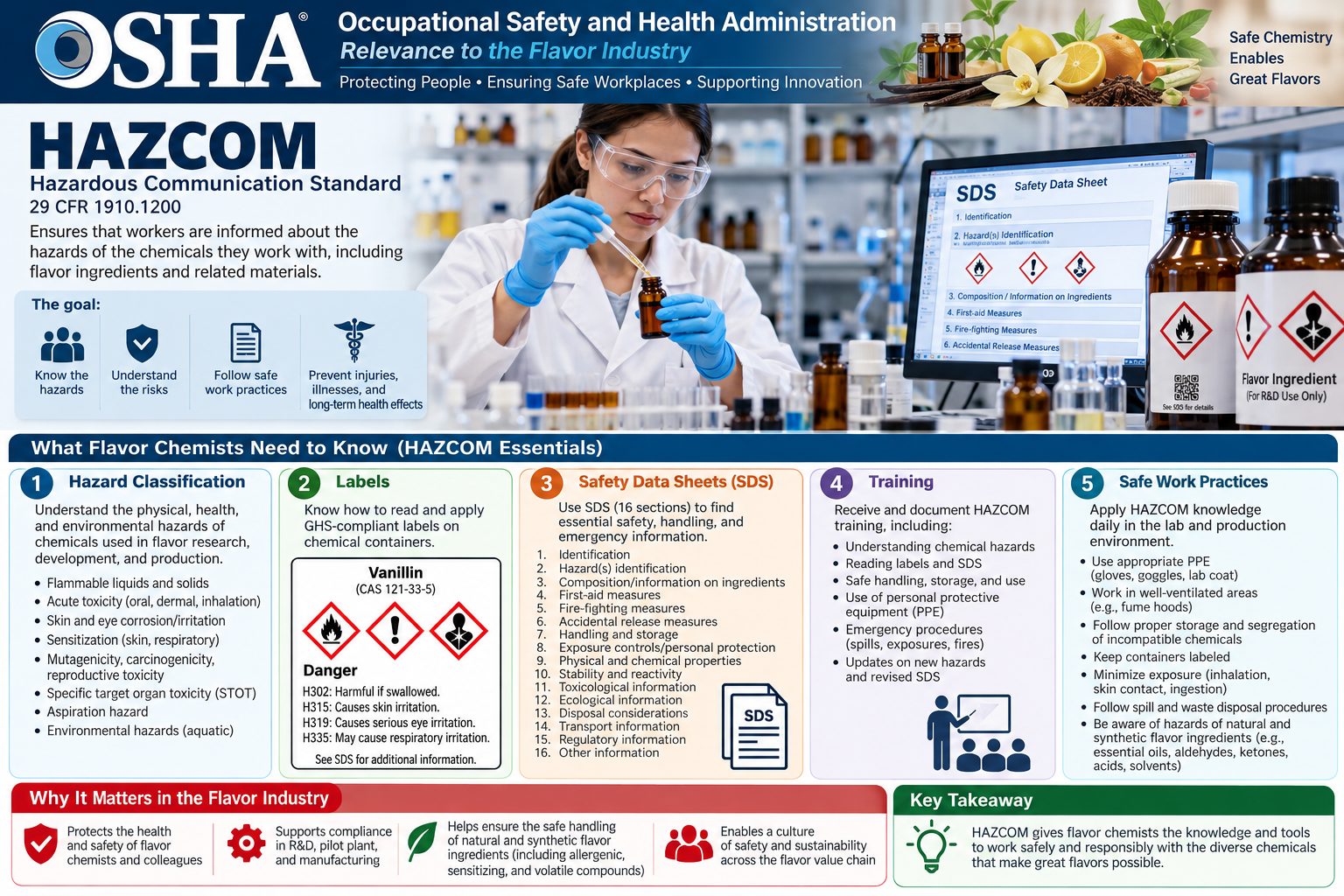
Hazard Communication Standard: Labels and Pictograms, released by OSHA
Below is a Comprehensive Study Guide for Flavor Chemists — Society of Flavor Chemists (SFC) Syllabus
1. Introduction: Why OSHA HazCom matters in the flavor industry
The Occupational Safety and Health Administration (OSHA) is a U.S. federal agency responsible for establishing and enforcing workplace safety and health standards.
The Hazard Communication Standard (HazCom or HCS), codified at 29 CFR 1910.1200, is designed to ensure that employees understand the hazards of chemicals they may encounter and know how to protect themselves.
The Society of Flavor Chemists (SFC) specifically includes OSHA — HAZCOM Hazard Communication Standard in its certification syllabus. The syllabus also covers Safety Data Sheets (SDS), laboratory procedures, raw materials, flash point testing, and other regulatory considerations.
This study guide expands that syllabus topic into the knowledge a flavor chemist should be able to explain and apply during written examinations, oral interviews, laboratory work, and flavor manufacturing.
Why is HazCom important for flavor chemists?
Flavorists routinely work with concentrated chemicals, including:
- Aldehydes, ketones, diketones, esters, alcohols, organic acids, and sulfur-containing compounds.
- Essential oils, oleoresins, natural extracts, and reaction flavor ingredients.
- Solvents such as ethanol, propylene glycol, triacetin, and ethyl acetate.
- Powders, spray-dried flavors, encapsulated flavorings, and other ingredients that may become airborne.
These ingredients may introduce physical hazards such as flammability or health hazards such as irritation, sensitization, or toxic effects from inhalation.
The most important distinction for flavor chemists:
A flavoring ingredient considered safe for consumption at its intended use level is not necessarily safe to inhale, handle in concentrated form, or expose to the eyes and skin.
For example, diacetyl (2,3-butanedione) is used for buttery flavor notes but occupational inhalation exposure has been associated with serious lung disease, including bronchiolitis obliterans.
Understand the difference between these regulatory concepts:
FDA / FEMA GRAS
Addresses safety under specified intended food-use conditions.
OSHA HazCom
Addresses chemical hazards and their communication in occupational settings.
A GRAS determination does not establish that a concentrated flavor ingredient is harmless by inhalation or skin contact.
2. Fundamental objectives of HazCom
The OSHA Hazard Communication Standard is often described as the Worker Right-to-Know Standard.
Its primary objectives are to:
- Identify and classify the physical and health hazards of chemicals.
- Communicate those hazards through standardized labels and Safety Data Sheets.
- Ensure employees receive appropriate chemical hazard information and training.
- Help employees understand protective measures and emergency procedures.
The standard uses the United Nations Globally Harmonized System of Classification and Labelling of Chemicals (GHS) as the basis for much of its classification and communication system.
Five essential HazCom elements
1. Hazard classification
Determine the physical, health, and other hazards covered by the standard.
2. Chemical labeling
Communicate hazards through chemical identifiers, pictograms, warnings, and precautionary statements.
3. Safety Data Sheets (SDS)
Provide standardized information on hazards, handling, storage, exposure controls, and emergencies.
4. Written HazCom program
Document how the employer communicates hazards and manages labels, SDSs, and chemical inventories where required.
5. Employee information and training
Teach employees to recognize chemical hazards, locate SDSs, and protect themselves.
3. Types of chemical hazards relevant to flavorists
HazCom distinguishes between physical hazards and health hazards. Flavor chemists should know the difference and be able to give examples.
A. Physical hazards
Physical hazards arise from characteristics such as flammability, instability, or reactivity.
| Hazard | Flavor industry relevance |
|---|---|
| Flammable liquids | Ethanol-rich flavors, ethyl acetate, citrus oils |
| Combustible dust | Certain powdered flavors, starches, sugars, maltodextrin |
| Reactive chemicals | Materials incompatible with oxidizers, acids, bases, or water |
| Gases under pressure | Compressed gases in laboratories and processing equipment |
| Corrosive to metals | Certain concentrated acids or alkaline solutions |
| Self-heating or other special hazards | Specific ingredients or preparations when classification criteria are met |
Example: An ethanol-based flavor may present a flash-fire hazard during large-batch mixing if flammable vapor accumulates and an ignition source is present.
The flash point is an important factor when classifying flammable liquids. OSHA's GHS-based flammable liquid categories include:
| Category | Flash point / boiling point criteria |
|---|---|
| 1 | Flash point below 23°C; initial boiling point at or below 35°C |
| 2 | Flash point below 23°C; initial boiling point above 35°C |
| 3 | Flash point 23°C to 60°C inclusive |
| 4 | Flash point above 60°C and at or below 93°C |
These are hazard classification categories, not automatic rules for every finished flavor or every transportation classification.
B. Health hazards
Health hazards involve adverse effects following chemical exposure.
| Hazard classification | Meaning for flavor chemists |
|---|---|
| Acute toxicity | Harmful effects after short-term exposure by oral, dermal, or inhalation routes |
| Skin corrosion or irritation | Tissue damage or irritation following skin contact |
| Serious eye damage or irritation | Eye injury from splashes or exposure |
| Respiratory sensitization | Potential for allergic-type respiratory reactions |
| Skin sensitization | Potential for allergic contact dermatitis |
| Carcinogenicity | Potential to cause cancer |
| Germ cell mutagenicity | Potential to cause heritable genetic mutations |
| Reproductive toxicity | Potential adverse effects on fertility or development |
| Specific target organ toxicity (STOT) | Toxic effects on particular organs after single or repeated exposures |
| Aspiration hazard | Serious lung injury if certain liquids enter the airways |
A chemical's hazard classification is determined from applicable evidence and OSHA criteria, not simply from its aroma, natural origin, or flavor use.
C. Routes of chemical exposure
A flavor chemist should be able to identify all four principal exposure routes.
Inhalation: Breathing vapors from concentrated flavor chemicals, heated flavors, aerosols, or flavor powders.
Skin absorption/contact: Exposure through chemical spills, handling concentrated ingredients, or contaminated gloves.
Eye contact: Splashes while pipetting, weighing, stirring, or transferring flavor ingredients.
Ingestion: Accidental transfer from contaminated hands or objects into the mouth.
In the flavor industry, inhalation deserves particular attention because volatile aroma chemicals may be present in workplace air even when their concentrations in finished foods are very low.
4. GHS hazard pictograms — essential examination knowledge
OSHA HazCom requires eight standardized hazard pictograms, depending on chemical classification. The GHS also contains an environmental hazard pictogram, but OSHA does not require it under its workplace HazCom standard.
Each OSHA pictogram is a black symbol on a white background inside a red diamond-shaped border. The eight required pictograms are:
| Pictogram | Meaning | Example of flavor industry relevance |
|---|---|---|
| Flame | Flammable or certain reactive materials | Ethanol, ethyl acetate, certain essential oils |
| Exclamation mark | Irritation, skin sensitization, harmful acute toxicity, certain other effects | Concentrated aroma chemicals with applicable classifications |
| Health hazard (human silhouette) | Carcinogenicity, respiratory sensitization, reproductive toxicity, STOT, aspiration hazard | Materials with confirmed classifications in these categories |
| Corrosion | Skin burns, serious eye damage, metal corrosion | Concentrated corrosive acid or alkali solutions |
| Skull and crossbones | Severe acute toxicity | Highly toxic chemical reagents, where present |
| Flame over circle | Oxidizers | Certain oxidizing reagents used in analytical work |
| Gas cylinder | Gases or chemicals under pressure | Compressed laboratory gases |
| Exploding bomb | Certain explosive, self-reactive or organic peroxide hazards | Special reactive chemicals, if used |
An additional GHS pictogram shows a dead tree and fish, representing environmental hazards. It is not mandatory under OSHA HazCom, although it may appear in international documentation.
A chemical may require multiple pictograms. Conversely, not every hazardous chemical requires every pictogram, and some hazard categories do not require one.
5. Hazardous chemical labeling requirements
OSHA requires that hazardous chemical containers be appropriately labeled. For shipped hazardous chemicals, a standard GHS-based label includes six principal elements.
| Required element | What the flavor chemist should know |
|---|---|
| Product identifier | Identifies the chemical or mixture and corresponds with the SDS |
| Supplier identification | Name, address, and telephone number of the responsible party |
| Signal word | Danger or Warning, as appropriate |
| Hazard statements | Standardized descriptions of classified hazards |
| Precautionary statements | Prevention, response, storage, and disposal measures |
| Hazard pictograms | Applicable red-diamond safety symbols |
Example: Hypothetical ethanol-rich flavor concentrate label
ETHANOL-BASED FLAVOR CONCENTRATE
Training example only — illustrative Category 2 flammable liquid classification
Pictogram: Flame (red diamond)
Signal word: DANGER
Hazard statement: Highly flammable liquid and vapor.
Illustrative precautions:Keep away from ignition sources.Use suitable ventilation.Keep containers tightly closed.Use appropriate protective equipment.Store according to the SDS.
Supplier: Example Flavor Company (fictional).
An actual shipped-container label must include all required supplier details, pictograms, and precautionary statements based on the finished mixture's classification.
A flavorist should recognize that dilution, solvent content, component interactions, and mixture classification may change the appropriate label.
What about small laboratory bottles?
Flavor laboratories often transfer chemicals from bulk containers into small amber glass vials or dispensing bottles.
OSHA generally requires appropriate workplace labeling, but certain exceptions apply. For instance, a portable container filled for the immediate use of the employee performing the transfer may be exempt from the usual secondary-container labeling requirements.
Important distinctions:
- An incoming supplier label should not be removed or defaced.
- A secondary container that will be stored or shared generally needs compliant workplace hazard identification.
- A small container does not automatically qualify for an exemption.
- Shipped small containers have specific labeling provisions under the updated HCS.
Example exam question: Can a flavor chemist dispense ethyl acetate into an unlabeled amber vial and leave it in the laboratory overnight?
Answer: Not under the immediate-use exception. If the vial is retained for later use, it needs appropriate workplace labeling.
6. Safety Data Sheets (SDS) — one of the most important topics
An SDS provides standardized information about the hazards of a chemical or chemical mixture.
The SFC syllabus separately identifies Safety Data Sheets under Quality Assurance/Quality Control, making SDS knowledge directly relevant to HazCom preparation.
The standardized SDS format has 16 sections. Under OSHA's current Appendix D, Sections 1–11 and 16 have mandatory information requirements. Sections 12–15 are used for GHS consistency but are not enforced by OSHA.
All 16 SDS sections
| Section | Information | Flavor industry significance |
|---|---|---|
| 1. Identification | Product identification, supplier, emergency telephone | Confirm identity of an incoming aroma chemical |
| 2. Hazard identification | Classification, pictograms, hazard statements | Identify immediate hazards before handling |
| 3. Composition/information on ingredients | Hazardous ingredients, CAS numbers, concentrations or ranges | Understand relevant mixture constituents |
| 4. First-aid measures | Instructions for inhalation, skin, eye, and ingestion exposure | Know how to respond to accidents |
| 5. Fire-fighting measures | Appropriate extinguishing media, combustion hazards | Manage fires involving flammable solvents |
| 6. Accidental release measures | Spill control, containment, cleanup | Handle chemical spills safely |
| 7. Handling and storage | Safe handling, incompatible materials, storage conditions | Store concentrates and solvents correctly |
| 8. Exposure controls/PPE | Exposure limits, ventilation, gloves, eye and respiratory protection | Control worker exposure |
| 9. Physical and chemical properties | Flash point, boiling point, density, vapor pressure, etc. | Understand volatility, fire risk, and other properties |
| 10. Stability and reactivity | Stability, hazardous reactions, incompatibilities | Avoid dangerous combinations and conditions |
| 11. Toxicological information | Routes of exposure, symptoms, toxicological effects | Understand potential human health effects |
| 12. Ecological information | Environmental toxicity, persistence, biodegradation | Environmental risk assessment |
| 13. Disposal considerations | Waste and container disposal guidance | Proper chemical waste management |
| 14. Transport information | UN number, transport hazard class, packing group | Shipping and DOT considerations |
| 15. Regulatory information | Other applicable regulatory information | Chemical regulatory review |
| 16. Other information | Preparation/revision date and related information | Assess document currency |
The five SDS sections a flavor chemist should check first
For routine work with an unfamiliar raw material, these are especially valuable:
- Section 2: What are the chemical's classified hazards?
- Section 7: How must the material be handled and stored?
- Section 8: What engineering controls and PPE are needed?
- Section 9: What physical properties are relevant, particularly flash point and vapor pressure?
- Section 10: What are the stability concerns and incompatible substances?
Sections 4, 5, and 6 should also be reviewed in advance for emergency preparedness.
Important SDS distinctions
SDS versus specification sheet
An SDS communicates chemical hazards and safe handling. A specification identifies quality and performance requirements, such as assay, refractive index, sensory profile, or other product parameters.
SDS versus Certificate of Analysis (COA)
A COA provides analytical or other quality-control results for a particular lot. It does not replace hazard communication documentation.
SDS versus allergen declaration
An allergen declaration addresses food allergen content. An SDS addresses occupational chemical hazards, including possible chemical sensitization. The two documents serve different regulatory purposes.
SDS versus FEMA GRAS information
FEMA GRAS information pertains to safety assessments for intended flavor uses in foods. It does not substitute for an SDS.
7. Hazard classification of compounded flavor mixtures
A finished flavor formulation may contain dozens of ingredients, each with its own hazards.
A flavor company manufacturing a hazardous chemical mixture generally must evaluate the mixture under applicable OSHA classification criteria rather than simply copy the individual raw-material SDSs.
The assessment may involve:
- Ingredient classifications and concentrations.
- Available data for the complete mixture.
- Applicable bridging principles and concentration thresholds.
- Additivity rules for certain hazard classes.
- Physical testing or relevant reliable information when necessary.
- Expected physical form and known or reasonably anticipated downstream uses.
OSHA does not universally require chemical testing solely to classify hazards; existing reliable data may be used.
Illustrative mixture example
Suppose a flavor contains:
| Ingredient | Concentration |
|---|---|
| Propylene glycol | 70% |
| Ethanol | 20% |
| Ethyl acetate | 5% |
| Aroma chemical mixture | 5% |
| Total | 100% |
A safety assessment should consider the finished mixture's flammability and all applicable health hazards, using reliable component and mixture data.
A chemist cannot assume the mixture is nonflammable just because propylene glycol is the largest component. Similarly, the mixture should not automatically be assigned the exact flammability category of its most hazardous ingredient.
Concentration thresholds
An important examination distinction is that 1% and 0.1% are not universal rules for every chemical hazard.
Different health hazard classifications have different mixture criteria. For example, OSHA's carcinogenicity criteria include a 0.1% threshold for certain carcinogenic ingredients, with additional rules governing Category 2 labeling.
Actual classification must use the applicable hazard-specific criteria in Appendix A or B.
Trade-secret flavor formulas and SDSs
Flavor formulations are proprietary. OSHA permits certain chemical identities and concentrations to be withheld as trade secrets when specified conditions are met.
However:
- Trade-secret protection does not eliminate hazard classification duties.
- Required hazard information must still be communicated.
- Applicable SDS disclosure and concentration-range rules must be followed.
- Special access provisions apply when information is needed by health professionals for diagnosis or treatment.
A flavorist should be able to explain why a proprietary formula does not excuse incomplete or misleading hazard information.
8. Special occupational hazards in flavor manufacturing
A. Diacetyl and flavorings-related lung disease
Diacetyl (2,3-butanedione), CAS 431-03-8, structure CH₃–CO–CO–CH₃
A diketone associated with buttery, creamy, and dairy-type flavor profiles. It is particularly important in flavor manufacturing because of its association with serious occupational respiratory disease.
Occupational exposure to diacetyl has been associated with bronchiolitis obliterans, sometimes called popcorn lung. This serious disease damages the small airways and can cause persistent, irreversible breathing impairment.
Related compounds, especially 2,3-pentanedione (acetyl propionyl), also raise inhalation safety concerns. Substituting one diketone for another does not necessarily eliminate the respiratory hazard.
Exposure limits to remember
| Substance | NIOSH 8-hour REL | NIOSH 15-minute STEL |
|---|---|---|
| Diacetyl | 5 ppb | 25 ppb |
| 2,3-Pentanedione | 9.3 ppb | 31 ppb |
REL means Recommended Exposure Limit; STEL means Short-Term Exposure Limit.
These are NIOSH recommendations, not OSHA permissible exposure limits (PELs). OSHA does not currently have substance-specific occupational exposure standards for diacetyl or 2,3-pentanedione, although other OSHA workplace standards still apply.
High-risk operations
- Pouring concentrated buttery flavor ingredients into open tanks.
- Heating formulations containing volatile flavor chemicals.
- Using high-speed mixers that create aerosols.
- Cleaning vessels containing concentrated diketones.
- Spray-drying or handling powders containing respiratory hazards.
- Performing open-container weighing, transfer, or sampling without adequate exposure controls.
Important: An SDS is only one part of hazard management. If no OSHA PEL exists, the company still needs an appropriate assessment of recognized exposure hazards and suitable protective measures.
OSHA and NIOSH recommend exposure assessment, engineering controls, appropriate PPE, training, and consideration of medical monitoring for relevant flavoring exposures.
B. Sulfur-containing flavor chemicals
Flavorists work with sulfur-containing materials such as thiols, sulfides, and disulfides.
Important considerations include:
- Potential irritation or other toxic effects, depending on the chemical.
- Possible flammability.
- High vapor-phase detectability at extremely low concentrations.
- Odor contamination of other flavors.
- Storage compatibility and containment.
The extremely low odor threshold of a sulfur chemical does not automatically indicate that the concentration is harmful, nor does a weak odor establish safety.
C. Aldehydes
Examples include cinnamaldehyde, benzaldehyde, and hexanal.
Potential hazards depend on the individual chemical and may include:
- Skin and eye irritation.
- Skin sensitization.
- Volatile vapor exposure.
- Chemical incompatibility or oxidation.
A chemist should not assume all aldehydes share identical hazard classifications.
D. Essential oils and terpenes
Examples include orange oil, lemon oil, peppermint oil, and terpene-rich fractions.
Potential occupational concerns include flammability, skin sensitization, aspiration hazards, and changes in hazard characteristics during storage or oxidation.
Natural does not mean nonhazardous.
E. Spray-dried and powdered flavors
Powders introduce potentially different hazards from liquids.
Important factors include:
- Airborne dust inhalation.
- Dust accumulation.
- Combustible dust explosibility for susceptible materials.
- Particle-size distribution.
- Equipment design and housekeeping.
- Dust generation during filling, mixing, and cleaning.
A powder containing ingredients with low volatility may still create airborne exposure when dispersed as dust.
F. Heated process and reaction flavors
Heating can change exposure conditions because temperature affects vapor generation and may lead to decomposition or reaction products.
Practical HazCom implications include reviewing:
- The original materials and the anticipated heated mixture.
- Likely vapors, fumes, or decomposition products.
- Ventilation and closed-system requirements.
- Process-specific monitoring needs.
- Emergency procedures during heating.
This is particularly relevant for Maillard reaction flavors and other thermal processing operations.
9. Hierarchy of controls — how to protect flavor laboratory employees
HazCom explains what hazards need to be communicated. The hierarchy of controls provides a framework for reducing exposure. The controls are listed from most effective (top) to least effective (bottom):
| Rank | Control | What it means |
|---|---|---|
| 1 | Elimination (highest priority) | Remove an unnecessary hazardous operation or ingredient |
| 2 | Substitution | Replace a hazardous material or process with a demonstrably safer alternative |
| 3 | Engineering controls | Use local exhaust ventilation, closed transfer systems, or containment |
| 4 | Administrative controls | Use SOPs, training, limited access, and controlled work practices |
| 5 | Personal protective equipment (last line of defense) | Use selected gloves, protective eyewear, and appropriate respiratory equipment |
Multiple controls are often needed together.
Practical example: Handling concentrated diacetyl
A flavor company may implement closed transfers, local exhaust ventilation, exposure monitoring, controlled work practices, and appropriate PPE. Respirators, when necessary, must be selected and managed under the applicable OSHA respiratory protection requirements.
A surgical mask is not an appropriate substitute for a respirator selected to control hazardous chemical vapor exposure.
Common PPE for flavor chemists
| PPE | Purpose | Important limitation |
|---|---|---|
| Chemical splash goggles | Protect eyes from splashes | Safety glasses may not provide equivalent splash protection |
| Chemical-resistant gloves | Reduce skin exposure | Glove compatibility varies with solvent and chemical |
| Laboratory coat or protective clothing | Protect clothing and skin | Must be appropriate for the chemical hazard |
| Closed-toe footwear | Protect feet from minor spills and breakage | Additional chemical protection may be required |
| Respiratory protection | Control inhalation exposure when necessary | Requires proper selection and applicable respiratory protection program |
Glove material should be selected using chemical compatibility and breakthrough data; nitrile is not automatically suitable for every flavor solvent.
10. Written HazCom program and employee training
For workplaces subject to the full HazCom program requirements, employers must develop and maintain a written hazard communication program.
Key elements include the approach for labeling, access to SDSs, employee information and training, and a hazardous chemical inventory.
What must employees be taught?
The required training covers topics such as:
- How to detect the presence or release of hazardous chemicals.
- Physical and health hazards in the work area.
- Appropriate protective measures.
- The employer's hazard communication program.
- How to read and interpret labels and SDSs.
- Where employees can find the relevant safety information.
Training must occur at the time of initial assignment and when a new chemical hazard employees have not previously been trained about is introduced into their work area. OSHA HazCom does not impose a universal annual refresher requirement, although employers may have other applicable obligations or policies.
Example: New aroma chemical introduction
When a new ingredient arrives, a flavor laboratory should have a process for verifying its identity, obtaining and reviewing hazard information, assigning appropriate storage, communicating new hazards, and ensuring that employees can handle it safely before use.
Important distinction: HazCom versus OSHA Laboratory Standard
Not every flavor laboratory has exactly the same regulatory obligations.
29 CFR 1910.1450 — Occupational Exposure to Hazardous Chemicals in Laboratories may apply where chemical work meets the regulatory definition of laboratory use, including laboratory-scale manipulations, multiple chemical procedures, and work outside production operations.
Where the Laboratory Standard applies, a Chemical Hygiene Plan (CHP) is required. It addresses safe practices, protective measures, training, and other chemical hygiene procedures.
Some production laboratories and pilot activities may fall outside its scope depending on the actual operations.
OSHA also has laboratory-specific HazCom provisions covering incoming labels, SDS availability, employee information and training, and chemical shipments leaving the laboratory.
A laboratory's chemical hygiene obligations must therefore be evaluated alongside the applicable HazCom requirements rather than assuming the same written-program rules apply to every facility.
11. Chemical storage, spills, and emergency response
A flavor chemist should know that hazards affect chemical handling throughout the material's life cycle.
Chemical storage
Materials should be segregated based on the hazards and incompatibilities identified in their SDSs and applicable workplace procedures.
Examples include keeping flammable liquids appropriately controlled, separating incompatible oxidizers and combustible materials, and ensuring containers are properly closed and identified.
Spill response
A chemist should know how to respond to a hazardous chemical spill without assuming that every spill is safe to clean personally.
The appropriate response depends on the substance, amount, ventilation, hazards, employee training, and available equipment. Major releases or uncertain conditions may require evacuation and a trained emergency response.
Fire response
For flammable liquid flavors, the relevant information includes the flash point, vapor properties, ignition sources, suitable extinguishing media, and applicable fire procedures.
An important operational distinction is that OSHA HazCom, OSHA flammable-liquid requirements, and DOT hazardous materials shipping regulations are separate regulatory frameworks that may overlap for the same flavor chemical.
12. OSHA HazCom versus other flavor-industry regulations
| Organization / system | Primary function |
|---|---|
| OSHA HazCom | Occupational chemical hazard classification and communication |
| GHS | International framework for chemical hazard classification and labeling |
| FDA | Food ingredients and food safety regulation |
| FEMA Expert Panel / GRAS | Safety evaluation of flavor ingredients for intended food uses |
| DOT | Hazardous materials transportation |
| EPA | Environmental regulatory responsibilities |
| NFPA / HMIS | Other workplace hazard identification/rating systems |
GHS versus HMIS versus NFPA
This is a useful examination topic because all three systems may appear in flavor facilities.
| System | Format | Main purpose |
|---|---|---|
| GHS | Pictograms, hazard statements, signal words | Standardized chemical hazard classification and communication |
| HMIS | Numerical health, flammability and physical hazard ratings, often with PPE information | Workplace hazard communication support |
| NFPA 704 | Colored diamond displaying numerical hazard ratings | Rapid emergency response hazard identification |
A particularly important difference:
GHS Category 1 usually denotes a more severe hazard than higher category numbers within that hazard class, while NFPA and HMIS numerical ratings generally increase with hazard severity.
Do not confuse the two numbering systems.
13. OSHA HazCom updates — what changed in 2024–2026?
OSHA updated the Hazard Communication Standard in May 2024, primarily aligning it with the seventh revised edition of GHS.
Key changes include modifications to certain hazard classification criteria, provisions for small-container labeling, changes affecting Safety Data Sheets, and clarification of how hazards are evaluated for chemicals under normal conditions of use.
OSHA extended the original compliance deadlines in January 2026.
Current compliance deadlines (as of October 27, 2026)
| Requirement | Deadline |
|---|---|
| Manufacturers/importers/distributors: updated provisions for substances | May 19, 2026 — passed |
| Employers: substance-related workplace labels, programs and training updates, as necessary | November 20, 2026 |
| Manufacturers/importers/distributors: updated provisions for mixtures | November 19, 2027 |
| Employers: mixture-related workplace labels, programs and training updates, as necessary | May 19, 2028 |
Why this matters: Finished compounded flavors are generally mixtures, so the November 2027 manufacturer compliance date is particularly relevant to companies producing flavor concentrates.
During the applicable transition periods, the standard permits compliance with the earlier HCS version, the updated provisions, or both as specified.
14. SFC certification exam — practice questions
The following are original practice questions based on the knowledge covered above, not official SFC examination questions.
HazCom Knowledge Test
10 multiple-choice questions. Answers follow the last question.
1. What is the primary purpose of OSHA's Hazard Communication Standard?
- A. Approve food flavor ingredients for human consumption
- B. Ensure chemical hazards and protective measures are communicated to workers
- C. Regulate the sensory quality of finished flavors
- D. Determine ingredient pricing
2. Does a FEMA GRAS determination automatically mean a chemical is safe to inhale during flavor manufacturing?
- A. Yes, all routes of exposure are covered
- B. Yes, provided the ingredient is natural
- C. No, intended food-use safety does not establish occupational inhalation safety
- D. Only for powdered flavors
3. Which SDS section provides exposure controls and personal protective equipment information?
- A. Section 2
- B. Section 3
- C. Section 8
- D. Section 14
4. Which pictogram indicates a possible respiratory sensitizer?
- A. Flame
- B. Health hazard silhouette
- C. Gas cylinder
- D. Flame over circle
5. Which statement best describes diacetyl and 2,3-pentanedione exposure limits?
- A. Both have OSHA PELs of 5 ppm
- B. NIOSH has recommended limits, but OSHA has no specific PELs for these substances
- C. Neither chemical presents inhalation hazards
- D. The FDA establishes workplace exposure limits
6. A flavorist transfers a solvent to an unlabeled vial and leaves it for use next week. Which statement is correct?
- A. The immediate-use labeling exemption always applies
- B. It is exempt because it is a flavor ingredient
- C. Appropriate workplace labeling is generally required
- D. Only containers over 1 liter need labeling
7. Which approach is preferred when controlling hazardous aroma vapor exposure?
- A. Rely only on odor detection
- B. Use engineering controls such as local exhaust or enclosed transfer where feasible
- C. Wear a surgical mask
- D. Avoid reading the SDS
8. Which document provides analytical results for a specific ingredient lot?
- A. Certificate of Analysis
- B. SDS Section 2
- C. Written HazCom program
- D. GHS label
9. What is the updated HCS mixture compliance deadline for chemical manufacturers?
- A. May 19, 2026
- B. November 20, 2026
- C. November 19, 2027
- D. May 19, 2028
10. Why can spray-dried flavor powders present hazards different from liquid flavors?
- A. Powders are always harmless
- B. Powders cannot contain volatile ingredients
- C. Powders may generate airborne dust and, in some cases, combustible dust hazards
- D. OSHA only covers liquids
Answer key
| No. | Answer | Explanation |
|---|---|---|
| 1 | B | HazCom is a worker right-to-know standard: it requires that chemical hazards and protective measures be communicated through labels, SDSs and training (Section 2). |
| 2 | C | GRAS covers intended food use at use levels. It says nothing about inhaling or handling the concentrated chemical at work (Section 1). |
| 3 | C | Section 8 (Exposure controls/PPE) covers exposure limits, ventilation, gloves, and eye and respiratory protection (Section 6). |
| 4 | B | The health hazard (human silhouette) pictogram covers respiratory sensitization, carcinogenicity, reproductive toxicity, STOT and aspiration hazard (Section 4). |
| 5 | B | NIOSH RELs are 5 ppb for diacetyl and 9.3 ppb for 2,3-pentanedione. OSHA has no substance-specific PELs for either (Section 8A). |
| 6 | C | The immediate-use exemption covers only a container used by the person who filled it, during the same work shift. A vial kept for next week needs a workplace label (Section 5). |
| 7 | B | Engineering controls rank above PPE in the hierarchy of controls. Odor is not a reliable warning, and a surgical mask is not a respirator (Section 9). |
| 8 | A | A Certificate of Analysis reports lot-specific quality results. It does not replace the SDS (Section 6). |
| 9 | C | Manufacturers, importers and distributors must comply with the updated provisions for mixtures by November 19, 2027 (Section 13). |
| 10 | C | Powders can become airborne and be inhaled, and some powders can create combustible dust hazards (Section 8E). |
15. Oral interview questions an SFC candidate should prepare for
In addition to multiple-choice recognition, a candidate should be prepared to explain the following topics in their own words.
| Question | Main points expected |
|---|---|
| What is OSHA HazCom, and why does it apply to flavorists? | Workplace chemical hazards, SDSs, labels, employee training, and exposure control |
| What is the difference between GRAS and occupational safety? | Safety depends on exposure route, dose, concentration, and intended use |
| How would you assess a new flavor raw material? | Identity, SDS review, hazards, storage, PPE, handling and risk controls |
| What is the difference between an SDS and COA? | Hazard communication versus lot-specific quality results |
| What hazards may arise when heating a flavor? | Volatile exposure, decomposition products, ignition hazards, and process conditions |
| Why does diacetyl deserve special attention? | Serious respiratory disease risk, inhalation controls, and NIOSH recommendations |
| How do GHS, HMIS, and NFPA differ? | Different communication purposes and different rating systems |
| What must be considered when classifying a compounded flavor? | Ingredient hazards, concentrations, mixture criteria, available data, and finished-product properties |
| What should a flavor chemist do when a chemical spills? | Recognize hazards, follow trained procedures, isolate or evacuate when needed, and use applicable response guidance |
| Why is a natural essential oil not automatically safe? | Natural origin does not exclude flammability, sensitization, aspiration, or other hazards |
16. Final SFC study checklist
- [ ] Explain OSHA's purpose and 29 CFR 1910.1200
- [ ] Distinguish food-use safety from workplace chemical safety
- [ ] Identify major physical and health hazard classes
- [ ] Recognize all eight OSHA-required hazard pictograms
- [ ] Explain label elements, signal words, and hazard statements
- [ ] Understand all 16 SDS sections and their practical uses
- [ ] Explain hazardous-mixture classification and trade-secret provisions
- [ ] Discuss diacetyl, 2,3-pentanedione, and occupational respiratory hazards
- [ ] Explain exposure routes, engineering controls, and PPE selection
- [ ] Distinguish HazCom, the Laboratory Standard, and a Chemical Hygiene Plan
- [ ] Explain the differences among GHS, HMIS, NFPA, and DOT
- [ ] Know the 2026–2028 HCS compliance deadlines
17. Official sources for further study
These are the principal references for the material covered in this guide.
- Society of Flavor Chemists — Official Syllabus
- OSHA — Hazard Communication Standard, 29 CFR 1910.1200
- OSHA — Appendix D: Safety Data Sheets
- OSHA — Official GHS Hazard Pictograms
- OSHA — Flavorings-Related Lung Disease
- OSHA — Occupational Exposure to Hazardous Chemicals in Laboratories
- OSHA — Updated HazCom Compliance Deadlines
Most important takeaway for the SFC examination
A competent flavor chemist should understand that HazCom is not just a chemical labeling requirement. It is a system for identifying chemical hazards, communicating them accurately, and supporting safe laboratory and manufacturing practices.
For examination preparation, focus especially on SDS interpretation, GHS classification and labeling, flammable solvents, inhalation hazards of flavor chemicals, diacetyl, practical exposure controls, and the difference between FDA/FEMA food-use safety and OSHA occupational safety.
The SFC syllabus names HazCom as a required knowledge area without specifying all the subtopics or exact examination questions. This guide therefore combines the published syllabus with applicable OSHA requirements and flavor-industry examples; it should be treated as a comprehensive preparation resource, not an official SFC-issued question bank.