Patent Document: A Meat-Containing Compound Cheese and Its Preparation Method
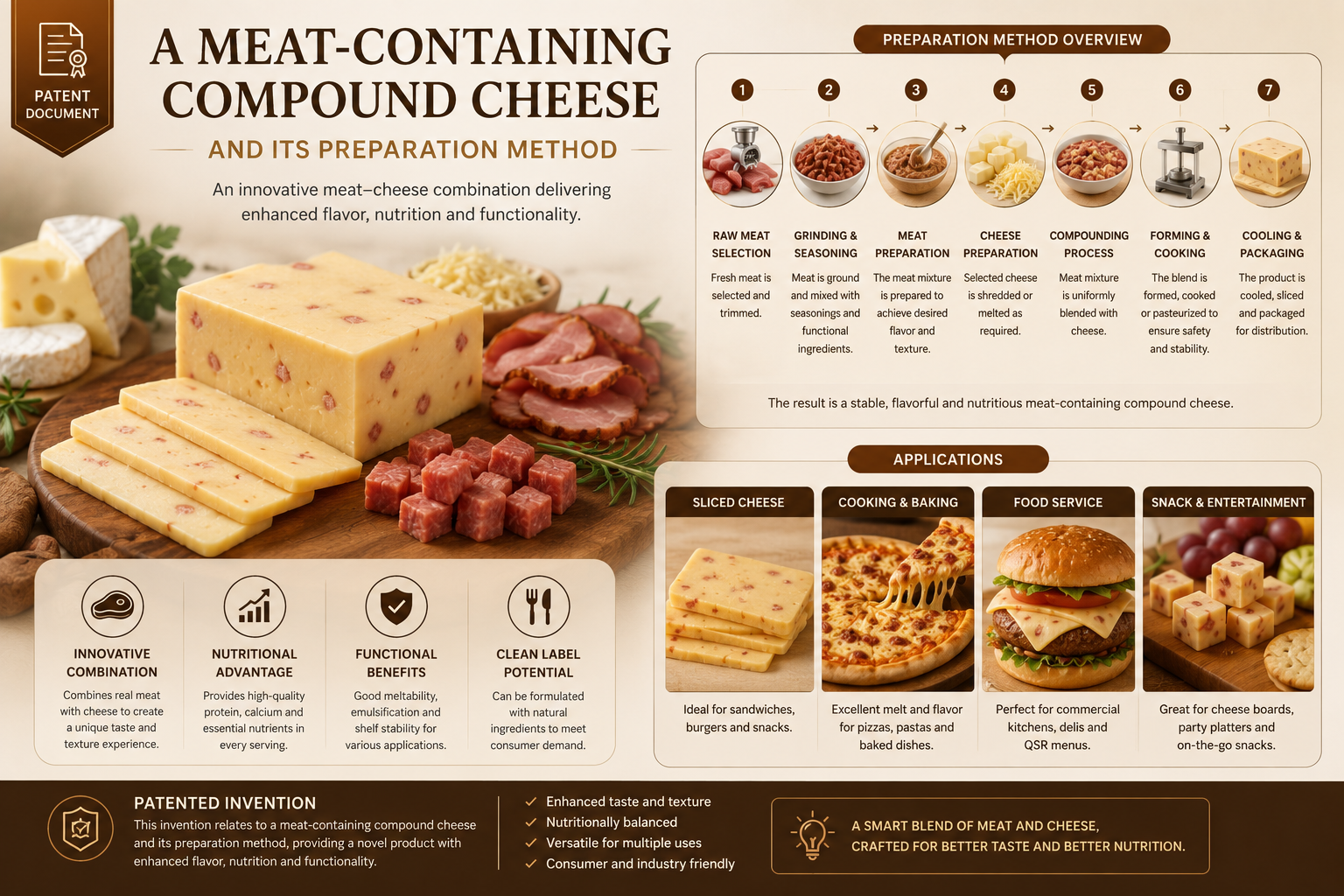
Patent Number: CN121795506A
Country: China
Status: Pending
Publication Date: March 10, 2026
Application Number: [Not specified in document]
Priority Date: [Not specified in document]
Inventors:
- 苗方 (Miao Fang)
- 解庆刚 (Xie Qinggang)
- 胡诚 (Hu Cheng)
- 郑姗 (Zheng Shan)
- 张旭光 (Zhang Xuguang)
- 冷友斌 (Leng Youbin)
- 陆思宇 (Lu Siyu)
Current Assignees:
- Feihe Gannan Dairy Products Co., Ltd.
- Feihe Harbin Dairy Co., Ltd.
- Heilongjiang Feihe Dairy Co., Ltd.
Technical Field
This invention belongs to the technical field of foods. It relates to a composite cheese and a preparation method thereof, in particular to a composite cheese that aligns with Chinese cooking and taste preferences, and more particularly to a composite cheese containing meat and its preparation method.
Background
According to the definition in the national food safety standard for processed cheese and cheese products (GB 25192-2022), processed cheese is prepared using cheese (with a proportion exceeding 50%) as the main raw material through processes such as heating, stirring, and emulsification. Products with a cheese content of 15-50% are classified as cheese products. These products are widely used in baking, instant snacks, and other applications. However, products made from a single milk-based raw material have relatively simple nutritional composition and a single flavor profile, making it difficult to meet the advanced requirements of current consumers for high protein content and compound flavors.
There is a certain disparity between the flavor characteristics of cheese and domestic mainstream consumption preferences, which restricts the popularization of cheese in the Chinese market to some extent. To enrich the taste of cheese and improve product acceptance, there is a practical necessity for fusion innovation combining cheese with foods favored by Chinese consumers.
Meat products serve as an important source of high-quality animal protein. Their unique chewiness—imparted by myofiber structure—along with characteristic flavors of mellow livestock meat, tender poultry, and fresh aquatic products, complement the milky aroma and soft, smooth texture of cheese. Theoretically, combining the two can achieve nutritional synergy of "milk protein and myoprotein" and sensory enhancement of "fermentation flavor and meat flavor," presenting significant market development potential.
However, attempts in the prior art still have significant limitations. For example:
Citation 1 (CN119817766A) discloses a fish cheese strip that is easy to store at room temperature, prepared from 1000-1200 parts by weight of processed cheese and 200-2000 parts by weight of fish slices using a method of cooling after high-temperature bonding. However, this method has problems of significant fishy smell and poor taste after the fish meat is mixed with processed cheese.
Citation 2 (CN118318973A) discloses a cheese sausage and its processing technology, comprising 50-70% meat, 25-47% cheese, and 3-5% ingredients. The ingredients include spices, starter cultures, flavoring agents, vitamin C, and sodium nitrite. The processing technology involves a series of steps including cheese strip forming, sausage filling, cold storage, fermentation, curing and air drying, chopping, and mixing. However, problems of significant fishy smell and unstable fermentation flavor still exist in the combined fermentation of meat and cheese.
Citation 3 (CN113017016A) discloses cheese meatballs and a preparation method thereof, made from the following raw materials by weight: 450-550 parts pork, 450-550 parts cheese, 4-6 parts edible salt, 8-12 parts white sugar, 2-4 parts monosodium glutamate, 2-4 parts chicken essence, 40-60 parts raw starch, and 40-60 parts eggs, with a fat-to-lean ratio of 3:7 for the pork. Although cheese is added to meatballs to improve nutritional value and taste richness, the preparation method essentially belongs to a simple physical mixing process of a kitchen-type nature with a short shelf life. It cannot construct a stable protein-fat emulsification system and does not fully consider the actual requirements of industrial production and circulation.
More fundamentally, the fusion of cheese with meat products faces a series of technical bottlenecks. The core contradiction derives from the differences in matrix properties between the two:
- Emulsion System Conflict: The stabilization of processed cheese relies on emulsifying salts (e.g., phosphates, citrates) mediating the reconstruction of casein micelles, forming a fat-protein-water three-phase equilibrium system through ion exchange. The myofiber proteins, connective tissue, and free fat contained in meat products can interfere with the hydration process of casein, damage emulsion stability, and easily cause issues such as oil precipitation, delamination, or rough texture. For example, after a certain production line directly adds meat emulsion, the oil separation rate increases by more than 35% compared to a pure cheese product because actin and casein compete for emulsifying salts.
- Poor Hot Processing Compatibility: The proper emulsifying temperature for processed cheese is typically 75-85°C. Excessive temperatures can cause casein denaturation, affecting its stretchability and soft, smooth texture. Meat products require prolonged heating above 70°C to achieve curing and microbial control. The mismatch in heat treatment conditions can lead to the processing dilemma of "scorching the cheese or undercooking the meat product."
- Flavor and Texture Imbalance: Fishy smell substances (such as aldehydes and nitrogen-containing compounds) from meat and fermented flavor components (such as methylthiopropanal) from cheese can create undesirable flavor superposition. Additionally, the fiber toughness of meat products and the viscoelasticity of cheese are difficult to coordinate, resulting in common finished product issues such as being hard on the outside and soft on the inside, or having an overly strong chewing sensation.
In view of the above, existing fusion products of cheese and meat are mostly at the "physical mixing" level. There is still a significant disadvantage in terms of flavor fusion, texture coordination, and processing stability, necessitating the development of a new technological system capable of systematically solving these problems.
Summary of the Invention
Problems to be Solved
The present invention is directed to further improvements in form, mouthfeel, and formability for current natural cheese products. Although existing cheese products have strong flavor, problems such as collapse of the emulsifying system, grease precipitation, delamination, and inconsistent flavor often occur when they are fused with meat products.
To this end, the present invention contemplates combining cheese with a meat material. However, there are significant challenges in this process. For example, natural cheese and meat materials, which are predominantly composed of protein and fat, are inherently less compatible. They are difficult to form into a uniform and stable system in the presence of moisture, resulting in poor formability.
Furthermore, the invention has discovered through extensive process adjustments that the good characteristics of both cheese and meat products can be achieved by adjusting the specific proportions of cheese and meat raw materials, supplementing with certain milk protein-containing components, and combining with a specific emulsification process. This approach yields good formability, particularly achieving good texture and appearance color that were previously difficult to obtain. It was further discovered that with the compounding of the specific components of the present invention, even if the thermal history unexpectedly exceeds optimal levels during processing, it is possible to maintain the basic flavor while ensuring the texture and appearance color. Additionally, the present invention provides a preparation process for the composite cheese. It has been found that a staged emulsification process more easily yields the desired composite cheese, resulting in a product that not only has good texture and appearance but also better develops good flavor. Ultimately, the final product achieves nutritional synergy and ingredient fusion of "milk protein plus actin" while maintaining good flavor.
Therefore, the composite cheese of the present invention is a novel fusion food of cheese and meat products. It has good texture and appearance, possesses the rich flavor of cheese and the unique taste of meat products, and meets the human body's requirements for nutrients such as calcium and protein while achieving flavor fusion and fine texture.
The preparation method is relatively simple, suitable for large-scale production, and has significant application prospects and market appeal in modern diets.
Solution to the Problem
It has been found that the above technical problems can be solved by implementing the following technical solutions:
[1] The invention provides a composite cheese containing meat, wherein the composite cheese comprises water and the following components: natural cheese, milk protein-containing components, emulsifying salt, and meat raw materials.
Based on 100 parts by mass of the composite cheese:
- The natural cheese comprises 15-80 parts by mass
- The milk protein-containing components comprise 1-25 parts by mass
- The meat raw materials comprise 1-25 parts by mass
The compound cheese is obtained by emulsifying the natural cheese and the emulsifying salt, and then sequentially adding the milk protein-containing component and the meat raw material.
[2] The composite cheese of [1], wherein the composite cheese has a substantially homogeneous texture.
[3] The composite cheese according to [1] or [2], wherein the milk protein-containing component is one or more selected from the group consisting of casein powder, milk protein powder, skim milk powder, whole milk powder, and whey protein powder.
[4] The composite cheese according to any one of [1] to [3], wherein the meat material is one or more selected from the group consisting of livestock meat, poultry meat, and aquatic meat, and the fat content of the meat material is 15 mass% or less and the moisture content is 30 mass% or less.
[5] The composite cheese according to any one of [1] to [4], wherein the content of the emulsifying salt is 1 to 4 parts by mass.
[6] The invention also provides a preparation method of the composite cheese of any one of the items [1] to [5], wherein the method comprises the following steps:
- Emulsifying and mixing the natural cheese in the presence of emulsifying salt, and then adding the milk-containing protein component for emulsifying and mixing, and optionally, directly heating by steam in the emulsifying and mixing;
- And mixing meat, namely further emulsifying and mixing the emulsified mixture with the meat raw material.
[7] The production method according to [6], wherein the method comprises:
- (1) Cutting the meat raw material into blocks with a thickness of 2-10 mm, and curing and dehydrating to reduce the moisture content of the meat raw material to below 30%;
- (2) The primary emulsification mixing step comprises carrying out the primary emulsification mixing of natural cheese and emulsifying salt at a temperature of 85-105°C at an emulsification speed of 1500-3000 rpm to obtain a mixed material 1;
- (3) Adding a milk protein component into the mixed material 1, and performing second-stage emulsification mixing at 85-105°C at an emulsification speed of 1500-3000 rpm to obtain a mixed material 2;
- (4) And adding the pretreated meat raw material into the mixed material 2, and performing the third-stage emulsification mixing at a temperature of 85-105°C at an emulsification speed of 100-1500 rpm for 5-30 min to obtain a mixed material 3.
[8] The method according to [7], wherein the method further comprises a step of shearing pretreatment of the natural cheese before the step of primary emulsification mixing, wherein the temperature of the shearing pretreatment is 25-30°C and the shearing speed is 1500-3000 rpm.
[9] The method according to [7] or [8], wherein the first stage emulsification mixing and the second stage emulsification mixing are both performed by steam direct heating.
[10] The preparation method according to any one of [7] to [9], wherein the emulsification mixing in the third stage is performed under a vacuum condition.
[11] The invention further provides a food, wherein the food comprises or uses the composite cheese of any one of [1] to [5].
Advantageous Effects of the Invention
Through implementation of the technical scheme, the invention has the following beneficial effects:
- The meat-containing composite cheese of the present invention features scientifically screened and proportioned components, allowing flexible addition of various nutritional and flavor components. It significantly enriches the nutritional composition of the product, improves and optimizes the taste profile, while maintaining good processing formability, enabling the production of formed products with regular appearance and good visual appeal.
- The composite cheese has a compact structure and fine texture. It combines the unique taste of meat products while preserving the original flavor and nutritional ingredients of cheese to the greatest extent, meeting the human body's requirements for nutritional elements such as calcium and protein. Meanwhile, the product of the invention has a simple preparation process, is easy to store and transport under normal temperature conditions, has a long shelf life, and is suitable for mass production.
- The composite cheese can be consumed in various forms such as cold dishes, desserts, or instant snacks. It offers diverse eating methods and adjustable personalized tastes, which is beneficial for meeting different market demands, enhancing the innovative competitiveness of the food industry, promoting dairy product consumption, and has broad market application prospects and social benefits.
Detailed Description
The following describes embodiments of the present invention, but the present invention is not limited thereto. Various modifications are possible within the scope of the invention as claimed, and embodiments and examples obtained by appropriately combining the technical means disclosed in different embodiments and examples are also included in the technical scope of the present invention.
Definitions and Terminology
- Unless otherwise indicated, all units used are units of international standard, and numerical values and ranges of values are understood to include systematic errors unavoidable in industrial production.
- The numerical range indicated by "numerical value A to numerical value B" or "numerical value A - numerical value B" means a range including the end point numerical values A and B.
- A numerical range indicated by "above" or "below" is a numerical range including the present number.
- The meaning of "can" includes both the meaning of performing a certain process and the meaning of not performing a certain process.
- "Optional" or "optionally" means that certain substances, components, steps of performing, conditions of applying, etc. may or may not be used.
- Unless otherwise specified, "normal temperature" or "room temperature" generally refers to a temperature of 23 ± 2°C.
- Unit names used are international standard unit names, and "%" used represent weight or mass% unless otherwise specified.
- The use of "amount" refers to "quality" unless specifically stated otherwise.
- "Comprising," "having," "including," or "containing" may be inclusive or open-ended and do not exclude additional, unrecited elements or method steps. They may also mean enclosed, excluding additional, unrecited elements or method steps.
- "About" is used to define numerical ranges and parameters, which are approximations. Unless explicitly stated otherwise, all ranges, amounts, values, and percentages used herein are modified by "about," generally meaning that the actual value is within ±5%, ±3%, ±1%, or ±0.5% of a particular value or range.
- "Some specific/preferred embodiments," "other specific/preferred embodiments," "an embodiment," etc., mean that a particular element is included in at least one embodiment and may or may not be present in other embodiments.
- The unit of "parts by mass" may be any unit by weight such as g, mg, kg, or t.
- Cheese: According to GB 5420-2021, cheese is a mature or immature soft, semi-hard, hard, or extra-hard dairy product in which the whey protein/casein ratio does not exceed the corresponding ratio in cow (or other dairy animal) milk (except whey cheese). It is obtained by any method of:
a) Coagulating or partially coagulating protein in milk and/or dairy products under the action of chymosin or other proper coagulants, with or without fermentation strains, edible salt, food additives, and food nutrition enhancers, with or without whey discharge, and with or without fermentation, to obtain solid or semi-solid products;
b) The coagulation process of milk and/or protein in dairy products is included in the processing technology, and the finished products are endowed with physical, chemical, and organoleptic properties similar to those described in a).
Core Technical Findings
The primary object of the present invention is to provide a composite cheese containing meat, in particular a composite cheese that meets Chinese cooking and taste preferences. The invention is mainly based on the following findings:
There is a difference between the flavor characteristics of cheese and domestic consumption preferences, which constrains its popularity in the Chinese market. To broaden the flavor expression of cheese and improve market acceptance, cheese needs to undergo fusion innovation with foods loved by Chinese consumers, such as meat products. However, in the actual fusion process, the following technical challenges are mainly faced:
- Water Separation During Storage: The cheese protein network structure tends to shrink under normal temperature storage conditions, reducing water-holding capacity and releasing free water, affecting the appearance and texture of the product.
- Grease Separation During Processing: During the hot processing stage, grease from cheese and meat is heated and melted. If the strength of the emulsifying system is insufficient, the grease tends to float up or separate, resulting in rough texture and uneven structure.
- Short Shelf Life: Meat components (such as fat and protein) and cheese are good culture media for microorganisms. It is difficult to achieve long-term storage using a conventional pasteurization process, and products are prone to spoilage. Microbial safety control must be effectively solved after fusion innovation.
In improving the mouthfeel of cheese components, the prior art mainly relies on the introduction of other components. The core difficulty is how to achieve uniform fusion among multiple components while retaining respective nutritional ingredients. The invention surprisingly discovers that the excellent characteristics of cheese and meat components can be synergistically maintained through specific proportions of components and combination of a specific emulsification process, resulting in a product with richer mouthfeel and good processing formability.
First Aspect: Composite Cheese Composition
In a first aspect, the present invention provides a composite cheese that includes a meat quality. The compound cheese combines the intense flavor of the cheese with the unique flavor of the meat product, thereby obtaining a product with intense flavor and a fragrant, mellow taste.
The composite cheese comprises, in addition to water, natural cheese, milk protein-containing components, emulsifying salt, and meat raw materials, and is formed into a composite cheese having a substantially uniform composition by mixing these components.
Natural Cheese
The source of the natural cheese is not particularly limited in principle. The milk raw material may be cheese derived from various animal milks or products thereof. Examples of animal milk include goat milk, cow milk, camel milk, colostrum thereof, and the like. Cow milk is preferred. For finished animal milk products, whole animal milk powder and the like are generally included.
The method for producing natural cheese is not particularly limited in principle. Components that are substantially solid at ordinary temperature can be obtained by separation through sterilization, fermentation, curd, and the like.
In some specific embodiments, the natural cheese is one or more of hard cheese, semi-hard cheese, and soft cheese.
Milk Protein-Containing Component
The milk-containing protein component is not particularly limited as long as it is a milk-containing protein component for general food.
In some specific embodiments, the milk protein-containing ingredient is selected from one or more of casein powder, milk protein powder, skim milk powder, whole milk powder, and whey protein powder.
Emulsifying Salt
The emulsifying salts are mainly used to assist in regulating the partial charge of the protein so that it more easily forms a uniform emulsifying system.
In some specific embodiments, the emulsifying salt comprises one or more of citrate and phosphate, preferably citrate.
In some specific embodiments, the citrate is sodium citrate or potassium citrate.
In some specific embodiments, the phosphate salt is one or more of a sodium salt of phosphoric acid and a potassium salt of phosphoric acid. The phosphate salt may be one or more of sodium polyphosphate, potassium polyphosphate, sodium pyrophosphate, potassium pyrophosphate, sodium hexametaphosphate, potassium hexametaphosphate, sodium dihydrogen phosphate, potassium dihydrogen phosphate, disodium hydrogen phosphate, dipotassium hydrogen phosphate, trisodium phosphate, and tripotassium phosphate.
Meat Raw Material
The meat material is not particularly limited as long as it is a meat material for general food.
In some specific embodiments, the meat material is selected from one or more of livestock meat, poultry meat, and aquatic meat. In some preferred embodiments, the meat material has a fat content of 15 mass% or less and a moisture content of 30 mass% or less.
In some specific embodiments, the meat material comprises one or more of pork, beef, mutton, donkey meat, horse meat, chicken, duck, goose, fish, shrimp, crab, shellfish, and the like.
Functional Components
To further optimize the overall performance and flavor of the product, the composite cheese may optionally incorporate functional ingredients according to actual needs or specific product quality criteria.
The functional components are not particularly limited in principle as long as they are within a safe dosage range. They may be, for example, nutritional supplements, flavor supplements, or the like.
In some specific embodiments, the functional ingredients include one or more of flavoring ingredients, toning ingredients, and ingredients with nutritional efficacy.
Flavoring ingredients enrich the product flavor, adjust taste and aroma, and cover possible off-odors in raw materials to meet the taste demands of different consumer groups. In some specific embodiments, the flavoring ingredient is selected from:
- Fatty components: Saturated fatty acids, polyunsaturated fatty acids, monounsaturated fatty acids, OPO structured fat, DHA, EPA, ARA, phospholipids, etc., which may specifically include canola oil, safflower oil, walnut oil, peanut oil, soybean oil, alglycerol, olive oil, tea oil, mera oil, olive oil, coconut oil, perilla oil, deep sea fish oil, cocoa oil, palm oil, beef tallow, butter, lard, medium-chain triglycerides, lecithin, etc.
- Sweet components: Glucose, high fructose syrup, trehalose, sucrose, maltose, solid corn syrup, fructose, isomaltooligosaccharide, fructo-oligosaccharides, galacto-oligosaccharides, inulin, sorbitol, mannitol, erythritol, maltitol, lactitol, xylitol, stevioside, acesulfame, aspartame, salt, etc.
- Natural spices: Licorice, clove, cumin, black pepper, pricklyash, garlic, fennel, onion, cardamon, vanilla, etc.
- Extracts: One or more extracts of citrus, vanilla, etc.
Toning ingredients are selected from food colors that meet the GB2760 standard.
Nutritionally effective ingredients are selected from nutritional supplements that meet the GB14880 standard.
Composition and Proportions
The composite cheese of the present invention can more easily obtain the desired characteristics of appearance, taste, flavor, etc., by satisfying the following composition.
Based on 100 parts by mass of the composite cheese:
| Component | Content (Parts by Mass) | Preferred Range | Examples |
|---|---|---|---|
| Natural Cheese | 15 - 80 | 55 - 65 | 15, 20, 25, 30, 35, 40, 45, 50, 55, 60, 65, 70, 75, 80 |
| Milk Protein-Containing Component | 1 - 25 | 5 - 9 | 1, 3, 5, 7, 9, 12, 15, 18, 20, 22, 25 |
| Meat Raw Material | 1 - 25 | 5 - 15 | 1, 3, 5, 7, 9, 12, 13, 14, 15, 18, 20, 22, 25 |
| Emulsifying Salt | 1 - 4 | 2 - 4 | 1, 1.5, 2, 2.5, 3, 3.5, 4 |
| Functional Components | ≤ 10 | 1 - 10 (preferred), 2 - 5 (more preferred) | 1, 2, 3, 4, 5, 6, 7, 8, 9, 10 |
| Water | Balance | - | - |
Rationale for Proportions:
- Natural Cheese (15-80 parts): Provides the basic source of flavor and texture. If too low (<15 parts), the milk flavor is insufficient and cheese characteristics are difficult to reflect. If too high (>80 parts), excessive casein and fat easily form dense networks, blocking even dispersion of other components (especially meat), leading to rough texture, hardening, or water separation.
- Milk Protein Component (1-25 parts): Serves as a protein supplement and texture regulator. This range effectively enhances the density of the protein network, improves water-holding capacity and emulsion stability, and endows the product with a compact structure and fine, smooth texture. Too low (<1 part) results in insufficient thickening and emulsifying effects. Too high (>25 parts) may introduce excessive milk solids, causing a creamy mouthfeel and unbalanced flavor.
- Meat Raw Material (1-25 parts): Provides unique flavor and chewing sensation. Too low (<1 part) may result in less obvious meat flavor and low flavor fusion. Too high (>25 parts) introduces excessive water and animal fat, destroying the protein emulsion system, causing fat separation, tissue separation, and significantly increasing the oil separation rate.
- Emulsifying Salt (1-4 parts): Key to forming a stable emulsifying system by integrating calcium ions, adjusting pH, and dissociating casein. Too low (<1 part) leads to insufficient protein hydration and emulsification, causing system instability. Too high (>4 parts) may generate bad salty and astringent tastes and affect protein function due to excessive ionic strength.
- Functional Components (≤10 parts): Used for personalized regulation of flavor, appearance, and nutritional value. The dosage should be balanced on the premise of ensuring the stability of the core system. Excessive addition may interfere with the presentation of the main flavor or affect the final texture.
Oil Separation Rate Control:
For the composite cheese of the present invention, control of the final oil separation rate is critical to achieving desirable physical and organoleptic properties. A low oil separation rate helps maintain the uniformity and stability of the system, allowing the intense milky aroma of the cheese and the delicious flavor of the meat to harmoniously present. In some preferred embodiments, the oil separation rate of the composite cheese should be controlled to be:
- Less than 0.3%
- Preferably less than 0.2%
- More preferably less than 0.1%
This low oil separation rate is advantageous for inhibiting microbial growth and extending the shelf life of the product.
Second Aspect: Preparation Method
In a second aspect, the invention provides a method for preparing the composite cheese according to the first aspect. The following method more easily obtains the composite cheese defined in the first aspect.
The preparation method aims to solve the problems of easy emulsification system collapse, poor hot processing compatibility, unbalanced flavor and texture, and short shelf life caused by direct mixing of cheese and meat products in the prior art.
General Process Overview
The preparation method may comprise the following steps:
- Emulsifying and mixing the natural cheese in the presence of emulsifying salt.
- Adding the milk-containing protein component for emulsifying and mixing (optionally, with direct steam heating during emulsification).
- Mixing meat: further emulsifying and mixing the emulsified mixture with the meat raw material.
Detailed Process Steps
The preparation method comprises the following specific steps: pretreatment of meat raw materials, primary emulsification mixing, secondary emulsification mixing, and tertiary emulsification mixing.
Step 1: Pretreatment of Meat Raw Material
- Cut the meat raw material into blocks with a uniform size of 2-10 mm.
- Remove blood spots, broken bones, and other impurities.
- Cure with seasonings to remove fishy smell and extract myofibrillar protein.
- Dehydrate using one or more methods (air drying, frying, heat baking, vacuum drying, etc.) to reduce the moisture content to below 30%.
Purpose: Moderate particle size facilitates uniform dispersion in subsequent mixing and prevents aggregation. Curing removes fishy smell, and salt helps extract myofibrillar protein, which can participate in forming a composite protein network during subsequent emulsification, enhancing system stability. Dehydration reduces the activity of meat raw materials, reduces the release of free water in the emulsification system, helps maintain system stability, and concentrates meat flavor substances.
Step 2: Primary Emulsification Mixing
- Shear pretreat the natural cheese (optional but preferred): Temperature 25-30°C, speed 1500-3000 rpm, time <1 min (preferably 30-60 s). This helps reduce the initial firmness of the cheese, making it easier to disperse.
- Mix the natural cheese (or sheared cheese) with emulsifying salt.
- Perform primary emulsification mixing.
Conditions:
- Temperature: 85-105°C (preferably 85-95°C)
- Speed: 1500-3000 rpm (preferably 2000-2500 rpm)
- Time: 1-20 min (preferably 2-6 min)
- Heating: Direct steam heating (preferred)
Mechanism: In this step, the emulsifying salt (especially citrate and phosphate) integrates calcium ions, adjusts pH, and dissociates casein micelles. This increases the negative charges of casein micelles, improves protein solubility and hydration capacity, and promotes fat globules to be wrapped by melted casein micelles under heating and high-speed shearing. This forms a uniform and stable O/W (oil-in-water) emulsifying system, which is the basis for constructing the stable structure of the whole product.
Step 3: Secondary Emulsification Mixing
- Add milk protein-containing components (e.g., casein powder, milk protein powder, whey protein powder, etc.) to the mixed material 1 obtained from the primary emulsification step.
- Perform secondary emulsification mixing.
Conditions:
- Temperature: 85-105°C (preferably 85-95°C)
- Speed: 1500-3000 rpm (preferably 1500-2000 rpm)
- Time: 1-20 min (preferably 2-6 min)
- Heating: Direct steam heating (preferred)
Mechanism: The added milk protein-containing components further supplement and strengthen the protein network. They interact with proteins in the processed cheese system formed above. Under heat and shear forces, they can better encapsulate fat, bind moisture, enhance the strength and stability of the emulsion system, and increase its ability to withstand the physicochemical changes brought by the subsequent addition of meat material.
Step 4: Tertiary Emulsification Mixing
- Add the pretreated meat raw material (and optionally, functional ingredients) to the mixed material 2 obtained from the secondary emulsification step.
- Perform tertiary emulsification mixing.
- This step is preferably performed under vacuum conditions to remove bubbles, prevent structure loosening and oxidative deterioration, promote rearrangement and consolidation of the protein-fat interface film, and effectively inhibit fat floating and precipitation during storage.
Conditions:
- Temperature: 85-105°C (preferably 102-105°C)
- Speed: 100-1500 rpm (preferably 500-1200 rpm)
- Time: 5-30 min (preferably 15-20 min)
- Atmosphere: Vacuum (preferred)
Mechanism: The meat material is introduced into the stabilized cheese protein emulsion system at a relatively gentle agitation rate. The higher temperature range (102-105°C) promotes the formation of a stable network structure of casein and emulsifying salt and ensures that the meat raw material reaches a safe curing temperature. The proper emulsification speed is favorable for forming a uniform and fine oil-water emulsification interface, avoiding fat aggregation and floating. The vacuum condition removes bubbles, promotes the rearrangement and consolidation of the protein-fat interface film, and enhances the dispersion and anchoring of grease in the composite system.
Step 5: Post-Processing
- Cooling: Cool the mixed material 3 (obtained from the tertiary emulsification step) to 0-30°C.
- Packaging: Package the cooled product.
- Storage: Store preferably at ambient/normal temperature.
Advantages: Traditional cheese meat products generally require refrigeration and have short shelf life, with issues of easy spoilage and texture deterioration. In contrast, the invention achieves stable and uniform fusion of the cheese protein network and meat components by combining the staged emulsification process with a specific formula. The process first builds a cheese emulsifying system with a stable structure as a continuous phase, and then introduces a meat disperse phase in stages, effectively avoiding the competition of emulsifying salt and the system conflict during hot processing.
The preparation process ensures stable balance of the fat-protein-water three phases, making the product structure fine and smooth with no obvious water and oil separation. Through testing, the quality guarantee period of the product can be as long as 9 months under normal temperature conditions, with microbial indices always meeting standards, low oil separation rate (below 0.3%), and excellent sensory quality. This invention systematically solves the key technical problems of water separation, oil separation, and microbial safety control while achieving flavor fusion of cheese and meat products.
Third Aspect: Food Product
In a third aspect, the invention provides a food product. The food product uses or includes the composite cheese of the first aspect.
In some specific embodiments, the food product may be a solid or soft food product at room temperature.
Examples
The following examples illustrate the present invention and should not be construed as limiting its scope. The specific conditions not noted in the examples are carried out according to conventional conditions or conditions recommended by the manufacturer. The reagents or apparatus used were conventional products commercially available.
Unified Meat Pretreatment Method (used in all examples):
- Select fresh meat with a fat content controlled below 15%.
- Cut raw materials into uniform meat blocks (2-10 mm square).
- Remove impurities such as blood spots and broken bones.
- Cure with seasonings to remove fishy smell.
- Dehydrate using one or more methods (air drying, frying, heat baking, vacuum drying, etc.) to control the final moisture content below 30%.
Example 1
Composition (by mass):
- Natural cheese: 80 parts
- Milk protein powder: 1 part
- Beef product: 3 parts
- Sodium citrate (emulsifying salt): 1 part
- Composite seasonings: 3 parts (1.5 parts rapeseed oil, 0.6 part salt, 0.9 part spices)
- Water (brought by steam): 12 parts
Preparation Method:
- Shear and premix the natural cheese to obtain a crushed material: shearing temperature 30°C, speed 2000 rpm, time 45 s.
- Stir and emulsify the crushed materials and sodium citrate to obtain Mixed Material 1: steam direct heating, temperature 85°C, speed 2000 rpm, time 2 min.
- Add milk protein powder to Mixed Material 1, continue stirring and emulsifying to obtain Mixed Material 2: steam direct heating, temperature 85°C, speed 2000 rpm, time 2 min.
- Add the beef product and composite seasoning to Mixed Material 2, start vacuumizing, continue stirring and emulsifying to obtain Mixed Material 3: temperature 105°C, speed 1000 rpm, time 15 min.
- Rapidly cool Mixed Material 3, package, and store at normal temperature.
Example 2
Composition (by mass):
- Natural cheese: 50 parts
- Milk protein powder: 20 parts
- Beef product: 13 parts
- Sodium citrate (emulsifying salt): 4 parts
- Composite seasonings: 1 part (0.5 part rapeseed oil, 0.2 part salt, 0.3 part spices)
- Water (brought by steam): 12 parts
Preparation Method:
- Shear and premix the natural cheese: temperature 25°C, speed 1500 rpm, time 40 s.
- Stir and emulsify the crushed materials and sodium citrate to obtain Mixed Material 1: steam direct heating, temperature 85°C, speed 2000 rpm, time 2 min.
- Add milk protein powder to Mixed Material 1, continue stirring and emulsifying to obtain Mixed Material 2: steam direct heating, temperature 85°C, speed 2000 rpm, time 6 min.
- Add beef product and composite seasoning to Mixed Material 2, start vacuumizing, continue stirring and emulsifying to obtain Mixed Material 3: temperature 105°C, speed 1000 rpm, time 15 min.
- Rapidly cool, package, and store at normal temperature.
Example 3
Composition (by mass):
- Natural cheese: 60 parts
- Milk protein powder: 7 parts
- Beef product: 14 parts
- Sodium citrate (emulsifying salt): 4 parts
- Composite seasonings: 3 parts (1.5 parts rapeseed oil, 0.6 part salt, 0.9 part spices)
- Water (brought by steam): 12 parts
Preparation Method:
- Shear and premix the natural cheese: temperature 25°C, speed 1500 rpm, time 40 s.
- Stir and emulsify the crushed materials and sodium citrate to obtain Mixed Material 1: steam direct heating, temperature 85°C, speed 2000 rpm, time 2 min.
- Add milk protein powder to Mixed Material 1, continue stirring and emulsifying to obtain Mixed Material 2: steam direct heating, temperature 85°C, speed 1800 rpm, time 4 min.
- Add beef product and composite seasoning to Mixed Material 2, start vacuumizing, continue stirring and emulsifying to obtain Mixed Material 3: temperature 105°C, speed 1200 rpm, time 15 min.
- Rapidly cool, package, and store at normal temperature.
Example 4
Composition (by mass):
- Natural cheese: 15 parts
- Milk protein powder: 25 parts
- Beef product: 25 parts
- Sodium citrate (emulsifying salt): 4 parts
- Composite seasonings: 10 parts (5 parts rapeseed oil, 2 parts salt, 3 parts spices)
- Water: 21 parts total (12 parts brought by steam, 9 parts added together with milk protein powder in step 3)
Preparation Method:
- Shear and premix the natural cheese: temperature 25°C, speed 1500 rpm, time 40 s.
- Stir and emulsify the crushed materials and sodium citrate to obtain Mixed Material 1: steam direct heating, temperature 85°C, speed 2000 rpm, time 2 min.
- Add milk protein powder and water to Mixed Material 1, continue stirring and emulsifying to obtain Mixed Material 2: steam direct heating, temperature 85°C, speed 1800 rpm, time 4 min.
- Add beef product and composite seasoning to Mixed Material 2, start vacuumizing, continue stirring and emulsifying to obtain Mixed Material 3: temperature 105°C, speed 1200 rpm, time 15 min.
- Rapidly cool, package, and store at normal temperature.
Example 5
Composition (by mass):
- Natural cheese: 60 parts
- Milk protein powder: 7 parts
- Beef product: 14 parts
- Sodium citrate (emulsifying salt): 4 parts
- Composite seasonings: 3 parts (1.5 parts rapeseed oil, 0.6 part salt, 0.9 part spices)
- Water (brought by steam): 12 parts
Preparation Method:
- Shear and premix the natural cheese: temperature 25°C, speed 1500 rpm, time 40 s.
- Stir and emulsify the crushed materials and sodium citrate to obtain Mixed Material 1: steam direct heating, temperature 85°C, speed 2000 rpm, time 2 min.
- Add milk protein powder to Mixed Material 1, continue stirring and emulsifying to obtain Mixed Material 2: steam direct heating, temperature 85°C, speed 2000 rpm, time 6 min.
- Add beef product and composite seasoning to Mixed Material 2, start vacuumizing, continue stirring and emulsifying to obtain Mixed Material 3: temperature 95°C, speed 1000 rpm, time 15 min.
- Rapidly cool, package, and store at normal temperature.
Reference Example 1
Composition (by mass): Same as Example 5 (60 parts natural cheese, 7 parts milk protein powder, 14 parts beef product, 4 parts sodium citrate, 3 parts composite seasonings, 12 parts water).
Preparation Method: Same as Example 5, except in step 4, the emulsification temperature for Mixed Material 3 is 110°C instead of 95°C.
Example 6
Composition (by mass): Same as Example 5 (60 parts natural cheese, 7 parts milk protein powder, 14 parts beef product, 4 parts sodium citrate, 3 parts composite seasonings, 12 parts water).
Preparation Method: Same as Example 5, except in step 4, the emulsification time for Mixed Material 3 is 10 minutes instead of 15 minutes.
Reference Example 2
Composition (by mass): Same as Example 5 (60 parts natural cheese, 7 parts milk protein powder, 14 parts beef product, 4 parts sodium citrate, 3 parts composite seasonings, 12 parts water).
Preparation Method: Same as Example 5, except in step 4, the emulsification time for Mixed Material 3 is 40 minutes instead of 15 minutes.
Comparative Example 1
Composition (by mass):
- Natural cheese: 84 parts
- Milk protein powder: 1 part
- Beef product: 1 part
- Sodium citrate (emulsifying salt): 1 part
- Composite seasonings: 1 part (0.5 part rapeseed oil, 0.2 part salt, 0.3 part spices)
- Water (brought by steam): 12 parts
Preparation Method: Same as Example 1.
Difference from Example 1: The proportions of raw material components are different (significantly higher natural cheese content, lower meat and emulsifying salt content).
Comparative Example 2
Composition (by mass):
- Natural cheese: 50 parts
- Milk protein powder: 30 parts
- Beef product: 3 parts
- Sodium citrate (emulsifying salt): 4 parts
- Composite seasonings: 1 part (0.5 part rapeseed oil, 0.2 part salt, 0.3 part spices)
- Water (brought by steam): 12 parts
Preparation Method: Same as Example 2.
Difference from Example 2: The milk protein powder content is increased to 30 parts (outside the claimed range), and the meat content is reduced to 3 parts.
Evaluation and Results
Product Appearance Comparison:
The patent document includes FIG. 1, which shows the appearance of the product of Comparative Example 4 (not included in the translated text provided). Based on the description, the products of the examples of the present invention exhibit good appearance, formability, compact structure, and fine texture compared to comparative examples.
Key Performance Indicators (from the disclosed information):
| Feature | Examples 1-6 | Comparative Examples 1-2 | Reference Examples 1-2 |
|---|---|---|---|
| Texture and Appearance | Good formability, regular appearance, compact structure, fine texture | Poor formability, issues of oil separation, delamination, or rough texture | Varying degrees of texture and appearance issues depending on temperature/time deviations |
| Flavor | Balanced flavor fusion of cheese and meat, rich and mellow taste | Unbalanced flavor, often with greasy or chemical notes | Potential flavor issues due to excessive thermal history (Ref. 1) or over-processing (Ref. 2) |
| Oil Separation Rate | Maintained at a low level (<0.3%, preferably <0.1%) | Increased oil separation rate, exceeding the acceptable threshold | May show some increase due to suboptimal processing parameters |
| Shelf Life | Up to 9 months at normal temperature | Shorter shelf life, prone to spoilage and texture deterioration | May be negatively impacted by suboptimal processing |
Interpretation of Results:
- Comparative Example 1: With significantly higher natural cheese (84 parts) and lower meat (1 part) and emulsifying salt (1 part), the system is too dominated by the cheese phase. The insufficient emulsifying salt fails to stabilize the system adequately when even a small amount of meat is introduced, likely leading to poor integration, phase separation, and a product that lacks the desired meat flavor integration.
- Comparative Example 2: With the milk protein powder content outside the claimed range (30 parts instead of ≤25 parts), excessive milk solids are introduced, resulting in a creamy mouthfeel and an unbalanced flavor. The meat content is also too low to provide a meaningful contribution, failing to achieve the goal of a true meat-cheese fusion product.
- Reference Example 1: Using a tertiary emulsification temperature of 110°C (above the claimed 85-105°C range) may cause excessive casein denaturation, potentially affecting the texture (stretchability, smoothness) and leading to a "scorched" flavor note.
- Reference Example 2: Using a tertiary emulsification time of 40 minutes (exceeding the claimed 5-30 minutes range) may lead to over-processing, potentially breaking down the protein network, causing structure loosening, and negatively impacting the final product's texture and appearance.
- Examples 1-6: All examples, with components and parameters within the claimed ranges, produced products with good formability, regular appearance, compact structure, fine texture, balanced flavor, and low oil separation rates, demonstrating the systematic solution provided by the invention to the key technical problems of water separation, oil separation, and microbial safety control while achieving flavor fusion.
Claims
Claim 1: A composite cheese containing meat, characterized in that the composite cheese comprises water and the following components: natural cheese, milk protein-containing components, emulsifying salt, and meat raw materials; based on 100 parts by mass of the composite cheese, the natural cheese comprises 15-80 parts by mass, the milk protein-containing components comprise 1-25 parts by mass, and the meat raw materials comprise 1-25 parts by mass; the compound cheese is obtained by emulsifying the natural cheese and the emulsifying salt, and then sequentially adding the milk protein-containing component and the meat raw material.
Claim 2: The composite cheese according to Claim 1, characterized in that the composite cheese has a substantially homogeneous texture.
Claim 3: The composite cheese according to Claim 1 or 2, characterized in that the milk protein-containing component is one or more selected from the group consisting of casein powder, milk protein powder, skim milk powder, whole milk powder, and whey protein powder.
Claim 4: The composite cheese according to any one of Claims 1 to 3, characterized in that the meat material is one or more selected from the group consisting of livestock meat, poultry meat, and aquatic meat, and the fat content of the meat material is 15 mass% or less and the moisture content is 30 mass% or less.
Claim 5: The composite cheese according to any one of Claims 1 to 4, characterized in that the content of the emulsifying salt is 1 to 4 parts by mass.
Claim 6: A method for preparing the composite cheese according to any one of Claims 1 to 5, characterized in that the method comprises:
- Emulsifying and mixing the natural cheese in the presence of emulsifying salt, and then adding the milk-containing protein component for emulsifying and mixing, and optionally, directly heating by steam in the emulsifying and mixing;
- And mixing meat, namely further emulsifying and mixing the emulsified mixture with the meat raw material.
Claim 7: The production method according to Claim 6, characterized in that the method comprises:
- (1) Cutting the meat raw material into blocks with a thickness of 2-10 mm, and curing and dehydrating to reduce the moisture content of the meat raw material to below 30%;
- (2) The primary emulsification mixing step comprises carrying out the primary emulsification mixing of natural cheese and emulsifying salt at a temperature of 85-105°C at an emulsification speed of 1500-3000 rpm to obtain a mixed material 1;
- (3) Adding a milk protein component into the mixed material 1, and performing second-stage emulsification mixing at 85-105°C at an emulsification speed of 1500-3000 rpm to obtain a mixed material 2;
- (4) And adding the pretreated meat raw material into the mixed material 2, and performing the third-stage emulsification mixing at a temperature of 85-105°C at an emulsification speed of 100-1500 rpm for 5-30 min to obtain a mixed material 3.
Claim 8: The method according to Claim 7, characterized in that the method further comprises a step of shearing pretreatment of the natural cheese before the step of primary emulsification mixing, wherein the temperature of the shearing pretreatment is 25-30°C and the shearing speed is 1500-3000 rpm.
Claim 9: The method according to Claim 7 or 8, characterized in that the first stage emulsification mixing and the second stage emulsification mixing are both performed by steam direct heating.
Claim 10: The preparation method according to any one of Claims 7 to 9, characterized in that the emulsification mixing in the third stage is performed under a vacuum condition.
Claim 11: A food product, characterized in that the food product comprises or uses the composite cheese according to any one of Claims 1 to 5.
###