Patent Document: Carbonated Soda Water and Its Preparation Method
Patent Information
- Patent Number: CN121986894A
- Country: China
- Other Languages: Chinese
- Inventors: Sun Yuwei (孙瑜薇), Yang Ye (杨晔), Qu Peng (曲鹏)
- Current Assignee: Yuanqi Forest Beijing Food Technology Group Co., Ltd.
- Application Number: CN202610375927.6A
- Status: Pending
- Publication Date: March 25, 2026
Technical Field
The invention relates to the technical field of food and beverage, and specifically to carbonated soda water and a preparation method thereof.
Background of the Invention
Carbonated soda water, as a beverage, is popular with consumers due to its unique characteristics of relieving summer heat, quenching thirst, providing a stimulating taste sensation, and reducing temperature. It occupies a significant share in the market. With the improvement of people's living standards and the widespread adoption and enhancement of health consciousness, consumers increasingly focus on health attributes such as low sugar, green, natural, and similar qualities. These have become important standards and trends in food and beverage consumption, promoting the rapid development of the carbonated soda water market.
At present, most soda water products sold on the market use purified water and carbon dioxide as raw materials. Some brands have weak bubble strength—strong and stimulating at the first sip, but the bubbles dissipate quickly, becoming soft and weak upon entry, which is not sufficiently satisfying. Meanwhile, carbon dioxide dissolves in water to form carbonic acid (H₂CO₃), making the water acidic with a slightly sour and astringent taste. Common carbonated soda water products suffer from poor taste or single flavor profiles.
In view of this, the present invention has been made.
Summary of the Invention
The invention aims to provide carbonated soda water and a preparation method thereof.
First Aspect: Carbonated Soda Water Composition
The invention provides carbonated soda water comprising, by mass:
- White birch juice: 0.1% – 1.5%
- Baking soda: 0.01% – 0.1%
- Licorice extract: 0.00001% – 0.0001%
- Lemon extract: 0.005% – 0.1%
- Balance: Water
The carbon dioxide gas capacity (at 20°C) multiple of the carbonated soda water is 3.0 – 4.2 times.
Preferred Composition
In an alternative embodiment, the components comprise, by mass:
- White birch juice: 0.6% – 0.9%
- Baking soda: 0.03% – 0.07%
- Licorice extract: 0.00005% – 0.00007%
- Lemon extract: 0.02% – 0.07%
- Balance: Water
The carbon dioxide gas capacity (at 20°C) multiple of the carbonated soda water is 3.2 – 4.2 times.
Bubble Characteristics
In an alternative embodiment, when 15 mL of the carbonated soda water is poured into a culture dish within 5 seconds under conditions of 20°C and normal pressure, and a photograph of the bubbles is taken at 5 seconds, the number of bubbles with diameters of 0.1 – 2 mm released in the 15 mL of carbonated soda water is more than 300, and the bubble retention time of the bubbles is ≥ 60 seconds.
Gas Retention Performance
In an alternative embodiment, the gas loss rate of the carbonated soda water over 30 minutes is ≤ 34%. The calculation formula for the gas loss rate is:
Gas Loss Rate = [(Gas content after bottle opening – Gas content after bottle opening for 30 minutes) / Gas content after bottle opening] × 100%
Preparation of Licorice Extract
In an alternative embodiment, the preparation method of the licorice extract comprises: crushing licorice root, extracting with water, filtering, concentrating, drying, and sieving.
Preparation of Lemon Extract
In an alternative embodiment, the preparation method of the lemon extract comprises: mixing lemon peel and green lemon peel, distilling and extracting, collecting the condensate, and separating to obtain lemon essential oil.
Second Aspect: Preparation Method
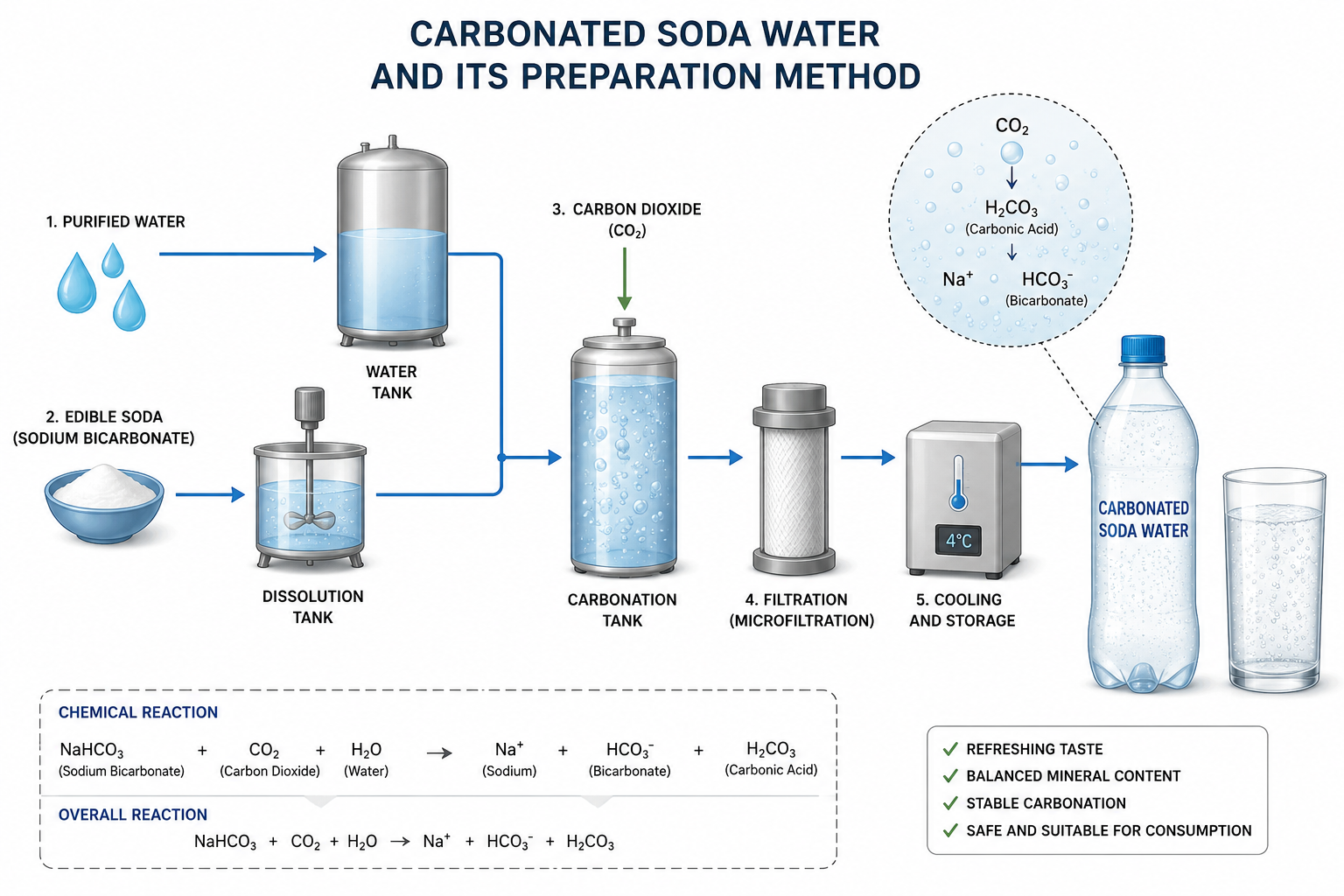
The invention provides a method for preparing the carbonated soda water according to any of the preceding embodiments, comprising: mixing the components, metering and sterilizing, followed by carbonation (aeration).
Beneficial Effects
The carbonated soda water provided by the invention combines the four components of white birch juice, baking soda, licorice extract, and lemon extract. When added to carbonated soda water, this combination achieves the following effects:
- Increased bubble count: The number of bubbles is increased.
- Improved bubble size and stability: Bubbles become more stable and firm.
- Extended oral cavity residence time: The retention time of bubbles in the oral cavity is prolonged.
- Significantly reduced gas loss rate: The gas loss rate is markedly reduced, resulting in a stronger, more persistent tingling sensation.
- Enhanced overall taste and flavor: The combination significantly improves the overall taste and flavor of the carbonated soda water, making it softer, richer, and more durable.
Drawings
- FIG. 1 is a chart showing statistics of the number of bubbles of carbonated water provided in Example 24.
- FIG. 2 is a chart showing statistics of the number of bubbles of carbonated water provided in Comparative Example 1.
- FIG. 3 is a chart showing statistics of the number of bubbles of carbonated water provided in Comparative Example 2.
- FIG. 4 is a chart showing statistics of the number of bubbles of carbonated water provided in Comparative Example 3.
- FIG. 5 is a chart showing statistics of the number of bubbles of carbonated water provided in Comparative Example 4.
- FIG. 6 is a chart showing statistics of the number of bubbles of carbonated water provided in Comparative Example 5.
Detailed Description
In order to make the objects, technical solutions, and advantages of the embodiments of the present invention more clear, the technical solutions of the embodiments of the present invention will be clearly and completely described below. Specific conditions not noted in the examples are carried out according to conventional conditions or conditions recommended by the manufacturer. The reagents or apparatus used are conventional products commercially available unless otherwise specified by the manufacturer.
Detailed Description of Components
White Birch Juice
White birch juice is the sap flowing out of the trunk of the white birch tree. It is transparent, colorless or slightly yellowish, and has a faint birch scent. It contains various nutrient components beneficial to the human body, such as minerals, vitamins, amino acids, and various bioactive substances, and is known as "guardian of human health" and "forest drop."
The white birch juice can be obtained by autonomous collection or can be purchased commercially.
Preparation Method for White Birch Juice: The raw juice of white birch is collected—specifically, in early spring each year after removing residual snow, a colorless or slightly yellowish transparent liquid is collected from living white birch trees. This raw juice, which has not been extracted or concentrated, maintains a natural, fresh, and flexible quality. The raw juice has a clear and transparent appearance, is fresh and cool in taste, and has a special birch fragrance. The collected raw juice is subjected to conventional detection, sterilization, filtration, and similar processes, and qualified products are retained as white birch juice.
Commercial Sources: When white birch juice is directly purchased on the market, manufacturers include but are not limited to: Yichun Jia Birch Biotechnology Co., Ltd.; Jilin Spring Share Co., Ltd.; and others. Any manufacturer capable of producing qualified raw white birch juice on the market can be used as the supplier for the white birch juice raw material in the present invention.
Baking Soda (Sodium Bicarbonate)
Sodium bicarbonate (baking soda) is used as an acidity regulator in foods. Excessive acidity in carbonated beverages can bring a sharp sour sensation. A small amount of baking soda can neutralize part of the sour taste, making the sour taste of the beverage softer and more mellow compared to the pungent sharp acid.
Licorice Extract
In carbonated water, excessively high acidity can give a sharp sour sensation, often accompanied by an unpleasant aftertaste and bitter taste. The sweetness of licorice extract is 50–100 times that of sucrose, making it suitable as a natural sweetener for food processing. Meanwhile, the antioxidant and bacteriostatic effects of licorice extract are also beneficial for prolonging the shelf life of food. The sweetness and unique licorice flavor of licorice extract can effectively encapsulate and neutralize these undesirable flavors, resulting in a smoother, more natural final taste without irritating aftertaste.
The licorice extract of the present invention may be prepared autonomously or commercially available.
Preparation Method: The preparation method comprises crushing licorice root, extracting with water, filtering, concentrating, drying, and sieving—all of which are conventional processes.
Commercial Sources: When licorice extract is commercially available, manufacturers include but are not limited to: Xinjiang Jinshuo Plant Additive Co., Ltd.; Gansu General Plant Pharmaceutical Co., Ltd.; and others. Any manufacturer capable of producing qualified licorice extract on the market can be used.
Lemon Extract
Lemon extract is usually obtained from lemon peel (aromatic oil rich in limonene) or pulp by conventional methods such as cold pressing, distillation, or solvent extraction. It concentrates the most essential aroma and flavor substances of lemon, such as fresh citrus notes, slightly bitter skin oil, and bright fruit sourness. The flavor of lemon extract is generally more complex, natural, and layered, making the taste of the beverage no longer single—even if bubbles slightly dissipate, the fresh flavor can be maintained.
Preferred Preparation Method: The preparation method of the lemon extract in the present invention comprises mixing lemon peel and green lemon peel, distilling and extracting, collecting the condensate, and separating to obtain lemon essential oil. Through the combination of lemon peel and green lemon peel, the advantages of the aroma, flavor, and active ingredients of both types of lemon peel can be combined. The volatile aromatic substances and functional ingredients of the lemon peel are preserved through the distillation and extraction process. The final extract has the characteristics of richer aroma layering, more balanced flavor, and stronger application adaptability. Meanwhile, the distillation process can purify the active ingredients, remove impurities, and improve the quality and stability of the extract. In a specific embodiment, lemon peel oil imported from Spain is selected, which has a strong fragrance.
Synergistic Mechanism
Through the synergistic effect of white birch juice, baking soda, lemon extract, and licorice extract, the present invention can not only bring a rich mouthfeel but also make bubbles firmer, slow down the time of bubble cracking in the oral cavity, and ensure that the stimulation of carbonated soda water is continuous for a longer period.
Bubble Evaluation Methods
Number of Bubbles and Bubble Retention Time
In the present invention, the number of bubbles and the bubble retention time are used to evaluate the bubble conditions in the carbonated soda water. Specifically:
- 15 mL of carbonated soda water is poured into a culture dish within 5 seconds under conditions of 20°C and normal pressure.
- A photograph of the bubbles is taken at 5 seconds.
- The number of bubbles with diameters of 0.1–2 mm released in the 15 mL of carbonated soda water is counted: > 300 bubbles.
- The bubble retention time is ≥ 60 seconds.
Gas Loss Rate (Gas Retention Performance)
The method for evaluating the gas retention performance of the carbonated product comprises:
- Testing the initial gas content data using a carbon dioxide gas capacity tester (fully automatic). This data is recorded as the gas content after bottle opening.
- Unscrewing the bottle cap, placing the bottle horizontally for 30 minutes, then capping the bottle cap and shaking uniformly.
- Recording the gas content data using the carbon dioxide gas capacity tester (fully automatic) after stabilization. This data is recorded as the gas content after bottle opening for 30 minutes.
The gas loss rate of the carbonated soda water over 30 minutes is ≤ 34%. The calculation formula is:
Gas Loss Rate = [(Gas content after bottle opening – Gas content after bottle opening for 30 minutes) / Gas content after bottle opening] × 100%
A lower gas loss rate indicates better gas retention performance and more bubbles retained in the bottle.
Summary of Mechanism
The present invention utilizes white birch juice, sodium bicarbonate, licorice extract, and lemon extract together to:
- Improve the speed of bubble rupture in the mouth.
- Improve the overall taste and flavor experience.
- Make the beverage softer, richer, and more durable.
- Improve the stability of bubbles.
Examples and Comparative Examples
Preparation Method
The examples and comparative examples provide a carbonated soda water prepared by the following method:
- Adding white birch juice, sodium bicarbonate, licorice extract, and lemon extract to 100 parts of purified water according to the parts by weight in Table 1.
- Suppliers:
- White birch juice: Yichun Jia Birch Biotechnology Co., Ltd.
- Sodium bicarbonate: Qingdao Alkali Industry Development Co., Ltd.
- Licorice extract: Xinjiang Jinshuo Plant Additive Co., Ltd.
- Lemon extract: Xinjiang Jinshuo Plant Additive Co., Ltd.
- Three replicates were prepared for each example and comparative example.
- After UHT sterilization, the products were carbonated (aerated), and their gas content was controlled.
Table 1: Component Addition Amounts for Various Carbonated Soda Water Examples (Parts by Weight)
| Sample | White Birch Juice | Baking Soda | Licorice Extract | Lemon Extract |
|---|---|---|---|---|
| Example 1 | 0.1 | 0.01 | 0.00001 | 0.005 |
| Example 2 | 0.1 | 0.01 | 0.00001 | 0.05 |
| Example 3 | 0.1 | 0.01 | 0.00001 | 0.1 |
| Example 4 | 0.1 | 0.01 | 0.00005 | 0.005 |
| Example 5 | 0.1 | 0.01 | 0.00005 | 0.05 |
| Example 6 | 0.1 | 0.01 | 0.00005 | 0.1 |
| Example 7 | 0.1 | 0.01 | 0.0001 | 0.005 |
| Example 8 | 0.1 | 0.01 | 0.0001 | 0.05 |
| Example 9 | 0.1 | 0.01 | 0.0001 | 0.1 |
| Example 10 | 0.1 | 0.05 | 0.00001 | 0.005 |
| Example 11 | 0.1 | 0.05 | 0.00001 | 0.05 |
| Example 12 | 0.1 | 0.05 | 0.00001 | 0.1 |
| Example 13 | 0.1 | 0.05 | 0.00005 | 0.005 |
| Example 14 | 0.1 | 0.05 | 0.00005 | 0.05 |
| Example 15 | 0.1 | 0.05 | 0.00005 | 0.1 |
| Example 16 | 0.1 | 0.05 | 0.0001 | 0.005 |
| Example 17 | 0.1 | 0.05 | 0.0001 | 0.05 |
| Example 18 | 0.1 | 0.05 | 0.0001 | 0.1 |
| Example 19 | 0.1 | 0.1 | 0.00001 | 0.005 |
| Example 20 | 0.1 | 0.1 | 0.00001 | 0.05 |
| Example 21 | 0.1 | 0.1 | 0.00001 | 0.1 |
| Example 22 | 0.1 | 0.1 | 0.00005 | 0.005 |
| Example 23 | 0.1 | 0.1 | 0.00005 | 0.05 |
| Example 24 | 0.1 | 0.1 | 0.00005 | 0.1 |
| Example 25 | 0.8 | 0.05 | 0.00006 | 0.05 |
| Example 26 | 1.5 | 0.01 | 0.00001 | 0.005 |
| Example 27 | 1.5 | 0.01 | 0.00001 | 0.1 |
| Example 28 | 1.5 | 0.01 | 0.0001 | 0.005 |
| Example 29 | 1.5 | 0.01 | 0.0001 | 0.1 |
| Example 30 | 1.5 | 0.1 | 0.00001 | 0.005 |
| Example 31 | 1.5 | 0.1 | 0.00001 | 0.1 |
| Example 32 | 1.5 | 0.1 | 0.0001 | 0.005 |
| Example 33 | 1.5 | 0.1 | 0.0001 | 0.1 |
| Comparative Example 1 | 0 | 0 | 0 | 0 |
| Comparative Example 2 | 0 | 0.05 | 0.00006 | 0.05 |
| Comparative Example 3 | 0.8 | 0 | 0.00006 | 0.05 |
| Comparative Example 4 | 0.8 | 0.05 | 0 | 0.05 |
| Comparative Example 5 | 0.8 | 0.05 | 0.00006 | 0 |
| Comparative Example 6 | 0 | 0 | 0.00006 | 0.05 |
| Comparative Example 7 | 0.8 | 0.05 | 0 | 0 |
| Comparative Example 8 | 2.0 | 0.02 | 0.0002 | 0.2 |
Experimental Example: Performance Evaluation
The gas retention performance (i.e., gas loss rate) and the mouthfeel of the carbonated soda water provided in the above examples and comparative examples were evaluated by the following test methods:
(1) Gas Retention Performance Evaluation (Gas Loss Rate)
Method:
- Testing initial gas content data using a carbon dioxide gas capacity tester (fully automatic). This data is recorded as the gas content after bottle opening.
- Unscrewing the bottle cap, placing the bottle horizontally for 30 minutes, then capping the bottle cap and shaking uniformly.
- Recording the gas content data using the carbon dioxide gas capacity tester (fully automatic) after stabilization. This data is recorded as the gas content after bottle opening for 30 minutes.
Calculation: Gas Loss Rate = [(Gas content after bottle opening – Gas content after bottle opening for 30 minutes) / Gas content after bottle opening] × 100%
A lower gas loss rate indicates better gas retention performance and more bubbles retained in the bottle.
(2) Sensory Evaluation of Mouthfeel
Method:
- Tasting the carbonated water.
- Feeling the mouthfeel of bubbles from entry into the mouth to the throat.
- Using a standard sample (scored as 10 points) as the reference.
- Comparing the tasting sample with the standard sample.
- Scoring the mouthfeel according to the bubble sensation (rinsing the mouth with purified water before tasting the next cup of sample).
- Five professional sensory evaluation personnel participated.
Table 2: Scoring Standards for Sensory Evaluation
| Score | Sensory Description |
|---|---|
| 10 | Extremely strong tingling sensation, bubbles persist, full mouthfeel |
| 8 | Strong tingling sensation, bubbles persist for a certain time, good mouthfeel |
| 6 | Moderate tingling sensation, bubbles dissipate quickly, somewhat flat |
| 4 | Weak tingling sensation, bubbles dissipate quickly, thin mouthfeel |
| 2 | Very weak tingling sensation, bubbles almost immediately dissipate, very thin mouthfeel |
| 0 | No tingling sensation |
Test Results
Table 3: Test Results for Different Examples
| Sample | Gas Loss Rate (%) | Mouthfeel Tingling Score | Overall Acceptability Score |
|---|---|---|---|
| Example 1 | 28.5 | 8.2 | 8.0 |
| Example 2 | 27.8 | 8.4 | 8.2 |
| Example 3 | 27.2 | 8.5 | 8.3 |
| Example 4 | 27.0 | 8.6 | 8.4 |
| Example 5 | 26.5 | 8.8 | 8.6 |
| Example 6 | 26.0 | 8.9 | 8.7 |
| Example 7 | 26.8 | 8.5 | 8.3 |
| Example 8 | 26.2 | 8.7 | 8.5 |
| Example 9 | 25.8 | 8.8 | 8.6 |
| Example 10 | 27.2 | 8.3 | 8.1 |
| Example 11 | 26.5 | 8.5 | 8.3 |
| Example 12 | 26.0 | 8.6 | 8.4 |
| Example 13 | 25.8 | 8.7 | 8.5 |
| Example 14 | 25.2 | 8.9 | 8.7 |
| Example 15 | 24.8 | 9.0 | 8.8 |
| Example 16 | 25.5 | 8.6 | 8.4 |
| Example 17 | 25.0 | 8.8 | 8.6 |
| Example 18 | 24.5 | 8.9 | 8.7 |
| Example 19 | 26.8 | 8.4 | 8.2 |
| Example 20 | 26.2 | 8.6 | 8.4 |
| Example 21 | 25.8 | 8.7 | 8.5 |
| Example 22 | 25.5 | 8.8 | 8.6 |
| Example 23 | 25.0 | 9.0 | 8.8 |
| Example 24 | 24.0 | 9.2 | 9.0 |
| Example 25 | 24.5 | 9.1 | 8.9 |
| Example 26 | 28.0 | 8.0 | 7.8 |
| Example 27 | 27.5 | 8.2 | 8.0 |
| Example 28 | 27.0 | 8.3 | 8.1 |
| Example 29 | 26.5 | 8.5 | 8.3 |
| Example 30 | 26.8 | 8.2 | 8.0 |
| Example 31 | 26.2 | 8.4 | 8.2 |
| Example 32 | 25.8 | 8.5 | 8.3 |
| Example 33 | 25.2 | 8.7 | 8.5 |
| Comparative Example 1 | 42.5 | 4.5 | 4.0 |
| Comparative Example 2 | 38.2 | 6.0 | 5.8 |
| Comparative Example 3 | 37.5 | 6.2 | 6.0 |
| Comparative Example 4 | 39.0 | 5.8 | 5.5 |
| Comparative Example 5 | 40.5 | 5.0 | 4.8 |
| Comparative Example 6 | 38.8 | 5.5 | 5.2 |
| Comparative Example 7 | 40.0 | 5.2 | 5.0 |
| Comparative Example 8 | 36.5 | 6.8 | 6.5 |
Analysis of Results
As can be seen from Table 3:
- Gas Loss Rate: The gas loss rate of the examples provided by the present application is significantly lower than that of Comparative Examples 1-8.
- Component Omission Effects:
- Comparative Examples 2-4 (omitting white birch juice, baking soda, and licorice extract, respectively) show slightly lower gas loss rates than Comparative Example 1 (omitting all components), but the gas loss rate is not reduced after omitting lemon extract (Comparative Example 5).
- Comparative Example 6 (omitting white birch juice and baking soda) and Comparative Example 7 (omitting licorice extract and lemon extract) show effects significantly inferior to Comparative Examples 2-5.
- Comparative Example 8 (adjusting component amounts) also results in significantly lower effects than the examples.
- Sensory Scores: The mouthfeel tingling scores of the examples are significantly higher than those of the comparative examples. Overall acceptability of the examples is also significantly higher.
- Synergistic Effect: From the scores for gas loss rate, mouthfeel tingling, and overall acceptability, it can be seen that the four components of the present invention have a synergistic effect.
Bubble Count Statistics
The present invention also conducted statistics on the number of bubbles in the carbonated soda water provided in Example 24 and Comparative Examples 1-5.
Detection Method for Number of Bubbles:
- Placing a culture dish on a storage table (soft light layer) of a lamp box in advance.
- Fixing a mobile phone using an iron stand with a clamp.
- Pouring a sample into the central area (15 mL of poured sample amount) of a round culture dish (60 mm diameter) at a constant speed under conditions of 20°C and normal pressure.
- Controlling the pouring to be completed within 5 seconds.
- Taking a photograph of the bubbles at 5 seconds.
- Counting the diameters and numbers of bubbles released in 15 mL of carbonated soda water.
Results:
- Example 24: 335 bubbles (FIG. 1)
- Comparative Example 1: 246 bubbles (FIG. 2)
- Comparative Example 2: 240 bubbles (FIG. 3)
- Comparative Example 3: 190 bubbles (FIG. 4)
- Comparative Example 4: 266 bubbles (FIG. 5)
- Comparative Example 5: 140 bubbles (FIG. 6)
Analysis:
- Example 24 of the present invention, containing white birch juice, baking soda, licorice extract, and lemon extract, added more bubbles to the carbonated soda water (up to 335 bubbles), making them more stable and firm.
- From the above bubble counts, it can be seen that bubbles are prone to aggregation in soda water containing no or fewer additives, and small bubbles rapidly accumulate into large bubbles, increasing the speed of bubble disappearance.
- The above experiments show that the combination of white birch juice, baking soda, licorice extract, and lemon extract can change the size of bubbles, making them firmer, prolonging their retention time in the oral cavity, and resulting in a stronger tingling sensation.
Summary
In summary, the four components of white birch juice, baking soda, licorice extract, and lemon extract are combined and added to carbonated soda water, achieving the following effects:
- Increased bubble count: The number of bubbles is increased.
- Improved bubble characteristics: The size of bubbles can be changed, making them more stable and firm.
- Extended oral cavity residence time: The retention time of bubbles in the oral cavity is prolonged.
- Significantly reduced gas loss rate: The gas loss rate is markedly reduced.
- Enhanced mouthfeel: The tingling sensation is stronger.
- Improved overall taste and flavor: The combination significantly improves the overall taste and flavor of the carbonated soda water, making it softer, richer, and more durable.
Claims (10)
- Carbonated soda water, characterized by comprising, by mass:
- White birch juice: 0.1% – 1.5%
- Baking soda: 0.01% – 0.1%
- Licorice extract: 0.00001% – 0.0001%
- Lemon extract: 0.005% – 0.1%
- Balance: Water
- The carbon dioxide gas capacity (at 20°C) multiple of the carbonated soda water is 3.0 – 4.2 times.
- The carbonated soda water according to claim 1, characterized by comprising, by mass:
- White birch juice: 0.6% – 0.9%
- Baking soda: 0.03% – 0.07%
- Licorice extract: 0.00005% – 0.00007%
- Lemon extract: 0.02% – 0.07%
- Balance: Water
- The carbon dioxide gas capacity (at 20°C) multiple of the carbonated soda water is 3.2 – 4.2 times.
- The carbonated soda water according to claim 1 or 2, characterized in that when 15 mL of the carbonated soda water is poured into a culture dish within 5 seconds under conditions of 20°C and normal pressure, and a photograph of the bubbles is taken at 5 seconds, the number of bubbles with diameters of 0.1 – 2 mm released in the 15 mL of carbonated soda water is > 300, and the bubble retention time of the bubbles is ≥ 60 seconds.
- The carbonated soda water according to claim 1 or 2, characterized in that the gas loss rate of the carbonated soda water over 30 minutes is ≤ 34%, wherein the calculation formula for the gas loss rate is: Gas Loss Rate = [(Gas content after bottle opening – Gas content after bottle opening for 30 minutes) / Gas content after bottle opening] × 100%.
- The carbonated soda water according to claim 1 or 2, characterized in that the preparation method of the licorice extract comprises: crushing licorice root, extracting with water, filtering, concentrating, drying, and sieving.
- The carbonated soda water according to claim 1 or 2, characterized in that the preparation method of the lemon extract comprises: mixing lemon peel and green lemon peel, distilling and extracting, collecting the condensate, and separating to obtain lemon essential oil.
- A method for preparing the carbonated soda water according to any one of claims 1 to 6, characterized by comprising: mixing the components, metering and sterilizing, followed by carbonation (aeration).
- The preparation method according to claim 7, characterized in that the sterilization is UHT sterilization.
- The carbonated soda water according to any one of claims 1 to 6, characterized in that the white birch juice is raw juice obtained by collecting from living white birch trees, which has not been extracted or concentrated.
- The carbonated soda water according to any one of claims 1 to 6, characterized in that the lemon extract is obtained from Spanish lemon peel oil.
Final Remarks
The above description is only of the preferred embodiments of the present invention and is not intended to limit the present invention. Various modifications and variations can be made to the present invention by those skilled in the art. Any modification, equivalent replacement, improvement, etc. made within the spirit and principle of the present invention should be included in the protection scope of the present invention.
###